A side hustle can cover anything from tutoring and dog walking to selling online or freelancing. Done well, it pays down debt, builds savings or grows into a business. This guide covers 60+ UK side hustle ideas, how to choose one, and the tax rules you need to know, checked against GOV.UK and other sources in October 2026.
Key takeaways
- £1,000 tax-free: HMRC's trading allowance covers up to £1,000 a year of gross side hustle income, across all your side hustles combined. The Budget on 28 October 2026 confirmed it will rise to £3,000 from 6 April 2027 (HMRC; see our Budget 2026 guide).
- Over £1,000? Register: you must register for Self Assessment by 5 October after the tax year ends, then file and pay by 31 January.
- Selling unwanted things isn't trading. HMRC says there's no tax if you only occasionally sell your own unwanted items. Buying things to resell is different.
- Platforms report to HMRC. Since 1 January 2024, sites like eBay, Vinted and Airbnb report sellers who make 30 or more sales or about £1,700 (€2,000) a year.
- National Insurance: in 2026/27, self-employed profits pay Class 4 NI at 6% between £12,570 and £50,270, and 2% above.
What is a side hustle, and why start one?
A side hustle is any way of earning money outside your main job, from babysitting to building an online shop. The best ones fit around your week, use skills you already have, and have low start-up costs.
People start side hustles for different reasons:
- Cost of living: extra income softens rising bills and gives you breathing room in your budget.
- Specific goals: clearing a credit card, building an emergency fund or saving a house deposit.
- Skills and career: freelancing and tutoring can build experience that helps in your main job.
- A future business: some side hustles grow into full self-employment.
For more ways to boost your pay, including from your main job, see our guide on how to increase your income.
How do you choose the right side hustle?
Start with your goal and your time, not the idea that sounds most exciting. A side hustle that pays £15 an hour and fits your week beats one that might pay £50 an hour but needs evenings you don't have.
Ask yourself three questions:
- How much do I need, and by when? For example, £250 a month to overpay your mortgage, or £600 for Christmas.
- How many hours can I give it each week? Be realistic about family, work and rest.
- Do I want steady income or a one-off boost? Tutoring or delivery gives regular income. Decluttering on eBay or Vinted gives a quick, one-off boost.
| Side hustle type | Start-up cost | Typical time | Best for |
|---|---|---|---|
| Selling unwanted items | None | A few hours | A one-off cash boost |
| Freelancing (writing, design, coding) | Low | Flexible | Using existing skills |
| Tutoring | Low | Evenings and weekends | Steady income |
| Delivery and driving | Vehicle costs | Flexible shifts | Earning on your own schedule |
| Renting a room, driveway or car | Low if you own the asset | Low | Earning from what you own |
| Cashback and survey apps | None | Minutes a week | Small, low-effort extras |
Take Action: Pick one or two ideas, set a monthly target, and try them for three months before adding more.
60+ side hustle ideas in the UK
The ideas below are grouped by how you'd do them. Each links to a well-known UK platform where you can start.
Online side hustles
- Freelancing - Offer writing, design, coding or marketing on Upwork or Fiverr.
- Online tutoring - Teach school subjects, languages or specialist skills with MyTutor or Tutorful.
- Sell products online - Use eBay, Etsy or Depop for handmade, vintage or unwanted items, or Vinted for clothes. Our UK Reseller Profit Tracker spreadsheet shows what you actually make after fees.
- Dropshipping and print-on-demand - Build a Shopify store and fulfil orders without holding stock using Printful or Spocket.
- Content creation - Start a YouTube channel, podcast or blog, and earn from ads, affiliate links or sponsorships.
- Social media management - Run Instagram, TikTok or LinkedIn accounts for small businesses, finding clients on PeoplePerHour.
- Virtual assistant - Provide remote admin support. Time Etc connects assistants with clients.
- Transcription and translation - Work with Rev or Gengo.
- Online surveys and research studies - Earn small amounts with Prolific, YouGov or Swagbucks.
- Website and app testing - Give feedback on sites and apps through UserTesting.
- Stock photography - Sell photos on Shutterstock or Adobe Stock.
- Self-publishing - Publish ebooks via Amazon Kindle Direct Publishing or Kobo Writing Life.
- Online coaching or consulting - Sell your expertise in business, fitness or another field as packaged sessions.
- Matched betting - Uses bookmakers' free bet offers to lock in a profit. Tools like OddsMonkey guide you through it. It's 18+ only, it carries risk if you make mistakes, and bookmakers can restrict accounts. Please gamble responsibly; free support is at BeGambleAware.org.
In-person and local side hustles
- Delivery and driving - Deliver with Deliveroo or Uber Eats, or drive with Uber or Bolt. See how much Uber drivers really earn before you commit to vehicle costs.
- Pet sitting and dog walking - Sign up to Pawshake or find local clients.
- Handyman and task work - Offer odd jobs and household help on Taskrabbit.
- Cleaning - Register with Housekeep or Helpling.
- Childcare and babysitting - Find work via Sitters or local parent groups.
- Event staffing - Pick up flexible bar or catering shifts through Indeed Flex.
- Mystery shopping - Review customer service with Market Force.
- Tour guiding - In a tourist area, list experiences on Airbnb Experiences.
- Seasonal work - Christmas retail, festival staffing or fruit picking. Search on Indeed.
- In-person tutoring - Private lessons, especially GCSE and A-level exam prep.
Asset-based and low-effort side hustles
- Rent out space - Earn from an unused driveway via JustPark, or let a spare room on Airbnb. The Rent a Room scheme lets you earn up to £7,500 a year tax-free from a furnished room in your home (£3,750 if you share the income).
- Car sharing - Rent out your car on Turo or Hiyacar.
- Investing for dividends - Build long-term income with an ISA on platforms like Trading 212. Capital at risk - the value of investments can go down as well as up.
- Cashback sites - Earn on shopping you'd do anyway with TopCashBack or Quidco. See our best cashback apps UK guide.
- Card-linked rewards - Airtime Rewards pays towards your phone bill when you shop at partner retailers with a linked card.
- Digital products - Sell templates, planners, guides or stock music on Gumroad or Etsy, designed in Canva.
- Peer-to-peer lending - Platforms like Assetz Capital pay interest on loans. Capital at risk, and it isn't covered by the FSCS like a savings account.
- Vending machines - Buy machines and place them in local businesses. Profits depend heavily on location.
For a ranked shortlist with realistic earnings, see our best side hustles UK guide.
Do you pay tax on a side hustle in the UK?
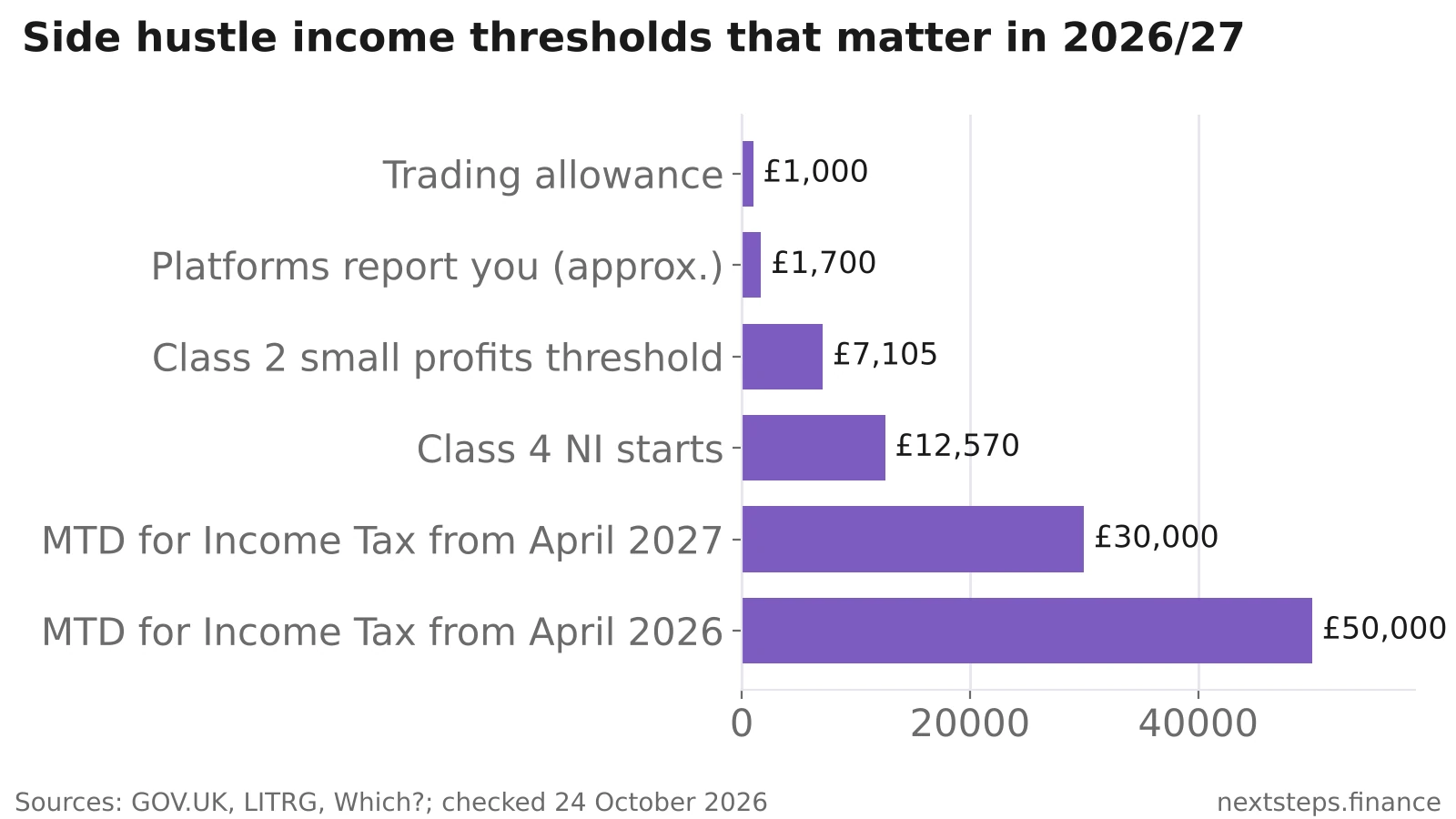
Only if your gross side hustle income is over £1,000 in a tax year. Below that, HMRC's trading allowance means you don't need to tell HMRC or pay tax on it, unless you're already filing a tax return for another reason.
The £1,000 trading allowance
The trading allowance is a tax exemption of up to £1,000 a year on income from self-employment, casual services and hiring out personal equipment. It applies to all your side hustles combined, not to each one. If your income is over £1,000, you can either deduct the £1,000 allowance or your actual expenses, but not both. If your expenses are higher than £1,000, claiming expenses is usually better.
You can't use it for income from a partnership, or from your own (or your spouse's) employer.
Registering for Self Assessment
If your gross trading income is over £1,000, you must register for Self Assessment by 5 October after the tax year ends (the tax year runs 6 April to 5 April). For 2026/27 side hustle income, that means registering by 5 October 2027, then filing your return and paying any tax by 31 January 2028. HMRC's Tax Confident guidance has an income checker if you're unsure. Your profit is added to your other income and taxed at your normal rates, above the £12,570 personal allowance. Our UK income tax guide explains the bands.
National Insurance on side hustle profits
For 2026/27, self-employed profits pay Class 4 National Insurance at 6% on profits between £12,570 and £50,270 and 2% above £50,270 (Which?, April 2026). Class 2 has been voluntary since April 2024. If your profits are below the £7,105 small profits threshold, you can choose to pay Class 2 at £3.65 a week to protect your State Pension record.
Making Tax Digital
Making Tax Digital (MTD) for Income Tax means keeping digital records and sending quarterly updates to HMRC. According to LITRG, it applies from 6 April 2026 if your gross income from self-employment and property is over £50,000, and from 6 April 2027 if it's over £30,000. Most side hustles are well below this, but it's worth knowing if yours is growing.
Take Action: Keep a simple record of every payment and expense from day one. Our UK Self-Employed Tax Tracker spreadsheet can do the sums for you.
Do eBay, Vinted and Airbnb report you to HMRC?
Yes, if you pass certain thresholds, but it's not a new tax. Since 1 January 2024, online platforms must collect and report information on sellers who make 30 or more sales or earn about £1,700 (€2,000) or more in a calendar year. Platforms send this to HMRC by 31 January each year (LITRG).
HMRC has said: "if you are not trading and just occasionally sell unwanted items online - there is no tax due." The tax rules haven't changed. What matters is whether you're trading: buying things to resell or making things to sell for profit usually counts, while clearing out your wardrobe doesn't.
How do you set up and grow a side hustle?
Keep it simple at first, then build what works. Most side hustles fail from overcommitment, not lack of ideas.
- Choose one idea that matches your goal and available time.
- Set up your accounts on the platform, and consider a separate bank account so side hustle money is easy to track.
- Check what's required: insurance for driving or tutoring, a food hygiene certificate for baking, or your landlord's or lender's permission to let a room.
- Check your employment contract for any rules on outside work or conflicts of interest.
- Promote yourself through local groups, social media and word of mouth, and ask happy customers for reviews.
- Review after three months. Work out your real hourly rate after costs, and drop anything that isn't worth your time.
Take Action: Put your side hustle income into your UK Budget Planner so it has a job, whether that's paying off debt, building savings or investing.
Frequently asked questions about UK side hustles
How much can you earn from a side hustle before paying tax in the UK?
You can earn up to £1,000 a year in gross side hustle income tax-free under HMRC's trading allowance. This covers all your side hustles combined. If you earn more than £1,000, you must register for Self Assessment by 5 October after the tax year ends and pay tax and National Insurance on your profits.
Do I need to tell HMRC about my side hustle?
Only if your gross side hustle income is over £1,000 in a tax year, or you already file a Self Assessment return. Below £1,000 you don't need to tell HMRC. Above it, register by 5 October after the tax year ends, then file and pay by 31 January. HMRC's online income checker can help if unsure.
Do I pay tax on selling clothes on Vinted or eBay?
Usually not. HMRC says you don't need to pay income tax on selling your own personal items, such as used clothes or unwanted furniture. Platforms report sellers with 30 or more sales or about £1,700 in a year, but that's not a tax. If you buy items to resell for profit, that's trading and may be taxable.
Do I need to tell my employer about a side hustle?
Check your employment contract. Some contracts restrict outside work or require you to disclose it, especially where there's a possible conflict of interest or the work overlaps with your employer's business. If your contract is silent, you usually don't need to tell them, but avoid using work time, equipment or clients.
What is the best side hustle in the UK?
The best side hustle is one that fits your skills, time and goal. Freelancing and tutoring often pay the most per hour for people with relevant skills. Selling unwanted items is quickest to start. Delivery work is flexible but has vehicle costs. Try one for three months and work out your real hourly rate.
Can I have more than one side hustle?
Yes. Many people combine several, such as selling online and tutoring. For tax, the £1,000 trading allowance covers all your side hustles together, not each one separately. Keep records for each so you can work out total income and expenses if you need to complete a Self Assessment return.
Your next step
Side hustles work best with a clear goal, a realistic time budget and good records from day one. Choose one idea from this guide, check the tax rules if you might earn over £1,000, and decide now where the extra money will go. For help building a plan around your income, see our personal finance review.