
The State Pension rise for April 2027 is now all but settled. With September's inflation figure published on 21 October, all three triple lock measures are known, and the highest is earnings growth of 3.9%. For someone on the full new State Pension that's an extra £9.40 a week, or about £489 over the year.
There's a catch this time. At around £13,036 a year, the full new State Pension will be higher than the £12,570 Personal Allowance for the first time, and the allowance is frozen. Here's what the rise means, who gets it, and how the tax side is expected to work.
Key takeaways
- The expected rise is 3.9%, matching total earnings growth for May to July 2026 published by the ONS on 15 September 2026.
- Full new State Pension: about £250.70 a week from April 2027 (up from £241.30), or £13,036.40 a year.
- Full basic State Pension (reached State Pension age before 6 April 2016): about £192.10 a week (up from £184.90), or £9,989 a year.
- The full new State Pension will exceed the £12,570 Personal Allowance, which stays frozen until April 2031. The Treasury has said people whose only income is the full new or basic State Pension, with no increments, won't pay income tax on it.
- Official confirmation is expected at the Autumn Budget on Wednesday 28 October 2026.
How much will the State Pension rise in April 2027?
The State Pension is expected to rise by 3.9% from April 2027. That's the earnings growth figure, which is the highest of the three triple lock measures this year.
The triple lock means the State Pension goes up each April by whichever is highest of:
- Average earnings growth for May to July of the previous year. The ONS confirmed total pay (including bonuses) grew 3.9% in May to July 2026.
- CPI inflation in the year to September. The ONS reported 3.5% for September 2026 on 21 October (see our breakdown of what 3.5% inflation means for your money).
- 2.5%, the minimum floor.
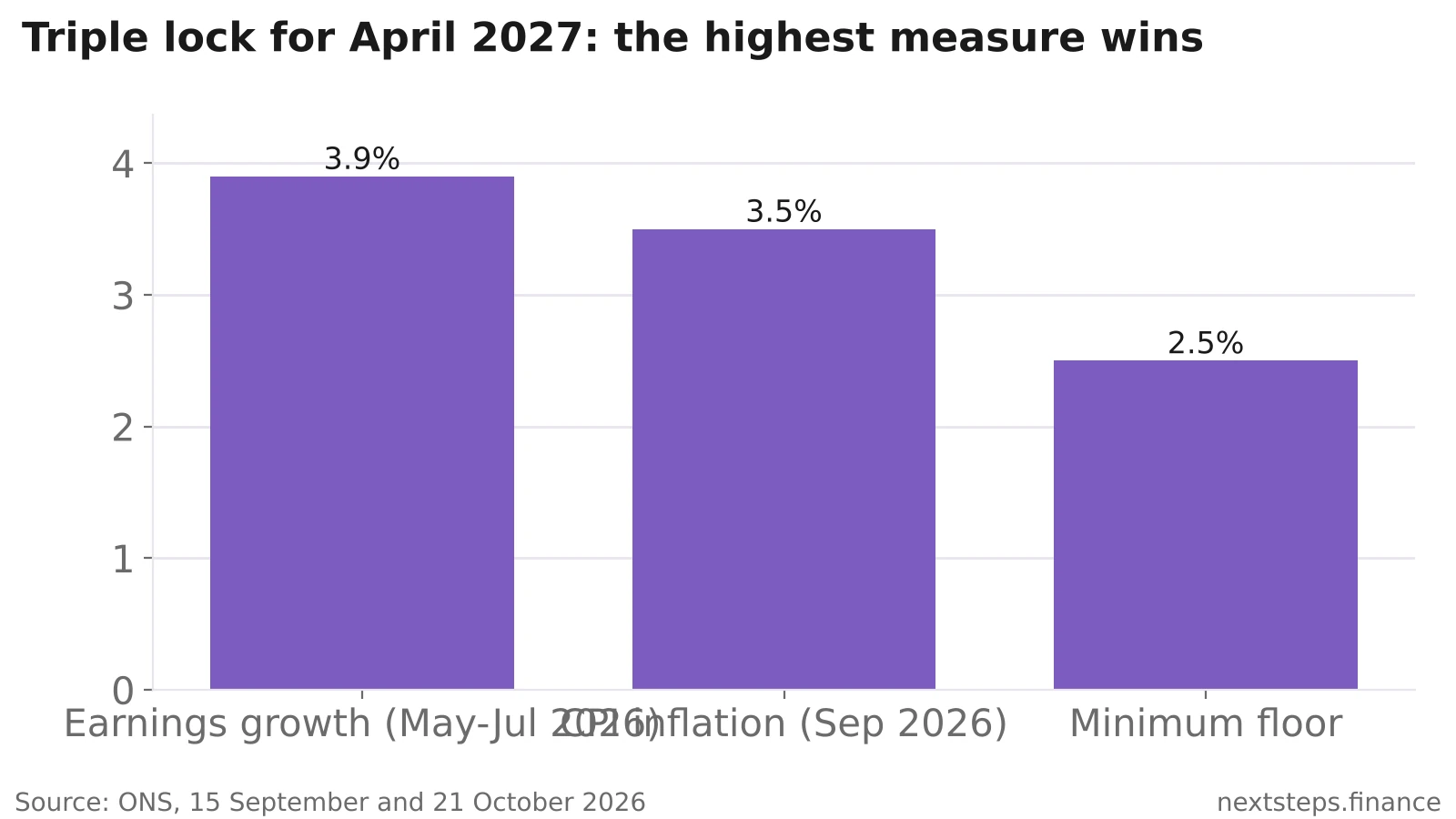
As Professional Paraplanner reported on 21 October, that points to the full new State Pension rising from £241.30 to £250.70 a week. Quilter's Jon Greer told the publication the detail is expected to "be confirmed in the Budget". The exact pence can shift slightly with rounding when the government publishes the official rates, so treat the figures below as very close estimates until then.
Take Action: If you're already claiming, you don't need to do anything. The increase is applied automatically from your first payment after the new rates start in April 2027.
New State Pension rates from April 2027
The full new State Pension is expected to be about £250.70 a week, and the full basic State Pension about £192.10 a week. Here's how that works out, based on the current rates and a 3.9% increase:
| 2026/27 (now) | 2027/28 (expected) | Increase | |
|---|---|---|---|
| Full new State Pension, weekly | £241.30 | £250.70 | +£9.40 |
| Full new State Pension, every 4 weeks | £965.20 | £1,002.80 | +£37.60 |
| Full new State Pension, yearly (52 weeks) | £12,547.60 | £13,036.40 | +£488.80 |
| Full basic State Pension, weekly | £184.90 | £192.10 | +£7.20 |
| Full basic State Pension, yearly (52 weeks) | £9,614.80 | £9,989.20 | +£374.40 |
State Pension is usually paid every four weeks, which is why the four-weekly figure is often what you'll see land in your bank account.
Will I get the full 3.9%?
Most people will see the headline 3.9% applied to the core State Pension they receive. Not everyone gets the full rate, though. The amount you get depends on how many qualifying years are on your National Insurance record, so if you're on less than the full rate, the 3.9% applies to your smaller amount. If you get extra amounts on top of the basic pension, such as additional State Pension, check your uprating letter, as those parts aren't always increased in the same way.
Take Action: Check your State Pension forecast on GOV.UK to see what you're on track for and whether filling gaps in your National Insurance record could boost it.
Will pensioners pay tax on the State Pension from 2027?
Pensioners whose only income is the full new or basic State Pension, without any increments, are not expected to pay income tax on it. Everyone else with other taxable income will still pay tax in the normal way.
The issue is simple maths. At £13,036.40 a year, the full new State Pension will be about £466 above the £12,570 Personal Allowance, and the allowance is frozen until April 2031 (Morningstar). AJ Bell warned in November 2025 that from April 2027 people on the full State Pension would face tax "regardless of whether they have any additional private pension income".
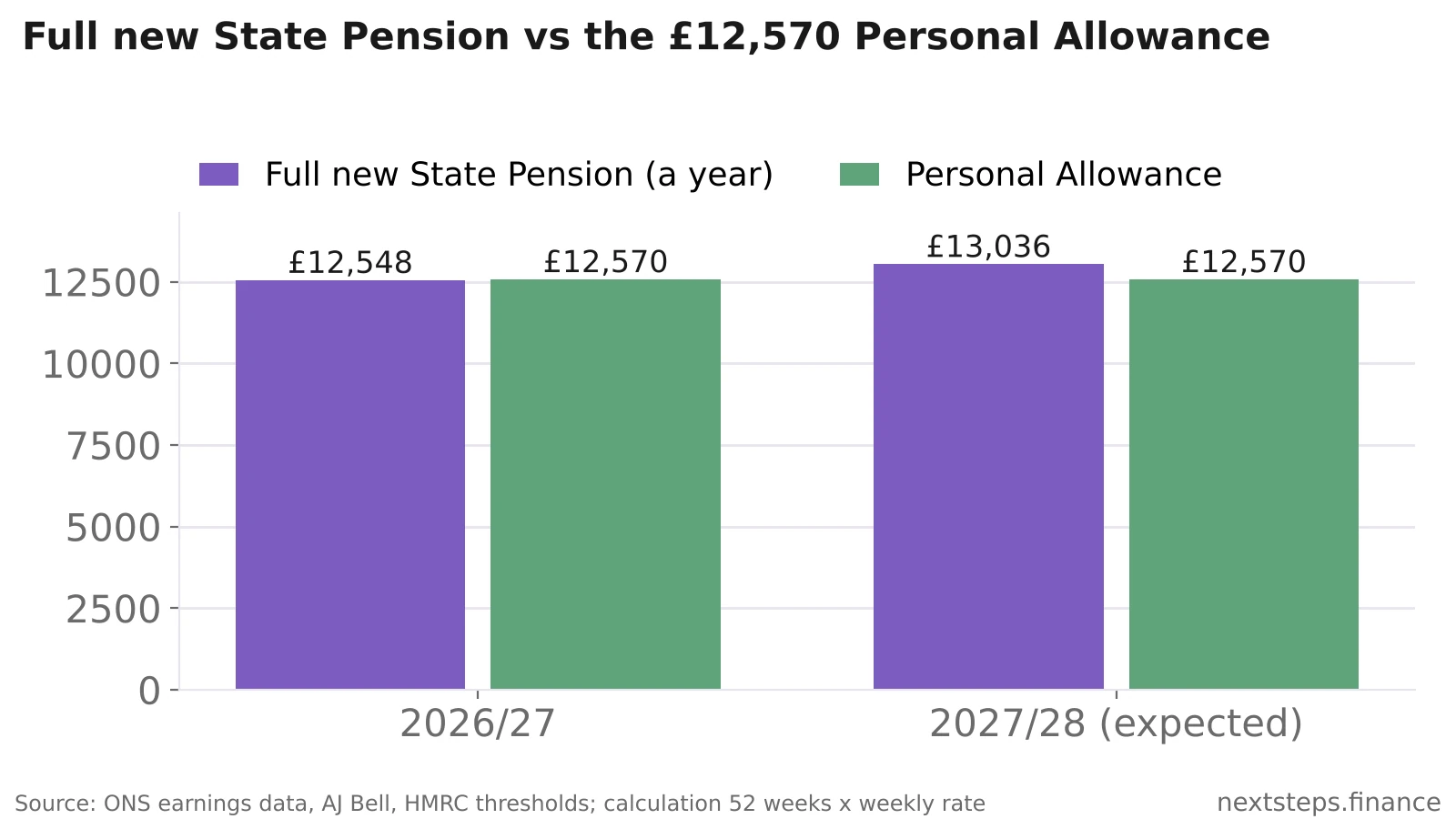
The government's answer, set out in the 2025 Budget, is that people relying only on the State Pension won't have to pay small amounts of tax via Simple Assessment from 2027/28 (LITRG). Which? reported in September 2026 that the Treasury's wording is: "Pensioners whose only income is the full new or basic state pension without any increments will not pay income tax", with the Chancellor expected to explain how it works at the Budget.
What if I have a small private or workplace pension?
If you have other taxable income, the waiver isn't expected to apply, and you'll pay 20% tax on income above £12,570. Here's a rough illustration for 2027/28 using the expected full new State Pension:
| Your income | Total | Taxable above £12,570 | Basic rate tax (20%) |
|---|---|---|---|
| Full new State Pension only | £13,036 | £466 | £0 if the promised waiver applies |
| State Pension + £2,000 private pension | £15,036 | £2,466 | about £493 |
| State Pension + £5,000 private pension | £18,036 | £5,466 | about £1,093 |
This is simplified: it ignores the Personal Savings Allowance, the savings starting rate and Marriage Allowance, all of which can reduce tax. HMRC usually collects tax owed on the State Pension by adjusting the tax code on your private or workplace pension, so check the code on your next pension payslip. LITRG also points out that it's still unclear how the waiver will treat people with extra amounts on top of the basic pension, such as additional State Pension or deferral increases.
Take Action: Read our UK income tax guide for how tax codes and allowances work, and look out for the Budget detail on 28 October.
What could the Budget on 28 October change?
The Budget is expected to confirm the 3.9% rise and set out how the State Pension tax waiver will work. It's due on Wednesday 28 October 2026, the first Budget from Chancellor John Healey.
According to Moneyfacts' Budget preview (20 October), measures already scheduled that matter for retirement planning include:
- The cash ISA limit for under-65s falls to £12,000 from April 2027 (over-65s keep the full £20,000). See our ISA allowance guide.
- Savings income tax rates rise by two percentage points from 2027/28, to 22%, 42% and 47%.
- Unused pension pots will count towards your estate for inheritance tax from April 2027.
- A renewed commitment to keep the triple lock in place until 2030.
Anything beyond these is speculation until the Chancellor stands up. We'll update this page once the official rates are published.
Is the State Pension enough to live on?
For most people, no. About £13,036 a year is a solid foundation, but it's well below what most households spend in retirement, so the State Pension works best alongside a workplace or private pension.
The gap is why pension tax relief matters. Every £80 a basic rate taxpayer pays into a personal pension becomes £100 with tax relief, and higher rate taxpayers can claim more back. If you're employed, start with your workplace pension and employer contributions, as employer money is the best deal going. Our UK pension guide covers the rest.
If you're self-employed, have old pots or want to top up, a self-invested personal pension (SIPP) is one option:
| Provider | What it offers | Key condition | Link |
|---|---|---|---|
| InvestEngine SIPP | No platform fee on DIY portfolios (0.25% a year for managed); ETF costs from 0.03%; 20% basic rate relief added automatically | Pension money is locked until age 55 (57 from 2028) | InvestEngine |
| Wealthify | Ready-made managed plans, including a SIPP: £5,000 minimum, 0.6% a year (0.3% on any portion over £100,000) plus fund costs of about 0.14% (Original plans); 25% tax relief top-up added automatically | Referral reward of £50 if you invest £5,000 in a SIPP (or £1,000 in an ISA) and hold it for six months | Wealthify |
| Your workplace scheme | Employer contributions on top of yours | Usually the first place to put extra money | Ask HR |
Capital at risk - the value of investments can go down as well as up. Fees and offers checked on 23 October 2026 on InvestEngine's tax relief page and Wealthify's refer-a-friend and pension pages; the Wealthify reward can't be combined with other introductory offers.
These may suit you if you're comfortable choosing or holding investments for the long term. If you're weighing up pension transfers, drawdown or how much to put in, regulated advice is worth paying for. Our personal finance review is a good starting point.
Take Action: Work out what you'll spend in retirement with the UK Budget Planner, then compare it with your State Pension forecast to see the gap your own savings need to fill.
FAQ
How much will the State Pension be in April 2027?
The full new State Pension is expected to be about £250.70 a week from April 2027, up from £241.30, which is around £13,036 a year. The full basic State Pension, for people who reached State Pension age before 6 April 2016, is expected to rise from £184.90 to about £192.10 a week. Official rates should be confirmed at the 28 October 2026 Budget.
Is the State Pension going up 3.9% or 3.5%?
It's expected to go up 3.9%. The triple lock uses whichever is highest of earnings growth (3.9% for May to July 2026, per the ONS), September CPI inflation (3.5%) or 2.5%. Earnings growth is the highest, so 3.9% applies. The government normally confirms the figure at the Autumn Budget, due on 28 October 2026.
Will I pay tax on my State Pension in 2027?
If the full new or basic State Pension is your only income, the Treasury has said you won't pay income tax on it, even though it will exceed the £12,570 Personal Allowance from April 2027. If you have other taxable income, such as a private or workplace pension, you'll generally pay 20% tax on income above £12,570.
When will the State Pension increase be paid?
The new rates start in April 2027, at the beginning of the 2027/28 tax year. Because the State Pension is usually paid every four weeks in arrears, many people will see the higher amount in their first payment after the change takes effect. You don't need to apply, as the increase is added automatically.
Is the triple lock staying?
The government has made a renewed commitment to keep the triple lock until 2030, according to Moneyfacts' Budget preview. Beyond that, the future of the policy is uncertain and may change. Planning your retirement on the assumption of the triple lock continuing forever is risky, so it's sensible to build your own pension savings too.
How can I check how much State Pension I'll get?
Use the free State Pension forecast on GOV.UK. It shows how much you could get, when you can claim it and whether you have gaps in your National Insurance record. You may be able to fill gaps with voluntary contributions, but check the forecast first, as not every gap increases your pension.
The bottom line
The State Pension is set to rise 3.9% in April 2027, taking the full new State Pension to about £250.70 a week. Pensioners living only on the State Pension shouldn't pay tax on it, but anyone with even a small private pension will start paying basic rate tax on more of their income because the Personal Allowance is frozen. Watch the Budget on 28 October for the official rates and the detail of the tax waiver, and use the UK Budget Planner to see how your retirement income stacks up.
This article is for general information only and isn't personal financial or tax advice. Tax treatment depends on your circumstances and may change.