
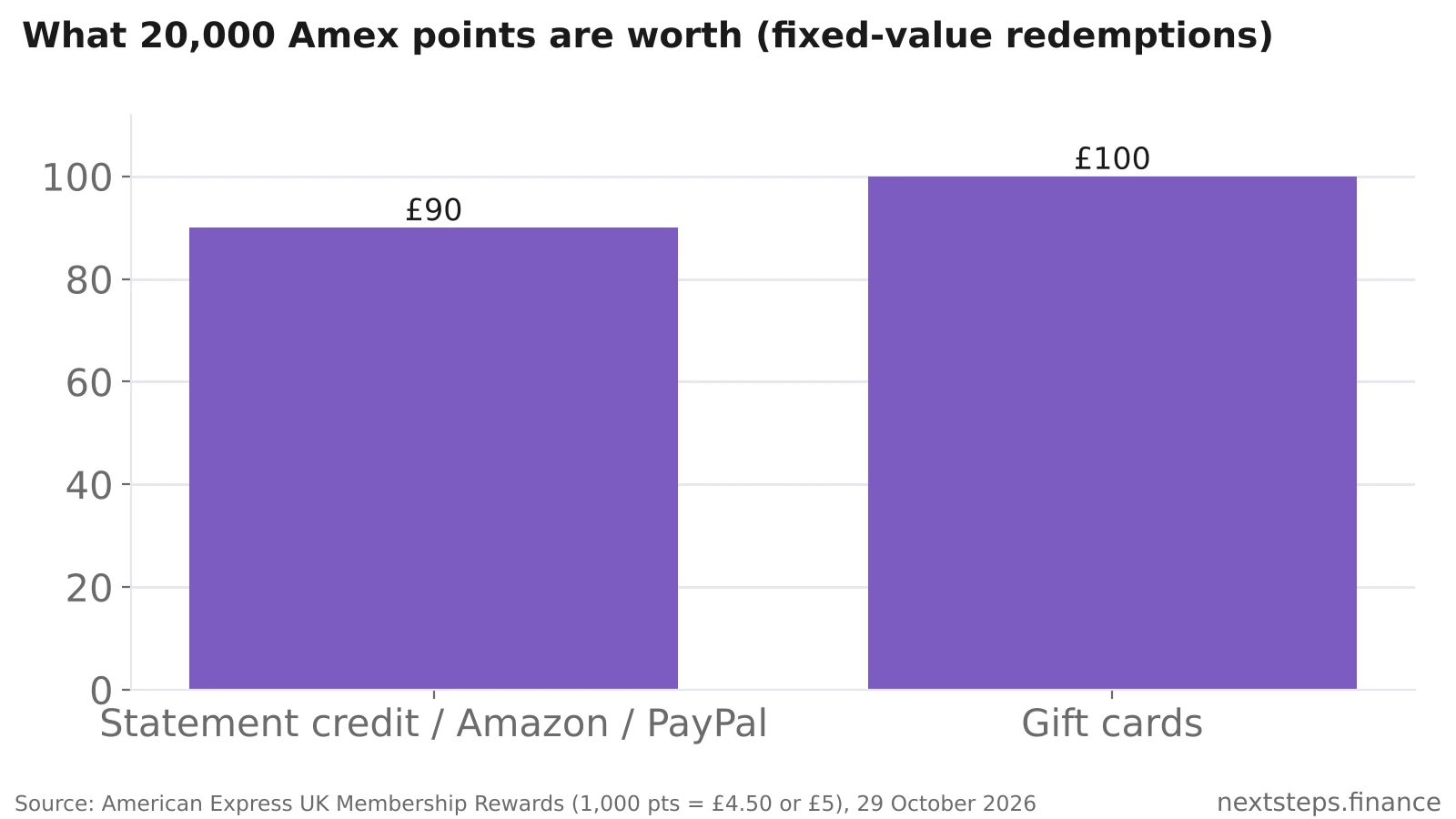
A good Amex points strategy comes down to three things: earning the most points from spending you'd do anyway, avoiding the mistakes that wipe points out, and redeeming them where each point is worth the most. Get the last step wrong and 20,000 points are worth £90. Get it right and the same points can cover a return flight.
Every card figure below was checked on American Express's UK website on 29 October 2026. Rewards cards change their terms often, so check the card page before you apply.
Key takeaways
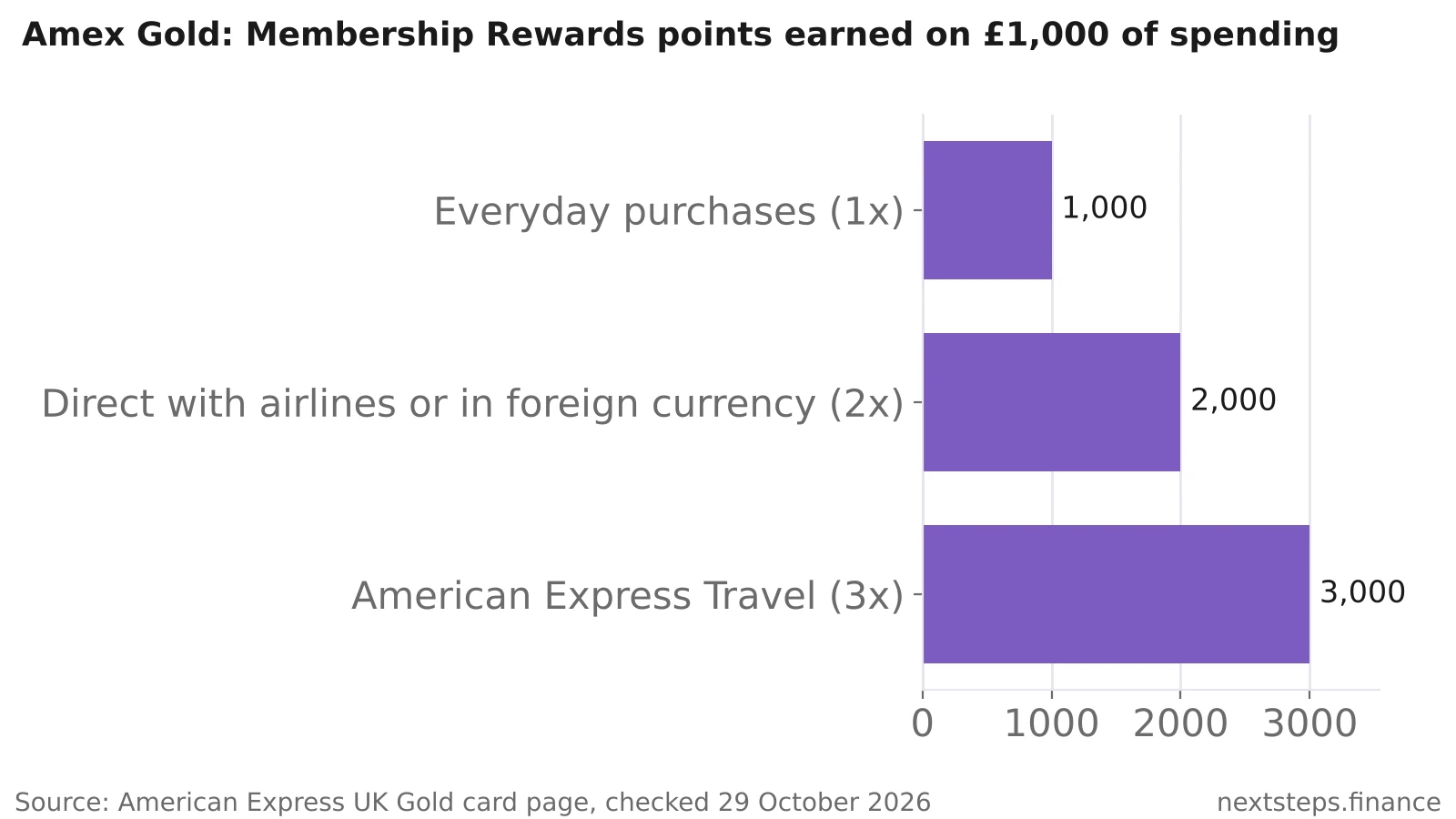
- The Amex Preferred Rewards Gold card costs £195 a year (£0 in the first year) and earns 1 point per £1, 2 points per £1 with airlines or in foreign currency, and 3 points per £1 at American Express Travel. Representative 85.8% APR variable.
- Welcome bonus: Gold pays 20,000 bonus points for spending £3,000 in the first three months, but only if you haven't held a personal Amex card in the past 24 months.
- Fixed redemptions are poor value: 1,000 points = £4.50 as statement credit, or £5 in gift cards, according to American Express.
- Transfers to British Airways Avios and Virgin Atlantic are 1:1, which is where most UK collectors get 1p or more per point.
- Points don't expire, but you can lose them if you close your account without redeeming or miss a payment.
How do American Express Membership Rewards points work?
Membership Rewards is the points scheme on most personal Amex cards in the UK, including Gold and Platinum. You earn at least one point for each full pound of eligible spending, and you can swap points for statement credit, gift cards or transfers to airline and hotel partners.
According to American Express's Membership Rewards page:
- Interest, fees, balance transfers and cash advances don't earn points.
- Points have no expiry date while your account is open.
- You lose points if you close your account without redeeming them within 30 days, if Amex cancels the account, or if you miss a monthly payment (you forfeit the previous month's points).
- Transfers to partners can't be reversed.
That last point is the most important. Treat points like a currency you only convert when you have a specific booking in mind.
What is the best Amex card for earning points in the UK?
For most people, the Preferred Rewards Gold card offers the best balance of earning rate and cost. It's free for the first year, which lets you collect the welcome bonus and decide whether it's worth £195 a year before paying anything.
| Card | Annual fee | Earn rate | Welcome offer (checked 29 Oct 2026) | Representative APR | Minimum income |
|---|---|---|---|---|---|
| Preferred Rewards Gold | £0 first year, then £195 | 1x, 2x airlines/foreign currency, 3x Amex Travel | 20,000 points for £3,000 spend in 3 months | 85.8% APR variable | £20,000 |
| Platinum | £650 | 1x, 2x at amextravel.co.uk | Not shown on Amex's card page | 685.3% APR variable | £35,000 |
| Cashback Everyday (no points) | £0 | 0.5% cashback, 1% above £10,000 | 2% cashback up to £200 in first 12 months | 29.1% APR variable | £15,000 |
Figures from American Express's Gold, Platinum and Cashback Everyday pages. The Gold and Platinum Representative APRs are high because they include the annual fee on an assumed £1,200 credit limit. The purchase rate on both is 29.1% variable. Credit is subject to status.
Gold also includes four Priority Pass lounge visits a year, a bonus of 5,000 points each time you spend £10,000 (up to 10,000 bonus points a year) and £5 back twice a month on Deliveroo (enrolment required). Platinum adds unlimited lounge access, dining credits and hotel status, which only make sense if you'll use them enough to cover the £650 fee. Our Amex Gold vs Platinum comparison goes through the maths.
Take Action: if you haven't had a personal Amex card in the past 24 months, the American Express Gold Card (Representative 85.8% APR variable, £0 fee in year one, then £195; credit subject to status) is the natural first card. See our Amex welcome bonus guide for how the 24-month rule works.
How to earn Amex points faster
The quickest wins come from putting the right spending on the right card, without spending more than you would anyway.
- Hit the welcome bonus first. On Gold, the 20,000 bonus points for £3,000 of spend in three months is worth more than a year of normal earning for many people. Time the application before a big planned expense, such as car insurance or a holiday, rather than spending extra.
- Book flights directly with airlines on Gold for 2 points per £1, or travel through American Express Travel for 3 points per £1. Compare prices first, because the extra point isn't worth paying more for the booking.
- Use it abroad. Gold earns 2 points per £1 in foreign currency, but check the card's non-sterling transaction fee in its summary box first, as a fee-free debit card may work out cheaper.
- Put regular bills on the card where Amex is accepted: phone, broadband, streaming and insurance. Then clear the balance in full by direct debit.
- Check Amex Offers in your app before you shop. These targeted deals give extra points or statement credits at specific retailers and need adding to your card first.
- Refer friends. Gold cardholders earn at least 9,000 points for each approved referral, up to 90,000 points a year.
Stack points with cashback sites
Shopping online through a cashback site such as TopCashBack and paying with your Amex means you earn the retailer's cashback and your Membership Rewards points on the same purchase. Our guide to stacking cashback apps shows how to layer offers without breaking any terms.
Take Action: set up a direct debit to pay your Amex statement in full each month. Interest at 29.1% wipes out the value of any points you earn.
How much are Amex points worth in the UK?
It depends entirely on how you redeem them. American Express values its fixed redemptions at 0.45p to 0.5p a point, while transfers to airline partners can be worth 1p or more when you book a good-value reward flight.
| Redemption | Value per point | 20,000 points worth | Who it may suit |
|---|---|---|---|
| Statement credit, Amazon, PayPal, Amex Travel | 0.45p | £90 | People who'll never use airline schemes |
| Gift cards | 0.5p | £100 | Small balances with no travel plans |
| Transfer to Avios or Virgin Points | Varies; often 1p+ on good reward flights | Often £200+ | Travellers flexible on dates |
You can work out the value of any redemption yourself: divide the cash price you'd otherwise pay (minus any taxes and fees you still pay on the reward) by the points needed. If a flight would cost £250 in cash and the reward costs 15,000 points plus £50 in taxes, each point is worth (£250 − £50) ÷ 15,000 = 1.33p.
Take Action: before you redeem, check the cash price of the same booking. If you're getting less than about 1p a point on a transfer, statement credit or gift cards may be simpler.
Which Amex transfer partners offer the best value?
For most UK cardholders, British Airways (Avios) and Virgin Atlantic (Virgin Points) are the most useful partners, and both transfer at 1 point to 1 airline point. American Express's airline partners page lists these ratios:
| Airline scheme | Transfer ratio | Good for |
|---|---|---|
| British Airways Club (Avios) | 1:1 | Short-haul Europe, family trips from regional airports |
| Iberia Club and Qatar Privilege Club (Avios) | 1:1 | Alternative ways to book Avios flights |
| Virgin Atlantic Flying Club | 1:1 | Long-haul economy and Upper Class to the US |
| Air France-KLM Flying Blue | 1:1 | European and long-haul flights via Paris or Amsterdam |
| Emirates Skywards | 2:1 | Rarely good value at this ratio |
| Singapore KrisFlyer | 3:2 | Specific long-haul premium bookings |
Hotel partners such as Hilton Honors and Marriott Bonvoy are also available, but hotel points tend to be worth less per Amex point than airline transfers. Check the current ratio in your Amex account before transferring.
Avios and Virgin Points work best for:
- Reward flights where cash prices are high, such as school-holiday dates or premium cabins.
- Two-for-one or companion vouchers. British Airways' own Amex cards give a Companion Voucher when you spend £15,000 in a cardmembership year. Our BA Premium Plus guide covers the latest earn rate cut.
- Topping up a balance that's slightly short for a booking you already want.
Watch for transfer bonuses. Amex sometimes runs limited-time promotions that add extra airline points on transfers. If you're not booking urgently, waiting for one stretches the same balance further.
How to avoid common Amex points mistakes
The biggest losses come from forfeiting points or redeeming them cheaply. These are the ones to watch:
- Missing a payment. Amex's terms say a missed monthly payment means forfeiting the previous month's points, on top of late fees and a hit to your credit file.
- Closing your card with points in it. Redeem or transfer within 30 days, or move them to another Membership Rewards card first.
- Transferring speculatively. Transfers are irreversible, so only move points once you've found reward availability.
- Applying for the wrong first card. The 24-month rule means opening any personal Amex card can block a better welcome bonus for two years. See the best order to get Amex cards.
- Carrying a balance. At 29.1% variable, a month's interest on a £1,000 balance (about £21) costs more than the points from that spending are worth on most redemptions.
Budgeting apps such as Emma can help you track your Amex spending against your budget so the card doesn't become a reason to spend more.
Frequently asked questions
What is the best Amex card for earning points in the UK?
For most people it's the American Express Preferred Rewards Gold card. It earns 1 point per £1, 2 points per £1 with airlines or in foreign currency, and 3 points per £1 at American Express Travel. It costs £195 a year but is free in the first year, with a Representative APR of 85.8% variable.
How much are 20,000 Amex points worth in the UK?
20,000 Amex points are worth £90 as a statement credit or against Amazon or PayPal purchases, and £100 as gift cards, based on American Express's rates of £4.50 and £5 per 1,000 points. Transferred 1:1 to Avios or Virgin Points for a good-value reward flight, they can be worth £200 or more.
Do Amex Membership Rewards points expire?
No. American Express says Membership Rewards points have no expiration date while your account is open. But you can lose them if you close your account without redeeming within 30 days, if Amex cancels your account, or if you miss a monthly payment, which forfeits the previous month's points.
Can you transfer Amex points to British Airways Avios?
Yes. Amex Membership Rewards points transfer to the British Airways Club at a 1:1 ratio, so 10,000 points become 10,000 Avios. You can also transfer 1:1 to Iberia, Qatar Airways and Virgin Atlantic. Transfers can't be reversed, so check reward seat availability before you move points.
Is the Amex Gold card worth £195 a year?
It may be if you'll use the points for flights and the extras such as four Priority Pass lounge visits and Deliveroo credits. As the first year is free, you can earn the 20,000-point welcome bonus and decide before the fee applies. If you only want cashback, a no-fee card may suit you better.
What is the Amex 24-month rule?
American Express says you won't get a welcome bonus on Gold if you hold, or have held, any personal Amex card in the past 24 months. For Platinum, the rule covers personal Membership Rewards cards. Business cards are separate. So your first personal Amex card should be the one with the best bonus for you.
What's the best Amex points strategy for you?
For most UK cardholders, a simple strategy works best: start with Gold, earn the welcome bonus on spending you'd do anyway, pay in full every month and save your points for a 1:1 transfer to Avios or Virgin Points when you've found a flight worth booking.
- Pick your first card carefully because of the 24-month rule.
- Use bonus categories (airlines, foreign currency, Amex Travel) only when the price is competitive.
- Never pay interest. A direct debit for the full balance protects your points and your credit score.
- Redeem at 1p+ a point where you can, and avoid statement credit at 0.45p unless you'll never travel.
If a rewards card doesn't suit your spending, a no-fee cashback card or a cashback credit card may be the better choice. You can also plan your card spending alongside your bills in the UK Budget Planner.