
Money from family can help a first-time buyer reach a mortgage deposit sooner. But a family transfer is not automatically accepted: the lender needs to know whether it is a gift, a loan or an arrangement that gives the donor an interest in the home.
This guide covers the lender paperwork, source-of-funds checks and inheritance-tax point before the money is transferred.
Key takeaways
- A genuine gifted deposit is normally non-repayable; many lenders also require the donor to have no ownership interest.
- Tell both your mortgage lender and conveyancer about the gift. Their checks serve different purposes.
- A lender may ask for a signed letter, donor identification and evidence showing where the money came from.
- Donor rules and documents vary by lender. Overseas gifts can involve extra checks.
- The donor's inheritance-tax position is separate from your mortgage application. HMRC's 7-year rule and £325,000 tax-free threshold may matter if the donor dies within seven years.
What is a gifted deposit for a mortgage?
A gifted deposit is money given to a homebuyer to help pay the deposit on a property. It often comes from a parent or grandparent, but each lender decides which donors it accepts.
The key question is whether the money is genuinely a gift:
| Arrangement | Repayment expected? | Donor gets a share of the home? |
|---|---|---|
| Gifted deposit | No | Usually no |
| Family loan | Yes | Not necessarily |
| Equity or ownership arrangement | Depends on agreement | The donor may have an interest |
A gift letter must not disguise a loan. If the donor expects repayment or wants a share of the property, explain the real arrangement to your broker and solicitor before applying.
How does a gifted deposit mortgage work in the UK?
There is not usually a separate mortgage product called a gifted-deposit mortgage. You apply for a normal residential mortgage and tell the lender that some or all of your deposit is being provided by someone else.
The deposit still affects your loan-to-value (LTV), the proportion of the property's value you borrow. A larger deposit may move you into another LTV band, but it does not guarantee a particular rate or approval. The lender still checks your income, spending, credit history, property and its own criteria.
For illustration, on a £300,000 home:
| Deposit | Cash needed | Mortgage before fees |
|---|---|---|
| 5% | £15,000 | £285,000 |
| 10% | £30,000 | £270,000 |
| 15% | £45,000 | £255,000 |
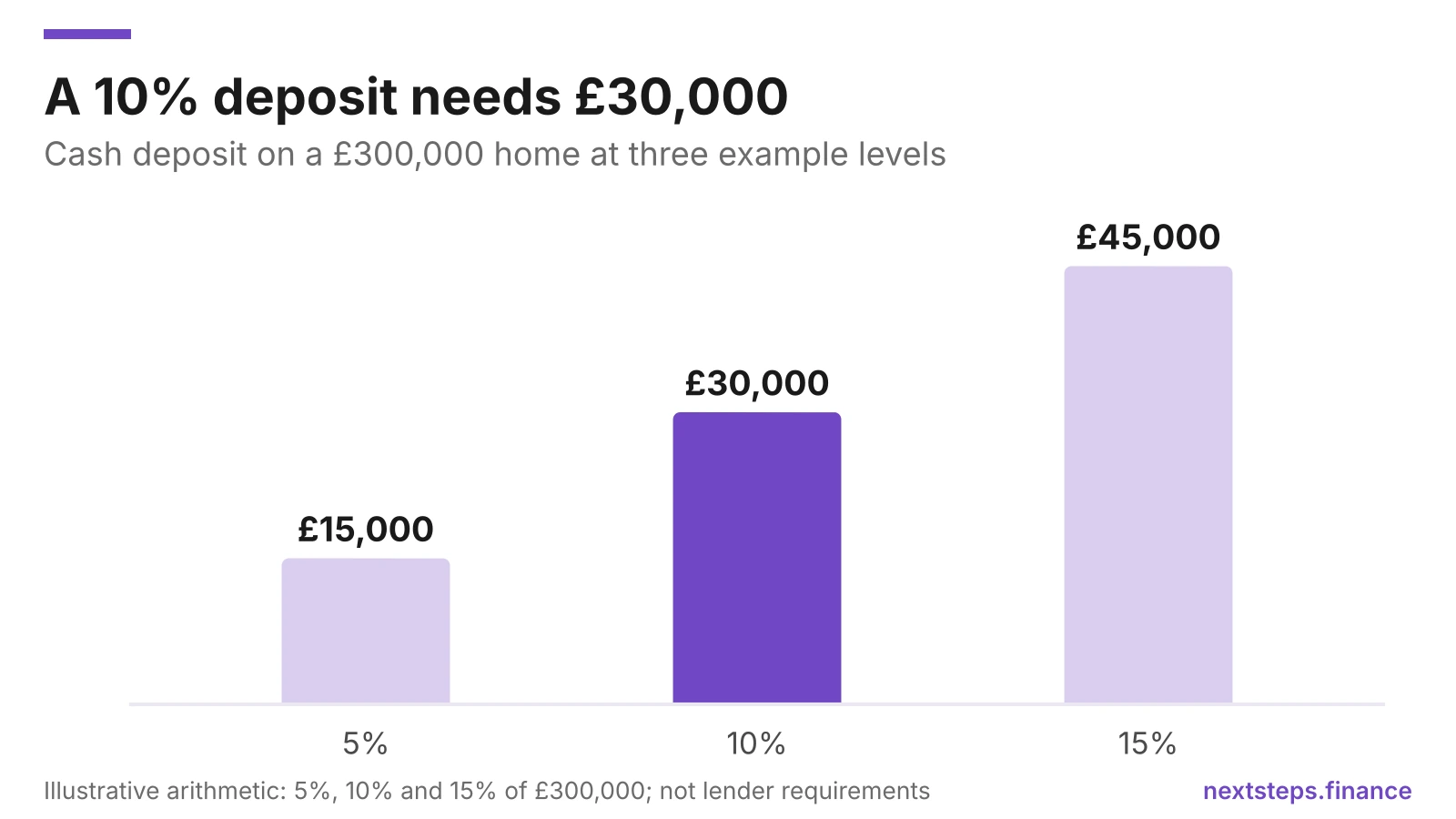
If you have saved £15,000 and a relative gives you another £15,000, your combined deposit is £30,000, or 10% of this example price. Only the lender can confirm whether that changes the products available to you.
The deposit is not the only cash you need. Allow for legal fees, surveys, mortgage fees, moving costs, purchase tax and a buffer. Purchase tax is separate from the gift, and the tax and its first-time buyer rules depend on which UK nation you buy in. See our guide to buying a house in the UK and renting vs buying guide for the wider costs.
Who can gift a house deposit?
Close family members are commonly accepted, but the answer depends on the lender. Some accept only named relatives, some accept friends, and at least one accepts almost anyone over 18.
The differences appear in lenders' own guidance:
| Lender | Who can give | Key conditions |
|---|---|---|
| Lloyds Bank | Listed relatives, such as parents, grandparents, siblings, blood-related aunts and uncles, and a partner you live with. Not family friends, cousins, employers, landlords or developers | Can't be a loan; the giver can't have any stake in the home |
| Santander | Close family, and friends too | Not repayable; the giver won't live in the property or have any claim to it |
| Nationwide | Anyone over 18 | No conditions attached; the giver can't expect to own part of the property. A Gifted Deposit Form is needed for gifts of £10,000 or more |
These are examples, not a market-wide rule. Policies can change and may differ between mortgage products. Tell the lender about every donor, especially if more than one person is contributing or the donor plans to live in the property.
Take Action: ask your broker or lender to confirm that the proposed donor and arrangement are acceptable before anyone transfers money.
What evidence do lenders and solicitors need?
Expect to explain who is giving the money, how much they are giving and where it came from. The lender applies its mortgage policy; your conveyancer checks the money's origin as part of its anti-money-laundering checks.
A gift declaration commonly records:
- The buyer's name and the donor's name, address and relationship.
- The amount being gifted and, where requested, the property being purchased.
- Confirmation that the money is a gift, not a loan, and will not be repaid.
- Confirmation that the donor will not own a share or retain an interest in the property.
Use the lender's or conveyancer's template if one is supplied. Lloyds says the donor should give photo ID such as a passport or driving licence and two different proofs of address, plus proof of where the money came from, such as the sale of a house, shares, a pension or an inheritance. Santander mentions the giver's bank statements covering the last three to six months, and a clear paper trail from the giver's account to yours and then to the solicitor.
Start early. An unexplained transfer can delay conveyancing even if the money itself is legitimate, so gather the donor's documents before you're under time pressure from an exchange date.
Can a gifted deposit come from overseas or be a family loan?
An overseas gift may be accepted, but it can trigger extra checks. Santander says the lender might need to carry out extra checks when the money comes from abroad. Nationwide asks for three months of statements if the money comes from within the EEA (outside the UK) and six months if it comes from outside the EEA.
Ask the lender and conveyancer what they need before transferring the money. They may request donor identification, evidence of the original source and an explanation of transfers or currency conversion. Avoid routing money through another person's account.
A repayable family loan is different. Tell the lender the amount, repayment expectation, interest (if any) and timing. Repayments can affect affordability, and a lender may not accept borrowed money as the deposit. If the donor expects repayment or a share of the property, ask a regulated mortgage adviser and solicitor about the available structure. Never sign a gift declaration that does not reflect the real agreement.
Does a gifted deposit affect inheritance tax?
It can affect the donor's estate, even though the lender is mainly concerned with whether the money is a genuine gift. HMRC's inheritance tax guide says no tax is due on a gift if the donor lives for seven years after giving it, unless the gift is part of a trust. The 7-year rule also doesn't apply to a "gift with reservation", where the donor keeps benefiting from what they gave.
The standard inheritance-tax threshold is £325,000. The donor's other gifts in the seven years before death, available exemptions and the value of their estate all matter. The annual gift exemption is £3,000 in total for each tax year, with unused exemption carried forward for one year only. It is not a separate £3,000 allowance for every recipient.
If the donor dies within seven years, tax may be due depending on cumulative gifts and the estate. Taper relief cuts the rate on gifts made three to seven years before death, but HMRC says it only applies if the total gifts made in those seven years are over the £325,000 threshold:
| Years between gift and death | Tax rate on the gift |
|---|---|
| Less than 3 | 40% |
| 3 to 4 | 32% |
| 4 to 5 | 24% |
| 5 to 6 | 16% |
| 6 to 7 | 8% |
| 7 or more | 0% |
Inheritance tax is usually paid by the estate, although HMRC says that if the donor gave away more than £325,000 in gifts in the seven years before death, the people who received those gifts pay the tax on them. Our inheritance tax planning guide covers the wider rules. The donor should keep a dated record and take tax advice if the amount is significant or their estate may be taxable.
How should you plan a gifted deposit alongside your savings?
Treat the gift as one part of your total home-buying plan. A simple process is:
- Set the target. Estimate the price, deposit, purchase tax, legal costs, survey, mortgage fees and moving costs.
- Separate each source. Record your own savings, each family gift, Lifetime ISA funds and other savings separately.
- Agree the gift terms. Confirm that it is non-repayable and that the donor understands the lender's conditions.
- Check the lender's rules early. Ask about the donor, letter, identification, statements and transfer timing.
- Keep the evidence. Save the declaration, donor documents, statements and transfer confirmations.
- Recheck before exchange. Make sure the conveyancer has cleared its questions and you still have money for costs and a buffer.
You may not need a paid tool if the gift is straightforward and a simple spreadsheet plus the lender's own form is enough. A mortgage broker can help identify lender criteria; a solicitor or tax adviser can deal with legal or inheritance-tax questions. Our Lifetime ISA and First Time Buyer ISA update explains the recent changes to first-home saving.
Take Action: agree the gift terms and evidence checklist first, then map the gift alongside your own savings and the rest of the buying costs. If you'd rather not build that plan yourself: