
The guided retirement UK plans are the Government's new way of turning workplace pension savings into retirement income. They would give eligible savers a ready-made option when they want regular income, rather than leaving everyone to navigate complex products alone.
The proposals are not an immediate change to every pension. This guide explains the proposed scope, how a default could work and the choices savers would retain.
Key takeaways
- Guided retirement is designed mainly for people with defined-contribution (DC) workplace pensions who are approaching the point of taking an income.
- Providers would have to make an appropriate default pension available, normally with protection against outliving savings.
- The default would be a starting option, not a compulsory product. You could choose another route, and payments would not begin until you request them.
- The DWP consultation and the FCA's matching discussion paper opened on 3 November 2026. GOV.UK gives the DWP deadline as 11:59pm on 21 December; the FCA paper closes on 22 December.
- Proposed compliance dates are summer 2029 for most master trusts and FCA-regulated workplace schemes, and summer 2030 for some other schemes. These dates could change.
What is guided retirement in the UK?
Guided retirement is a proposed framework for helping people convert defined-contribution pension savings into a sustainable retirement income. Instead of leaving every saver to decide from scratch how to use their pot, a provider would design or select default pension options for groups of members with broadly similar needs.
A DC pension builds up a pot from contributions and investment returns. At retirement, the saver normally has to decide whether to take cash, keep the money invested and draw an income, buy an annuity, or combine options. Each route has trade-offs, including the risk of spending too much or being overly cautious.
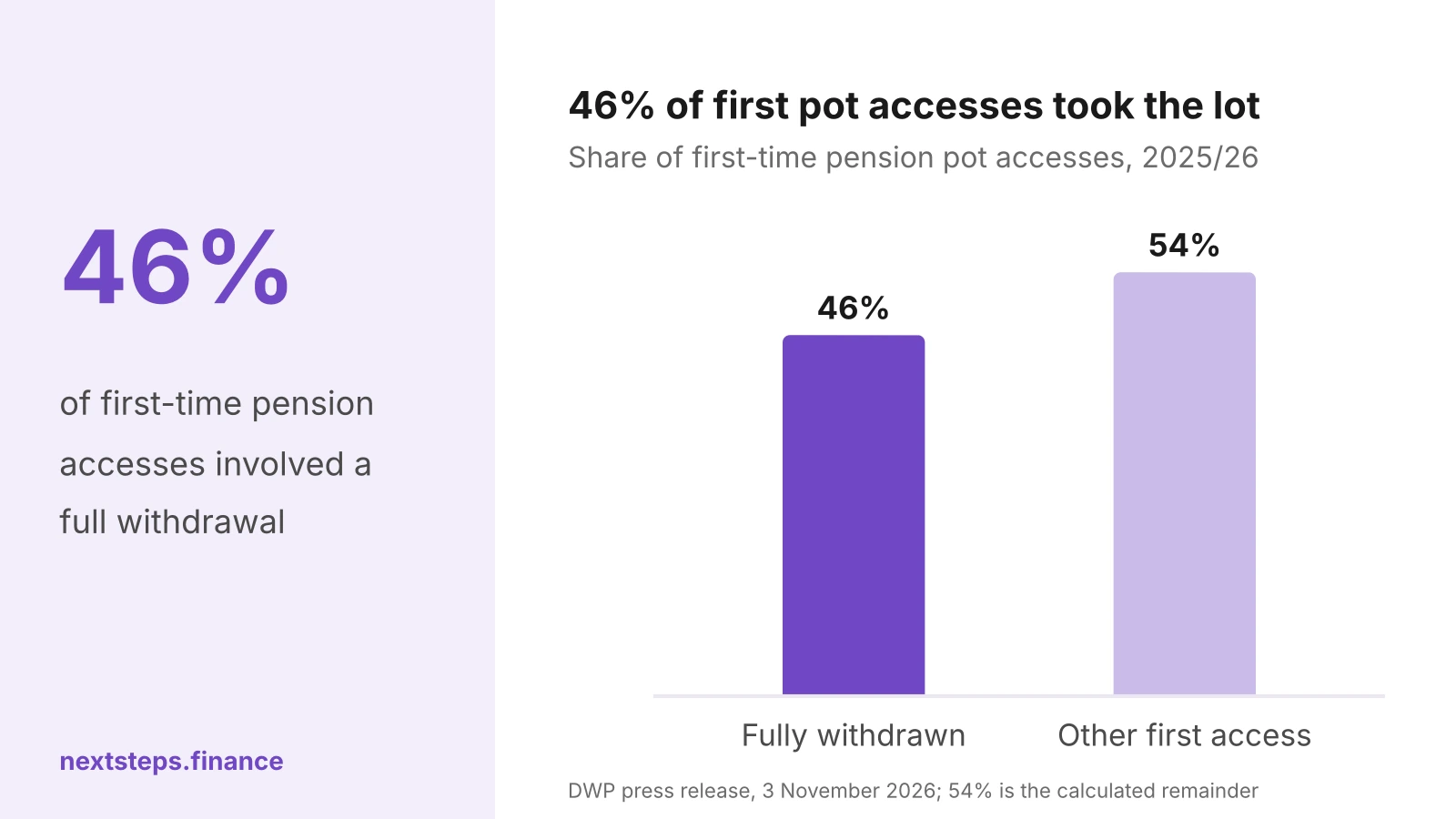
The Government says around 17 million private-sector workers now saving into a pension will be given the option of an income in retirement, according to its 3 November announcement. It also reported that around 46% of first-time pension pot accesses in 2025/26 involved the whole pot being withdrawn. That is a share of first-time access events, not 46% of all pension savers.
The Pension Schemes Act 2026 provides the legislative basis, but detailed secondary legislation and regulatory rules are still being developed. The DWP consultation sets out the proposals.
Why is the government introducing guided retirement?
Automatic enrolment has helped more employees build pension pots, but a DC pot is not a guaranteed pension income. People reaching retirement must decide how much to withdraw, how to invest what remains and how to make it last for an uncertain lifetime.
Someone may withdraw too much early and run short later. Someone else may be so cautious that they spend very little. Investment falls, inflation and living longer than expected can all affect the result.
Guided retirement is intended to reduce the burden. Providers would design a default for a group of members, using scheme scale and potentially collective risk-sharing. The DWP's guiding principles for default pensions, published in July 2026, are to reduce complex decisions, protect against longevity risk, preserve choice and require a single point of consent before a saver moves into a default.
A default is designed for a group, not as individualised advice.
Who could guided retirement apply to?
The consultation focuses on workplace DC pensions, including occupational schemes whose members are primarily DC savers and FCA-regulated workplace arrangements such as group personal pensions, group stakeholder pensions and workplace SIPPs.
The current proposal does not extend to ordinary personal pensions or SIPPs opened outside a workplace. The consultation asks whether to include them now or in future. This matters to self-employed people who have only an individual SIPP.
Some arrangements are proposed to be excluded, including defined-benefit schemes with a DC additional voluntary contribution section, executive schemes, small self-administered schemes, whole-life collective schemes and deferred pots of £1,000 or less that fall under the small-pot consolidation rules.
A proposed £10,000 threshold (after tax-free cash, across your DC pots with the same provider) would determine when longevity protection must be included in a default. Below it, a provider wouldn't have to offer lifetime income protection, though it still could, especially where the pot is someone's only pension wealth. It is not a final rule: the consultation asks whether £10,000 is the right level.
FCA-regulated providers operate across the UK, while occupational pension policy is devolved in Northern Ireland. DWP says it is working with the Northern Ireland Department for Communities and that the proposals are relevant to Great Britain and Northern Ireland.
How would a guided-retirement default pension work?
A provider would design one or more default pensions for groups of members. It may ask a few straightforward questions to identify which group best fits a member. These questions are intended to allocate someone to a pre-designed option, not to assess every part of their personal finances.
If a member does not answer, the proposal is that the provider would still allocate them to a default using factual information it already holds, such as age and pot size.
A default would normally need to include protection against longevity risk for pots above the proposed threshold. The consultation discusses several possible approaches:
- Retirement Collective Pension Schemes: trustee-managed arrangements that pool risk and target an income designed to last for life.
- Managed drawdown with later-life protection: a saver may retain flexibility earlier on, with an annuity or another mechanism helping secure income later.
- A flex-then-fix approach: the arrangement could have a flexible phase followed by a more secure phase.
The consultation says a drawdown strategy alone can't deliver the required lifetime protection. Where a default has phases, the guiding principles say members must be told when their ability to choose differently becomes restricted.
A default would not simply start paying money because you reached a certain age. Under the proposals, payment would only begin after you request it and confirm your bank details.
Is guided retirement the same as an annuity or drawdown?
No. Guided retirement is a framework for how workplace providers offer a default route into retirement income. An annuity and drawdown are ways of using a DC pension pot. A guided-retirement default could use one of those approaches or combine elements of them.
| Option | How it works | Main trade-off |
|---|---|---|
| Lifetime annuity | You exchange some or all of your pot for an insurer's guaranteed income, usually for life | More certainty, but less access to the money; terms depend on the annuity selected |
| Drawdown | Your pot stays invested and you withdraw money over time | More flexibility, but investment values and withdrawals affect how long the pot lasts |
| Guided-retirement default | Your workplace provider offers a pre-designed income option for a group of members | Less decision-making at the start, but the features, charges and flexibility need review |
An annuity can provide a guaranteed income, but the amount depends on factors such as age, health, options selected and market rates. Drawdown lets you control withdrawals, but income is not guaranteed and the pot can fall in value. Our UK pension guide explains the current ways of taking a pension.
A guided-retirement default may look different from one provider to another. Compare the income illustration, charges, inflation treatment, survivor benefits and restrictions rather than assuming every default is equivalent to a traditional final-salary pension.
Can you opt out or take your pension another way?
The proposals are designed to preserve choice. Eligible members would be shown a default option, but could choose another route offered by their provider or seek an option elsewhere.
You may still be able to take tax-free cash, use drawdown, buy an annuity or take lump sums under the existing pension rules. The consultation proposes that when someone takes only a pension commencement lump sum (tax-free cash), the provider must tell them a default exists but needn't give its full details until they later ask to take benefits. It also proposes a new requirement to explain how taking tax-free cash affects future income.
The default is not personalised regulated financial advice. If you have a defined-benefit pension, a guaranteed annuity rate, significant health concerns or complex tax circumstances, a standard default may not reflect all your needs.
If you are 50 or over and have a UK-based DC pension pot, the free, impartial Pension Wise service can explain your current options. For a personal recommendation about products, investments or tax planning, consider an adviser authorised by the Financial Conduct Authority.
When could guided retirement start, and what should savers do now?
The DWP consultation opened on 3 November 2026 and the Government says it runs to 22 December 2026, although the GOV.UK landing page gives a deadline of 11:59pm on 21 December, so anyone responding should aim for the earlier date. The FCA's discussion paper DP26/2 closes on 22 December 2026, and the FCA plans to consult on draft rules in the second half of 2027. The Government is asking providers, trustees, employers, savers and consumer groups for views on how the system should work.
The proposed timetable is indicative. The consultation suggests master trusts and FCA-regulated workplace schemes could need to comply by summer 2029, with group master trusts for connected employers and single-employer trusts following by summer 2030. Master trusts offering a retirement collective pension could get an extra 12 months for their default pensions. These dates depend on consultation feedback, secondary legislation and FCA rules, so they may change.
There is no need to transfer a pension simply because guided retirement has been announced. Instead:
- Identify each pension type. Check whether it is DC or defined benefit, and whether it is a workplace arrangement or a personal pension.
- Find your current options. Ask your provider what it offers today for annuities, drawdown, lump sums and guaranteed features.
- Check charges and guarantees. Do not give up a guaranteed annuity rate or valuable scheme benefit without understanding its value.
- Review your wider retirement income. Include your State Pension forecast, other pension pots, savings and any income you expect from work.
- Use free guidance or regulated advice. Pension Wise can explain the options; an FCA-authorised adviser can make a personal recommendation if you need one.
For a wider overview, see our UK pension guide, the retirement planning topic page and our pension guide. Our article on pensions and inheritance tax from April 2027 covers a separate change that may affect how you plan to pass on unused pension savings.
Frequently asked questions
Is guided retirement compulsory?
The proposals would require in-scope providers to make a suitable default pension available. They are not designed to force every saver to use it. Members would retain the ability to choose another option, seek guidance or advice, or make a different arrangement.
Will my pension automatically be paid into a default?
No. A provider may allocate an eligible member to a default, including where the member does not answer allocation questions. However, payments would only start after the member requests them and confirms their bank details.
Does guided retirement apply to a personal pension or SIPP?
Not under the current proposal if it is a non-workplace personal pension or SIPP. Group SIPPs run as workplace schemes are included in the proposed scope. The Government is asking whether individual pensions should be included now or in future.
Will a guided-retirement pension guarantee a fixed income for life?
Not necessarily. The default must normally include protection against outliving savings, but the mechanism could vary. A collective pension may target an income, while another design could combine drawdown and an annuity. The amount, inflation protection and guarantees depend on the arrangement.
Can I still take tax-free cash from my pension?
The consultation does not propose removing the existing option to take tax-free cash. If you only take tax-free cash, your provider would tell you a default exists, with the full details shown when you later ask to take an income. Check your provider's rules before acting.
This article is general information, not personal financial or investment advice. Pension rules and scheme terms can change. Check the latest GOV.UK and Pension Wise guidance, read your provider's documents and consider regulated advice before making an irreversible pension decision.