
A surviving spouse or civil partner may qualify for an inherited ISA allowance, formally called an additional permitted subscription (APS). It lets them pay money into their own ISA above the normal annual limit. The rules are set out in HMRC's APS guidance.
Key takeaways
- APS is available to a surviving spouse or civil partner who was living with the ISA holder at the date of death, whether or not they inherit the ISA itself.
- It is separate from the normal £20,000 ISA allowance for 2026/27.
- The limit uses the higher of the ISA value at death or when the account stops being a continuing account of a deceased investor.
- Cash subscriptions are generally allowed for three years after death, or 180 days after estate administration ends if that is later.
- Moving inherited investments into an ISA without selling them has a separate 180-day deadline.
What is an inherited ISA allowance?
An APS is an extra amount a surviving spouse or civil partner can subscribe to an ISA after their partner dies. It sits on top of the ordinary annual ISA limit rather than using it up. The standard adult limit is £20,000 for 2026/27, according to HMRC's ISA subscription guidance.
If your APS is £40,000, for example, you could potentially subscribe £20,000 under the normal allowance and £40,000 under APS in the same tax year, subject to provider acceptance and the APS deadlines.
The allowance is not the inherited money. The ISA assets themselves are dealt with through the deceased person's estate and will or intestacy arrangements. HMRC confirms that the survivor can use an APS even if they do not inherit the ISA assets. Receiving ISA money does not complete the APS process: the survivor must claim and use the extra subscription with an ISA manager.
For the ordinary rules, see our ISA allowance guide, cash ISA versus savings account guide and ISA and Lifetime ISA overview.
Who can claim an additional permitted subscription?
Only a surviving spouse or civil partner can claim an APS, and the couple must have been living together at the date of death.
HMRC says the couple must not have been separated under a court order, a deed of separation, or in circumstances where the marriage or civil partnership had broken down. An unmarried partner who lived with the deceased does not qualify, even if they shared finances or were named in a will.
You do not have to inherit the ISA itself. HMRC also allows a non-UK resident to make an APS into most ISAs, although not into a Lifetime ISA.
If the deceased had ISAs with more than one provider, there can be a separate APS limit with each ISA manager. Several ISAs held with the same manager are dealt with together. Ask each provider to confirm its figure.
How much inherited ISA allowance can you get?
The APS is based on the higher of the ISA value at the date of death or its value when it stops being a continuing account of a deceased investor. A continuing account normally ends at the earliest of the completion of estate administration, the third anniversary of death, or the account being closed. See HMRC's explanation of continuing accounts.
A simple APS valuation example
Suppose an ISA was worth £50,000 on the date of death and £54,000 when it ceased to be a continuing account. If the survivor has not already elected to use the date-of-death valuation, the APS can be based on the higher £54,000 figure.
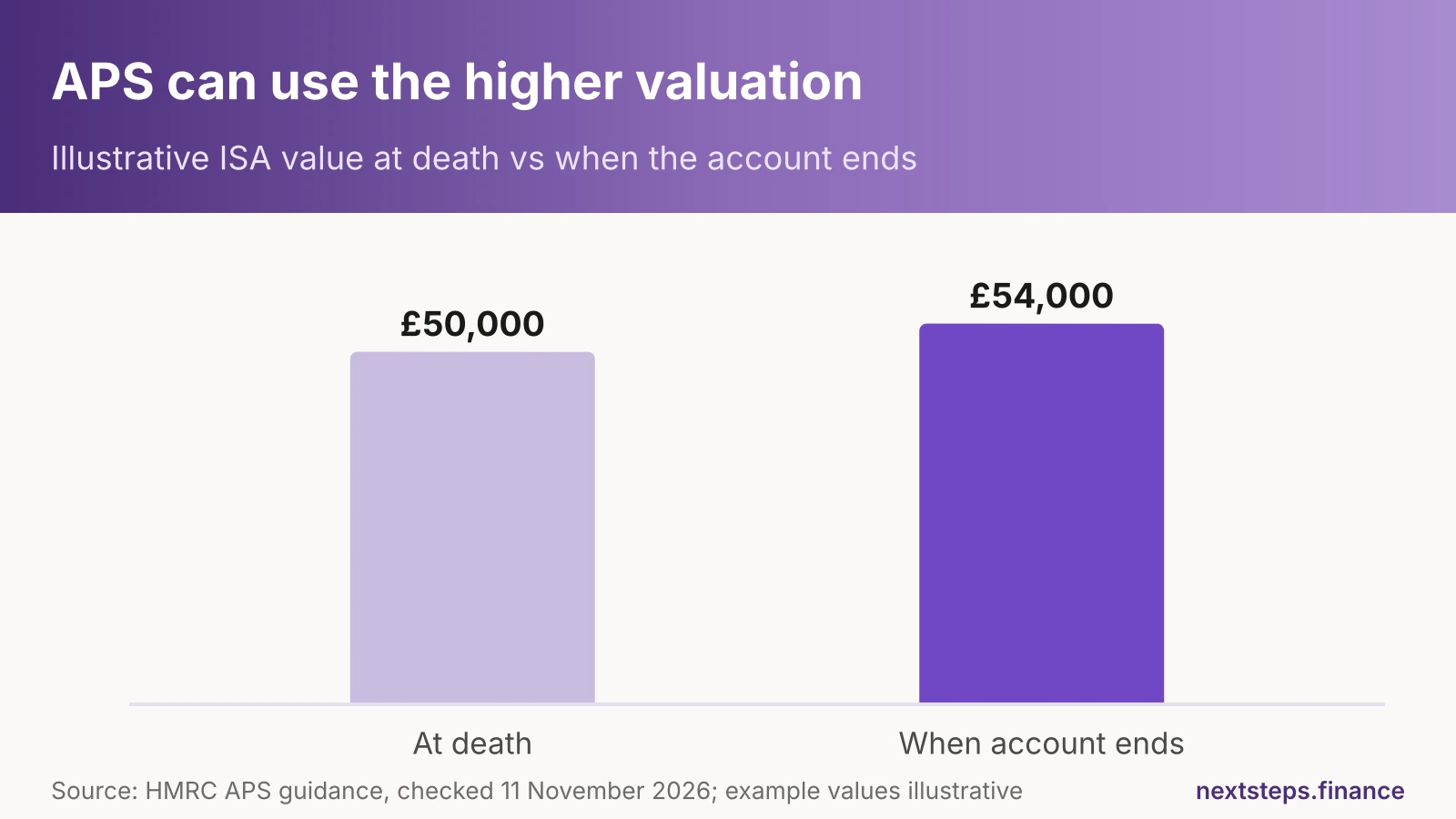
There is an important choice before paying in. If you choose the date-of-death value and subscribe some or all of that APS, HMRC says you cannot later ask for the alternative calculation based on the value when the account ceases to be a continuing account.
For accounts with the same manager, HMRC says the combined limit must use a consistent valuation basis. Do not add the date-of-death value of one account to the later value of another. Ask the provider to explain its calculation before subscribing.
What are the deadlines for using an APS?
The deadline depends on whether you are paying cash into your ISA or moving inherited investments across without selling them.
| APS route | Deadline |
|---|---|
| Cash subscription | Within three years of death, or within 180 days after estate administration is complete if that is later |
| Inherited investments transferred in specie | Within 180 days of becoming beneficially entitled to the investments |
For cash, the later deadline matters if the estate takes more than three years to administer. Keep the executor's confirmation of the completion date and ask the provider to confirm the final date it will accept.
For an in-specie subscription, the 180 days run from when the survivor becomes beneficially entitled to the non-cash assets. HMRC says the provider should treat this as the date it is formally told that the assets are now owned by the surviving spouse or civil partner. Each interim distribution can have its own 180-day window.
Do not leave the request until the final weeks. Providers may need to verify the death, relationship and asset ownership before accepting an APS.
How do you claim an APS from an ISA provider?
Start with the provider that held the deceased person's ISA. Ask its bereavement team for the APS process, the value at death, the value when the account ceased to be a continuing account, and the allowance available. If there were several providers, contact each one.
The provider may ask for the deceased's full name and permanent address at death, date of birth, date of death, National Insurance number if known, date of the marriage or civil partnership, and details identifying the ISA. You will also need to declare that you are the surviving spouse or civil partner and were living together at the date of death.
You can use the original provider or another provider that agrees to accept the APS. Providers are not required to accept APS subscriptions, so check before opening an account or moving money.
If you choose a different provider, it contacts the original manager to confirm the APS details. This is not a normal transfer of the deceased person's ISA. Once you start making APS subscriptions with a particular manager, further payments up to that limit must be made with the same manager. Any unused balance cannot be used with another manager, unless the provider's ISAs are moved to a new manager in a bulk transfer.
A cash APS can be funded with money you inherited or your own cash. To move inherited investments without selling them, the in-specie route is only available for qualifying assets inherited from the deceased and must be handled by the manager that held those investments. If you use another provider, ask about a cash APS instead.
Keep copies of the provider's APS confirmation, valuation, declaration and payment records. If its figures do not match the estate paperwork, ask it to explain before subscribing.
What happens to an ISA while the estate is being settled?
An ISA held by someone who has died becomes a continuing account of a deceased investor. It can retain its ISA tax advantages until the earliest of the completion of estate administration, the third anniversary of death or the account being closed.
No further subscriptions can be made into the deceased person's continuing account. Existing investments may still be actively managed, subject to the account terms. If the estate is still being administered and the account has not closed by the third anniversary, HMRC says the ISA wrapper must be removed on the next working day; later income and gains become taxable in the hands of the estate.
This period is separate from the survivor's APS. The estate process deals with the deceased's assets; the APS gives the surviving spouse or civil partner a separate allowance for their own ISA.
If you are also reviewing pension death benefits, our pensions and inheritance tax guide covers that separate set of rules.
Can an APS go into a Lifetime ISA or stocks and shares ISA?
An APS can generally be paid into a cash ISA, stocks and shares ISA or innovative finance ISA. It cannot be paid into a Junior ISA. A Lifetime ISA has extra restrictions.
A surviving spouse or civil partner may use an APS with a Lifetime ISA only if they are UK-resident, under 50 and have not already paid into a Lifetime ISA in that tax year. The Lifetime ISA's own £4,000 annual limit and one-LISA-per-tax-year rule still apply. APS paid into a Lifetime ISA counts towards that £4,000 limit, even though APS paid into other adult ISAs is treated as a previous-year subscription. See HMRC's Lifetime ISA death guidance.
The in-specie route is narrower: it is for qualifying non-cash assets inherited from the deceased and must be completed with the manager that held those investments. For more on choosing an investment account, see our stocks and shares ISA comparison.
Moving inherited investments into an ISA does not remove investment risk or guarantee their value. If you are unsure about keeping or selling investments, consider independent regulated advice.
Frequently asked questions
Does an inherited ISA allowance count towards the £20,000 limit?
No. An APS is additional to the ordinary annual ISA subscription limit. For 2026/27, the normal adult limit is £20,000, and an eligible survivor can use that allowance as well as their APS. Lifetime ISA subscriptions have their own £4,000 annual cap.
Can I claim an APS if I do not inherit the ISA money?
Yes. HMRC makes the APS available whether or not the surviving spouse or civil partner inherits the deceased's ISA assets. The allowance can be funded using the survivor's own cash or cash they inherited. The will or intestacy arrangements determine who receives the underlying assets.
Can an unmarried partner use an inherited ISA allowance?
No. APS is available to a surviving spouse or civil partner, not an unmarried cohabiting partner. The couple must also have been living together at the date of death and must not have been separated in the circumstances specified by HMRC.
Can I use an APS with a different ISA provider?
Yes, if the new provider agrees to accept it. The new manager contacts the original provider to confirm the allowance. Once you make an APS subscription with a manager, further payments for that allowance must stay with the same manager, and any unused balance can't be used with another one.
Can an APS be paid into a Lifetime ISA?
It can, but only if the survivor is UK-resident, under 50 and has not already paid into a Lifetime ISA that tax year. The £4,000 annual payment limit still applies, and an APS paid into a Lifetime ISA counts towards it.