
Trading 212 has become one of the UK's most popular investing apps because it removes the fees that eat into small portfolios. This review covers what the ISA costs, what you can invest in, how safe your money is, and who should look elsewhere. Everything was checked in October 2026.
Capital at risk. The value of investments can go down as well as up, and you may get back less than you invest.
Key takeaways
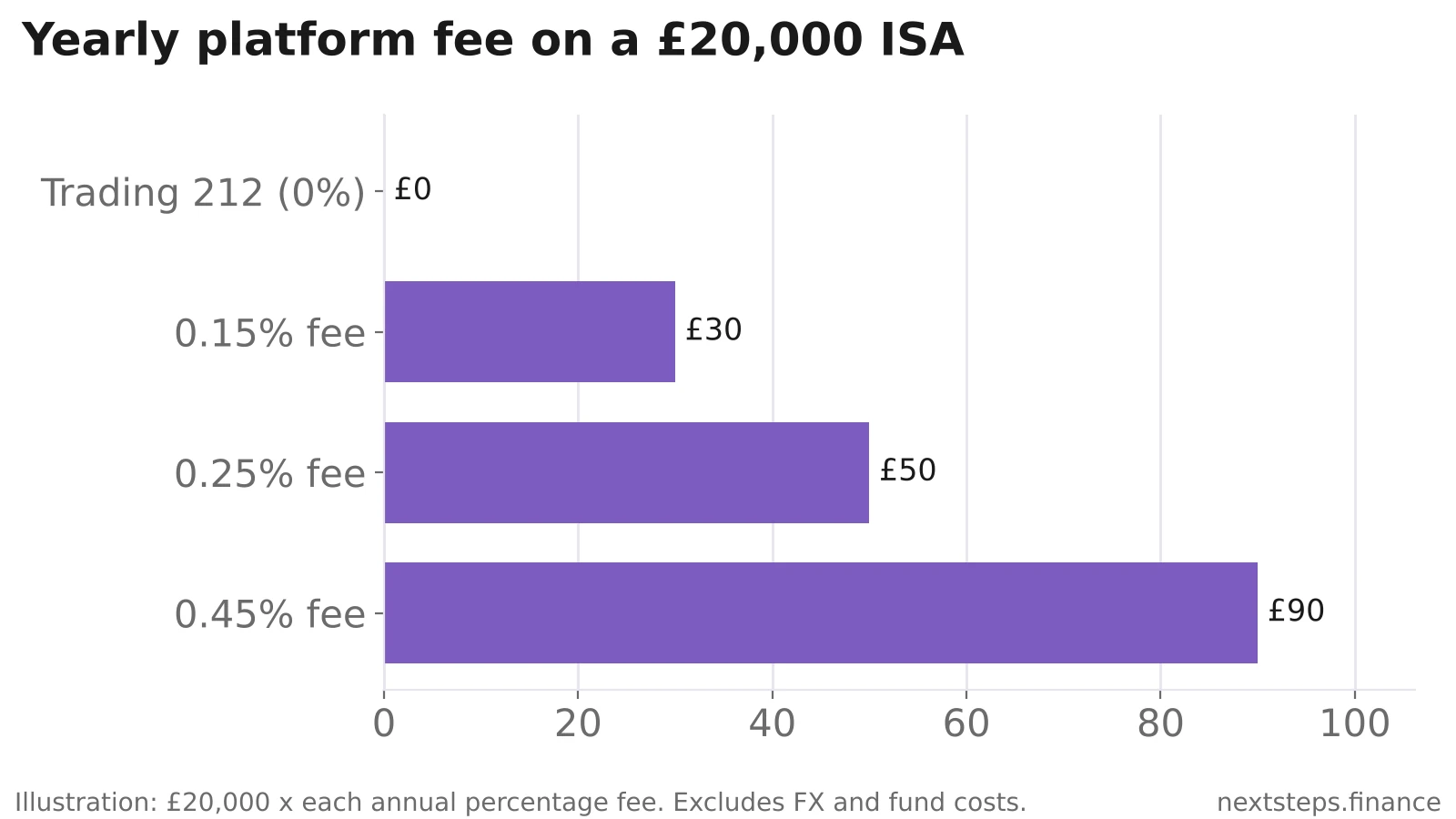
- £0 platform fee and £0 commission on shares and ETFs. On a £20,000 ISA, a 0.25% platform elsewhere would cost £50 a year.
- 0.15% FX fee on trades in a different currency, e.g. buying US shares with pounds. UK shares also attract 0.5% stamp duty, which is a government tax charged everywhere.
- Card deposits over £2,000 in total cost 0.7%. Bank transfers are free, so fund your ISA by bank transfer.
- Pies let you build and automate a diversified portfolio.
- Protection: FCA-regulated, with FSCS cover up to £85,000 if the firm fails. That doesn't cover investment losses.
- No OEICs or unit trusts, so you can't buy traditional funds like many Vanguard or Fidelity funds directly. ETF versions are usually available.
What is the Trading 212 Stocks & Shares ISA?
It's a tax-free investment account. You can put in up to £20,000 in the 2026/27 tax year (your total across all ISAs). Any growth and dividends are free of UK tax. Inside it you can buy UK, US and European shares, ETFs and investment trusts, including fractional shares from as little as £1.
Trading 212 also offers a Cash ISA, an Invest account and, since 2026, a SIPP (personal pension), so you can keep everything in one app.
How much does the Trading 212 ISA cost?
| Cost | Trading 212 ISA |
|---|---|
| Platform / account fee | £0 |
| Commission on shares and ETFs | £0 |
| FX fee (non-sterling trades) | 0.15% |
| Card / Apple Pay / Google Pay deposits | Free up to £2,000 in total, then 0.7% |
| Bank transfer deposits | Free |
| Transfers in and out | Free |
| Stamp duty on UK shares | 0.5% (government tax, not a Trading 212 fee) |
ETFs have their own ongoing charge (OCF), which is built into the fund price, whichever platform you use. A global index ETF typically costs 0.1-0.25% a year.
Take Action: Fund your ISA by bank transfer rather than card, and favour sterling-priced ETFs if you want to avoid the FX fee.
What can you invest in?
- Thousands of shares and ETFs across the UK, US and Europe
- Investment trusts listed in London
- Fractional shares, so you can own part of an expensive share
- Pies: pick a mix of shares and ETFs with target weightings, invest a lump sum or a regular amount, and rebalance with one tap
What's missing: OEICs and unit trusts (traditional funds), bonds, and in-depth research reports. If you want a specific fund like Vanguard LifeStrategy, you'd need a different platform, or an ETF alternative.
Is Trading 212 safe?
Trading 212 UK is authorised and regulated by the Financial Conduct Authority. Client money and investments are held separately from the company's own money. If Trading 212 failed, you'd be covered by the FSCS for up to £85,000 for investments it held for you.
FSCS doesn't protect you from investments falling in value. That's market risk, which applies everywhere.
Trading 212 pros and cons
Pros
- No platform fee or commission, which is ideal for small and growing portfolios
- Fractional shares and Pies make diversified, automated investing simple
- Interest on uninvested cash (around 3.8% AER variable on GBP in October 2026)
- Stocks & Shares ISA, Cash ISA, SIPP and Invest in one app
- Free transfers in and out
Cons
- 0.15% FX fee on non-sterling trades
- No OEICs or unit trusts
- Limited research and no phone advice
- 0.7% fee on card deposits above £2,000
How does Trading 212 compare with InvestEngine?
Both charge £0 platform fees for DIY investing, and both are popular for low-cost ETF ISAs.
- Trading 212 wins on choice: individual shares as well as ETFs, Pies, a Cash ISA and a SIPP.
- InvestEngine is ETF-only, but has no FX fee to worry about on its ETF range, and also offers fully managed portfolios for a small fee.
If you just want a few global ETFs, either works well. If you want individual shares too, Trading 212 is the better fit. See our full Trading 212 vs InvestEngine comparison.
Who is the Trading 212 ISA best for?
A good fit if you:
- Want a low-cost, app-based ISA you'll manage yourself
- Invest smaller or regular amounts, where flat fees would hurt
- Want both ETFs and individual shares
- Like automating with Pies
Look elsewhere if you:
- Want traditional funds (OEICs)
- Want advice, research or phone support
- Are a US person (Trading 212 doesn't accept US persons)
How to open a Trading 212 ISA
- Download the app and sign up. New customers using a referral link or code can get a free fractional share, typically worth £8-£25 and occasionally up to £100.
- Verify your identity (passport or driving licence).
- Choose Stocks & Shares ISA.
- Fund it by bank transfer to avoid card fees.
- Build a Pie or buy individual shares and ETFs.
Open a Trading 212 ISA. Capital at risk.
Related guides
- ISA Allowance UK 2026: Limits and Rules
- Best Stocks and Shares ISA UK 2026
- Trading 212 vs InvestEngine
FAQ
Is Trading 212 good for a Stocks and Shares ISA?
Yes, for DIY investors it's one of the cheapest options in the UK. There's no platform fee and no commission on shares and ETFs, and you can invest from £1 with fractional shares. The main costs are a 0.15% FX fee on non-sterling trades and the funds' own charges. It doesn't offer OEICs or unit trusts.
Is my money safe with Trading 212?
Trading 212 UK is regulated by the Financial Conduct Authority, and client assets are held separately from the company's money. If the firm failed, investments are protected by the FSCS up to £85,000. FSCS doesn't cover losses from falling markets.
Does Trading 212 charge fees on its ISA?
There's no platform fee and no commission on shares or ETFs. You pay 0.15% FX on trades in a different currency, 0.5% stamp duty on UK share purchases (a government tax), and 0.7% on card deposits above £2,000 in total. Bank transfer deposits and ISA transfers are free.
Can I transfer my ISA to Trading 212?
Yes. You can transfer existing Stocks & Shares or Cash ISAs to Trading 212 free of charge, and the transfer doesn't use your annual ISA allowance. Always use the official transfer process rather than withdrawing cash, or you lose the tax-free status of that money.
How much can I put in a Trading 212 ISA in 2026/27?
Up to £20,000 across all your ISAs in the 2026/27 tax year (6 April 2026 to 5 April 2027). The allowance doesn't roll over, so any unused amount is lost at the end of the tax year.
The information in this article is for educational purposes only and does not constitute financial advice. Capital at risk: the value of investments can fall as well as rise. Fees and rates were checked on 21 October 2026 and can change. Tax treatment depends on your individual circumstances and may change.
Sources: Trading 212 ISA, Money to the Masses Trading 212 review, Campaign for a Million: Trading 212 review 2026, GOV.UK: Individual Savings Accounts.