
A bank transfer scam refund UK claim may be available even though you personally approved the payment. The rules cover authorised push payment (APP) scams, where a criminal deceives you into sending money to an account they control. They do not cover every payment dispute or every type of fraud.
This guide explains who is covered, the £85,000 limit, the claim process and how to challenge a refusal. It adds practical detail to our UK banking basics guide and best UK bank accounts guide.
Key takeaways
- Mandatory APP reimbursement rules apply to eligible Faster Payments and CHAPS transfers made on or after 7 October 2024 between UK accounts.
- The standard cap is £85,000 per claim. A payment firm may apply an excess of up to £100, but not to a consumer it considers vulnerable.
- A bank should normally reimburse within five business days. It can pause that clock for permitted checks, but must reach an outcome within 35 business days.
- Report promptly and no later than 13 months after the final relevant payment in the claim.
- Civil disputes, international payments, card, cash and cheque payments, and transfers through other payment systems are outside the rules.
What is a bank transfer scam refund?
A bank transfer scam refund is reimbursement for money you were tricked into sending to a fraudster. The formal term is authorised push payment fraud, or APP fraud, because you authorised the transfer after being deceived.
Examples include a fake "safe account" call, a bogus investment, a romance scam or a criminal changing the bank details on a solicitor's invoice. The rules were set by the Payment Systems Regulator (PSR), and UK Finance's guide to APP fraud reimbursement sets out how banks apply them.
This differs from an unauthorised transaction, such as a criminal using stolen card details or accessing your account without permission. Different payment-services protections apply, so report it to your bank immediately.
It also differs from a civil dispute. If you knowingly paid a genuine trader but the work was poor or an item never arrived, that is not automatically an APP scam. Consumer law or a card dispute route may apply. If you paid by card, our Section 75 vs chargeback guide explains those separate protections.
Does the £85,000 APP scam refund rule apply to me?
The rules may apply if you are an individual, a qualifying micro-enterprise or a charity, and you were deceived into making an eligible UK bank transfer on or after 7 October 2024.
The payment must have moved through Faster Payments or CHAPS from one UK account to another. UK Finance says payments to or from credit unions, municipal banks and national savings banks aren't covered, and nor are payments to an account you control yourself.
UK Finance says the rules cover payments from personal accounts, micro-enterprises (fewer than ten staff and turnover or balance sheet of no more than €2 million) and charities with annual income under £1 million. If you made several payments, keep every transaction reference and amount, not just the final transfer.
If your loss is above £85,000, still report all of it to your bank and keep a record of the full amount.
Which bank transfers are excluded from the refund rules?
Not every transfer connected with a scam falls within the mandatory APP reimbursement requirement.
| Payment or situation | How the rules generally apply |
|---|---|
| UK-to-UK Faster Payment or CHAPS made on or after 7 October 2024 | Potentially covered if it is an APP scam |
| Payment made before 7 October 2024 | Not covered by the new rules; the older voluntary CRM Code may be relevant |
| International payment | Generally outside the requirement |
| Card, cash or cheque payment | Different protections or complaint routes apply |
| Cryptocurrency or another payment system | Outside these Faster Payments and CHAPS rules |
| Payment to a genuine trader in a contract dispute | Usually a civil dispute, not APP fraud |
| Payment made for an unlawful purpose | Excluded |
For losses before 7 October 2024, Which? says the older Contingent Reimbursement Model (CRM) Code may help if your bank had signed up. It was voluntary, most but not all banks joined, and it had its own conditions.
Which? lists crypto transfers among the payments not covered, so if you sent money to a crypto exchange and then on to a fraudster in cryptocurrency, the crypto leg falls outside these rules. Give your bank the full payment chain; do not assume every leg has the same status.
How much can a bank refund and how long should it take?
The standard maximum reimbursement is £85,000 per APP scam claim. The sending bank can apply an excess of up to £100, a smaller excess or none. It cannot deduct an excess from a consumer it considers vulnerable in relation to the scam.
The bank should normally reimburse within five business days after you report the claim. It can "stop the clock" while it gathers information it needs, but it must still reach an outcome within 35 business days.
The PSR's reimbursement dashboard, updated on 30 July 2026, reports that between 7 October 2024 and 31 March 2026, 88% of the money lost to APP scams was reimbursed. It also says 82% of claims were closed within five business days and 98% within 35. The first percentage measures money; the other two measure claims.
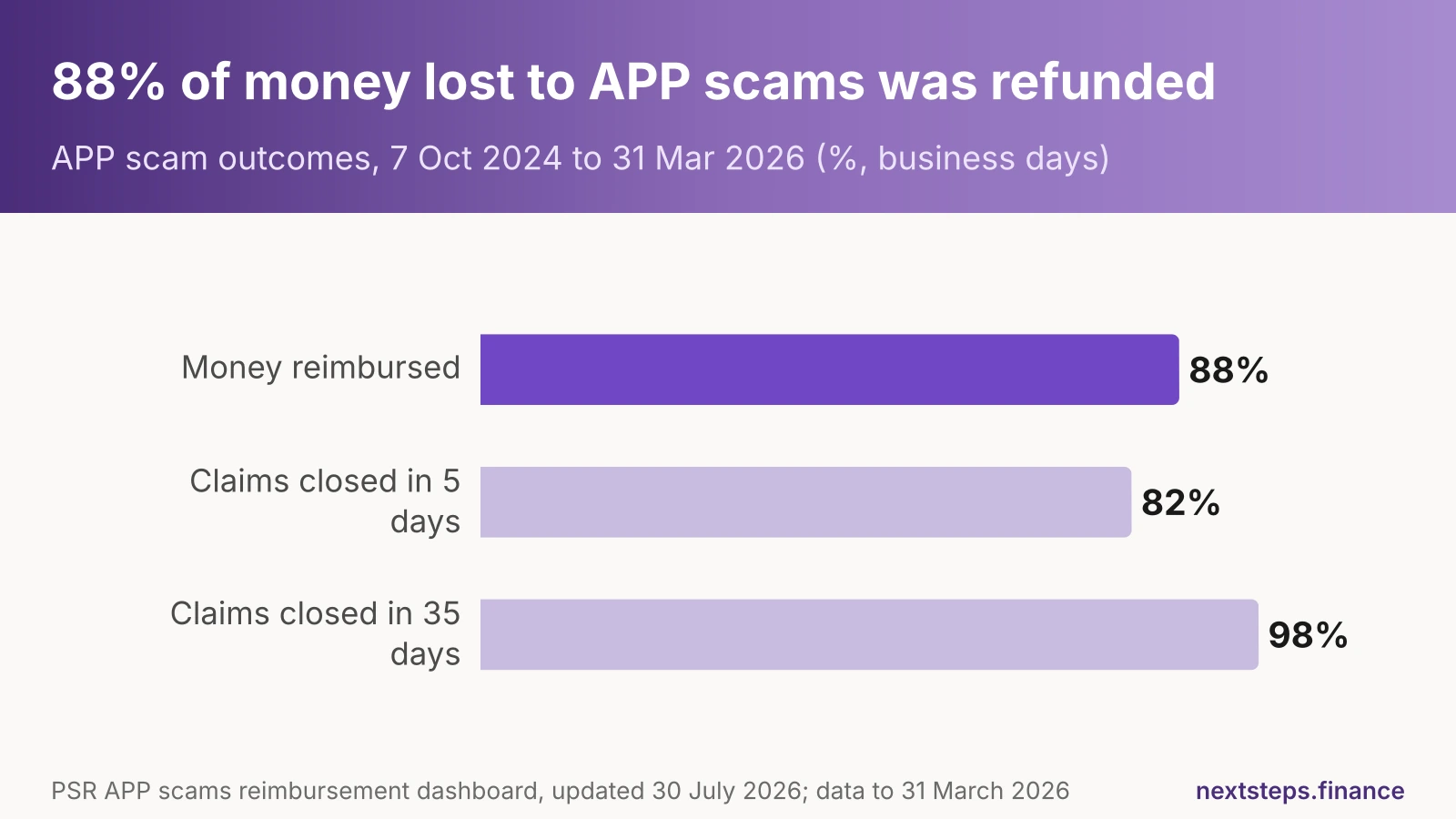
These are historical results, not a promise that your claim will be accepted or settled in five days. The bank may need to investigate, but it should explain what it is waiting for and follow the permitted timetable.
Can a bank refuse an APP scam refund?
A bank cannot reject a claim simply because you authorised the transfer or because the scam seems obvious with hindsight. Which? describes the bar for refusing on grounds of gross negligence as a high one.
The two main exceptions are where the consumer acted fraudulently or was grossly negligent. UK Finance says gross negligence means showing a significant degree of carelessness, which is more than ordinary carelessness. The payment provider has to demonstrate that the exception applies.
The consumer standard of caution concerns four things:
- Warnings: taking notice of warnings from your bank or the police about the payment.
- Prompt reporting: telling your provider as soon as you suspect a scam, and within 13 months of the final relevant payment.
- Information: responding to reasonable and proportionate requests needed to assess the claim.
- Police reporting: reporting the matter when asked, or consenting to your provider reporting it on your behalf.
Vulnerability matters. If you're a vulnerable customer, UK Finance says no excess is applied. Explain relevant circumstances, such as illness, bereavement, disability or coercion, and ask the bank to take them into account.
How do you claim a bank transfer scam refund?
Act quickly. Contact your bank using the number in its official app, on your card or on its website-not a number supplied by the person who contacted you.
- Call your bank immediately. Say you have been the victim of an APP scam. Ask it to stop or recall the payment if possible, secure your account and register a formal reimbursement claim. A recall may not recover the money, but speed can matter.
- Report the fraud. Follow the bank's instructions about police reporting. In England, Wales and Northern Ireland use Report Fraud, which replaced Action Fraud in January 2026 (Which?). In Scotland, report to Police Scotland on 101.
- Preserve evidence. Keep payment confirmations, dates, amounts, recipient details, messages, emails, phone numbers, websites, adverts, invoices and call records. Take screenshots before a fake profile or website disappears.
- Give a clear timeline. Explain how contact started, what the criminal said, why you believed them, any warnings shown and when you realised it was a scam. Include every payment in a multi-step fraud.
- Respond to genuine requests. Check that requests are genuine before sharing information, then reply promptly and keep copies.
Write down the date you first reported the scam. The 13-month limit runs from the final relevant payment, but do not wait until the deadline. Reporting promptly is part of the consumer standard of caution and gives the bank the best chance of tracing funds.
What if the bank rejects or delays your claim?
Ask for the bank's decision and reasons in writing. If it refuses reimbursement, request the evidence and the specific rule it relied on, including why it believes an exception applies. If it misses the timetable, ask why and whether it has paused the clock for an allowed reason.
If you disagree, make a formal complaint to the bank or payment provider. UK Finance says that if the bank can't resolve a complaint by the next day, it must contact you to say it is looking into it. If you remain unhappy with its final response, you can take the complaint to the Financial Ombudsman Service (FOS).
The FOS is free and independent. It can consider whether the bank applied the APP rules correctly and took your circumstances into account. Which? says an Ombudsman case can take three to nine months, so keep pressing the bank first.
The PSR set these rules. A Financial Services and Markets Bill now in Parliament would move the PSR's functions, including this reimbursement requirement, to the FCA; commentary on the Bill says the substance of the requirement isn't changing, only who supervises it. Keep your evidence together and explain clearly what you believe the bank got wrong. You do not need to pay a claims company to complain to the FOS. If you later decide to move accounts, our UK bank switching guide explains the Current Account Switch Service.
Frequently asked questions
Will my bank refund me if I transfer money to a scammer?
You may be entitled to reimbursement if you were deceived into making a UK Faster Payments or CHAPS transfer on or after 7 October 2024. The standard cap is £85,000 per claim. Your bank must assess the facts and any permitted exception; a refund is not automatic for every disputed payment.
How much can I claim for a bank transfer scam?
The mandatory APP reimbursement cap is £85,000 per claim. A bank may apply an excess of up to £100, but not if it considers you vulnerable in relation to the scam.
Can a bank deduct £100 from an APP scam refund?
It can choose to apply an excess of up to £100, or a lower amount, but it does not have to. The excess cannot be applied to a consumer the provider considers vulnerable in relation to the scam. Ask your bank to explain any deduction in its written decision.
How long does a bank have to refund an APP scam?
The usual reimbursement deadline is five business days after you report the claim. The bank can pause the clock while it gathers permitted information, but it must reach an outcome within 35 business days. The PSR reports that 98% of claims between October 2024 and March 2026 were closed within 35 business days.
What if I was scammed before 7 October 2024?
The newer mandatory reimbursement rules do not cover payments made before 7 October 2024. The older voluntary CRM Code may apply if your bank had signed up, which most but not all banks did. You can still complain to your bank, and then to the FOS, about how the scam was handled.
Important: This guide is general information, not legal or financial advice. The outcome of a claim depends on the payment route, dates, evidence and your individual circumstances. Contact your bank promptly and consider the FOS if you disagree with its decision.