
Black Friday falls on Friday 27 November 2026 this year, with Cyber Monday on 30 November. Before you buy that TV, laptop or sofa, it's worth knowing how you'll get your money back if the item never turns up, arrives broken or the shop goes bust. The two tools are Section 75 and chargeback, and the card you pay with decides which you get.
This guide explains the difference, what changed for buy now pay later this summer, and exactly how to claim.
Key takeaways
- Section 75 covers single items costing over £100 and up to £30,000 bought fully or partly on a credit card, under the Consumer Credit Act 1974.
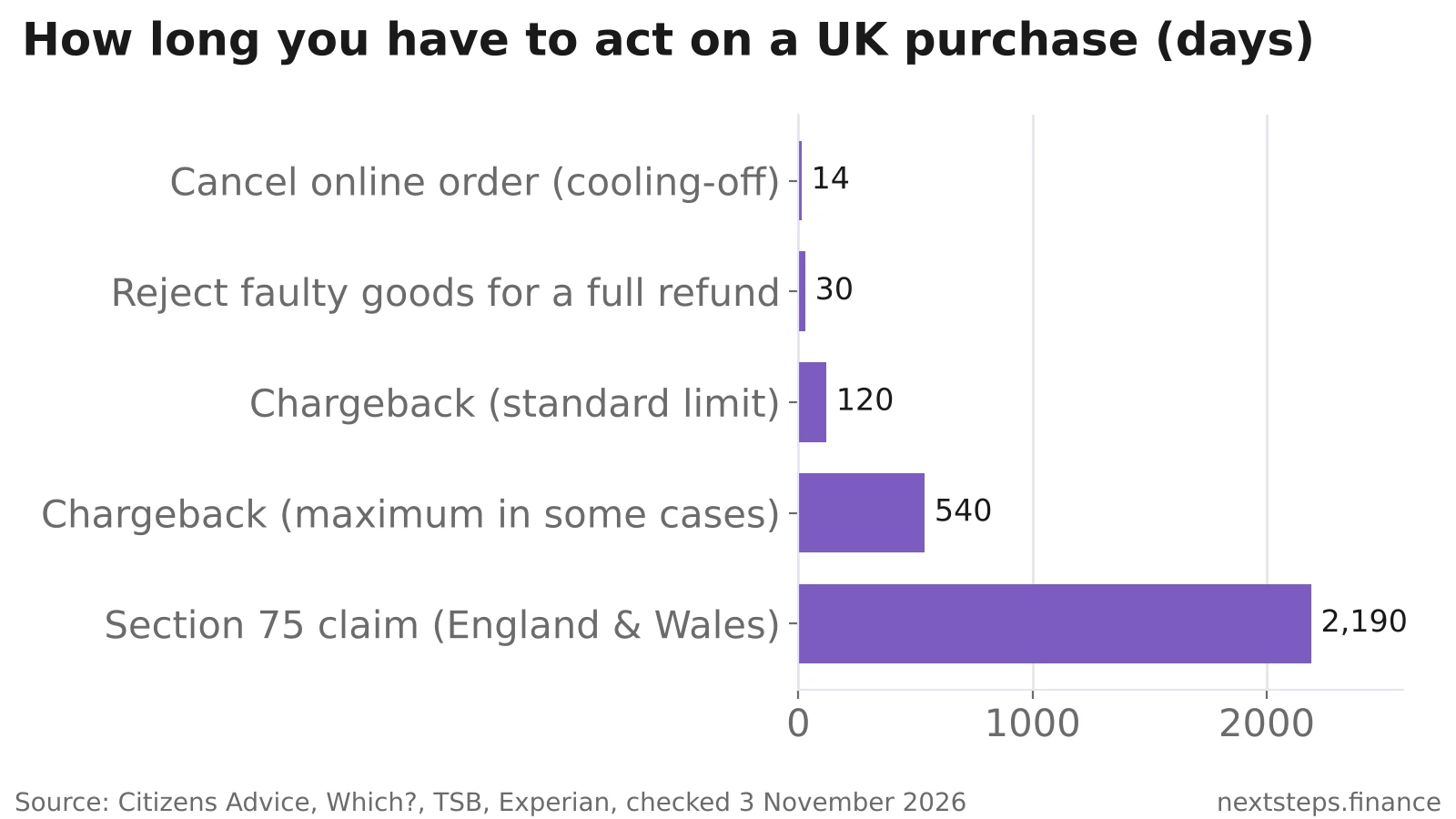
- You have up to six years to make a Section 75 claim in England, Wales and Northern Ireland, and five years in Scotland, according to Experian.
- Chargeback has no minimum spend and works on debit cards, but it's a Visa, Mastercard and Amex scheme rule with a usual 120-day limit (up to 540 days in some cases, per TSB).
- Regulated buy now pay later now has Section 75 protection for agreements taken out from 15 July 2026, the FCA confirms.
- Debit cards, charge cards and prepaid cards don't get Section 75, and paying through PayPal or a marketplace can break it.
What is Section 75 and how does it work?
Section 75 of the Consumer Credit Act 1974 makes your credit card provider jointly and severally liable with the retailer for breach of contract or misrepresentation. In plain English: if the shop lets you down, you can claim the full amount from your card provider instead.
Which? explains that the provider "is just as responsible as the retailer or trader for the goods or service supplied", which is "particularly useful if the retailer or trader has gone bust". Typical claims include:
- goods that never arrive
- items that are faulty or not as described
- a retailer or holiday firm that goes bust before delivering
- a service that isn't provided as promised
The rules that trip people up:
- The £100 limit is per item, not per basket. Experian says the limit "applies to each item, not the whole basket". Two £60 items in one order aren't covered.
- You only need to pay part on the card. A £10 deposit on a credit card for a £1,500 sofa covers the full £1,500, because the card company is liable "even if you made only part of the payment".
- The upper limit is £30,000 per item (the cash price).
- The main cardholder should make big purchases. Barclaycard says additional cardholders aren't covered. Which? says some additional-cardholder purchases can still be covered, but recommends the primary cardholder buys anything big to be safe.
Take Action: For any single Black Friday item over £100, put at least part of the payment on a credit card in your own name.
What is chargeback and when should you use it?
Chargeback is a way to ask your card provider to reverse a payment through the card scheme (Visa, Mastercard or American Express). It's your main protection on debit cards, and on anything under £100.
As Experian puts it, chargeback "is not a legal requirement like Section 75, so you're not guaranteed to get your money back". In practice, banks use it regularly and it often works well for simple problems like non-delivery.
Key rules, using TSB's chargeback guidance as an example of how UK banks apply them:
- Time limit: raise it "at the latest within 120 days of the transaction date". Some cases, such as event tickets for a date after the 120 days, can go up to 540 days from the original transaction.
- Non-delivery: you usually have to wait 15 days past the expected delivery date before raising it.
- No spend limits: Experian notes there are "no minimum or maximum spend limits".
- It's discretionary: the bank decides whether to pursue it, and the retailer can defend it.
Take Action: If you pay by debit card and something goes wrong, contact the retailer first, then call your bank promptly. Don't wait until day 119.
Section 75 vs chargeback: which protects you better?
Section 75 is stronger because it's a legal right with a longer deadline and the Financial Ombudsman can enforce it. Chargeback is wider (any amount, more card types) but weaker.
| Section 75 | Chargeback | |
|---|---|---|
| What it is | Legal right (Consumer Credit Act 1974) | Card scheme rule (Visa, Mastercard, Amex) |
| Cards covered | Credit cards; regulated BNPL from 15 July 2026 | Debit, credit and charge cards |
| Item price | Over £100, up to £30,000 per item | Any amount |
| Time limit | Up to 6 years (5 in Scotland) | Usually 120 days, up to 540 in some cases |
| Paid only part on the card? | Covers the full item cost | Usually limited to the amount paid on the card |
| Guaranteed? | Provider is legally liable if your claim is valid | No, it's at the bank's discretion |
The time limits matter most. A sofa that falls apart after five months is past the 120-day chargeback window, but well within Section 75.
Does Section 75 apply to Klarna, PayPal and Amex?
It depends on how the payment is routed. Any third party between you and the shop can break the "debtor-creditor-supplier" link that Section 75 relies on.
Buy now pay later (Klarna, Clearpay and others)
This changed on 15 July 2026. The FCA says it "started regulating Deferred Payment Credit, often known as Buy Now Pay Later, on 15 July 2026", and that Section 75 "is available. This is the same protection you'd have if you used a credit card to pay instead." Regulated BNPL lenders must also check affordability, and you can complain to the Financial Ombudsman.
Two catches:
- Agreements taken out before 15 July 2026 stay unregulated, so the new protections don't apply to them.
- Only BNPL from a separate lender is regulated. If the lender and the shop are the same business, the FCA says it is "not regulated".
The FCA says about 11 million people use BNPL in the UK (February 2026 press release). Section 75 protection is welcome, but BNPL is still borrowing, so only use it for things you'd buy anyway.
PayPal
Paying through a PayPal wallet usually breaks Section 75. Barclaycard lists PayPal, Amazon Marketplace, Klarna, Clearpay and Curve as third parties that stop cover. There's an exception: if the retailer uses PayPal to take payments and you enter your card as normal, Barclaycard says you're still covered. PayPal's own buyer protection may help instead.
American Express
Amex credit cards are covered by Section 75, like any other credit card. Charge cards, where you clear the balance in full each month, aren't covered by Section 75, so check which type you hold. Chargeback still applies to both.
Take Action: For big buys, pay the retailer directly with a credit card rather than through a wallet or marketplace seller.
Which card should you use on Black Friday?
For single items over £100, a credit card you clear in full each month gives you the strongest protection. For smaller purchases, a debit card with chargeback is fine.
If you're choosing a card for Christmas and Black Friday spending, the American Express Preferred Rewards Gold Credit Card (Representative APR 85.8% variable, credit is subject to status) is worth a look because it adds extra cover on top of Section 75. On Amex's own Gold card page, checked on 3 November 2026:
- Purchase Protection: if an eligible item is stolen or damaged within 90 days, Amex covers repair or replacement up to £2,500 per item, subject to an excess.
- Refund Protection: if a UK retailer won't take back an eligible item within 90 days, Amex will refund up to £300.
- Welcome bonus: Amex's card comparison page shows 20,000 Membership Rewards points when you spend £3,000 in your first three months.
- Fee: £0 in the first year, then £195 a year. The purchase rate is 29.1% p.a. variable.
- Eligibility: you can't get the welcome bonus if you've held a personal Amex card in the last 24 months, and you need an income of at least £20,000.
The downsides are real. Not every retailer accepts Amex, the fee kicks in from year two, and the high APR means it only makes sense if you repay in full. Only aim for the £3,000 spend if it's money you'd spend anyway. Our Amex welcome bonus guide and cashback credit cards guide cover the alternatives, including no-fee cards.
| Option | Best for | Key condition | Link |
|---|---|---|---|
| Amex Gold credit card | Big Black Friday buys plus points | £3,000 spend in 3 months for the bonus; £195 fee from year 2 | Amex Gold |
| Your existing credit card | Section 75 without a new application | Repay in full to avoid interest | Your bank's app |
| Debit card | Items under £100 | Chargeback only, usually 120 days | Your bank's app |
Stack your card with cashback: our Black Friday cashback guide shows how to earn back a percentage through Quidco or TopCashBack on top of any card rewards.
Take Action: Avoid applying for new credit right before a mortgage or loan application. Our credit score guide explains why.
How do you make a Section 75 or chargeback claim?
Start with the retailer, then go to your card provider, then to the Financial Ombudsman if needed.
- Contact the retailer and give it a chance to fix the problem. Keep emails, order confirmations and photos.
- Check your other rights. For online orders, Citizens Advice says you get a 14-day cooling-off period starting the day after delivery. For faulty goods, Which? says you have 30 days to reject them for a full refund.
- Claim from your card provider. Most have an online Section 75 or dispute form. Say which you're claiming: Section 75 (credit card) or chargeback (debit card).
- Wait up to eight weeks. Which? says the provider has eight weeks to deal with your complaint.
- Go to the Financial Ombudsman if you're rejected or hear nothing after eight weeks. Experian notes you have six months from the provider's final response to do this. It's free.
Take Action: Screenshot the product page and price when you buy. The CMA warns about "misleading countdown timers", "false claims about stock levels" and "misleading prices", and a screenshot helps prove what you were promised.
What's not covered by Section 75?
Section 75 has gaps, so don't assume every card payment is protected.
- Items of £100 or less (use chargeback)
- Debit, charge and prepaid cards
- Purchases through most third parties, such as marketplace sellers or wallets
- Cash withdrawals and money transfers
- BNPL agreements taken out before 15 July 2026, or BNPL offered by the retailer itself
- Changing your mind on an item that isn't faulty or misdescribed (use your cooling-off rights instead)
If you're planning big Christmas spending, set a limit first in our UK Budget Planner so the protection doesn't come with a credit card bill you can't clear.
FAQ
Is Section 75 better than chargeback?
Usually, yes. Section 75 is a legal right under the Consumer Credit Act 1974, lasts up to six years and can cover the full cost of an item over £100 even if you only paid a deposit on your credit card. Chargeback is a card-scheme process with a usual 120-day limit, but it works on debit cards and any amount.
Does Section 75 cover items under £100?
No. Section 75 only applies to a single item costing over £100 and up to £30,000, and the limit is per item, not per basket. For cheaper items, ask your bank for a chargeback instead. Chargeback has no minimum or maximum spend, but it's not a legal right and usually has a 120-day time limit.
Does Section 75 apply to Klarna?
For regulated buy now pay later agreements taken out from 15 July 2026, yes. The FCA says Section 75 is now available, the same as paying by credit card. It doesn't apply to BNPL agreements taken out before 15 July 2026, or where the shop itself provides the credit, because those aren't regulated.
Can I make a Section 75 claim if I paid with PayPal?
Usually not, because PayPal sits between you and the retailer and breaks the link Section 75 needs. Barclaycard says you are still covered if the retailer uses PayPal only to process your card payment as normal. Otherwise, use PayPal's own buyer protection or ask your card provider about chargeback.
What is the time limit for a Section 75 claim?
You usually have up to six years from the purchase to make a Section 75 claim in England, Wales and Northern Ireland, and five years in Scotland. That's far longer than the 120-day chargeback limit. Claim as soon as you can, though, because evidence is easier to gather early.
Is Amex covered by Section 75?
Amex credit cards, like the Preferred Rewards Gold Credit Card, are covered by Section 75 for items over £100 and up to £30,000. Charge cards, where the full balance is due each month, are not covered by Section 75. Chargeback still applies to Amex cards, as Amex runs its own chargeback scheme.
This article is general information, not personalised financial or legal advice. If you're unsure about a large claim, Citizens Advice can help for free, or see our personal finance review.