
Zero based budgeting in the UK (also written zero-based budgeting) works the same way as anywhere else: you start each month with your take-home pay and assign every pound before you spend it, until nothing is left unallocated. The difference is the numbers. This guide uses real 2026/27 tax rates, the current Ofgem price cap and official food and council tax figures to build a complete zero-based budget, step by step, so you can copy it with your own pay.
Foundations
Zero Based Budgeting UK: Give Every £ a Job
Zero based budgeting UK guide: give every pound of your take-home pay a job until £0 is left, with a worked £28k example and real 2026 bills.
In this article
- 01Key takeaways
- 02What is zero-based budgeting?
- 03How do you do zero based budgeting in the UK?
- 04What does a zero-based budget look like on a UK salary?
- 05Is zero-based budgeting better than the 50/30/20 rule?
- 06What are the pros and cons of zero-based budgeting?
- 07What are the best apps for zero-based budgeting in the UK?
- 08How do you stick to a zero-based budget?
- 09FAQ
- 10The bottom line
Key takeaways
- Zero-based budgeting means income minus planned spending, saving and debt payments equals £0 every month. Money you save still counts as "spent" on a job.
- A £28,000 salary gives about £1,973 a month take-home in England, Wales and Northern Ireland in 2026/27, before any pension or student loan.
- Real costs to plan around: the Ofgem price cap is £1,723 a year (about £144 a month) from 1 October to 31 December 2026, and average council tax in England is £1,868 per home in 2026-27.
- Sinking funds are what make it work: about £145 a month set aside in our example covers Christmas, birthdays, clothes and yearly bills, so they never break the budget.
- It suits tight or irregular budgets, people paying off debt and anyone who never knows where their money went. It takes more effort than the 50/30/20 rule.
If you'd like a ready-made zero-based plan for the whole year, the UK Budget Planner has a "left to allocate" total built in, with monthly sinking funds and bill tracking.
What is zero-based budgeting?
Zero-based budgeting is a monthly plan where your take-home pay minus everything you've allocated comes to exactly £0. Every pound is given a job before the month starts, whether that's rent, groceries, an emergency fund or a night out.
The idea comes from business, where a zero-based budget means justifying every cost from scratch instead of rolling last year's figures forward. In personal finance it's simpler: you write down your income, then list every place it will go, and keep allocating until "left to allocate" shows £0.
Three things people often get wrong:
- £0 doesn't mean an empty bank account. If £150 goes to your emergency fund, that money is allocated but still yours.
- It's built on take-home pay, not salary. Use what lands in your account after Income Tax, National Insurance, pension and any student loan.
- It's redone every month. Bills, birthdays and paydays change, so the plan does too. Most months it takes 15-20 minutes once it's set up.
How do you do zero based budgeting in the UK?
You do a zero-based budget in six steps: work out your exact monthly income, list fixed bills, add variable essentials, set up sinking funds, allocate savings and debt, then give whatever is left a job until the balance is £0.
- Write down your take-home pay for the month. Use your payslip, not your salary. If you're paid four-weekly, you get 13 paydays a year, so plan on one payday a month and treat the 13th as a bonus with its own job.
- List fixed bills. Rent or mortgage, council tax, energy, water, phone, broadband, insurance and subscriptions. Your bank statement's Direct Debits and standing orders are the quickest source.
- Add variable essentials. Food shopping, travel, fuel and household items. Use the average of your last three months, not a hopeful guess.
- Set up sinking funds. Divide every yearly or irregular cost by 12: Christmas, birthdays, car servicing, the TV licence, holidays and clothes.
- Allocate savings and debt. Your emergency fund, any extra payments on expensive debt, and goal savings such as a house deposit.
- Give the rest a job. Spending money, a small buffer, or more savings. Keep going until income minus allocations equals £0.
If you already use a spreadsheet, add a "left to allocate" cell that subtracts every category from your income. Our guide to making a budget spreadsheet in the UK shows exactly how to set one up, or start from the free budget template.
Take Action: Before you start, download your last three months of bank statements. Every number in your budget should come from them.
What does a zero-based budget look like on a UK salary?
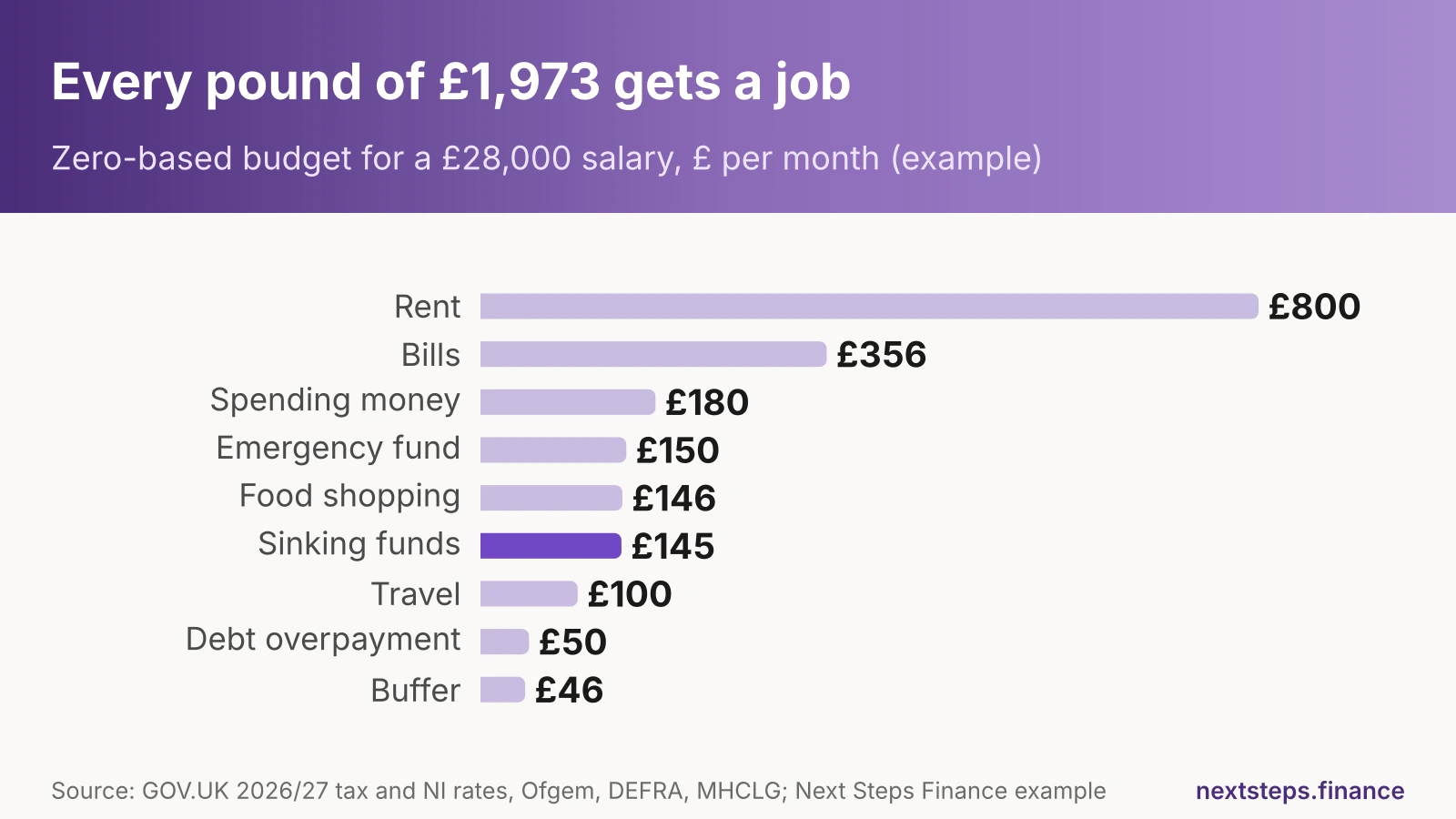
On a £28,000 salary, a single renter has about £1,973 a month to allocate in 2026/27. The example below gives every pound a job, using official figures for energy, council tax and food, and example amounts for costs that vary too much to average.
Step 1: work out take-home pay
Using HMRC's rates and thresholds for 2026 to 2027, the Personal Allowance is £12,570, basic rate Income Tax is 20% and employee National Insurance is 8% on earnings between £12,570 and £50,270.
| Per year | Per month | |
|---|---|---|
| Gross salary | £28,000 | £2,333 |
| Income Tax (20% of £15,430) | -£3,086 | -£257 |
| National Insurance (8% of £15,430) | -£1,234 | -£103 |
| Take-home pay | £23,680 | £1,973 |
A workplace pension or student loan comes off before you see your pay. On £28,000, a Plan 2 loan takes nothing (the threshold is £29,385), but a Plan 5 loan takes about £22.50 a month (9% above £25,000). Use your own payslip figure. Our UK income tax guide explains the bands.
Step 2: allocate every pound
| Job | Monthly | Where the figure comes from |
|---|---|---|
| Rent | £800 | Example; use your own |
| Council tax | £117 | £1,868 England average per home (MHCLG, 2026-27) less 25% single person discount |
| Energy | £144 | £1,723 a year under the Ofgem price cap, 1 Oct-31 Dec 2026 |
| Phone, broadband, water, insurance | £95 | Example |
| Food shopping | £146 | £33.63 per person per week (DEFRA Family Food FYE 2025) |
| Travel | £100 | Example |
| Sinking funds | £145 | Christmas £40, holiday £50, yearly bills £30, clothes £25 |
| Emergency fund | £150 | Savings goal |
| Debt overpayment | £50 | Extra on top of minimum payments |
| Eating out | £55 | £12.69 per person per week (DEFRA) |
| Personal spending | £100 | Hobbies, gifts, nights out |
| Subscriptions | £25 | Example |
| Buffer | £46 | For prices that come in higher than planned |
| Total allocated | £1,973 | Left to allocate: £0 |
Notice that savings, debt and sinking funds take £345 a month, about 17% of take-home pay. That's the main advantage of a zero-based budget: the money you'd usually "find" at the end of the month has a job from day one.
Our 30k salary budget shows three more worked budgets with pension contributions included.
Is zero-based budgeting better than the 50/30/20 rule?
Neither is better for everyone. Zero-based budgeting gives more control and suits tight budgets or debt repayment, while the 50/30/20 rule is quicker to set up and suits people with more breathing room.
| Method | How it works | Effort | May suit you if |
|---|---|---|---|
| Zero-based budgeting | Every pound gets a job until £0 is left | High | Money is tight, you're clearing debt or you overspend without noticing |
| 50/30/20 rule | 50% needs, 30% wants, 20% savings | Low | Your costs fit the split and you want a simple guide |
| Pay yourself first | Save a fixed amount on payday, spend the rest freely | Low | You find saving hard but don't overspend |
| Envelope or pots method | Cash or pots for each category | Medium | You want hard limits on spending categories |
In our example, needs take about 71% of take-home pay, well above the 50% that 50/30/20 suggests. That's common on UK salaries with high rents, and it's where zero-based budgeting helps: instead of failing a rule, you decide where each pound goes. Our complete guide to budgeting in the UK compares every method in more detail.
What are the pros and cons of zero-based budgeting?
The biggest advantage is that nothing is left unplanned, so overspending becomes visible straight away. The biggest drawback is time: it needs a monthly reset and some tracking to work.
Pros
- You see exactly where every pound goes, which makes it easier to cut the right things.
- Savings and debt payments are planned first, not left to whatever's spare.
- Irregular costs (Christmas, car repairs, annual renewals) are covered by sinking funds, so they don't land on a credit card.
- It works with any income, including variable or four-weekly pay.
Cons
- It takes 15-20 minutes each month, plus regular checks.
- If you plan too tightly with no buffer, one surprise bill can make it feel like failure.
- It's harder for couples unless you agree the categories together.
- With very irregular income, you may need to budget on last month's pay rather than this month's.
Take Action: Always include a buffer line. Around 2-3% of take-home pay (£46 in our example) stops small surprises derailing the whole plan.
What are the best apps for zero-based budgeting in the UK?
Any tool that shows "left to allocate" works for zero-based budgeting: a spreadsheet, a paper planner or a banking app with pots. The simplest method is to move each allocation into a separate pot on payday.
Use pots to make the allocations real
With Monzo, Salary Sorter lets you split a payment into pots for bills, spending and savings as soon as it arrives. It works on any payment into your account over £100, you can have up to 20 pots at any time, and you can save your split so it's applied automatically next payday. You need to set up the pots first. Monzo says eligible money is protected by the FSCS up to £120,000 per person.
New customers who join through a referral link currently get £10 and a free month of Monzo Extra, under Monzo's referral terms (version 1.0, from 12 November 2025). You need to be a UK resident aged 18 or over with no Monzo account, and within 30 days of entering your mobile number you must download the app, apply, add money and make a card payment. After the free month you decide whether to pay for Extra. There's no end date, but Monzo can change or withdraw the offer at any time.
| Tool | Cost | How it helps a zero-based budget |
|---|---|---|
| Monzo pots + Salary Sorter | Free account | Splits pay into up to 20 pots automatically |
| Your current bank's savings pots or spaces | Usually free | Same idea if your bank offers it; no need to switch |
| Budget template | Free | Spreadsheet with a left-to-allocate total |
| UK Budget Planner | Paid | Full-year plan with sinking funds and bill tracking |
You don't need a new account to do this. Many banks offer pots or savings spaces, and a spreadsheet works fine if you move the money yourself. Our round-up of the best budgeting apps UK compares more options, including apps that work with the bank you already have.
How do you stick to a zero-based budget?
You stick to it by checking it weekly, moving money between categories when plans change, and keeping the total at £0. Overspending in one category isn't failure; it just means taking money from another job.
- Do a 10-minute weekly check-in. Compare what you've spent with each category.
- Move, don't ignore. If food runs £20 over, take £20 from personal spending or the buffer and update the plan.
- Fund Christmas now. With about six weeks to go, our Christmas budget guide shows how to set a realistic limit and avoid borrowing.
- Build the emergency fund first. Three months of essentials is a common target. The emergency fund guide explains how much and where to keep it.
- Plan for price changes. Ofgem updates the price cap every three months, so check your energy line each quarter.
If you'd like to check your own figures before you start, the free UK budget calculator works out take-home pay and a starting split. For a personal review of your budget, debts and goals, see our personal finance review.
FAQ
What is the zero-based budgeting method?
Zero-based budgeting is a method where you give every pound of your monthly take-home pay a specific job, such as bills, food, savings, debt payments or spending, until income minus allocations equals £0. Saving counts as a job, so a zero-based budget doesn't mean spending everything. You rebuild the plan at the start of each month.
Does zero-based budgeting mean spending all your money?
No. Zero-based budgeting means allocating all your money, not spending it. Savings, emergency fund contributions, sinking funds and extra debt payments are all allocations. In our £28,000 example, £345 of the £1,973 monthly take-home pay goes to savings, sinking funds and debt, about 17%, while the plan still balances to £0.
Is zero-based budgeting good for beginners?
Zero-based budgeting can work for beginners, but it takes more effort than simpler methods like the 50/30/20 rule. It's most useful if money is tight, you're paying off debt or you don't know where your money goes. Starting with a template that shows "left to allocate" makes the first month much easier.
How do you do zero-based budgeting with irregular income?
With irregular income, base your zero-based budget on last month's actual earnings rather than what you expect this month. Fund essentials and bills first, then savings, then spending. If you're paid four-weekly, you get 13 paydays a year, so budget for 12 and give the extra payday its own job.
What is the difference between zero-based budgeting and 50/30/20?
The 50/30/20 rule splits take-home pay into fixed percentages: 50% needs, 30% wants and 20% savings. Zero-based budgeting has no fixed percentages; you allocate every pound based on your real costs until nothing is left. Zero-based budgeting gives more control, while 50/30/20 is quicker and simpler to follow.
The bottom line
Zero-based budgeting in the UK means giving every pound of your take-home pay a job until there's £0 left to allocate, with savings, debt and sinking funds counted as jobs. On a £28,000 salary that's about £1,973 a month, and a plan built around real bills can still put around £345 a month towards savings, sinking funds and debt.
To set up your own, the UK Budget Planner does the left-to-allocate maths for you across the whole year, or start with the free budget template. For more methods and guides, visit the budgeting hub.
Found this useful? Add Next Steps Finance as a preferred source and Google will show you more of our guides in search and AI answers.
Put this into practice
Build your budget in one sitting
The UK Budget Planner works out your take-home pay, splits it with the 50/30/20 rule, tracks spending through the year and forecasts five years ahead. Made for UK pay, tax and bills.