
If your pay has crossed £60,000, you do not automatically have to stop claiming Child Benefit. The Child Benefit tax charge is based on adjusted net income, not simply salary, household income or the name on the claim. Pension contributions and Gift Aid can affect the calculation.
Eligible people can use HMRC's PAYE service instead of registering for Self Assessment solely for this charge. The guide also covers the Budget 2026 overpayment proposal. See our saving for children guide for the wider picture.
Key takeaways
- The High Income Child Benefit Charge (HICBC) starts above £60,000 adjusted net income and reaches 100% at £80,000.
- In 2026/27, Child Benefit is £27.05 a week for the eldest or only child and £17.90 for each additional child.
- If both partners are over £60,000, the one with the higher adjusted net income pays. Combined household income is not used.
- Taxable bonuses, benefits, savings interest, dividends and some rental income can count towards adjusted net income; eligible pension contributions and Gift Aid reduce it.
- Some people can pay through PAYE if they do not need a tax return for another reason and meet HMRC's timing rules.
What is the Child Benefit tax charge in 2026/27?
The High Income Child Benefit Charge claws back some or all of the Child Benefit received by a family when one partner's adjusted net income is above £60,000. The threshold and taper apply across the UK; Scotland's different Income Tax bands do not change the HICBC thresholds.
For every £200 of adjusted net income above £60,000, the charge increases by 1% of the Child Benefit received. It reaches 100% at £80,000. The rule changed from 6 April 2024: for 2023/24 and earlier, the threshold was £50,000 and the taper was 1% for every £100.
| Adjusted net income | Share of Child Benefit repaid | Share kept |
|---|---|---|
| £60,000 or less | 0% | 100% |
| £62,000 | 10% | 90% |
| £64,000 | 20% | 80% |
| £66,000 | 30% | 70% |
| £68,000 | 40% | 60% |
| £70,000 | 50% | 50% |
| £72,000 | 60% | 40% |
| £74,000 | 70% | 30% |
| £76,000 | 80% | 20% |
| £78,000 | 90% | 10% |
| £80,000 or more | 100% | 0% |
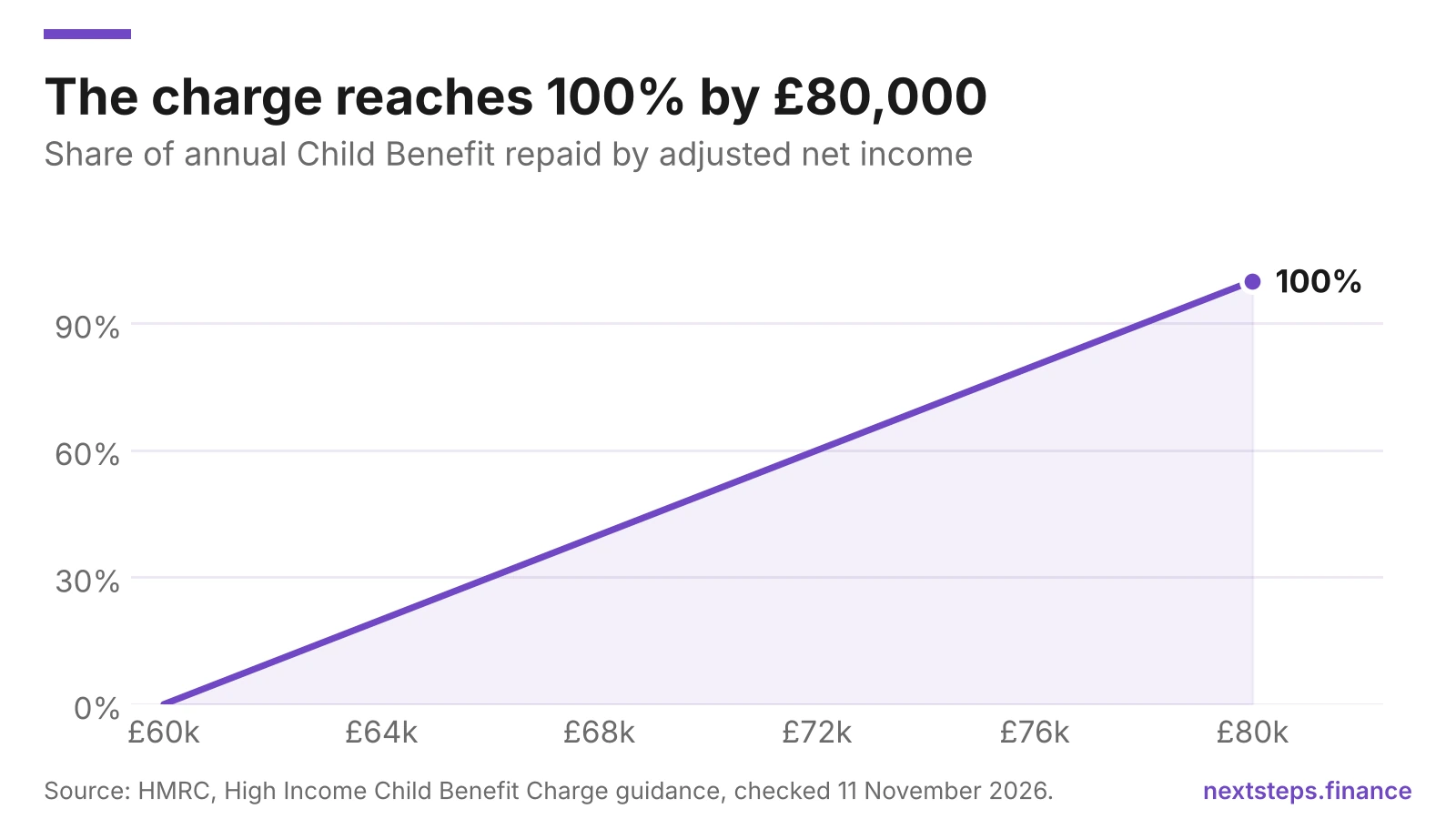
HMRC's 2026/27 weekly rates are £27.05 for the eldest or only child and £17.90 for each additional child. Provisional rates for 2027/28 are £28.00 and £18.55.
| Children | Weekly Child Benefit | Full-year amount (52 weeks) |
|---|---|---|
| 1 | £27.05 | £1,406.60 |
| 2 | £44.95 | £2,337.40 |
| 3 | £62.85 | £3,268.20 |
For example, a two-child family receiving a full year's £2,337.40 would repay half if the higher earner's adjusted net income were £70,000. These annual figures use 52 weeks; the real charge depends on entitlement dates and changes during the year. Use HMRC's Child Benefit tax calculator for an estimate, or try the quick check below with your own adjusted net income:
- Your adjusted net income for 2026/27£70,000
Who pays the charge in a couple?
The person with the higher adjusted net income is responsible if both partners are above the threshold. If only one partner is over £60,000, that person pays, even if the other partner receives the Child Benefit.
The test is individual, not household-based:
- One parent earns £59,000 and the other £59,000: no HICBC, despite combined income of £118,000.
- One parent has adjusted net income of £80,000 and the other has no income: the higher earner repays the full award.
HMRC defines a partner as someone you are married to, in a civil partnership with, or living with as a couple, provided you are not permanently separated. HMRC says the charge may also apply if someone else gets Child Benefit for a child living with you and they contribute at least an equal amount towards the child's upkeep. It does not matter whether the child is your own.
If a partner moves in or you permanently separate during the tax year, the charge can apply for the relevant period. A short absence, such as working away or a hospital stay, does not count as permanent separation. Tell HMRC if your circumstances change.
How do you calculate adjusted net income?
Adjusted net income is your total taxable income before Personal Allowances, less specific tax reliefs. It is not always the same as salary. HMRC includes items such as taxable employment benefits, self-employed profits, savings interest, dividends and some rental income.
A practical calculation is:
- Add taxable income for the tax year, including salary, bonuses, taxable benefits and other taxable income.
- Deduct eligible reliefs such as trading losses and gross pension contributions.
- Deduct the grossed-up value of eligible Gift Aid donations.
- Check the result against the £60,000 threshold.
For relief-at-source pension contributions and Gift Aid, use the gross amount. An £80 personal pension contribution that receives £20 basic-rate relief is treated as £100. An £80 Gift Aid donation is also treated as £100 after basic-rate tax is added.
Worked example: someone has a £65,000 salary and £1,000 of taxable savings interest, giving £66,000 of taxable income. They make a £4,000 net personal pension contribution, grossed up to £5,000, and an £800 net Gift Aid donation, grossed up to £1,000. Their illustrative adjusted net income is £60,000.
See HMRC's adjusted net income guidance for the full calculation. Check workplace pension deductions against your payslip or payroll records so you do not deduct the same contribution twice.
Can pension contributions or Gift Aid reduce the charge?
Yes. Eligible gross pension contributions and Gift Aid donations reduce adjusted net income, so they can lower the percentage of Child Benefit you repay or bring you below the threshold.
For example, if adjusted net income is £70,000 before an additional eligible £10,000 gross pension contribution, the resulting figure would be £60,000. That would remove the HICBC for the year, assuming there is no other income or adjustment.
But a pension contribution is not free money: pension savings are normally locked away until the minimum pension access age, and contributions are subject to tax-relief and annual-allowance rules. A Gift Aid donation is a real charitable gift, not a payment that leaves you better off by itself.
Our tax strategies guide explains pension relief and Gift Aid. If your income includes bonuses, dividends, property or overseas income, an accountant can help check the calculation.
How do you pay the Child Benefit tax charge?
HMRC provides two routes. Eligible employees can use the online PAYE service and have the charge collected through their tax code. People who need to file Self Assessment for another reason must include the charge on their tax return.
| Route | Who can use it | How it works |
|---|---|---|
| PAYE | You do not need a tax return for another reason, are paying for the current or previous tax year, and it is on or before 31 January after the tax year | HMRC changes your tax code and tells your employer or pension provider |
| Self Assessment | You need a return for another reason, such as self-employment, or the PAYE deadline has passed | Register if required, declare Child Benefit and pay through your tax return |
If you have never filed a tax return and must use Self Assessment, HMRC says to register by 5 October following the tax year. For a 2025/26 charge, the online return and payment deadline is 31 January 2027. If you also have self-employment or other untaxed income, the charge belongs on your Self Assessment return. Our Self Assessment deadline guide explains the dates.
If you previously filed Self Assessment only for this charge, HMRC says you can phone it to leave Self Assessment and pay through PAYE instead. Check the official PAYE payment service or Self Assessment guidance before choosing a route.
Should you opt out of Child Benefit payments?
You can claim Child Benefit but choose not to receive payments. This avoids the HICBC while keeping the claim active, so the claimant can still receive National Insurance credits towards their State Pension. The child can also receive a National Insurance number automatically shortly before turning 16.
This is different from not claiming at all. Keeping a claim may be valuable if a parent is not working or has gaps in their National Insurance record. HMRC confirms that you can opt out of payments and restart them later.
If adjusted net income is between £60,000 and £80,000, receiving Child Benefit and paying the charge means the household keeps part of the award. At £80,000 or above, the charge equals the full award, so opting out may be simpler if you do not want payments passing through your account and being repaid. You must still settle any charge for periods when payments were received before you opted out.
You can opt out through HMRC or restart payments online. If your income falls below the threshold for a full tax year, tell HMRC if you no longer need to pay the charge or file a return for this reason.
What did Budget 2026 change?
Budget 2026 announced a change for families who received a Child Benefit overpayment and paid HICBC for the same period. HMRC will be able to offset the tax charge paid against the overpayment, rather than making the family repay the benefit and separately request a tax refund.
HMRC's policy paper, published on 28 October 2026, says the change comes into force when Finance Bill 2026-27 receives Royal Assent and applies retrospectively from HICBC's introduction in January 2013. Until then, don't assume an offset has been applied, and keep any HMRC overpayment notices.
For wider tax changes announced in October, see our Budget 2026 guide. Our UK tax guide explains how adjusted net income fits into the wider tax system.
This is general information, not personal tax advice. The charge can be complicated where a relationship changes during the year or income comes from several sources. Check HMRC guidance or speak to a qualified tax adviser if you are unsure.
Frequently asked questions
Is the Child Benefit tax charge based on household income?
No. HMRC tests each partner's adjusted net income separately. A couple with two incomes of £59,000 each does not pay the charge, even though their combined income is £118,000. If both partners are over £60,000, the one with the higher adjusted net income is responsible.
Who pays the charge if my partner receives Child Benefit?
The higher earner pays, not necessarily the person who claims or receives the payments. If your adjusted net income is over £60,000 and your partner's is lower, you are responsible even if Child Benefit is paid into your partner's bank account.
Can pension contributions reduce the Child Benefit tax charge?
They can if the contributions qualify for tax relief and reduce your adjusted net income. Gross pension contributions and eligible Gift Aid donations can bring income below £60,000 or reduce the percentage repaid. Check pension tax-relief rules and the annual allowance before contributing.
Can I pay the Child Benefit tax charge through PAYE?
Yes, if you do not need to submit a Self Assessment return for another reason, are paying for the current or previous tax year, and register by 31 January after the relevant tax year. HMRC adjusts your tax code so the charge is collected through regular PAYE payments.
Do I still get National Insurance credits if I opt out of Child Benefit payments?
Yes. If you make a Child Benefit claim but choose not to receive payments, you remain registered and can still receive National Insurance credits towards your State Pension. Your child can also receive a National Insurance number automatically shortly before turning 16.