The surprise is that January can cover two tax years: the final amount for the year just ended and an advance payment towards the year you are in. If this is your first time making payments on account, the first January bill can be much larger than expected.
Key takeaways
- Each payment on account is normally 50% of the previous year's qualifying tax liability.
- The usual dates are 31 January and 31 July. For 2026/27, the instalments are due on 31 January 2027 and 31 July 2027.
- You normally do not have to make them if your previous Self Assessment bill was below £1,000, or more than 80% of your tax was collected outside Self Assessment.
- In your first year of payments on account, January can include the full previous-year bill plus another 50% towards the next year.
- You can ask HMRC to reduce instalments if your expected bill is lower, but reducing them too far can mean interest on the shortfall.
What are payments on account for sole traders?
Payments on account are advance payments towards your next Self Assessment tax bill. They are not a second tax or an extra charge: HMRC collects part of the next bill earlier and credits those payments when your actual tax is worked out.
HMRC says each instalment is usually half of the tax you owed in the previous year. For a self-employed person, the calculation includes Class 4 National Insurance as well as Income Tax. The payments are normally due by midnight on 31 January and 31 July.
When you submit the return for that tax year, HMRC compares the actual bill with the payments already made. If the payments were too low, you pay the difference as a balancing payment. If they were too high, you may be due a refund or credit.
The payment dates and basic rules apply across the UK. The underlying Income Tax calculation can differ for Scottish taxpayers because Scotland has its own non-savings Income Tax bands. If you are new to self-employment, our UK self-employment guide covers registration, records and allowable expenses.
Who has to pay payments on account?
You normally have to make payments on account if both of these conditions apply:
- Your previous Self Assessment bill was £1,000 or more.
- Less than 80% of the tax you owed was collected outside Self Assessment, for example through PAYE or tax deducted from savings interest.
You do not have to make them if either exception applies. Being self-employed does not automatically mean you will have payments on account.
For example, if you have a PAYE job and a small freelance business, most of the tax on your total income may already be collected through your salary. If more than 80% was collected this way, you may fall within the exception. If you earn through a side hustle, our side-hustles guide explains the trading allowance and when you may need to register. Our trading allowance guide covers the current and announced thresholds.
HMRC's payments on account guidance explains the two tests. Your Self Assessment statement or online account is the place to check the actual amounts HMRC expects you to pay.
There are also differences between what is included in the instalments and what is settled later. HMRC's Self Assessment Manual, updated on 30 October 2026, explains that the calculation is based on the previous year's relevant tax and National Insurance liability after specified deductions. Capital Gains Tax, student loan repayments and Class 2 National Insurance are not included in the payments-on-account calculation. Capital Gains Tax and student loan amounts due through Self Assessment are instead included in the balancing payment.
How much are payments on account in January and July 2027?
For the 2026/27 tax year, the first payment on account is due on 31 January 2027 and the second on 31 July 2027. Each is normally half of the previous year's qualifying liability.
Keep the tax years separate:
| Date | What the payment relates to |
|---|---|
| 31 January 2027 | Online 2025/26 tax return and any 2025/26 balancing payment, plus the first 2026/27 payment on account if required |
| 31 July 2027 | Second 2026/27 payment on account |
| 31 January 2028 | Online 2026/27 return and any balancing payment, plus the first 2027/28 payment on account if required |
The 2025/26 payments on account, where applicable, were due earlier, on 31 January 2026 and 31 July 2026. The 31 January 2027 date is the balancing-payment deadline for 2025/26 and the first advance instalment towards 2026/27. Our Self Assessment deadline guide explains the filing and payment dates for the 2025/26 return.
To estimate an instalment, start with the qualifying amount HMRC used for the previous year and divide it by two. If that amount was £4,000, each payment on account for the following year would normally be £2,000.
Do not assume the amount is simply half your business profit or half your total tax bill. Tax deducted at source and certain other items affect the calculation. HMRC's own statement is definitive, particularly if you also have PAYE income or student loan repayments.
Why can the first January payment be 150% of your tax bill?
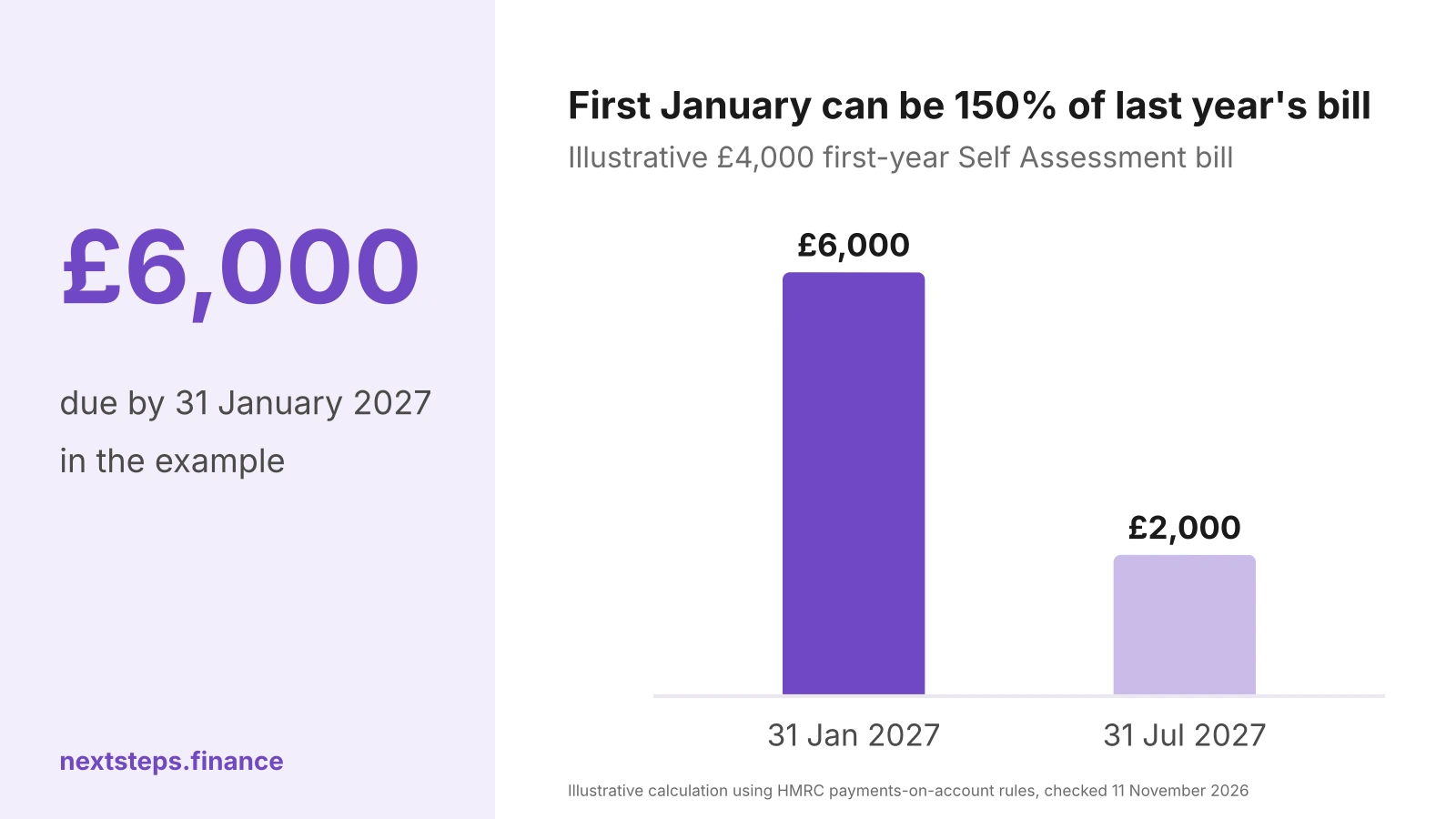
Your first January payment can be 150% of the previous year's bill because you may have to pay the full amount for the year just ended and the first payment on account for the year ahead on the same day.
Suppose your 2025/26 Self Assessment bill is £4,000 and you did not make payments on account towards that bill. The 31 January 2027 amount can include:
| What is due | Illustrative amount |
|---|---|
| Full 2025/26 tax bill | £4,000 |
| First payment on account for 2026/27 | £2,000 |
| Total due by 31 January 2027 | £6,000 |
| Second payment on account by 31 July 2027 | £2,000 |
That £6,000 is not a tax bill for one year. It is the £4,000 bill for 2025/26 plus an advance payment towards 2026/27. The second £2,000 instalment follows in July.
If you have already made payments on account for the year just ended, the January balancing amount may be much smaller. For example, if your 2025/26 bill is £4,500 and you have already paid £4,000 towards it, the balancing payment is £500. The next year's payments on account would be £2,250 each, making the January total £2,750 and the July payment £2,250.
HMRC's worked examples show both situations. The figures above are illustrations, not a prediction of your bill.
Can you reduce payments on account if your profits fall?
Yes. If you reasonably expect your current-year tax bill to be lower than the previous year's, you can ask HMRC to reduce your payments on account. This may be relevant if you have stopped trading, reduced your hours, lost a major client or expect lower profits for another genuine reason.
You can make the request through your HMRC online account by viewing your latest Self Assessment return and choosing Reduce payments on account. Alternatively, use form SA303 and post it to HMRC. HMRC says a reduction may be appropriate if your business profits or other income go down, the tax relief you're entitled to goes up, or more tax is deducted at source than in the previous year. You must claim by 31 January after the end of the tax year.
Be careful not to reduce the instalments simply because the January amount feels uncomfortable. Estimate the full year's liability using realistic income and expense figures. If the final bill is higher than the reduced payments, HMRC will charge interest on the difference.
How can you budget for payments on account?
The most reliable approach is to keep records current, estimate your tax as the year progresses and reserve money before it reaches your personal spending account. Waiting until the Self Assessment deadline to work out what you owe leaves little time to find the cash.
A practical routine is:
- Record income when it arrives. Keep invoices, payment dates and refunds together rather than reconstructing turnover in January.
- Record allowable expenses and mileage. Keep receipts and note the business proportion of costs that are partly personal.
- Update your estimate regularly. Compare year-to-date profit with the months remaining and consider whether your income is seasonal.
- Check the HMRC statement. Confirm payments already made, the next due dates and the actual amounts charged.
- Keep the tax money separate. A separate savings pot can make it less tempting to spend money already earmarked for HMRC.
HMRC also offers a free Budget Payment Plan. If you're up to date with payments from your last Self Assessment bill, you can set up weekly or monthly Direct Debit payments towards your next bill, and pause them for up to six months if you need to. If the plan does not cover the full amount due, you still need to pay the difference by the deadline. See HMRC's Budget Payment Plan guidance.
You can do this with a basic spreadsheet. If you have several income streams, lots of expenses or mileage, or a side business alongside PAYE, a structured tracker may make the cash-flow picture easier to follow.
The UK Self-Employed Tax Tracker is a Google Sheets template priced at £19.99 as a one-off payment. It has seven connected tabs for income, expenses, mileage and working from home, a dashboard with a projected tax estimate and monthly tax pot, payment dates and amounts, and a summary arranged around the self-employment pages of the Self Assessment return. It includes an example and a blank version, with updates for new tax years.
It is designed for sole traders using the cash basis. It is not for limited companies, partnerships or rental income, and it is not Making Tax Digital software: it does not connect to HMRC or submit anything. Its calculations are estimates based on what you enter, not tax advice or a substitute for checking your HMRC statement or asking an accountant about a complex position.
If your records are simple, you may not need a paid tracker. HMRC's online account, a free spreadsheet and regular reminders may be enough. The paid template may suit you if you want income, expenses, mileage and estimated payments in one place throughout the year.
Frequently asked questions
Do all sole traders have to make payments on account?
No. HMRC normally requires them only if your previous Self Assessment bill was at least £1,000 and less than 80% of the tax was collected outside Self Assessment. If either exception applies, you may not need instalments. Check your HMRC statement rather than assuming they apply because you are self-employed.
Do payments on account include National Insurance?
For self-employed people, payments on account include Class 4 National Insurance as well as Income Tax. Class 2 National Insurance is excluded from the calculation. The exact amount depends on your previous-year liability and relevant deductions, so use the figure on your Self Assessment statement.
Can I reduce my payments on account to zero?
You can ask HMRC to reduce or cancel them if you have a reasonable basis for expecting no relevant Self Assessment liability or a lower bill. You can apply online or use form SA303. If the final bill is higher than your reduced instalments, HMRC can charge interest on the shortfall.
What happens if my profits increase?
Your payments on account may not cover the full tax due if your profits rise. When you submit the return, HMRC calculates the actual liability, credits the instalments already paid and asks for any remaining amount as a balancing payment. The next year's payments on account may also increase.
Is a tax tracker the same as Making Tax Digital software?
No. A spreadsheet can help you record income, expenses and estimated tax, but it does not automatically submit quarterly updates to HMRC. If Making Tax Digital for Income Tax applies to you, check HMRC's requirements and use compatible software. Our self-employed digital tax rules guide explains the wider reporting change. A planning spreadsheet does not replace that obligation.