
Landlord tax is going up for the second Budget in a row. Chancellor John Healey's Budget on 28 October 2026 confirmed new property income tax rates of 24%, 44% and 49% from April 2027, two points higher than the 22%, 42% and 47% announced a year earlier. Here's what that means for your tax bill, with worked examples, and what else in the Budget affects landlords.
Key takeaways
- Rental profit will be taxed at 24%, 44% or 49% from 6 April 2027, up 4 points on today's 20%, 40% and 45% rates.
- Mortgage interest relief rises from 20% to 24%, which softens the rise for landlords with a mortgage.
- A basic-rate landlord with £10,000 of rental profit and no mortgage pays £400 more a year. With £4,000 of mortgage interest, the rise is £240.
- HMRC estimates 2.4 million landlords will be affected by 2031/32.
- Making Tax Digital reaches landlords with property and self-employed income over £30,000 from 6 April 2027.
What is the new landlord tax rate from April 2027?
From 6 April 2027, property income has its own tax rates: 24% basic rate, 44% higher rate and 49% additional rate. HMRC's policy paper on property and savings income rates, published on 29 October 2026, confirms the rates "take effect for the 2027 to 2028 tax year and subsequent tax years".
Today, rental profit is taxed like your salary, at 20%, 40% and 45%. Last year's Budget had already legislated separate property rates of 22%, 42% and 47% for 2027/28. This year's Budget adds a further two points. HMRC's impact note describes this as a measure to "increase tax rates on property income by 2 percentage points".
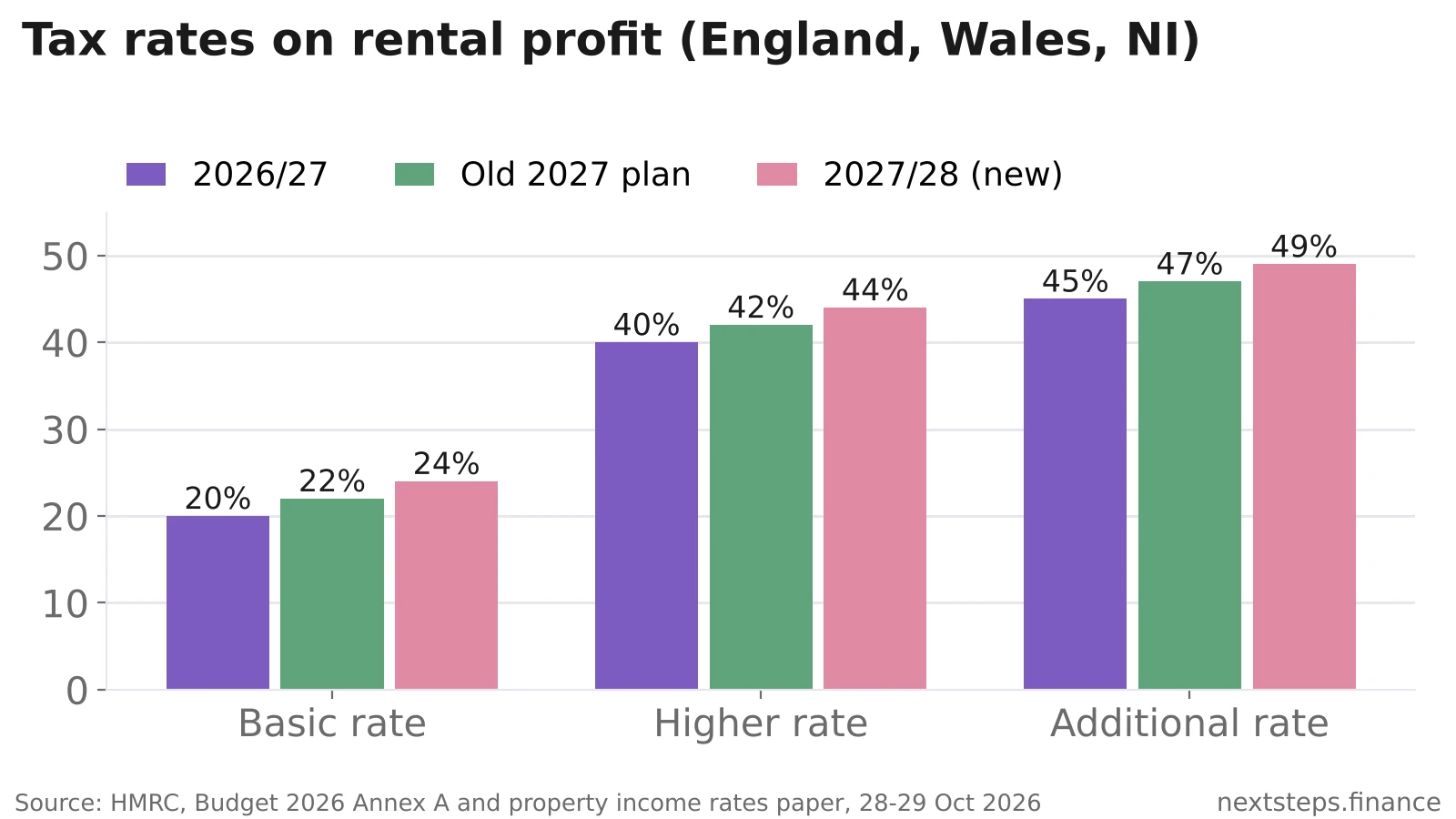
| Tax band | 2026/27 (now) | Old plan for 2027/28 | 2027/28 (Budget 2026) |
|---|---|---|---|
| Basic rate | 20% | 22% | 24% |
| Higher rate | 40% | 42% | 44% |
| Additional rate | 45% | 47% | 49% |
| Mortgage interest tax credit | 20% | 22% | 24% |
The income tax bands themselves don't change. HMRC's Budget 2026 rates annex keeps the Personal Allowance at £12,570 and the basic-rate band at £37,700 in 2027/28, so the higher rate still starts at £50,270 of total income.
Take Action: work out which band your rental profit falls into in 2027/28. That decides whether you're looking at a 4-point rise on the 24% rate or on the 44% rate.
Does the new rate apply in Scotland and Wales?
The new rates apply to individuals in England, Wales and Northern Ireland. HMRC's policy paper says "the governments of Scotland and Wales have been provided with the ability to set property income rates in line with their current Income Tax powers".
In practice:
- England and Northern Ireland: 24%, 44% and 49% from 6 April 2027.
- Wales: the same rates apply, but the Welsh Government now has the power to set its own property rates.
- Scotland: Scottish taxpayers already pay Scottish income tax rates on non-savings income, and the Scottish Government can now set property income rates. Watch the Scottish Budget for 2027/28.
How much more tax will landlords pay?
For most small landlords, the rise is a few hundred pounds a year. A basic-rate landlord pays about £400 more for every £10,000 of rental profit if they have no mortgage. Mortgaged landlords pay a bit less extra, because the tax credit for mortgage interest rises too.
That's because of how mortgage interest works for individual landlords. You can't deduct it as an expense. Instead, you get a tax credit worth a percentage of the interest. PKF Francis Clark's Budget analysis confirms: "Finance costs, such as mortgage interest, will be relieved at 24% as a tax credit." Today that credit is 20%.
Here are four worked examples. Each landlord's salary uses up their Personal Allowance, so all the rental profit is taxed. "Rental profit" here means rent minus allowable expenses, before mortgage interest.
| Landlord | Rental profit | Mortgage interest | Tax 2026/27 | Tax 2027/28 | Extra a year |
|---|---|---|---|---|---|
| Basic rate (£25,000 salary) | £10,000 | £4,000 | £1,200 | £1,440 | £240 |
| Basic rate, no mortgage | £10,000 | £0 | £2,000 | £2,400 | £400 |
| Higher rate (£60,000 salary) | £12,000 | £8,000 | £3,200 | £3,360 | £160 |
| Higher rate, no mortgage | £12,000 | £0 | £4,800 | £5,280 | £480 |
How the first example works in 2027/28: £10,000 × 24% = £2,400, minus a tax credit of £4,000 × 24% = £960, leaves £1,440. In 2026/27 it's £2,000 minus £800, which is £1,200.
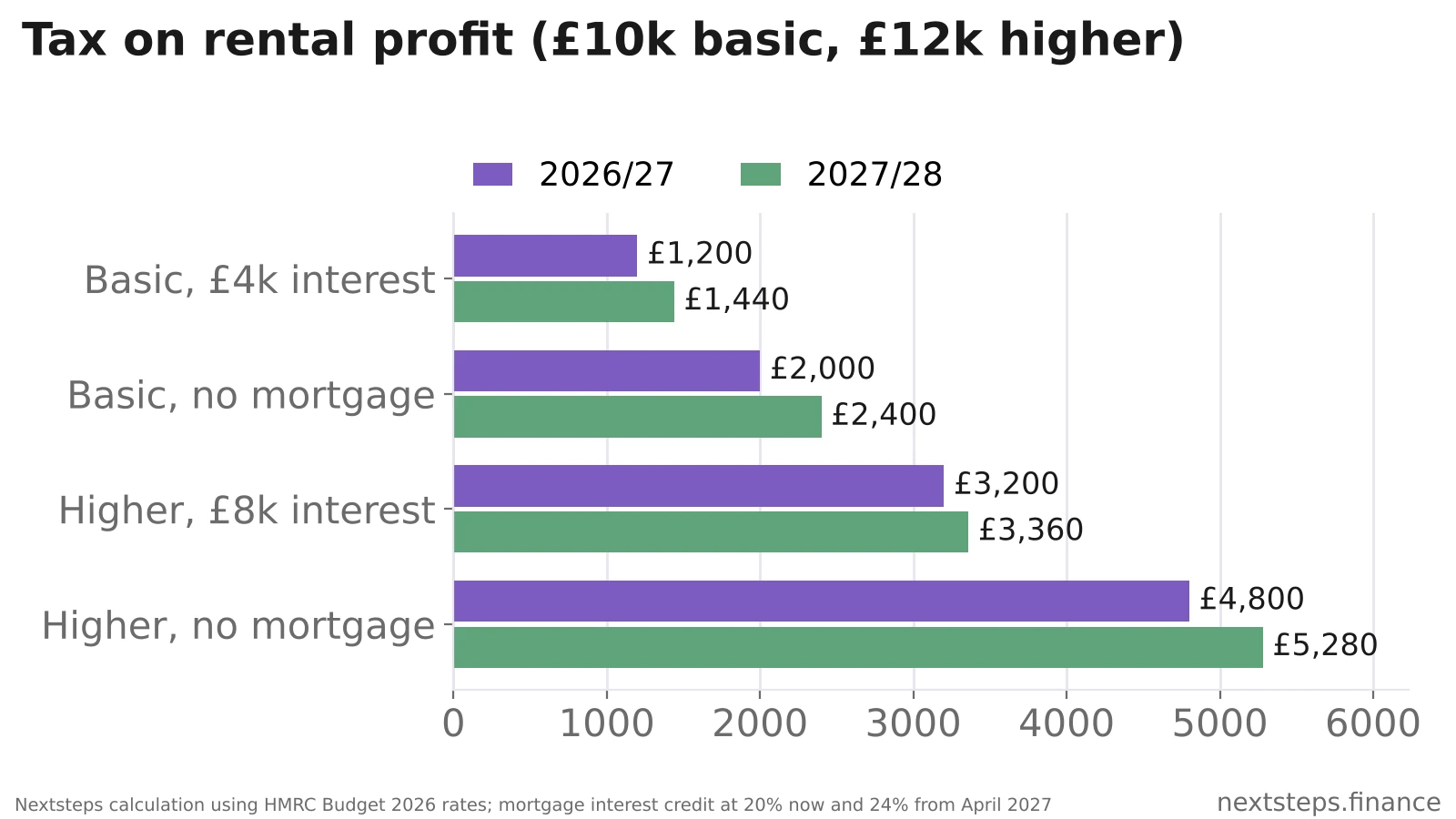
Higher-rate landlords with big mortgages still lose out most overall, because their interest only gets relief at the basic rate (24%) while the profit is taxed at 44%. The examples are simplified. Your real bill depends on your other income, and the tax credit is capped in some cases, such as when your property profits are lower than your interest.
HMRC's impact note estimates that around 5% of taxpayers "will see an average tax rise of £225 annually in 2027 to 2028", and that by 2031/32, 2.4 million landlords will face changes. The Treasury expects the property rate rise to raise £575 million in 2028/29.
Take Action: plug your own numbers into our UK Landlord Tax Tracker, which works out mortgage interest relief and gives a live tax estimate, or redo the examples above with your figures.
Is the property allowance changing?
No. The £1,000 property allowance and Rent a Room relief both stay as they are. PKF Francis Clark notes that "there is no corresponding increase to the property allowance", even though the trading allowance for side hustles triples to £3,000 from April 2027 (see our guide to the £3,000 trading allowance).
So if you earn a little rent, for example from a driveway or a room, the first £1,000 is still tax-free under the property allowance, and Rent a Room relief still covers furnished lodgers in your own home.
How does the personal allowance work for landlords from 2027?
From April 2027, your Personal Allowance is used up against other income first. HMRC's earlier policy paper on these rates says "reliefs and allowances will only be applied to property, savings and dividend income after they have been applied to other sources of income".
PKF explains this means the allowance "must be allocated against pension, employment or trading income first", so the higher property rates "apply where possible". If most of your income is a salary or pension, little changes in practice. If you live mainly on rental income, it's worth running the numbers, because you can no longer choose the order that suits you best.
Do landlords need to use Making Tax Digital in 2027?
Yes, if your income is high enough. HMRC confirmed on 5 October 2026 that Making Tax Digital for Income Tax "will extend to sole traders and landlords earning more than £30,000 from 6 April 2027". The threshold falls to £20,000 from April 2028.
Key points from HMRC:
- The test is gross income, not profit. It "includes gross income from self-employment and property before any tax allowances or expenses are deducted".
- It's based on 2025/26. If your combined property and self-employed income was over £30,000 in 2025/26, you join from 6 April 2027.
- You send quarterly updates using compatible software, then a final declaration after the tax year. HMRC says the updates "are not additional tax returns, but short summaries".
- Existing users (income over £50,000) have their second quarterly update due on 7 November 2026.
The Budget also eases the start for new joiners: according to HMRC's Budget overview, late submission penalty points won't apply to quarterly updates in 2027/28 for those joining in April 2027.
Our guide to self-employed finances and the new digital tax rules covers record-keeping in more detail.
Take Action: add up your gross rents and any self-employed turnover for 2025/26. If it's over £30,000, choose MTD-compatible software before April 2027.
What else in the Budget affects landlords?
A few other measures matter for landlords and property owners:
- Savings tax also rises. Interest outside an ISA will be taxed at 24%, 44% or 49% from April 2027 across the UK. See who pays the savings tax rise.
- High Value Council Tax Surcharge. From April 2028, owners of homes in England worth £2 million or more will pay an annual surcharge of £2,500 to £7,500 depending on value, according to Propertymark. Owners, not tenants, will be liable.
- Capital gains tax is unchanged. Rates stay at 18% and 24%, with a £3,000 annual exempt amount. Gains on residential property still have to be reported and paid within 60 days of completion.
- Business Asset Disposal Relief falls from a £1 million to a £500,000 lifetime limit from 6 April 2027. This mainly affects business owners rather than ordinary buy-to-let.
For the full picture, read our Budget 2026 summary.
How should landlords prepare for the tax rise?
Start with your numbers, then decide whether anything needs to change. For many small landlords, the right move is simply to budget for a slightly higher bill.
- Estimate your 2027/28 bill using the 24%, 44% or 49% rates and a 24% mortgage interest credit.
- Claim every allowable expense: letting agent fees, repairs, insurance, safety certificates and replacing furnishings. Each £100 of expenses saves £24 to £49 in tax from April 2027.
- Set aside tax money monthly so the 31 January payment isn't a shock. Keeping it in a cash ISA means the interest isn't caught by the higher savings tax either. The Trading 212 Cash ISA tracks 0.15% below the Bank of England's Bank Rate, according to its help centre, so the rate moves when Bank Rate does. Fixed-rate ISAs from banks may pay more if you can lock money away. If you also use Trading 212 to invest, capital at risk - the value of investments can go down as well as up.
- Think carefully before restructuring. Moving properties into a limited company can mean stamp duty and capital gains tax, and PKF notes incorporation relief "no longer applies automatically" from 6 April 2026. Get regulated advice first, or book a personal finance review.
Take Action: pick one job this week, such as totting up 2025/26 gross rents for the MTD test.
Frequently asked questions
What is the landlord tax rate from April 2027?
From 6 April 2027, rental profit is taxed at 24% for basic-rate taxpayers, 44% for higher-rate and 49% for additional-rate taxpayers in England, Wales and Northern Ireland. That's 4 points above today's 20%, 40% and 45%. The Budget on 28 October 2026 added 2 points to the 22%, 42% and 47% rates set a year earlier.
Is mortgage interest relief changing for landlords?
Yes. Individual landlords get a tax credit on mortgage interest rather than deducting it. From 6 April 2027, that credit rises from 20% to 24% to match the new property basic rate. Higher-rate landlords still only get relief at the basic rate, so they pay 44% on profit but get 24% back on interest.
How much more tax will I pay on rental income?
A basic-rate landlord with no mortgage pays about £400 more a year for every £10,000 of rental profit from April 2027. A higher-rate landlord pays about £400 more per £10,000 too, before mortgage interest. A bigger tax credit on mortgage interest reduces the rise, so mortgaged landlords typically pay less extra.
Do the new property tax rates apply in Scotland?
Not automatically. HMRC says the new rates apply to individuals in England, Wales and Northern Ireland, and the Scottish and Welsh governments now have powers to set their own property income rates. Scottish taxpayers should check the Scottish Budget for 2027/28 to see what rates will apply to their rental profit.
When do landlords have to use Making Tax Digital?
Landlords and sole traders with combined gross property and self-employed income over £50,000 have used Making Tax Digital since 6 April 2026. The threshold drops to £30,000 from 6 April 2027 and £20,000 from April 2028. The test uses gross income before expenses, based on the tax year two years earlier.
Is the £1,000 property allowance going up?
No. The £1,000 property allowance and Rent a Room relief stay the same after the Budget 2026. Only the trading allowance, which covers side hustle and self-employed income, rises from £1,000 to £3,000 from 6 April 2027. Rental income above the £1,000 property allowance is taxed at the new property rates.
The bottom line
The landlord tax rise is real but, for most small landlords, measured in hundreds rather than thousands of pounds a year. The bigger change is administrative: Making Tax Digital reaches many more landlords in April 2027. Get your records in order now, budget for the new rates and keep tax money somewhere it earns interest, such as a cash ISA. If you're weighing up bigger moves like selling or incorporating, get advice tailored to your situation first.