
If you have built up savings over several years, understanding the FSCS protection limit is just as important as finding a competitive interest rate. The Financial Services Compensation Scheme (FSCS) is a safety net if an authorised bank, building society or credit union fails and cannot repay eligible deposits.
The standard limit increased from £85,000 to £120,000 on 1 December 2025. But the rules are not simply £120,000 for every account or every banking brand. Here's how the limit works, including joint accounts, shared banking licences and large one-off deposits.
Key takeaways
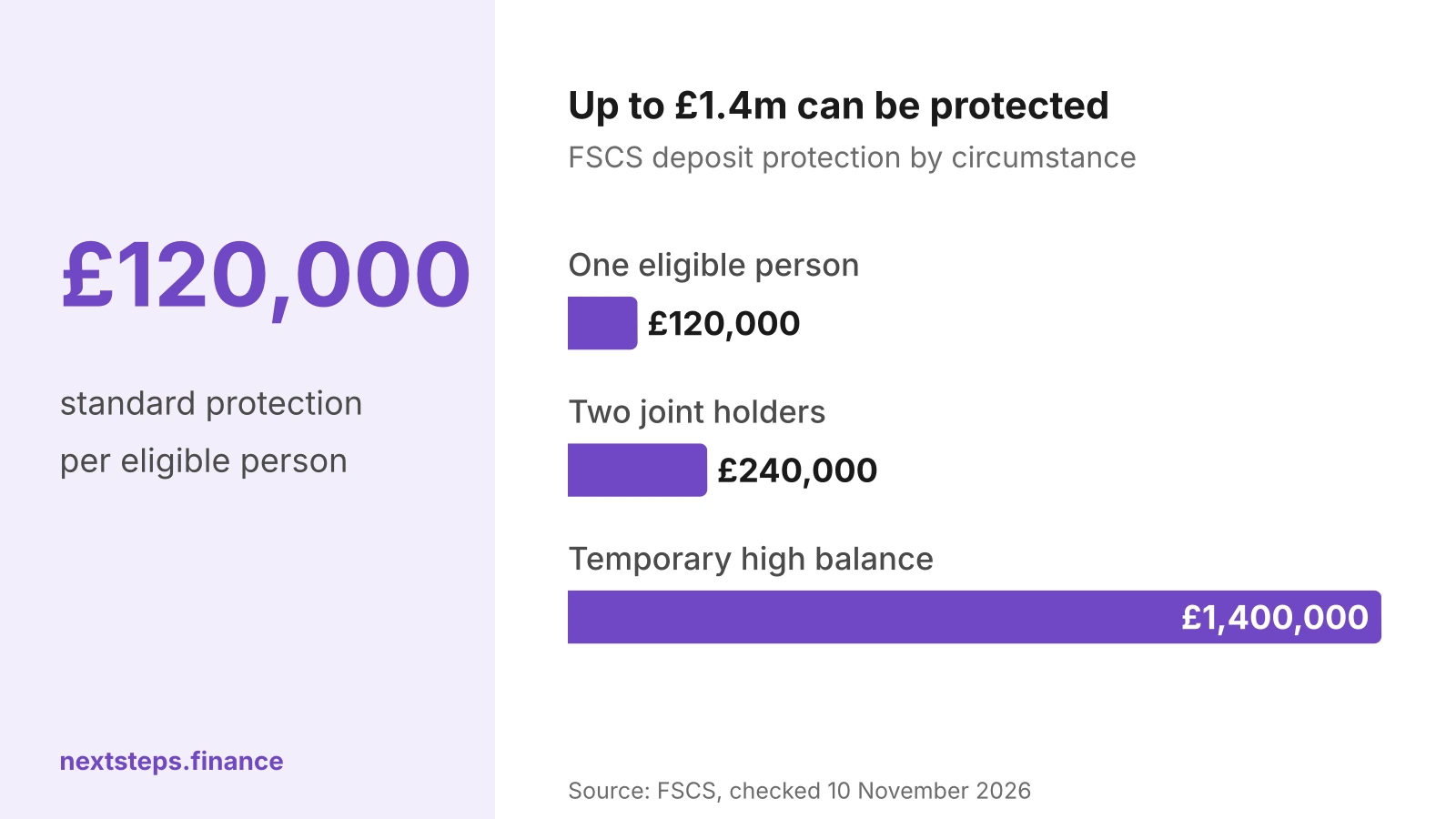
- £120,000: Standard protection per eligible person, per authorised firm, for failures from 1 December 2025.
- £240,000: Potential protection for a joint account with two eligible account holders, assuming neither has other deposits reducing their individual cover.
- £1.4 million: Temporary high balance protection of up to £1.4 million per eligible person for qualifying life events, generally for six months.
- All accounts count: Current accounts, savings accounts and Cash ISAs with the same authorised firm are added together.
- Brand names can mislead: Two different banking brands may share one authorisation and one protection limit.
What is the FSCS protection limit?
The FSCS protection limit is £120,000 per eligible person, per authorised deposit-taking firm. It applies to eligible deposits held with UK-authorised banks, building societies and credit unions if the firm fails and is unable to repay customers.
The limit increased from £85,000 to £120,000 on 1 December 2025, following a review by the Prudential Regulation Authority (PRA). The Bank of England confirms it applies to firms that fail on or after that date; for earlier failures the old £85,000 limit still applies.
Eligible deposits can include money in:
- Current accounts.
- Easy-access and notice savings accounts.
- Fixed-rate savings accounts.
- Cash ISAs.
- Eligible credit union accounts.
The limit is not a promise that every product carrying a bank's name is covered. The deposit must be held with an eligible authorised firm and meet the FSCS rules. Use the FSCS deposit protection guide to check the scope and exclusions.
Is FSCS protection per account or per bank?
FSCS protection is calculated across all eligible deposits you hold with the same authorised firm, not separately for each account. If the same bank holds your current account, savings account and Cash ISA, the balances are added together.
For example, imagine you have these accounts with one authorised bank:
| Account | Balance |
|---|---|
| Current account | £8,000 |
| Easy-access savings | £42,000 |
| Fixed-rate savings | £55,000 |
| Cash ISA | £35,000 |
| Total | £140,000 |
Your eligible deposits total £140,000. Under the standard limit, up to £120,000 would be protected, leaving £20,000 above the limit.
Opening another account with the same bank does not create another £120,000 allowance. The same applies if one of the accounts is marketed under a different product name.
Do different bank brands share the same FSCS limit?
Yes. Different banking brands can operate under the same authorised firm and share one FSCS protection limit. The legal entity and its banking authorisation matter more than the name on the app or debit card.
For example, the FSCS confirms that HSBC and First Direct share a banking licence. If you held £75,000 with HSBC and £65,000 with First Direct, your combined eligible deposits would be £140,000. The standard limit would still be £120,000, leaving £20,000 above it.
Other groups can also have several trading names under one authorisation. Do not assume two brands are separate banks just because they have different websites or apps.
To check, use the FSCS bank and savings protection checker and the FSCS explanation of banking licences. The FCA Financial Services Register can also help identify the authorised legal entity and its trading names.
How much FSCS protection do joint accounts receive?
A joint account can have up to £120,000 of protection for each eligible account holder. A joint account with two eligible holders can therefore have up to £240,000 of protection in total, provided neither person's individual limit is reduced by other eligible deposits with the same authorised firm.
For example, a couple with a £240,000 joint account and no other deposits at that bank could potentially have the full balance protected: £120,000 for each person.
However, your share of a joint account is considered alongside your own eligible deposits at that firm. Assuming equal ownership, if you have £100,000 in an individual account and £100,000 in a joint account, your share of the joint account is £50,000. Your total is £150,000, so £30,000 would be above your £120,000 standard limit. Your partner's share is assessed separately.
The example assumes equal ownership. The way an account is held and the beneficial ownership of the money can affect how FSCS assesses a claim. See the FSCS guidance on deposit protection for more detail.
What is FSCS temporary high balance protection?
Temporary high balance protection can cover qualifying deposits up to £1.4 million per eligible person for up to six months after certain major life events. This is a temporary limit for qualifying balances, rather than an extra £1.4 million added on top of the standard limit.
Qualifying events can include:
- Selling your main home.
- Receiving an inheritance.
- Receiving certain insurance payouts.
- Receiving qualifying retirement benefits.
- Receiving redundancy payments.
- Receiving certain compensation payments, including some divorce or personal injury settlements.
For example, if you sell your main home and receive £450,000, the proceeds may qualify for temporary high balance protection. The standard £120,000 limit may therefore not be the only protection available.
The six-month period generally starts when the money becomes legally yours or is first credited, depending on the event. Moving the money between accounts does not restart the clock. Some personal injury, disability or incapacity-related claims can qualify for unlimited protection under separate rules.
Not every large payment qualifies. The property must generally relate to your main residence, and the event and evidence must meet the FSCS requirements. Keep documents such as completion statements, probate papers, court orders or insurer letters. Read the FSCS temporary high balance rules before relying on this cover.
Are savings apps and digital banks covered by FSCS?
Some savings apps provide access to eligible bank deposits, while others are e-money or payment institutions. The fact that a service looks like a bank in an app does not, by itself, mean its customer balance is an FSCS-protected deposit.
There are two common arrangements to understand.
A savings platform or app using a partner bank: The provider may arrange for your money to be deposited with one or more authorised banks. FSCS protection, if applicable, is generally assessed against the underlying deposit-taking bank and your total eligible deposits with that bank. Check the account terms to see where the money is held and whether it is spread across partner banks.
An e-money or payment institution: E-money balances are not protected as bank deposits by the FSCS. These firms have separate safeguarding requirements, which are not the same as FSCS deposit protection. If a provider fails, recovering safeguarded funds can involve an insolvency process and may take time.
Providers can change their banking arrangements, so check the current product terms rather than relying on an old review or a brand's general description. For example, Revolut's Instant Access Savings has been held with a partner bank, ClearBank, while its newer Personal Instant Access Savings terms name Revolut Bank UK Ltd as the provider. Which one you have changes which firm's £120,000 limit applies. See the current Revolut savings terms and our Revolut savings account review.
The FCA explains the difference between banks and payment providers in its guide to using payment service providers.
What happens if your bank goes bust?
If an authorised deposit-taking firm fails and cannot repay eligible customers, the FSCS can compensate eligible depositors up to the applicable limit. In most straightforward deposit failures, FSCS aims to pay compensation automatically within seven working days.
You normally do not need to submit a claim for a straightforward eligible deposit. More complex cases can take longer. Temporary high balance claims and cases where ownership of the money is unclear may require evidence and a separate assessment.
FSCS protection does not prevent a bank from failing. It is a compensation scheme that can return eligible deposits after a qualifying failure. It is also free to use. Be wary of claims management companies offering to make an FSCS claim in return for a percentage of your compensation.
You can find details of the process on the FSCS bank failure guidance.
How can you check whether all your savings are protected?
If you have substantial savings, review your protection across every bank and savings provider. The key is to identify the authorised firms holding your money and total your eligible deposits with each one.
- List your accounts. Include current accounts, savings accounts, fixed-term deposits and Cash ISAs.
- Identify the authorised firm. Check the legal entity behind each bank brand or savings app.
- Combine balances. Add eligible deposits held with the same authorised firm, including money held through a savings platform.
- Check joint accounts. Include your share of joint balances when assessing your own protection.
- Check temporary high balances. If you have recently received money from a qualifying life event, review the additional rules and keep supporting evidence.
- Use the FSCS checker. Verify your providers and any shared banking licences using the official FSCS protection checker.
If your eligible deposits exceed £120,000 with one authorised firm, you may want to consider whether holding some money with a separate authorised institution is appropriate. Check that the new provider really is separately authorised and remember that you may already have deposits with its banking group.
When comparing accounts, consider access restrictions, withdrawal conditions and fees as well as the interest rate. Our guide to the best savings accounts in the UK can help you compare account types. If you're comparing tax-free and taxable savings, read our Cash ISA or savings account guide. You can also read our emergency fund guide and emergency fund alternatives if you're deciding how much cash to keep readily available, or see where savings rates stand after the rise to 4%.
Frequently asked questions
Is the FSCS protection limit still £85,000?
No. The standard FSCS deposit protection limit increased from £85,000 to £120,000 on 1 December 2025. The new limit applies to eligible deposits held with authorised banks, building societies and credit unions when the relevant firm fails on or after that date.
Are Cash ISAs covered by FSCS?
Yes. Eligible cash deposits held in a Cash ISA with a UK-authorised bank or building society receive the same standard deposit protection as other eligible savings accounts. The ISA tax advantages do not increase the FSCS protection limit, and other eligible deposits with the same authorised firm count towards the same limit.
Are Premium Bonds protected by FSCS?
No. Premium Bonds are issued by National Savings and Investments (NS&I), a government-backed savings organisation. NS&I says its products are backed by HM Treasury, so this is a separate form of protection rather than FSCS deposit compensation.
Can I have more than £120,000 protected?
Yes. You can potentially protect more than £120,000 by holding eligible deposits with separate authorised firms. Joint accounts can have up to £120,000 protection per eligible account holder, and qualifying temporary high balances can receive up to £1.4 million for up to six months.
How do I know if my bank is FSCS protected?
Use the official FSCS bank and savings protection checker. Search for your provider and check whether it shares a banking licence with another brand you use. If you cannot find the provider, check its legal terms and the FCA Register rather than assuming that the money is covered.
How long does FSCS take to pay compensation?
For most straightforward deposit failures, FSCS aims to pay eligible customers automatically within seven working days. More complex cases, including temporary high balance claims or cases where the beneficial owner is unclear, can take longer and may require supporting evidence.
Understanding the FSCS protection limit is an important part of managing your savings. Before chasing a higher interest rate, check which authorised firms actually hold your money and whether your total deposits fall within the relevant protection limits.