Two things changed for savers in the space of a week. The Budget on 28 October raised the tax on savings interest from April 2027, and today the Bank of England raised Bank Rate to 4%, which pushes savings rates, and the interest you earn, higher. Together, they mean more savers will go over their tax-free allowance. Here's how to work out whether a Cash ISA or an ordinary savings account suits you.
Key takeaways
- Bank Rate rose to 4% on 5 November 2026. Variable savings rates should edge up, and tracker accounts move straight away.
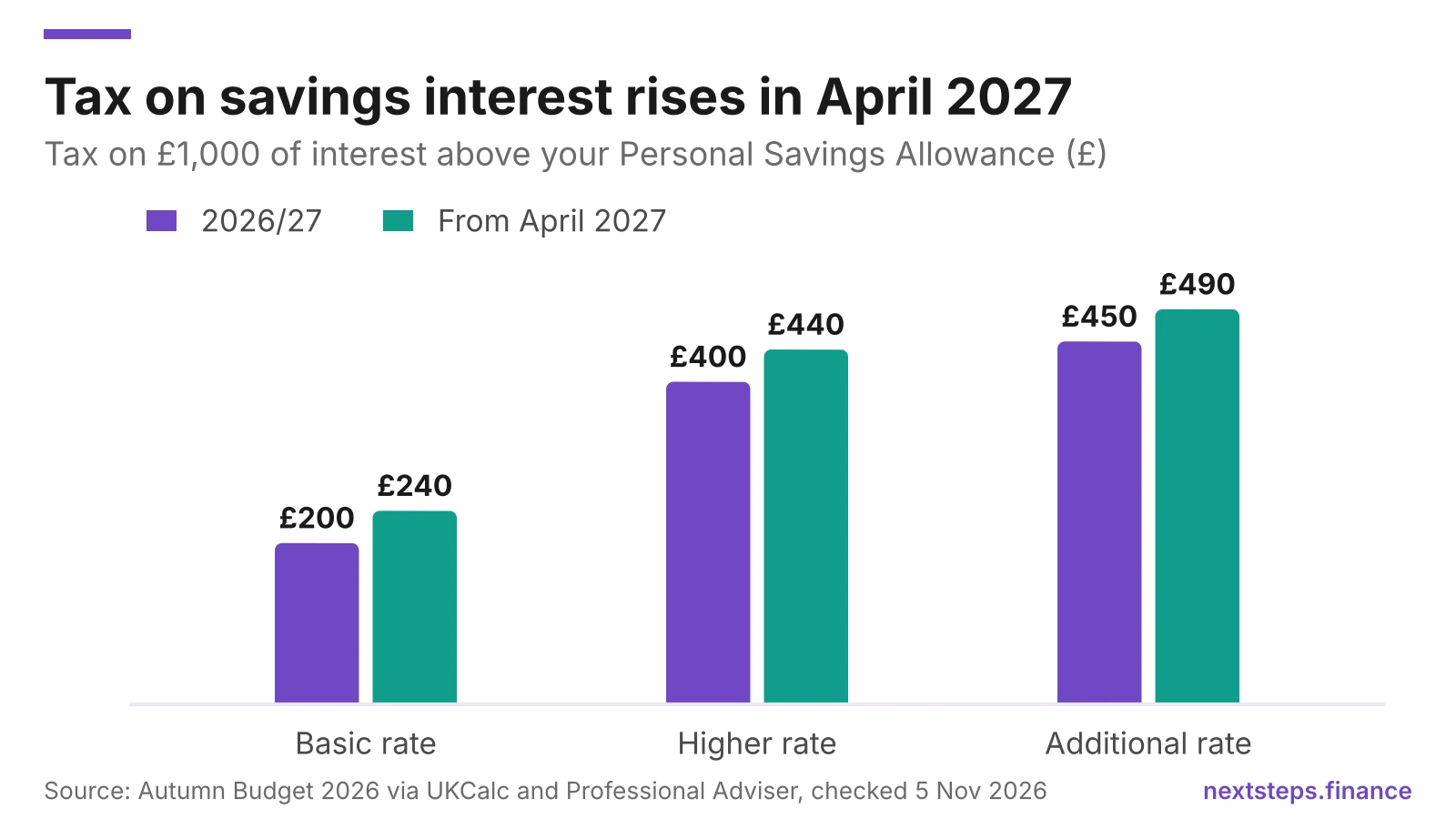
- Savings tax rises from 6 April 2027 to 24% for basic-rate, 44% for higher-rate and 49% for additional-rate taxpayers, up from 20%, 40% and 45% (UKCalc).
- The Personal Savings Allowance is unchanged: £1,000 of interest a year for basic-rate taxpayers, £500 for higher-rate and £0 for additional-rate.
- The Cash ISA limit stays at £20,000 a year after the Budget scrapped the planned cut.
- Top rates are close: the best easy access account paid 4.57% on 4 November, and the Plum Cash ISA pays 4.66% tax-free.
How does the rate rise change the Cash ISA decision?
Higher rates mean you earn more interest on the same balance, so you hit your Personal Savings Allowance (PSA) sooner. Once you're over it, every extra pound of interest is taxed, and from April 2027 it's taxed more heavily.
Here's roughly how much you can hold in an ordinary savings account before going over your PSA, at different rates:
| Savings rate | Basic rate (£1,000 PSA) | Higher rate (£500 PSA) | Additional rate (£0 PSA) |
|---|---|---|---|
| 3.5% | £28,571 | £14,286 | £0 |
| 4.0% | £25,000 | £12,500 | £0 |
| 4.5% | £22,222 | £11,111 | £0 |
| 5.0% | £20,000 | £10,000 | £0 |
So at today's best easy access rates, a higher-rate taxpayer with more than about £11,000 outside an ISA is likely to be paying tax on some of the interest. Fixed-rate bonds can push you over faster, because some pay all the interest at maturity, which can land in a single tax year.
You may also get up to £5,000 of interest tax-free under the starting rate for savings if your other income is low, typically under about £17,570.
What's changing with savings tax in April 2027?
The 28 October 2026 Budget raised the rates of tax on savings income by a further two points on top of the rise already planned, according to Professional Adviser. From 6 April 2027:
| Taxpayer | 2026/27 | From April 2027 |
|---|---|---|
| Basic rate | 20% | 24% |
| Higher rate | 40% | 44% |
| Additional rate | 45% | 49% |
The change still needs to pass through the Finance Bill, but it's government policy. ISA interest stays tax-free, and the PSA stays the same. Our savings tax rise guide has the full detail, and our Cash ISA limit post covers the allowance.
Which pays more after tax?
Compare a Cash ISA with an ordinary account on the rate you actually keep. If your interest is above your PSA, a 4.57% account only pays a higher-rate taxpayer about 2.56% after 44% tax from April 2027. Compare that with a tax-free Cash ISA:
- Amount saved£30,000
- Rate A (AER)4.66%
- Rate B (AER)2.56%
- Months12 months
If you're a basic-rate taxpayer with modest savings that stay under your PSA, the comparison is simply the headline rates, and the best ordinary account may pay a little more. Once you're over the allowance, the ISA usually wins.
Take Action: Add up the interest you're likely to earn this tax year and next across all your accounts (outside ISAs). If it's close to £1,000 (basic rate) or £500 (higher rate), start using a Cash ISA.
Where are the best rates after the rise?
These were among the leading rates on 4 and 5 November 2026. Rates are variable and can change quickly after a Bank decision.
| Account | Rate (AER, variable) | Tax | Notes |
|---|---|---|---|
| Plum Cash ISA | 4.66% | Tax-free | Through the Plum app, all plans |
| Oxbury Bank easy access | 4.57% | Taxable | Top non-bonus rate on Moneyfacts, 4 Nov |
| Trading 212 Cash ISA | 3.85% | Tax-free | Tracks Bank Rate minus 0.15 points |
The Plum Cash ISA paid 4.66% AER (variable) on all plans when checked today, according to Plum's plans page. The Trading 212 Cash ISA follows Bank Rate automatically, so it rose to 3.85% today, according to Trading 212's help centre. Both are cash ISAs, so your money isn't invested. Trading 212 also offers investing products: capital at risk, and the value of investments can go down as well as up.
For the full list, including fixed-rate bonds paying up to 5.40%, see savings rates after the 4% rate rise.
Should you fix your savings now?
If you think rates are close to their peak, fixing part of your savings can lock in today's higher rates for a year or more. Several forecasters expect Bank Rate to peak around 4.25% in early 2027 (see will interest rates rise again?), and the Bank projects inflation falling back towards 2% by late 2028, which would usually bring rates down.
Fixing may suit you if:
- You won't need the money for the fixed term
- You want certainty that your rate won't fall
- You can use a fixed-rate Cash ISA to keep the interest tax-free
Keep an easy access emergency fund first. Our guide to fixed savings rates explains how to decide how much to fix.
Who might choose which?
| Your situation | May suit you |
|---|---|
| Basic-rate taxpayer with savings under about £20,000 | Best ordinary easy access account or a Cash ISA; check both rates |
| Higher-rate taxpayer with over about £11,000 in savings | Cash ISA for savings above that |
| Additional-rate taxpayer | Cash ISA, because you have no PSA |
| Saving towards a first home | A Lifetime ISA may give a 25% bonus (see our Lifetime ISA guide) |
| Want rates to follow Bank Rate | A tracker Cash ISA |
You can open one Cash ISA per tax year from each provider, and split your £20,000 allowance across Cash, Stocks and Shares, Innovative Finance and Lifetime ISAs (up to £4,000 in a Lifetime ISA). Interest in ISAs doesn't count towards your PSA.
If you're unsure how savings fit with your mortgage, debt and pension, our household finances review can help you see the whole picture.
FAQ
Is a Cash ISA worth it after the rate rise to 4%?
For many savers, yes. Higher rates mean more interest, so more people go over their Personal Savings Allowance, and tax on savings interest rises to 24%, 44% and 49% from April 2027. If your interest is likely to exceed £1,000 (basic rate) or £500 (higher rate), a Cash ISA can save tax.
How much can I save before paying tax on interest?
It depends on your tax band and your rate. At 4.5%, a basic-rate taxpayer can hold about £22,000 before using their £1,000 Personal Savings Allowance, and a higher-rate taxpayer about £11,000 before using their £500 allowance. Additional-rate taxpayers have no allowance.
When does the savings tax rise happen?
The new savings tax rates of 24%, 44% and 49% apply from 6 April 2027, following the Autumn Budget on 28 October 2026. They still need to be passed in the Finance Bill. Interest earned in an ISA stays tax-free, and the Personal Savings Allowance is unchanged.
Will Cash ISA rates go up after the Bank of England rise?
Some will. Tracker Cash ISAs, such as Trading 212's, move with Bank Rate automatically. Other variable Cash ISAs may rise if providers choose to pass the increase on, but they don't have to. Fixed-rate Cash ISAs won't change until they mature.
What is the Cash ISA limit for 2026/27?
You can put up to £20,000 a year into ISAs in the 2026/27 tax year, and all of it can go into a Cash ISA. The Budget on 28 October 2026 cancelled the planned cut to a £12,000 Cash ISA limit for under-65s from April 2027.
The bottom line
Today's rate rise and the April 2027 tax rise both push in the same direction: more savers will be taxed on interest, so the Cash ISA is worth more. If you're a basic-rate taxpayer with under about £20,000 saved, compare headline rates. If you're a higher-rate taxpayer, or your savings are growing, sheltering more in a Cash ISA before April 2027 may suit you.
Check how much interest you earned last year, compare the after-tax rate with the calculator above, and use your £20,000 allowance before the tax year ends on 5 April 2027.