
The Bank of England has raised interest rates for the first time in over three years, and savings rates should follow. But your bank doesn't have to pass the rise on, and many savers are still earning well under 3%.
Here's where savings rates stand after the rise to 4%, which accounts move automatically, why a Cash ISA matters more than it did, and what to do this week.
Key takeaways
- Bank Rate rose from 3.75% to 4% on 5 November 2026, with the Monetary Policy Committee voting 8-1. The one dissenter wanted a bigger rise (MoneySavingExpert).
- The top easy access account paid 5.00% AER on 4 November (LemFi, including a 1.89% six-month bonus). Oxbury Bank paid 4.57% with no bonus (Moneyfacts).
- Top fixed rate bonds paid up to 5.40% AER (Afin Bank, five years) on 4 November (Moneyfacts).
- Trading 212's Cash ISA tracks Bank Rate minus 0.15 points, so it should now pay 3.85% AER, and the change applies straight away (Trading 212).
- Tax on savings interest rises to 22%, 42% and 47% from 6 April 2027, which makes tax-free ISA interest worth more (GOV.UK).
Will savings rates go up after the Bank of England rise?
Some will, but not all, and not straight away. Banks set their own savings rates, and nothing forces them to pass on a Bank Rate rise.
The rise was widely expected, so many providers had already priced it in. MoneyWeek's Kalpana Fitzpatrick said "most banks have already priced in the increase in their offerings so you may not see any uplift" (MoneyWeek). That's why fixed rates have climbed for months. Moneyfacts says the average one-year fixed rate rose from 3.90% to 4.44% between the start of April and the start of October 2026, and the average five-year fix from 4.02% to 4.58%.
What happens to your account depends on its type:
| Account type | What happens after the rise | When |
|---|---|---|
| Tracker accounts (e.g. Trading 212 Cash ISA) | Rate moves with Bank Rate automatically | Immediately or within days |
| Ordinary easy access | Bank decides whether to pass on any of the rise | Weeks, after notice, or not at all |
| Old or closed-issue accounts | Often left behind | Rarely improved |
| Fixed rate bonds and ISAs | No change until the fix ends | At maturity |
Moneyfacts warns that savers in closed accounts risk "their loyalty going unrewarded". Its Rachel Springall says they miss out on an extra £139 over three years compared with an easy access account (Moneyfacts).
Take Action: Open your banking app and find the rate on each savings pot. If it's below 4%, you're earning less than Bank Rate itself.
What are the best savings rates now?
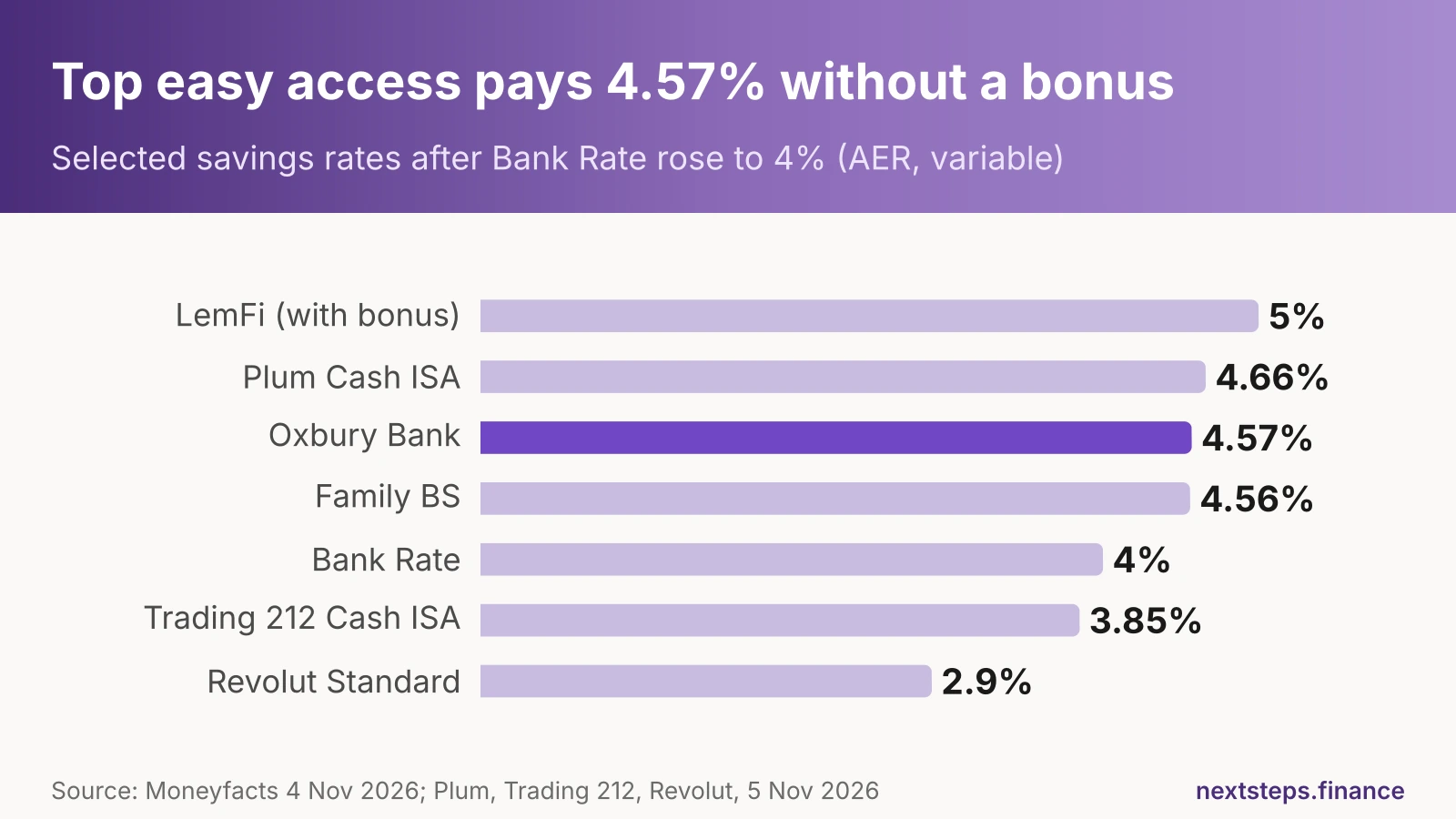
The best easy access rates pay around 4.5% or more, comfortably above inflation of 3.5%. These were the leading rates in Moneyfacts' tables on 4 November 2026, plus the two Cash ISAs we checked today:
| Account | Rate (AER, variable unless stated) | Catch | Link |
|---|---|---|---|
| LemFi easy access | 5.00% | Includes a 1.89% bonus for six months | Moneyfacts |
| Oxbury Bank easy access | 4.57% | No bonus | Moneyfacts |
| Zopa easy access | 4.56% | Includes a 1.05% bonus for 12 months | Moneyfacts |
| Family Building Society | 4.56% | No bonus | Moneyfacts |
| Plum Cash ISA | 4.66%, tax-free | Through the Plum app | Plum |
| Trading 212 Cash ISA | 3.85%, tax-free | Tracks Bank Rate minus 0.15 | Trading 212 |
| Afin Bank 5-Year Fixed (Issue 15) | 5.40% fixed | Money locked for five years | Moneyfacts |
Bonus rates flatter the headline. LemFi's 5.00% drops once its six-month bonus ends, so note the date and be ready to move again.
Try it with your own numbers:
- Amount saved£10,000
- Rate A (AER)4.57%
- Rate B (AER)2.9%
- Months12 months
On £10,000, moving from 2.90% to 4.57% earns about £167 more a year. For more options, including regular savers, see our best savings accounts guide.
Take Action: If your easy access rate is under 4%, compare it with the table above. Switching usually takes minutes in an app.
What happens to the Trading 212 Cash ISA rate?
Trading 212's Cash ISA is one of the few accounts guaranteed to follow the rise. Trading 212 sets its rate at "0.15% below the BoE's base rate", and its help centre uses this exact example: a 4% base rate gives 3.85% AER.
The rules, from Trading 212's help centre:
- The rate updates "immediately after BoE base rate change", up or down.
- If Trading 212 widens its margin beyond 0.15 points, it gives 14 days' written notice.
- Interest is calculated daily and paid monthly, on the third calendar day of the month.
- The ISA is flexible with instant access.
New customers who open through a promotional link may also get a fixed amount of extra interest on top for a set period, on deposits made in the current tax year (Trading 212). The size and dates of any promotion are shown when you sign up, so check them before you rely on them.
The downside is that 3.85% is below the best easy access accounts and below Plum's 4.66% Cash ISA. Where the tracker helps is if more rises come: if Bank Rate reached 4.25%, the help centre example shows 4.10%. You can open a Trading 212 Cash ISA here. Trading 212 also offers investing. Capital at risk - the value of investments can go down as well as up. Our Trading 212 ISA review covers the rest of the app.
Should you put your savings in a Cash ISA now?
For many savers, yes. Interest in an ISA is tax-free, and tax on savings interest is going up.
GOV.UK confirms the Personal Savings Allowance lets basic-rate taxpayers earn £1,000 of interest tax-free, higher-rate taxpayers £500 and additional-rate taxpayers nothing. From 6 April 2027, interest above that is taxed at 22%, 42% and 47%, up from 20%, 40% and 45%.
At 4.57%, a higher-rate taxpayer uses up the £500 allowance on about £10,940 of savings. A basic-rate taxpayer reaches the £1,000 limit at about £21,880. Above those amounts, look at what you actually keep:
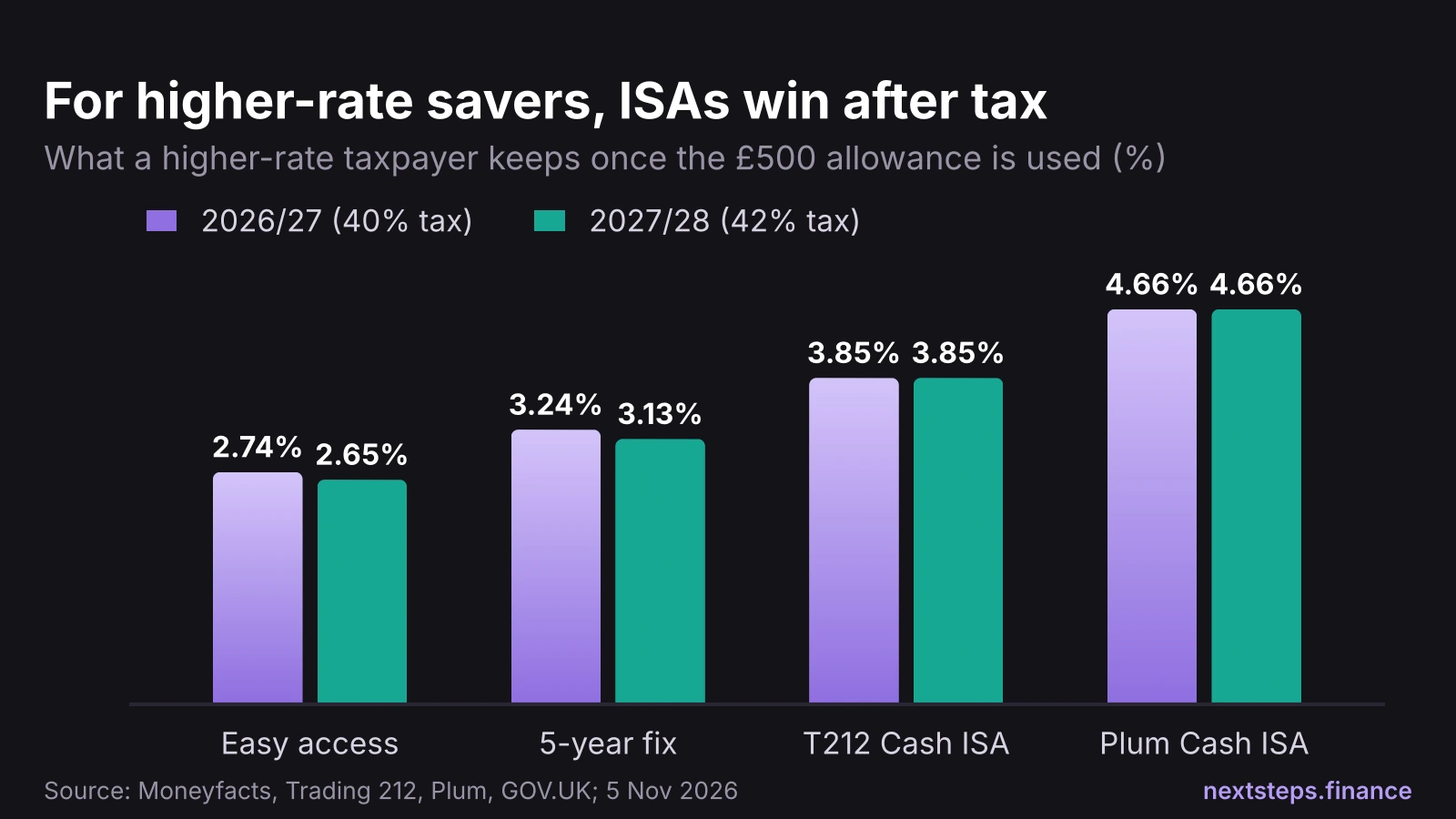
Once the allowance is used up, a higher-rate taxpayer would need an ordinary account paying about 6.4% to match a 3.85% ISA. A basic-rate taxpayer would need about 4.8%, or about 4.9% from April 2027. The £20,000 yearly ISA allowance applies, and the Cash ISA limit is staying at £20,000, as covered in our Budget 2026 Cash ISA explainer.
Take Action: If your interest is close to your Personal Savings Allowance, move savings into a Cash ISA before the tax rise. Read our guide to the April 2027 savings tax rise for worked examples.
Should you fix your savings now or wait?
It depends on whether you think rates will keep rising. Fixing now locks in today's 5%+ rates, but you'd miss out if rates climb further.
The signals point to more rises. Governor Andrew Bailey said the rise "shouldn't be seen as the first in an inevitable long sequence of hikes", but added that "unless the conflict in the Middle East is resolved, neither does it seem likely to be the last increase". MoneyWeek reports that the MPC expects inflation to rise to 5% by the middle of 2027. AJ Bell's Sarah Coles said the market is pricing in another rise "as early as February" (MoneySavingExpert).
A split approach may suit you if you're unsure:
- Keep an emergency fund in easy access (see our emergency fund guide).
- Fix money you won't need for one to two years, so you're not locked in for long if rates rise.
- Only fix for five years at 5.40% if you're sure you won't need the money. Early access is usually not allowed.
Our earlier post on fixed savings rates topping 5% explains the trade-offs in more detail. If you're unsure what fits your circumstances, a personal finance review can help.
When is the next Bank of England decision?
The next decision is on Thursday 17 December 2026, and the first of 2027 is on Thursday 4 February 2027 (Bank of England).
Forecasters see February as the likeliest date for the next move. ICAEW's Suren Thiru said a February rise looks "increasingly likely" (MoneyWeek). If you have a mortgage, see what the rise means for you in our Bank of England rate rise explainer and mortgage rates guide.
Frequently asked questions
Will my savings rate go up automatically?
Only if your account tracks Bank Rate, like Trading 212's Cash ISA, which moved to 3.85% after the rise to 4% on 5 November 2026. Most easy access accounts are set by the bank, which can raise them later, by less, or not at all. Fixed rate accounts stay the same until they end.
What is the best savings rate in the UK right now?
On 4 November 2026, Moneyfacts listed LemFi at 5.00% AER for easy access, including a 1.89% six-month bonus, and Oxbury Bank at 4.57% with no bonus. Top fixed rate bonds paid up to 5.40% AER for five years. Plum's Cash ISA paid 4.66% AER on 5 November.
Is it worth moving savings after the interest rate rise?
Usually, if you're earning less than 4%. On £10,000, moving from 2.90% to 4.57% earns about £167 more a year before tax. Check for withdrawal limits, bonus periods and whether you're near your Personal Savings Allowance, in which case a Cash ISA may leave you with more.
How much interest can I earn before paying tax?
Basic-rate taxpayers can earn £1,000 of savings interest a year tax-free, higher-rate taxpayers £500 and additional-rate taxpayers nothing, according to GOV.UK. Some people with low other income also get a starting rate for savings of up to £5,000. Interest earned inside an ISA doesn't count.
Should I fix my savings before rates rise again?
Fixing locks in today's rate, up to 5.40% for five years on 4 November 2026, but you'd miss out if rates keep rising. Markets expect another rise as early as February 2027. Many savers split their money: easy access for emergencies, and one- or two-year fixes for cash they won't need.
The bottom line
The rise to 4% is good news for savers, but only if you act on it. Accounts tracking Bank Rate, like the Trading 212 Cash ISA, move automatically, while many high street accounts won't change at all.
Check your rates today. Move anything earning under 4%, use your ISA allowance before tax on interest rises in April 2027, and only fix money you're sure you won't need. To see how much you can save each month in the first place, try our UK Budget Planner.