
The rules change for deaths on or after 6 April 2027, about five months away. Until then, most pensions sit outside your estate. After that date, your personal representatives will have to value your pensions, add them to everything else you own, and pay any inheritance tax (IHT) within six months. The 28 October 2026 Budget confirmed there's no reprieve.
Key takeaways
- Start date: the change applies to deaths on or after 6 April 2027. It became law in the Finance Act 2026, which received Royal Assent on 18 March 2026, according to HMRC's technical note.
- Who's affected: HMRC estimates that in 2027-28 10,500 estates will pay IHT for the first time and about 38,500 will pay more, with the average bill rising by around £34,000.
- Double tax at 75+: if you die aged 75 or over, your beneficiary pays income tax on what's left after IHT. That can leave them just £33,000 of every £100,000 inherited.
- Still exempt: pensions left to a spouse, civil partner or charity, death-in-service benefits and dependants' scheme pensions.
- Allowances frozen: the £325,000 nil-rate band and the residence nil-rate band are fixed until April 2031.
What is changing with pensions and inheritance tax in April 2027?
From 6 April 2027, unused pension funds and most death benefits will be added to your estate when IHT is worked out. HMRC's policy paper says the measure "will take effect in respect of deaths on or after 6 April 2027". If someone dies before that date, the current rules apply.
Today, most defined contribution pensions (workplace pensions, personal pensions and SIPPs) pass outside your estate because the scheme pays them at its discretion. GOV.UK still says you "do not usually pay Inheritance Tax on a lump sum because payment is usually 'discretionary'". That is what ends in April 2027.
The change covers registered UK schemes and qualifying overseas schemes. For long-term UK residents, it applies wherever the scheme is based.
The Budget on 28 October 2026 left the policy in place. Law firm Osborne Clarke notes "there was no reprieve on this measure". The Budget instead added technical tweaks, covered below. See our Budget 2026 summary for the wider changes.
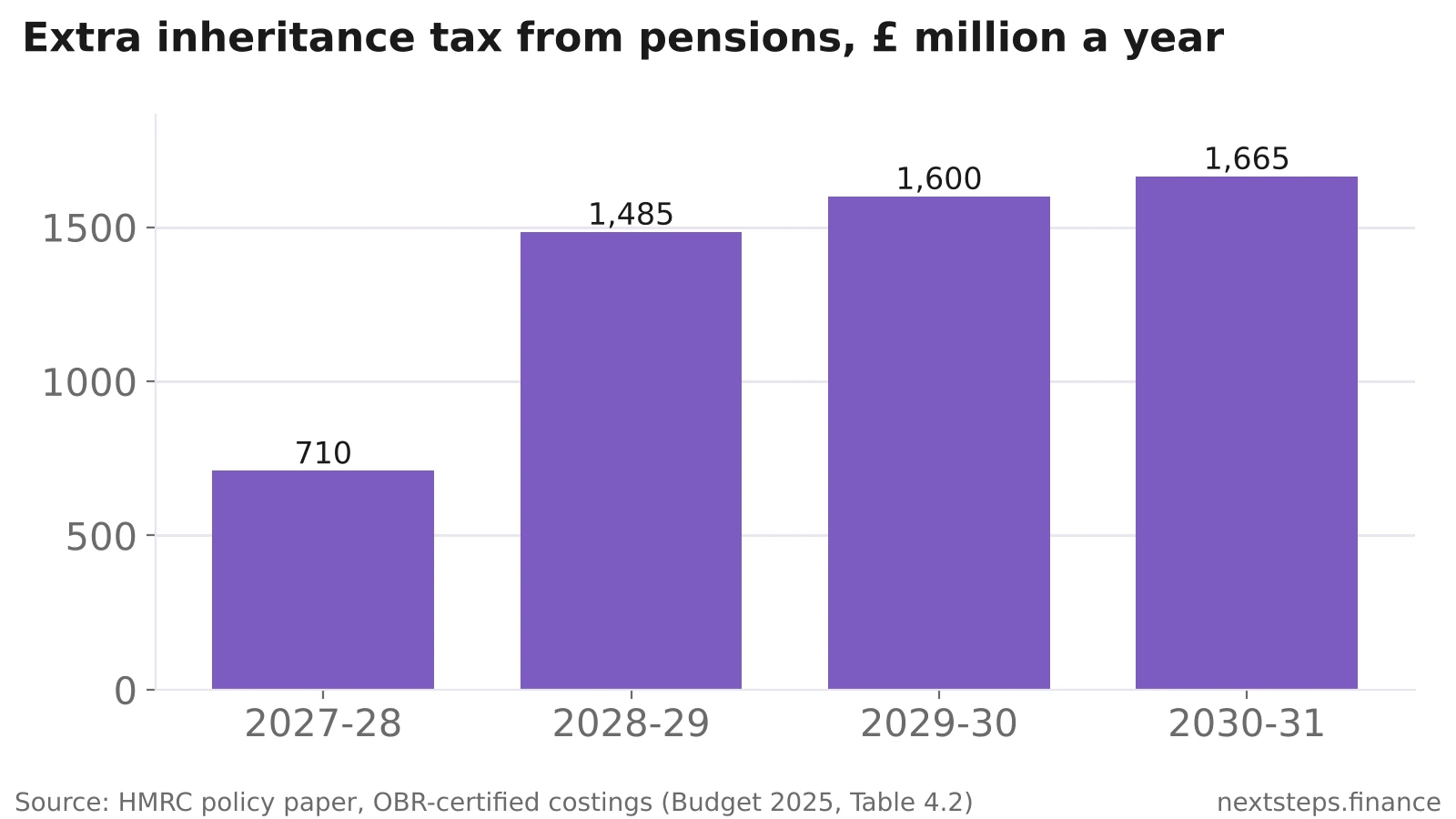
HMRC expects the change to raise almost £1.5 billion in 2028-29, its first full year, rising to £1.665 billion by 2030-31.
Which pensions are exempt from inheritance tax?
Some pension money stays outside IHT completely. The exclusions and exemptions in HMRC's technical note are:
| Pension or benefit | IHT from April 2027? | Notes |
|---|---|---|
| Unused DC pot (workplace, personal pension, SIPP) | Yes | Added to your estate |
| Lump sum death benefits | Yes | Unless excluded below |
| Left to a spouse or civil partner | No | Spouse exemption applies |
| Left to a charity | No | Charity exemption applies |
| Death-in-service benefit from your current job | No | Excluded, e.g. "3 times the salary" |
| Refund of contributions from a past job | Yes | Deferred benefits aren't excluded |
| Dependants' scheme pension (e.g. widow's pension from a final salary scheme) | No | Excluded, but taxed as income |
| Joint-life annuity bought with your own annuity | No | Excluded |
Two details catch people out. First, death-in-service cover only escapes IHT if it comes from the job you held immediately before death. Second, the spouse exemption only defers the tax. When the surviving partner dies, whatever's left in their estate is assessed then.
Take Action: ask each pension provider for a statement showing your current value and who you've nominated. Many people have pots from old jobs they've forgotten about.
How much inheritance tax will be paid on my pension?
Your pension is taxed at 40% only on the part of your estate above your tax-free allowances. GOV.UK sets the standard threshold at £325,000. You can pass a home to children or grandchildren and raise your threshold to £500,000, as long as your estate is worth less than £2 million (GOV.UK). That extra £175,000 is the residence nil-rate band (Fidelity).
Married couples and civil partners can pass on unused allowances, so many couples can leave up to £1 million free of IHT once both have died. Both nil-rate bands are frozen until April 2031, according to the Budget 2025 document reported by Professional Adviser.
The £2 million problem
Adding a pension can push an estate over the £2 million mark. Above that figure the extra home allowance starts to be withdrawn, so a large pension can cost more than 40% of its own value in practice. If your home, savings and pensions together come close to £2 million, this is worth modelling with an adviser.
What is the 67% pension tax trap?
The "67% trap" is the combined effect of IHT and income tax when someone dies aged 75 or over. GOV.UK confirms that if the pension owner was 75 or over, income tax is "deducted by the provider" from what the beneficiary receives. From April 2027, IHT is charged first.
HMRC's technical note says the part of the pension used to pay IHT "does not count towards the beneficiary's taxable income". So income tax is charged on the 60% that's left. Here's what a beneficiary keeps from a £100,000 pension when the nil-rate bands are already used up:
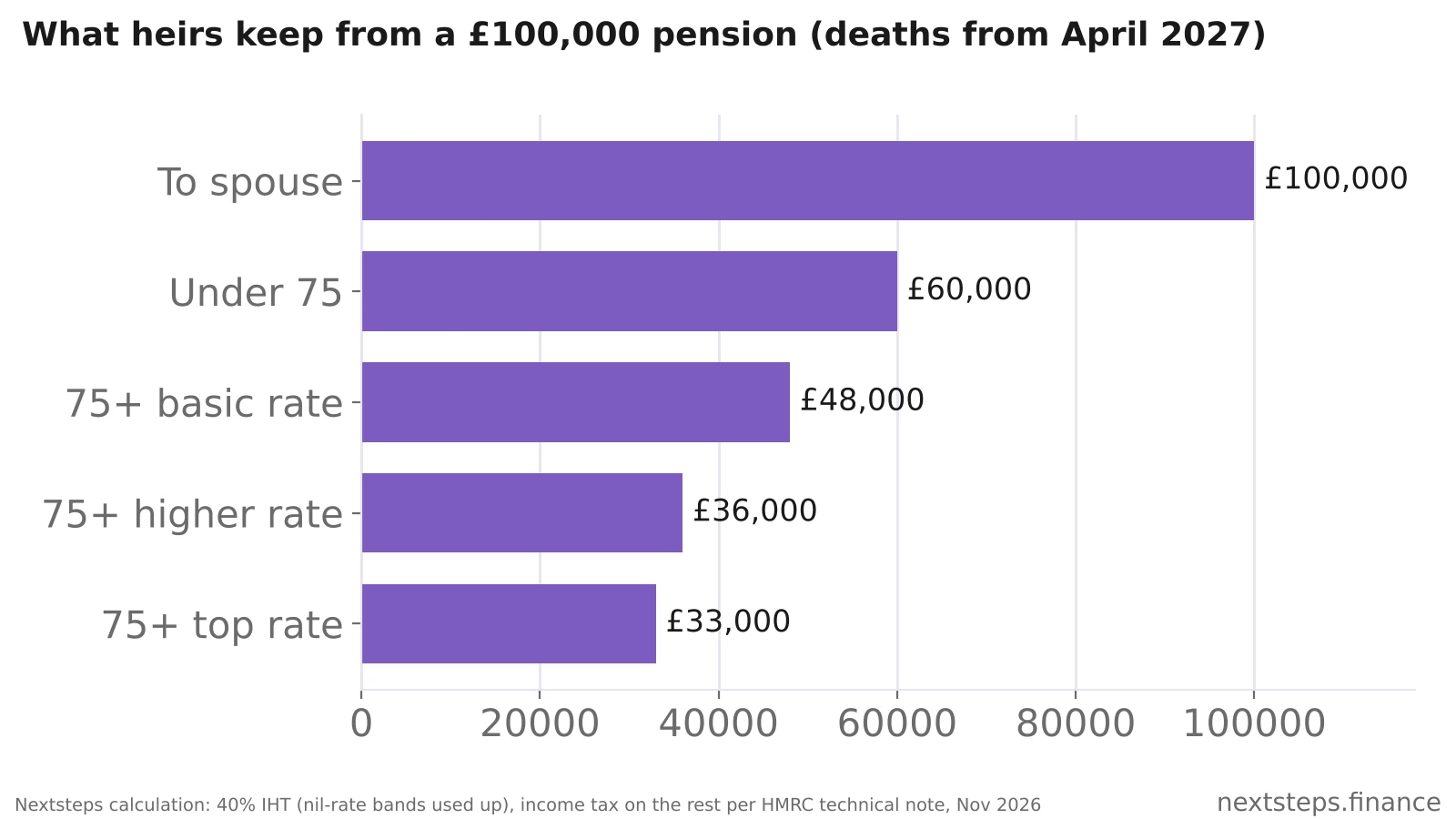
| Who inherits £100,000 | IHT at 40% | Income tax | They keep | Effective tax |
|---|---|---|---|---|
| Spouse (death under 75) | £0 | £0 | £100,000 | 0% |
| Child (death under 75) | £40,000 | £0 | £60,000 | 40% |
| Basic-rate child (death 75+) | £40,000 | £12,000 | £48,000 | 52% |
| Higher-rate child (death 75+) | £40,000 | £24,000 | £36,000 | 64% |
| Additional-rate child (death 75+) | £40,000 | £27,000 | £33,000 | 67% |
These match the worked figures from MoneyWeek. In real life, a big lump sum can push a beneficiary into a higher band in the year they take it, so drawing an inherited pot over several tax years can cut the income tax.
Who pays the inheritance tax on a pension, and when?
Your personal representatives (executors) are responsible for reporting and paying any IHT on your pensions. The pension scheme normally isn't liable. IHT is due by the end of the sixth month after the death, and interest runs after that.
HMRC's technical note gives executors two new tools:
- Withholding notice: executors can tell a scheme to hold back up to 50% of the death benefits for up to 15 months after the end of the month of death. This stops the money being paid out before the tax is known.
- Payment notice: executors, or each beneficiary, can ask the scheme to pay IHT straight to HMRC. The notice must be for at least £1,000 and an exact amount, and the scheme must pay within 35 days.
The Budget on 28 October 2026 added a third change. For payments made on or after that date, lump sum death benefits no longer face income tax just because they're paid more than two years after the scheme learns of the death, according to Osborne Clarke. This helps families when probate drags on. Note that the GOV.UK death benefits page still describes the old two-year rule, as the change needs the Finance Bill 2026-27.
Take Action: make sure your executors know where every pension is. A will and a simple list of accounts will save them months.
How can I reduce inheritance tax on my pension?
There's no single trick, but several legitimate steps can help. Which one suits you depends on your age, health, income and what else you own, so get regulated advice for large estates.
- Update your nomination forms. Leaving pensions to a spouse or civil partner keeps them IHT-free on the first death. Leaving some to charity is exempt too.
- Use your gift allowances. Everyone can give £3,000 a year free of IHT. Larger gifts usually fall outside your estate if you survive seven years (MoneyWeek).
- Give from surplus income. Regular gifts from income you don't need, such as a monthly payment into a grandchild's Junior ISA, can be exempt straight away. Keep records.
- Rethink which pot you spend first. Many retirees spent ISAs first to keep pensions for heirs. Some now draw more from pensions instead. ISAs are also in your estate, but heirs don't pay income tax when they take money out of an inherited ISA. Watch your tax band when you draw: going above £50,270 of income means 40% tax.
- Don't stop saving. You still get tax relief on contributions, and you may need the money. MoneyWeek says it's "usually a bad idea to stop or reduce your contributions".
Consolidating old pensions
Tracking down old pots makes your executors' job easier and often cuts fees. If you want a low-cost home for them, InvestEngine offers a SIPP with no account fee (ETF costs apply), from £100, for UK residents aged 18 to 75, and accepts transfers from most major providers. Its SIPP page describes a random referral bonus, which isn't guaranteed and needs £100 invested. Check whether your current scheme has exit fees or guarantees you'd lose before transferring. Capital at risk - the value of investments can go down as well as up. Our InvestEngine review covers the catches. Final salary (defined benefit) pensions are a different matter, and transferring one usually needs regulated advice.
Should I take my pension out before April 2027?
Probably not just to avoid IHT. Taking a large sum out can trigger a big income tax bill now, at up to 45%, and the cash simply joins your estate unless you spend or give it away. Advisers report a surge in clients drawing more from pensions, but the sums only work in some cases.
It can make sense if you're older, have more than you'll need, and plan to give the money away and survive seven years, or give regularly from surplus income. For most people under 75 with an estate below the thresholds, nothing changes in practice. If you're unsure, our personal finance review is a good starting point. Read our UK pension guide for the basics, and our state pension rise guide for what pensioners will get from April 2027.
Frequently asked questions
Will my pension be subject to inheritance tax from 2027?
Yes, for deaths on or after 6 April 2027, most unused pension pots and lump sum death benefits count towards your estate. IHT at 40% is only due on the part of your estate above your allowances, starting at £325,000. Pensions left to a spouse, civil partner or charity are exempt.
Is death-in-service included in inheritance tax from 2027?
No. HMRC's technical note excludes death-in-service benefits payable from your current employment, such as a lump sum of three times your salary. Benefits from a job you'd already left, such as a refund of contributions, aren't excluded and will count towards your estate.
Can I leave my pension to my spouse tax-free?
Yes. Pensions left to a spouse or civil partner stay free of inheritance tax under the spouse exemption. If you die under 75 they also pay no income tax on it. If you die at 75 or over, they pay income tax at their own rate when they draw it.
Who pays the inheritance tax on an inherited pension?
The executors (personal representatives) report and pay it, normally by the end of the sixth month after the death. They can ask the scheme to hold back up to 50% of the benefits while the tax is worked out, and to pay the IHT directly to HMRC using a payment notice. Beneficiaries can also be liable once the money reaches them.
Do I pay income tax and inheritance tax on an inherited pension?
Only if the person who died was 75 or over. IHT is charged first, then income tax is charged at your marginal rate on what's left. HMRC confirms the part used to pay IHT isn't taxed as income. For an additional-rate taxpayer, that means paying up to 67% overall.
Are the inheritance tax thresholds going up?
No. The £325,000 nil-rate band has been frozen since 2009 and is now fixed, along with the residence nil-rate band, until April 2031. That means more estates will pay IHT as pension and house values grow.
What should you do now?
Pensions become part of your estate for deaths from 6 April 2027, so the next five months are a good time to get organised. Start with three things: find every pension and check its value, update your nomination forms, and add your pensions to a rough estate total. If that total is near £1 million for a couple, or £2 million for anyone, take regulated advice. For more on the wider picture, see our inheritance tax planning guide and how the Budget changed savings tax.