
So, are house prices falling? On the latest figures, gently, and not everywhere. Lloyds' index, published on 6 November 2026, recorded the steepest annual drop in three years, the day after the Bank of England raised Bank Rate to 4%. Nationwide's index shows prices flat in October and growth slowing to its weakest since January 2024.
For buyers, a small price fall doesn't automatically mean a cheaper home, because mortgage rates have risen faster than prices have fallen. Here's what the numbers say, where prices are dropping, and what it means for you.
Key takeaways
- Lloyds: average UK house price £296,285 in October 2026, down 0.6% in the month and 1.2% in a year (Lloyds House Price Index, 6 November 2026).
- Nationwide: average price £273,566, unchanged on the month, with annual growth slowing to 0.5% from 0.8% in September (Nationwide).
- London prices are down 3.1% in a year, and the South East, South West and Eastern England are down 2.3% to 2.4%. Northern Ireland is up 4.4% and Scotland 2.8%.
- Mortgage rates are the bigger story: Moneyfacts put the average two-year fix at 5.87% and five-year fix at 6% at the start of November, before the Bank Rate rise to 4% (City AM).
- A 1.2% price fall on an average home saves about £3,560, but a 0.25-point rise in your mortgage rate costs about £41 a month on a 90% mortgage.
If you're buying, the UK Budget Planner helps you see how much you can afford each month, which matters more than the headline price: try the UK Budget Planner.
Are house prices falling in the UK right now?
Yes, on the Lloyds measure. The Lloyds House Price Index shows the average UK home fell by £1,882 in October to £296,285, a monthly drop of 0.6%. Prices were down 0.5% over the quarter and 1.2% over the year.
Lloyds called it "the biggest annual fall since October 2023". Nationwide's October figures are softer: prices were unchanged in October and annual growth slowed to 0.5%, the weakest since January 2024.
| House price index | Average price | Monthly change | Annual change |
|---|---|---|---|
| Lloyds (October 2026) | £296,285 | -0.6% | -1.2% |
| Nationwide (October 2026) | £273,566 | 0.0% | +0.5% |
The two indices use different data and methods, so their averages aren't directly comparable. Both are based on mortgage approvals rather than completed sales, so they're early signals. What they agree on is direction: the market has stalled and is drifting lower.
Take Action: don't read too much into one month. Watch the next Lloyds release on 7 December 2026 to see whether the fall continues.
Why are house prices falling?
House prices are falling mainly because borrowing has become more expensive. Mortgage rates rose through the autumn as markets priced in higher Bank Rate, and the Bank of England duly raised rates to 4% on 5 November 2026, its first increase since mid-2023.
Andrew Assam, Mortgages Director at Lloyds, said "renewed inflationary pressures, driven in part by the conflict in the Middle East, are keeping borrowing costs high". Nationwide's Chief Economist Robert Gardner pointed to "mounting financial market expectations of Bank Rate increases" pushing up the market rates that mortgages are priced from, and said "new buyer enquiries remain weak".
There are three linked pressures:
- Higher mortgage rates. The average two-year and five-year fixes were both around 6% at the start of November. Our guide to why mortgage rates hit a three-year high explains the swap-rate mechanics.
- Inflation. With inflation forecast to approach 5%, household budgets are squeezed and lenders' affordability tests are tighter. See how to protect your budget as inflation heads to 5%.
- Weaker confidence. Propertymark's Nathan Emerson said the base rate rise "will continue to weigh on consumer confidence" (ITV News).
Where are house prices falling the most?
House prices are falling most in London, where the Lloyds average is down 3.1% in a year to £524,892. That's roughly £16,800 less than a year ago. The South East, South West and Eastern England have each fallen by between 2.3% and 2.4%.
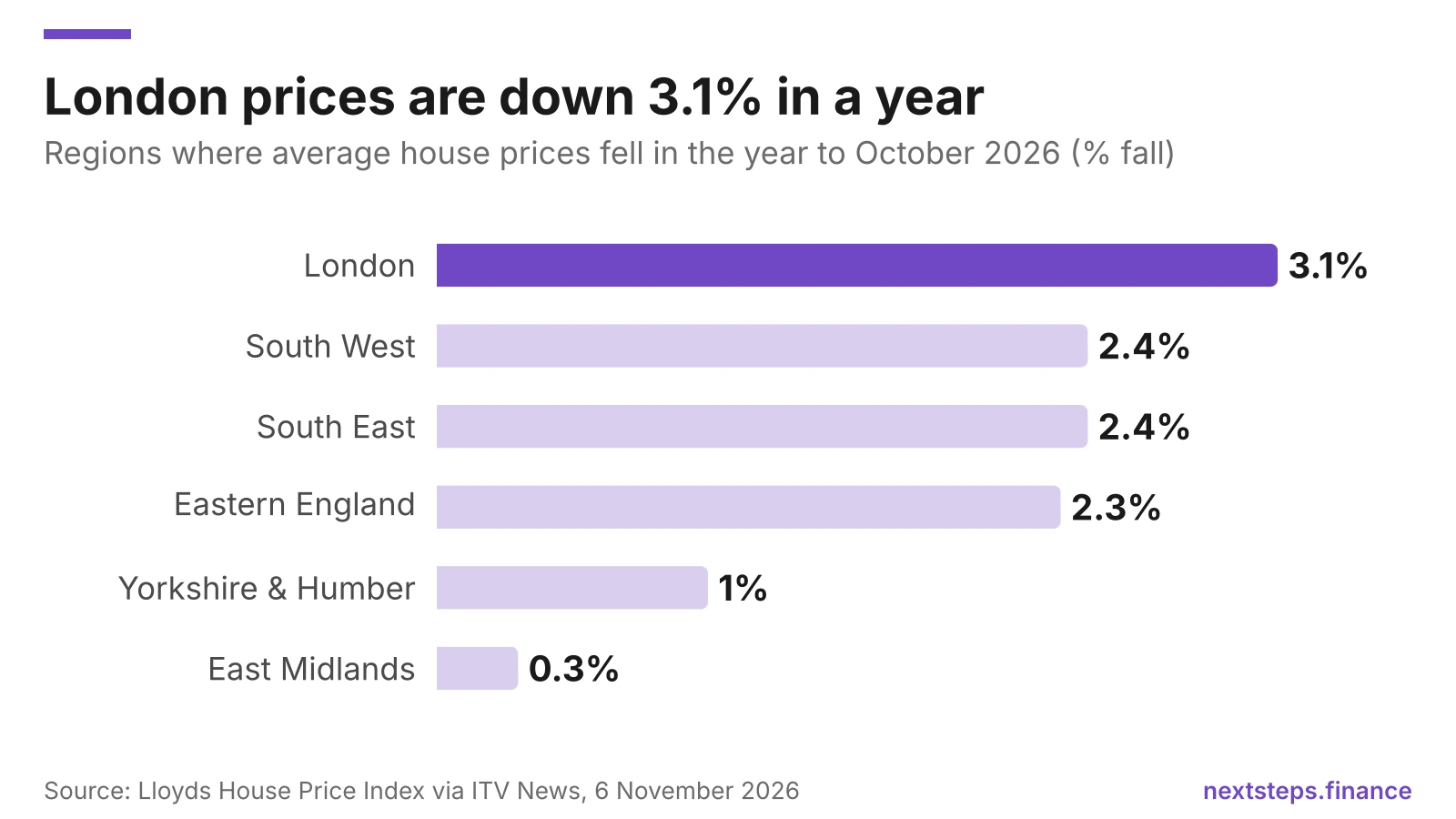
Further north, prices are still rising. These are the Lloyds regional figures, based on the latest three months of mortgage approvals:
| Region | Average price | Annual change |
|---|---|---|
| Northern Ireland | £228,708 | +4.4% |
| Scotland | £222,667 | +2.8% |
| North West | £249,916 | +2.2% |
| North East | £184,318 | +2.0% |
| Wales | £233,116 | +1.6% |
| West Midlands | £261,656 | +0.3% |
| East Midlands | £244,426 | -0.3% |
| Yorkshire and the Humber | £214,485 | -1.0% |
| Eastern England | £327,241 | -2.3% |
| South East | £379,258 | -2.4% |
| South West | £298,057 | -2.4% |
| London | £524,892 | -3.1% |
Source: Lloyds House Price Index via ITV News, 6 November 2026.
The pattern makes sense. The most expensive areas need the biggest mortgages, so they feel rate rises first. Cheaper regions, where prices are lower relative to wages, have held up.
Is now a good time to buy a house?
It may be a better time to negotiate, but not necessarily a cheaper time to borrow. A 1.2% fall in price is small next to the rise in mortgage rates over the past year.
Here's the trade-off on an average Lloyds-index home of £296,285 with a 10% deposit, a £266,657 mortgage over 25 years:
| Scenario | Effect |
|---|---|
| Price 1.2% lower (£292,730) | About £3,560 off the price and about £20 a month off repayments |
| Mortgage rate 0.25 points higher (5.87% to 6.12%) | About £41 a month more in repayments |
| Monthly repayment at 5.87% | About £1,697 |
Nextsteps calculation, repayment mortgage over 25 years, using the Moneyfacts average two-year fixed rate at the start of November.
In other words, a quarter-point rise in rates costs roughly twice as much each month as the saving from a 1.2% price fall. That's why falling prices haven't made homes feel more affordable yet. Try it with your own numbers:
- Mortgage amount£266,657
- Interest rate5.87%
- Term25 yrs
- Monthly overpayment£0
Buyers do have more leverage, though. Iain McKenzie of The Guild of Property Professionals said the figures "should serve as a wake-up call for sellers", and Fine & Country's Nicky Stevenson said "buyers are still motivated to move" (ITV News). In a slower market, offers below asking price are more likely to be considered.
Take Action: get a mortgage agreement in principle before you house-hunt, so you know your real budget. If you're on a fix that ends in 2027, see how much more a tracker costs after the rise to 4% and compare options early.
Will house prices fall further in 2027?
Neither Lloyds nor Nationwide expects a crash. Lloyds' Andrew Assam said "conditions are likely to remain subdued in the near term, but we don't expect this to lead to a sustained period of falling house prices."
Nationwide's Robert Gardner said forward-looking indicators "suggest further softness in the near term", but added that "once the energy shock fades, there are good reasons to believe the market will regain momentum".
Two things support prices. Wages are rising faster than house prices, which Lloyds says should "gradually narrow" the gap and improve affordability. And most homeowners are on fixed rates: UK Finance says 87% of outstanding homeowner mortgages are fixed, which limits forced sales (ITV News). The risk is the 2.3 million fixed deals that UK Finance says expire in 2027, many of which will move to higher rates.
Nobody can predict house prices reliably, so treat any forecast as a range, not a promise. The Bank of England's next decisions and the path of inflation will matter more than anything else.
What do falling house prices mean for first-time buyers?
Falling prices help first-time buyers in two ways: deposits stretch further, and sellers are more willing to negotiate. The catch is that the monthly mortgage cost is higher than a year ago, so affordability checks are tougher.
If you're saving for a first home, a Lifetime ISA is still worth a look. According to GOV.UK, you can use it penalty-free for a first home costing £450,000 or less, as long as the account has been open for at least 12 months and the money goes to your conveyancer. From 29 October 2026, buying above £450,000 costs a 20% withdrawal charge instead of 25% (HMRC policy paper). With London's average at £524,892, that cap still matters. Our guide to the Lifetime ISA penalty cut covers the details.
| Option | Who it may suit | Key condition | Link |
|---|---|---|---|
| Plum Cash Lifetime ISA | First-time buyers aged 18-39 who want cash, not investments | 4.30% AER variable for 12 months, including a 1.19% bonus, then 3.11% | Plum |
| Easy access savings | Anyone buying within 12 months, or over the £450,000 cap | No government bonus; rates vary | Savings rates after the rise to 4% |
Plum's Cash Lifetime ISA pays 4.30% AER (variable) for the first 12 months, including a Plum bonus of 1.19% if you meet the conditions, then 3.11% (Plum, rate from 3 November 2026). Plum's help pages say the bonus depends on when your account is activated, so check the rate shown in the app before you pay in. That's on top of the 25% government bonus of up to £1,000 a year. The downside: you need to have the account open for 12 months before buying, and money taken out for anything other than a first home, retirement at 60 or terminal illness still loses 25%.
Take Action: if you're 18 to 39 and could buy in more than a year, opening a Lifetime ISA now starts the 12-month clock. Plum is one option for a cash LISA.
What do falling house prices mean for sellers and homeowners?
For sellers, it means pricing realistically. With buyer enquiries weak, homes priced at last year's levels in the South are likely to sit on the market. For most homeowners who aren't moving, a 1% to 3% fall changes little, except that it may slightly reduce your equity when you remortgage.
If your loan-to-value is close to a threshold such as 75% or 60%, a small fall could push you into a higher band and a higher rate. Check your estimated value before your fix ends. Landlords face a separate squeeze, with tax on rental profit rising from April 2027: see the landlord tax rise explained.
Take Action: if your fix ends in the next six months, start comparing deals now. Most lenders let you secure a rate up to six months ahead. If your situation is complex, a personal finance review can help you see the full picture.
Frequently asked questions
Are house prices going down in the UK?
Yes, on the Lloyds index. The average UK house price fell 0.6% in October 2026 and 1.2% over the year to £296,285, the biggest annual fall since October 2023. Nationwide's index shows prices flat in October with 0.5% annual growth. Prices are falling in London and the South but rising in Scotland, Northern Ireland and the North.
Why are house prices dropping?
House prices are dropping because mortgages have become more expensive. The Bank of England raised Bank Rate to 4% on 5 November 2026, and average two- and five-year fixed mortgage rates were around 6% at the start of November. Higher inflation is squeezing budgets and affordability tests, and surveyors report weak demand from new buyers.
Will house prices fall in 2027?
Lenders expect a subdued market in the near term but not a long slide. Lloyds said it doesn't expect "a sustained period of falling house prices", and Nationwide expects near-term softness before momentum returns once the energy shock fades. Wages rising faster than prices should help affordability, but forecasts are uncertain.
Where are house prices falling the most?
London has the biggest fall, with prices down 3.1% in the year to October 2026 to an average of £524,892, according to Lloyds. The South East and South West are down 2.4% and Eastern England 2.3%. Northern Ireland (+4.4%), Scotland (+2.8%) and the North West (+2.2%) are still rising.
Should I wait for house prices to drop before buying?
Waiting can backfire, because mortgage rates matter more than small price moves. On a £266,657 mortgage, a 0.25-point rate rise adds about £41 a month, roughly double the saving from a 1.2% price fall. It may suit you to buy when you've found the right home and can afford the monthly payments, and to negotiate hard on price.
Bottom line
UK house prices are falling, but slowly: 1.2% a year on the Lloyds index and flat on Nationwide's. The falls are concentrated in London and the South, while cheaper regions are still rising. For most buyers, mortgage rates around 6% matter far more than a small dip in prices.
If you're planning a purchase, start with the monthly numbers. The UK Budget Planner shows what you can comfortably spend on housing, and our free budget template is a quick way to get started. If you're saving for a first home, a Lifetime ISA such as Plum's adds a 25% government bonus, as long as you can wait 12 months and stay under the £450,000 cap.