
ISA reporting changes 2028 are about what banks, building societies and investment platforms send to HMRC, not a new tax on savings. A policy paper published on 19 November 2026 sets out monthly reporting of ISA subscription events from April 2028, plus reporting of transfers between managers and extra information about investors and accounts. Here is what changes and what you may need to check.
Key takeaways
- Monthly reporting starts on 6 April 2028. ISA managers will report prescribed subscription events and transfers to HMRC each month.
- The National Insurance number rule starts on 6 April 2027. Under the 2025 ISA regulations, an ISA account receiving a subscription needs the investor's number or a declaration that they are not eligible for one.
- The adult ISA allowance remains £20,000. The planned £12,000 cash ISA limit for under-65s will be revoked from 6 April 2027.
- The limit still applies across providers. You remain responsible for tracking new money paid into all your adult ISAs in a tax year.
- ISA returns remain tax-free. The new framework changes administration and compliance, not the tax treatment of money inside an ISA.
What are the ISA reporting changes in 2028?
HMRC is moving ISA managers towards monthly digital reporting so it can identify subscription-limit breaches closer to when they happen. The policy paper, published on 19 November 2026, says providers must report prescribed subscription events, transfers between managers and additional information about investors and their accounts. HMRC expects around 500 ISA managers to be significantly affected.
A subscription is new money paid into an ISA. HMRC defines a subscription event more broadly as an action that changes an investor's current-year subscription position. Paying money in is one example; an adjustment that changes the amount counted towards the allowance can also be reportable.
| What ISA managers will do | What it means |
|---|---|
| Report subscription events monthly | HMRC can compare payments and adjustments more frequently |
| Report transfers between managers | HMRC receives information when an ISA moves between providers |
| Provide more investor and account information | Records can be matched and checked more accurately |
| Submit revised annual returns digitally | The existing annual reporting process is updated |
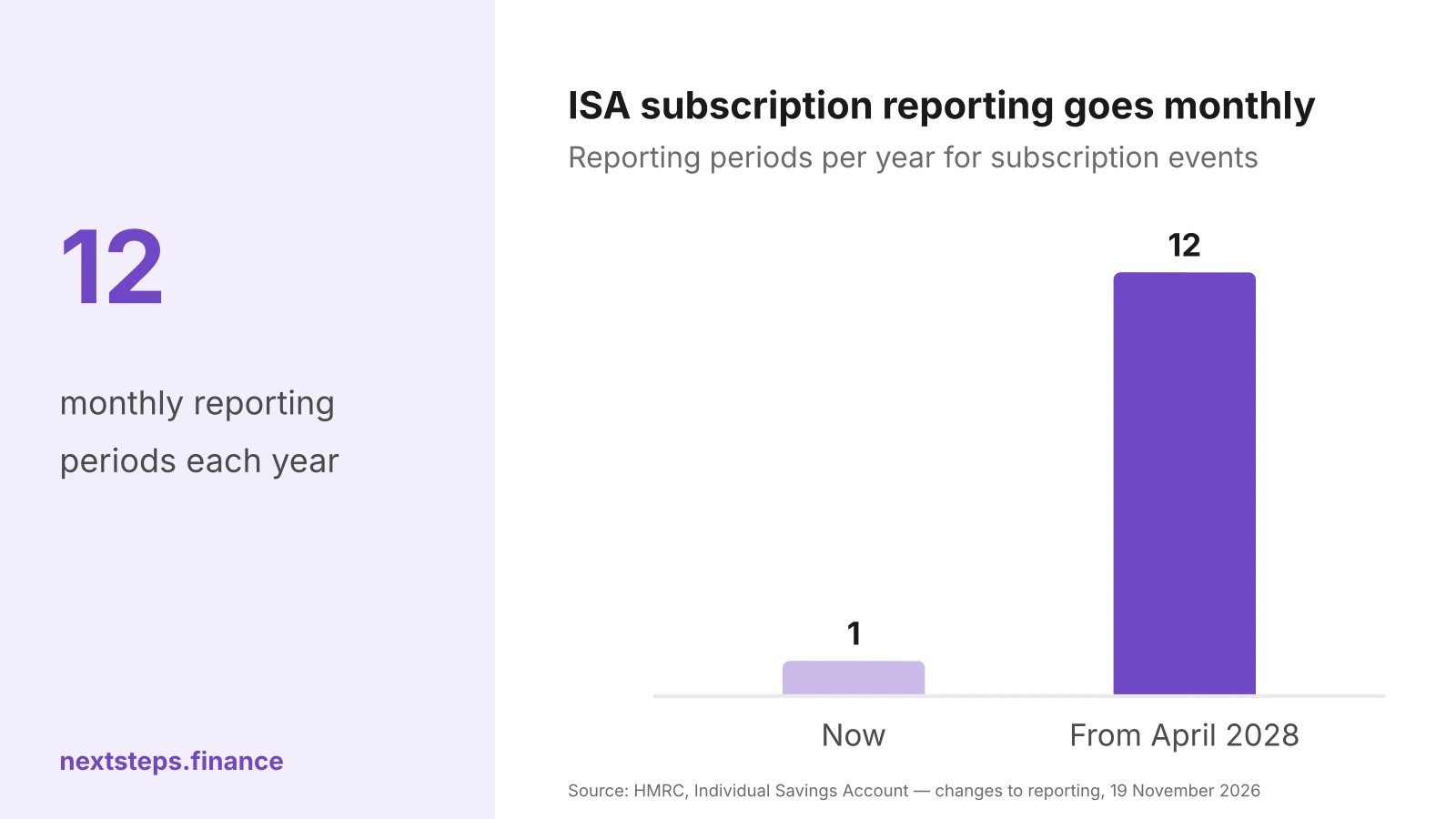
The chart compares reporting periods for subscription information in a year: one annual cycle under the existing arrangement and 12 monthly periods under the new framework. It does not mean every saver will receive 12 letters or that every payment is checked in real time.
HMRC's aim is to find and resolve breaches sooner and reduce retrospective interventions. The policy paper does not yet list every data field or the final technical reporting timetable. Providers will need to update their systems and explain any information they need from customers.
For the wider rules on account types and allowances, see our ISA and Lifetime ISA guide.
When do the ISA reporting changes start?
There are two important dates: the National Insurance number requirement starts in April 2027, while the monthly reporting framework starts in April 2028. They are related parts of modernising ISA administration, but they are not the same change.
| Date | Change | What savers should know |
|---|---|---|
| 6 April 2027 | ISA accounts receiving subscriptions must have a National Insurance number or a declaration of ineligibility | Check that your provider has the right details before paying in |
| 6 April 2027 | The legislation for the planned under-65 cash ISA cap is revoked | The cash ISA limit remains £20,000 within the overall adult allowance |
| 6 April 2028 | Monthly digital reporting of subscription events and transfers begins | Providers report to HMRC; this is not a new monthly filing for savers |
The 2027 National Insurance number date comes from the 2025 ISA amendment regulations and HMRC's current subscription guidance. The latest November 2026 policy paper gives 6 April 2028 as the start of the monthly reporting package.
HMRC's 2025 policy paper described digital reporting as mandatory from 6 April 2027. HMRC's October 2026 tax-free savings newsletter then put the wider compliance reforms and digital ISA reporting at 6 April 2028, which the November paper confirms. The November paper also restates the National Insurance number requirement as part of the 2028 package, including for people who already hold ISAs, so expect providers to ask for missing numbers in the run-up to both dates.
Will HMRC see my ISA balance and investments?
The new rules give HMRC more timely information about subscriptions and transfers; the published policy does not describe a live feed of every ISA balance, holding or investment decision. It is a reporting framework for checking ISA rules, especially the annual subscription limit.
HMRC says managers will report prescribed subscription events, transfers and additional information about investors and accounts. It has not published a complete technical list of fields in the policy note, so it would be wrong to claim that HMRC will receive a real-time view of every saver's portfolio.
The tax treatment of an ISA is unchanged. Under GOV.UK's ISA guidance, interest on cash and income or capital gains from investments inside an ISA remain tax-free. If you complete a tax return, you do not need to declare ISA interest, income or gains on it.
This is about provider records and compliance information, not a new tax on ISA returns. A provider may still contact you if it needs missing information or if a subscription needs correcting.
Do I need a National Insurance number for an existing ISA?
From 6 April 2027, an ISA account receiving a subscription must have the investor's National Insurance number, or a declaration that the investor is not eligible for one. This can affect existing accounts if you continue paying money in.
HMRC's 2025 policy paper says the National Insurance number element has effect from 6 April 2027, and its subscription guidance says that from that date any ISA account receiving a subscription will need a number or a declaration that the investor isn't eligible for one. The November 2026 paper adds that people who are eligible but don't have a number will be expected to apply for one.
If you are eligible but cannot find your number, check a payslip, P60 or letter about tax, pensions or benefits. You can also view it in the HMRC app or Personal Tax Account. GOV.UK explains how to find your National Insurance number.
If you have never been eligible for a number, HMRC's wording allows you to confirm that to the ISA manager. Do not guess or use someone else's number; ask your provider what declaration it accepts.
Is the £20,000 ISA allowance changing?
No. The overall adult ISA subscription limit remains £20,000, and the cash ISA limit will also remain £20,000 for under-65s from 6 April 2027. The reporting changes do not create a second allowance or reduce the amount you can save.
The November policy paper confirms that the regulations which would have cut the cash ISA limit to £12,000 for people under 65 (SI 2026/1018) will be revoked with effect from 6 April 2027. That follows the decision announced at Budget 2026. Our cash ISA limit guide explains the policy change.
The Lifetime ISA limit remains £4,000 a tax year within the overall £20,000 adult allowance. A Junior ISA has a separate limit. The GOV.UK ISA overview sets out the current limits. Our ISA allowance guide covers how the limits work in practice, and our ISA vs pension calculator compares where your next pound could go.
The new reporting framework is not a reason to rush money into an ISA or move an account. If you are deciding between a cash ISA and an ordinary savings account, the choice still depends on your rate, tax position and access needs. Our Cash ISA or savings account guide covers that separate question.
What happens if I pay into multiple ISAs or exceed the limit?
You can pay into more than one ISA of the same type in a tax year, but the £20,000 adult limit is shared across all your subscriptions. Monthly reporting should help HMRC spot an excess sooner; it does not give each provider a separate allowance or remove your responsibility to keep track.
For example, if you pay £8,000 into a cash ISA with one provider and £7,000 into a stocks and shares ISA with another, you have used £15,000 of your £20,000 limit. A further £5,000 of new subscriptions would use the rest. Interest, dividends and investment growth inside the ISA do not use the allowance.
HMRC's current guidance says managers do not need to establish how much you have paid into ISAs held with other managers, and that investors are responsible for not exceeding the overall limit. The new system is intended to make breaches easier to identify after it starts.
A transfer is different from paying in new money. Use the receiving provider's transfer process rather than withdrawing the money yourself and paying it back in. GOV.UK says a properly arranged transfer can move all or part of an ISA without using a fresh annual subscription. Read how ISA transfers work before starting one.
The November 2026 policy paper says the new rules introduce timescales for correcting oversubscriptions and deadlines for complying with HMRC directions to correct subscription errors, but it doesn't give the number of days. If you think you have exceeded the limit, contact the ISA managers involved and follow their correction process; do not assume an informal withdrawal automatically fixes the record.
What should ISA savers do before April 2028?
Most people do not need to change provider or submit a new form to HMRC because of the monthly reporting announcement. The useful preparation is administrative: keep your details accurate, understand how much of your allowance you have used and respond to any request from your ISA manager.
- Find your National Insurance number. Check your payslip, P60, HMRC app or Personal Tax Account before the April 2027 requirement applies to subscriptions.
- Keep a running total of new subscriptions. Record the date, amount, ISA type and provider whenever you pay in.
- Separate transfers from new contributions. Use the formal transfer process and keep the confirmation.
- Read provider messages. Your manager may ask you to confirm personal information or correct an error as its systems are updated.
- Check HMRC guidance nearer the start date. The policy paper says detailed guidance will support implementation.
You do not need to close existing ISAs simply because monthly reporting is coming. If you have a complicated subscription history, a flexible ISA or an oversubscription spanning several tax years, ask the providers involved or a suitably qualified tax adviser how to correct it.
Bottom line: the ISA reporting changes 2028 make providers report subscription information to HMRC more frequently. Check your National Insurance number before April 2027 and continue to treat the £20,000 allowance as one combined limit across your adult ISAs.
This article is general information, not personal tax or investment advice. Check the latest HMRC guidance and your provider's terms before acting on an individual ISA issue.
Frequently asked questions
Will HMRC check my ISA every month?
From 6 April 2028, ISA managers must report prescribed subscription events monthly. This should help HMRC identify excess contributions sooner, but the policy does not describe a live check of every balance or investment. Reports are made by providers, not submitted by savers.
Do I have to tell HMRC how much I pay into my ISA?
No new monthly filing for individual savers is set out in the policy paper. ISA managers report the required information to HMRC. You remain responsible for staying within the overall allowance, so keep your own record of subscriptions across providers.
Do I need to give my National Insurance number to my existing ISA provider?
From 6 April 2027, an ISA account receiving a subscription must have the investor's National Insurance number or a declaration that they are not eligible. If you continue paying into an existing account, check with the provider that its records are complete.
Does transferring an ISA use my annual allowance?
No. A properly arranged transfer of existing ISA money does not count as a new subscription. Start the transfer with the new provider and use its ISA transfer process. Withdrawing the money yourself and paying it into another account is not the same as a formal transfer.
Will the ISA allowance fall to £12,000 in April 2027?
No. The government has decided not to implement the planned £12,000 cash ISA cap for people under 65. The cash ISA limit remains £20,000 from 6 April 2027, within the overall adult ISA allowance of £20,000. The November 2026 policy paper confirms the repeal takes effect on that date.