
The 4.5x mortgage rule UK is back in the headlines because the rules for higher loan-to-income (LTI) lending changed on 28 October 2026. The change gives some lenders more room to make larger loans, but it does not mean every first-time buyer can borrow 4.5, 5 or 6 times their salary.
The important distinction is between a limit on a lender's overall mortgage book and the amount one household can afford. Here is what changed, what stayed the same and how to plan a first-home purchase without relying on a headline multiple.
Key takeaways
- 4.5 times income is the high-LTI threshold, not a legal maximum for an individual borrower. It uses the income assessed by the lender, or the combined income of joint applicants.
- From 28 October 2026, the firm-specific 15% limit was removed. Regulators still aim to keep high-LTI lending across the market consistent with a 15% limit.
- The latest published high-LTI share was 14.1% in 2026 Q2. This is a market statistic for mortgages within the policy's scope, not a personal borrowing allowance.
- Lenders still assess income, spending, credit and future interest-rate risk. A higher permitted lending share does not override an affordability decision.
- The average first-time buyer LTI was 3.6 times income in 2025, according to ONS mortgage statistics. That is an average, not a target or a limit.
What is the 4.5x mortgage rule UK?
Under the PRA's policy, a mortgage is high loan-to-income when the loan is or exceeds 4.5 times the borrower's income. For a joint mortgage, the calculation uses the applicants' joint income. It is a rule for monitoring lenders' overall lending, not a rule that says an individual can borrow no more than 4.5 times salary.
For example, a £180,000 mortgage against assessed annual income of £40,000 has an LTI of 4.5. A £315,000 mortgage against joint income of £70,000 also has an LTI of 4.5. Those loans fall into the high-LTI category; neither example means a lender must approve the application.
The threshold applies to the mortgage amount, not the property's asking price. A £300,000 home with a £30,000 deposit needs a £270,000 mortgage. If the lender assesses joint income at £60,000, that is also 4.5 times income before the rest of the application is considered.
What changed on 28 October 2026?
Before 28 October, each lender in scope generally had its own limit: no more than 15% of its new mortgages could be at or above 4.5 times income. The PRA's final policy statement (PS19/26, published with the FCA on 14 October 2026) removed that firm-specific cap. The new PRA rules and supervisory statement took effect on 28 October 2026, as did the FCA's matching guidance.
The 15% framework has not disappeared. Regulators still aim to keep the aggregate share of high-LTI lending across the market consistent with the Financial Policy Committee's 15% recommendation. While the aggregate stays within that level, individual lenders can go above 15%. If it doesn't, the regulators say they may expect lenders to bring their high-LTI share back towards 15% gradually. A lender planning to go above 15% is expected to tell its regulator, and each lender's share is now measured over a rolling four quarters. This is a market-wide monitoring and adjustment framework, not a promise of extra borrowing for every applicant.
The Bank of England's latest published measure showed high-LTI mortgages made up 14.1% of mortgages within the policy's scope in 2026 Q2, up from 9.7% in 2025 Q3. The Bank also says the regulators have not set any current expectation for lenders to reduce their high-LTI lending. Q2 is the latest published quarter as at 20 November, not a post-change reading or a measure of any one lender's current allowance.
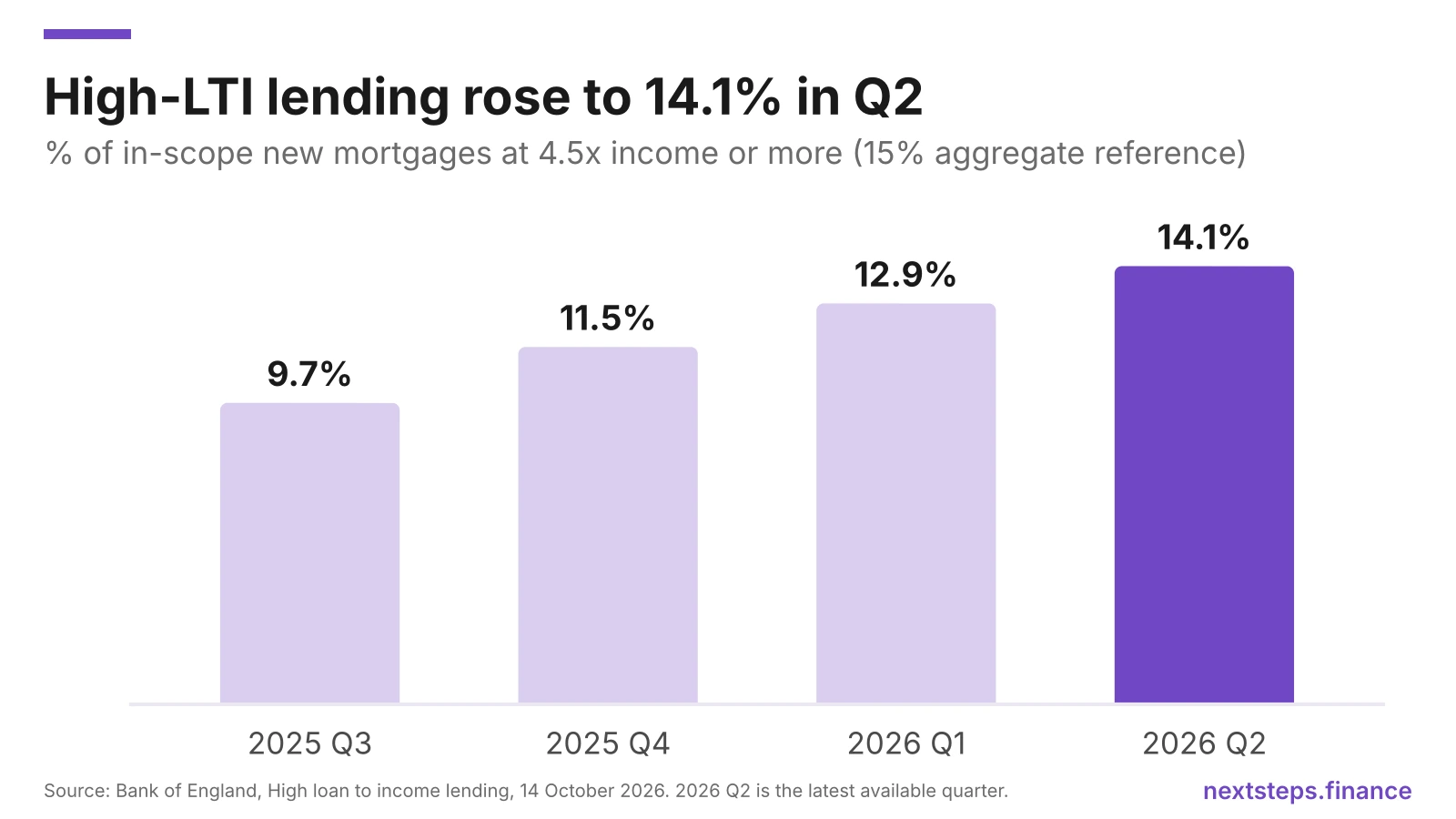
The new policy took effect on 28 October 2026. It changes how lenders manage high-LTI lending overall; it does not require them to increase it or change their individual underwriting criteria.
Does the change mean you can borrow more than 4.5 times your salary?
Possibly with some lenders, but the rule change does not guarantee a larger mortgage. It removes one portfolio constraint on individual lenders; it does not change the lender's view of your income, spending, deposit, credit history or ability to keep up repayments.
The rules have never banned lending above 4.5 times income: they limited how much of it lenders could do. Each lender decides whether it will consider a higher multiple, for whom, and on what evidence. Most people borrow well below it: ONS figures put the average first-time buyer loan-to-income ratio at 3.6 in 2025.
The arithmetic below shows what different multiples mean. It is not a list of lender offers or a recommendation to borrow the largest amount.
| Assessed annual income | 4 times income | 4.5 times income | 5 times income |
|---|---|---|---|
| £40,000 | £160,000 | £180,000 | £200,000 |
| £50,000 | £200,000 | £225,000 | £250,000 |
| £70,000 joint | £280,000 | £315,000 | £350,000 |
A lender may use a different income figure from the salary you first put into a calculator. It decides how to treat bonuses, overtime, commission, variable earnings and self-employed profits, and what evidence it needs. A larger deposit reduces the amount you need to borrow and may move you into a lower loan-to-value band, but it does not automatically make a high LTI affordable.
How do lenders assess mortgage affordability?
Lenders look beyond the income multiple. They need to decide whether the monthly payment is affordable now and whether you are likely to keep paying if your circumstances or interest rates change.
Lenders review your income, outgoings and how secure your work is. Evidence usually includes payslips and bank statements, and self-employed applicants are asked for accounts or tax calculations. Each lender sets its own evidence requirements.
Outgoings can include:
- Credit cards, personal loans and car finance.
- Child maintenance, childcare and school or nursery fees.
- Council Tax, utilities, phone and broadband.
- Service charges, ground rent and other property costs.
- Regular spending such as travel, food, insurance and subscriptions.
For a joint application, the lender assesses both applicants' income and commitments. A second income can increase the amount available on paper, but existing debts, childcare costs or a change in one person's employment can reduce the amount a lender is willing to offer.
Your credit history and deposit matter too. A clean record does not guarantee approval, and a higher deposit does not cancel out unaffordable monthly commitments. The lender's full underwriting decision is more important than a headline 4.5x calculation.
Do mortgage lenders still stress test interest rates?
Yes. The FCA's MCOB 11.6.18R stress-test rule requires lenders to take account of likely future interest-rate increases on affordability for at least five years. If the mortgage contract is shorter than five years, the lender considers its duration. If the initial rate is fixed for five years or more, the FCA says no stress test is required.
The FCA says the rule does not prescribe which rate a lender should use, so there's no universal "plus 2 percentage points". Lenders set their own approach, having regard to market expectations rather than their own rate forecasts. That is why a lender's affordability result can differ from a simple online calculation.
For context, the Bank of England's Money and Credit figures, published on 29 October, put the effective rate on newly drawn mortgages at 4.63% in September 2026, up from 4.60% in August. That is a backward-looking average across new business, not a live rate available to you. A £200,000 repayment mortgage over 25 years at 4.63% would cost about £1,126 a month before fees. At 6.63%, the same loan would cost about £1,367. Use your own lender illustration rather than assuming either rate will be offered.
- Mortgage amount£200,000
- Interest rate4.63%
- Term25 yrs
- Monthly overpayment£0
Check the payment against your wider bills too. Our mortgage rates guide explains why advertised deals and the Bank of England's effective average are not the same thing.
How should first-time buyers plan around the 4.5x rule?
Start with a monthly payment you could manage, then work backwards to a mortgage size. A maximum borrowing figure is not a house budget: you also need the deposit, legal work, survey, purchase tax where applicable, moving costs and money for unexpected repairs.
ONS mortgage statistics show the average first-time buyer loan-to-income ratio was 3.6 in 2025, while the median loan-to-value ratio was 85.6%. The figures are official statistics in development and describe completed mortgage sales, not every person looking to buy. They are useful context, but they do not tell you what a lender will offer today.
A practical planning order is:
- Choose a comfortable monthly payment. Include the mortgage, Council Tax, utilities, insurance, service charges and maintenance, not just the loan repayment.
- Set a deposit target. Compare the cash needed at different loan-to-value levels and keep purchase costs separate from the deposit.
- Check your savings route. A Lifetime ISA may help if you meet its age, account-opening and property-price rules. Our Lifetime ISA guide explains the current withdrawal rules.
- Tell the lender about any family contribution. A genuine gift and a repayable family loan are treated differently. See our gifted deposit mortgage guide.
- Get an agreement in principle and confirm the full application criteria. An agreement in principle is an early indication, not a final mortgage offer.
MoneyHelper's free guide to how much to spend on a mortgage is a good starting point. For the wider buying process, see our UK first-home guide. You can also build a free spreadsheet with your deposit, fees and monthly costs.
If you want those items connected in one place, the UK First-Time Buyer Planner is a paid Google Sheets tool with up to six savings pots, Lifetime ISA tracking, purchase costs for all four UK nations, borrowing scenarios from 4x to 6x income and a 2% rate-rise test.
It handles one or two buyers, but it is not a lender decision or regulated mortgage advice. It does not cover shared ownership, Right to Buy, guarantor mortgages, buy-to-let or buyers who are not UK resident. If one of those applies, or your income is complex, a free spreadsheet and a qualified mortgage adviser may be more suitable.