The cash ISA limit is safe. In his first Budget, Chancellor John Healey scrapped Rachel Reeves's plan to cap cash ISA saving at £12,000 a year for under-65s, so you can keep putting the full £20,000 annual allowance into cash.
The same Budget also put up the tax on savings interest held outside an ISA for the second year running. So the cash ISA isn't just surviving, it's becoming more valuable. Here's what changed, who it helps, and how to use your allowance well before April 2027.
Key takeaways
- The cash ISA limit stays at £20,000 a year for all ages. The planned £12,000 cap for under-65s from 6 April 2027 won't go ahead (GOV.UK Budget 2026).
- The overall ISA allowance is still £20,000. The Lifetime ISA limit is £4,000 and the Junior ISA limit is £9,000.
- Savings tax outside ISAs rises from April 2027 to 24% (basic rate), 44% (higher) and 49% (additional), according to Unbiased's Budget summary.
- A new "starter" ISA for first-time investors is planned, but it's at an early stage with no amounts or dates yet.
- Unused allowance doesn't roll over. The 2026/27 allowance resets on 6 April 2027.
Has the cash ISA limit changed in Budget 2026?
No. The cash ISA limit stays at £20,000, and the cut that was due in April 2027 has been cancelled.
Last year's Budget announced that from 6 April 2027, people under 65 could only put £12,000 of their £20,000 ISA allowance into cash. The rest would have had to go into stocks and shares. The aim was to push more savers into investing.
The Budget document confirms the government is "reversing the planned cut to the cash ISA allowance." MoneySavingExpert reports the £20,000 cash limit will apply to people of all ages, and that it would have been the first cut to the limit since 2017.
| ISA type | Annual limit 2026/27 | After Budget 2026 |
|---|---|---|
| Overall ISA allowance | £20,000 | £20,000 (unchanged) |
| Cash ISA (under 65) | £20,000 | £20,000 (planned £12,000 cut scrapped) |
| Cash ISA (65 and over) | £20,000 | £20,000 |
| Lifetime ISA | £4,000 | £4,000 (to be replaced by a First Time Buyer ISA for new savers from April 2029) |
| Junior ISA | £9,000 | £9,000 |
Take Action: Nothing changes for you right now. If you were planning to rush money into cash before April 2027 to beat the cap, there's no longer a deadline for that.
Why the cash ISA matters more from April 2027
Because the tax on savings interest outside an ISA is going up. A cash ISA keeps all your interest tax-free, whatever your tax band.
From April 2027, interest above your Personal Savings Allowance will be taxed at 24% for basic-rate taxpayers, 44% for higher-rate taxpayers and 49% for additional-rate taxpayers. That's two points higher than the rates last year's Budget had already set for April 2027. Mouthy Money notes the Treasury expects 84% of income taxpayers to be unaffected, mainly because the Personal Savings Allowance covers their interest.
The Personal Savings Allowance is £1,000 of interest a year for basic-rate taxpayers, £500 for higher-rate taxpayers and nothing for additional-rate taxpayers. Once your interest goes over that, the new rates bite. We go through every tax band in our guide to the savings tax rise from April 2027.
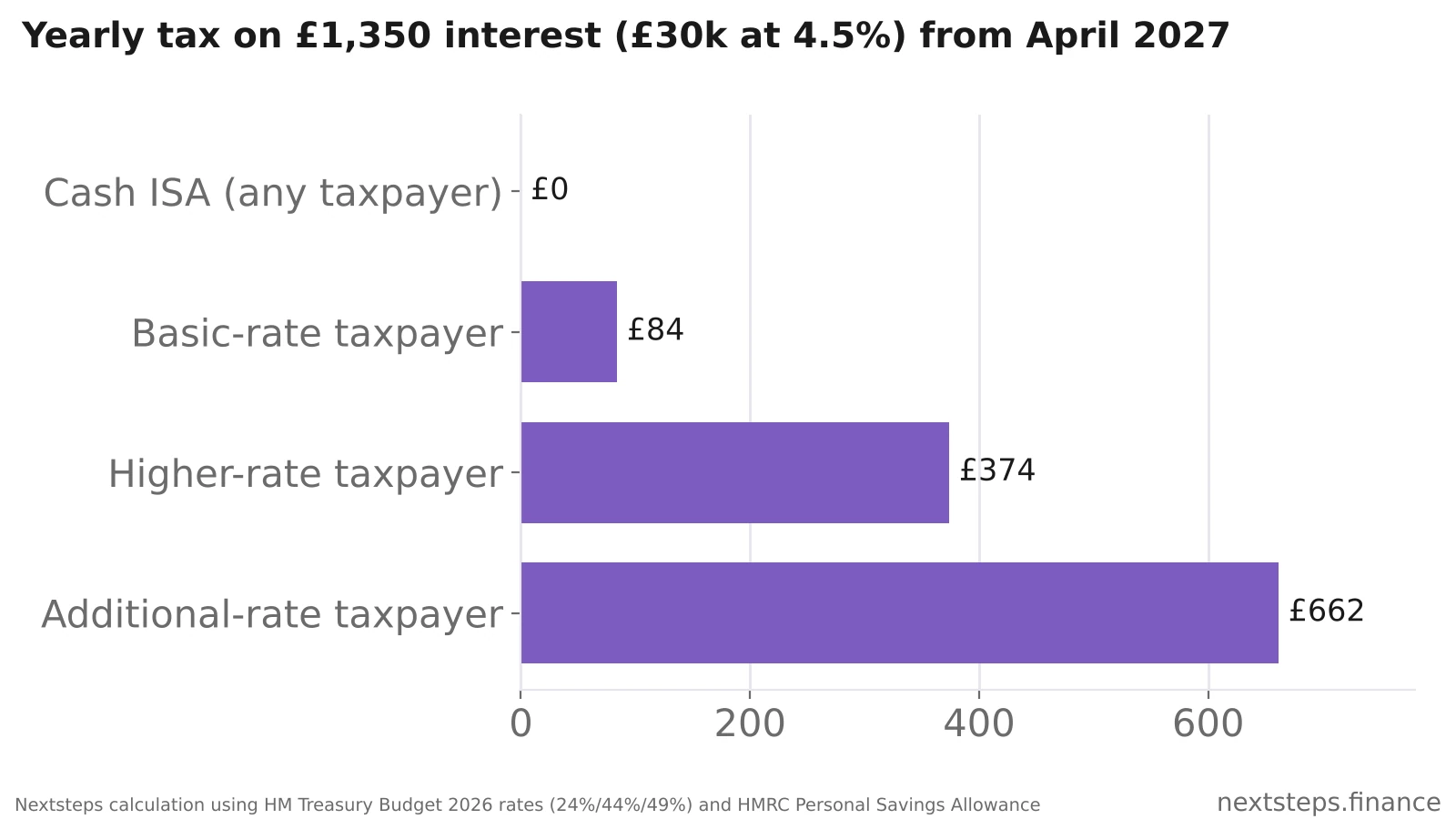
On £30,000 earning 4.5% (an illustrative rate, not a quote), you'd earn £1,350 of interest a year. Held outside an ISA from April 2027, a higher-rate taxpayer would lose £374 of that to tax. In a cash ISA, they keep all £1,350.
Who benefits most from the cash ISA U-turn?
Mainly savers under 65 with larger cash balances, and anyone saving for something in the next few years.
- Higher-rate taxpayers. With only a £500 allowance, it doesn't take much savings for interest to become taxable. At 4.5%, anything over about £11,100 outside an ISA would be taxed at 44% from April 2027.
- People saving for a house deposit or a big purchase. Money you'll need within five years usually belongs in cash rather than the stock market, so a full £20,000 cash allowance helps.
- Cautious savers and those building an emergency fund. You can keep a larger rainy-day pot tax-free. See our emergency fund guide for how much to hold.
- Building societies and borrowers. Building societies rely heavily on savers' deposits to fund mortgages, so the decision is also seen as helping mortgage lending.
Where to put your cash ISA allowance
The best place is usually a competitive easy-access or fixed cash ISA, chosen on rate and on how often you'll need the money. Rates are variable and change often, so check before you open one.
Two app-based options pay well right now, each with conditions worth reading:
| Provider | Cash ISA rate (checked 28 Oct 2026) | Key conditions | Best for |
|---|---|---|---|
| Plum Cash ISA | 4.29% variable, plus a 0.88% bonus for 12 months on money paid in through the app (5.17% total) | Keep at least £100 in. More than 3 withdrawals in a tax year drops the rate to 3.00%. Bonus doesn't apply to transfers in. | New money you won't touch often |
| Trading 212 Cash ISA | Tracks 0.15% below Bank of England Bank Rate (3.60% at today's 3.75% Bank Rate) | Rate moves with Bank Rate. New customers may get a fixed promotional top-up for a period. | Simple tracker rate in an investing app |
Sources: Plum help centre and Trading 212 help centre, 28 October 2026.
A few honest points. Plum's headline 5.17% includes a one-year bonus, so expect the rate to fall back after 12 months. Its withdrawal limit means it's a poor home for an emergency fund you'll dip into. Trading 212's rate will drop if Bank Rate is cut, and the next Bank of England decision is on 5 November. Fixed-rate cash ISAs from banks and building societies can beat both if you can lock money away; our guide to fixed savings rates explains when fixing makes sense.
Take Action: Compare the rate after any bonus ends, check the withdrawal rules, and confirm the account is flexible if you might take money out and put it back in the same tax year.
Cash ISA or stocks and shares ISA?
It depends on when you'll need the money. Cash suits money for the next few years. Stocks and shares suit money you can leave for five years or more.
The government still wants more people to invest. Instead of forcing it with a cash cap, it now plans a carrot: a new starter ISA for first-time investors. International Adviser reports the government will work with the industry to design it, with no incentive amount or launch date announced yet.
You don't have to wait for it. You can split your £20,000 between cash and a stocks and shares ISA in any proportion. Low-cost platforms make a small start easy. For example, InvestEngine offers a stocks and shares ISA with managed portfolios at 0.25% a year plus average ETF costs of about 0.11%, from a £100 minimum (InvestEngine). Capital at risk - the value of investments can go down as well as up. Our best stocks and shares ISA comparison covers the alternatives.
Take Action: Keep your emergency fund and short-term goals in cash, and consider investing money you won't need for at least five years.
What hasn't been decided yet?
Some earlier ISA proposals are still unclear. In June 2026, the previous government proposed a 22% charge on interest from cash held inside stocks and shares ISAs from April 2027, and a ban on moving money from stocks and shares ISAs into cash ISAs for under-65s. MoneySavingExpert says it is checking whether these still go ahead after the Budget.
Until that's confirmed, avoid leaving large sums uninvested as cash inside a stocks and shares ISA for long periods, and keep cash savings in a proper cash ISA.
How to plan your ISA saving before April 2027
Start with your budget, then decide how much to save and where. The order that works for most people:
- Work out what you can save each month. Our UK Budget Planner gives every pound a job and shows how much is genuinely spare.
- Build an emergency fund of three to six months' essential costs in easy-access cash.
- Use your cash ISA for anything above your Personal Savings Allowance, especially if you're a higher-rate taxpayer.
- Invest for the long term in a stocks and shares ISA or your pension.
- Use the 2026/27 allowance before 5 April 2027. It doesn't roll over.
If you'd like a second pair of eyes on how your savings, ISA and pension fit together, our personal finance review walks through your whole picture with a Chartered Accountant.
More Budget 2026 guides
For the full picture of what changed on 28 October 2026, start with our Budget 2026 summary, then dig into the details:
- Savings tax rise from April 2027
- Lifetime ISA penalty cut and the new First Time Buyer ISA
- £100 energy payment: who gets it and when
FAQ
Is the cash ISA limit being cut to £12,000?
No. The Budget on 28 October 2026 cancelled the planned cut. It would have limited under-65s to £12,000 a year in cash from April 2027. Instead, everyone can keep putting up to £20,000 a year into a cash ISA, within the overall £20,000 ISA allowance.
What is the ISA allowance for 2026/27?
The ISA allowance for 2026/27 is £20,000. You can split it across cash, stocks and shares, innovative finance and Lifetime ISAs, but the Lifetime ISA has its own £4,000 limit inside the £20,000. The allowance runs to 5 April 2027 and unused allowance doesn't carry over.
Do I pay tax on cash ISA interest?
No. Interest earned inside a cash ISA is tax-free and doesn't use up your Personal Savings Allowance. That matters more from April 2027, when tax on savings interest outside ISAs rises to 24% for basic-rate, 44% for higher-rate and 49% for additional-rate taxpayers.
Should I move my savings into a cash ISA before April 2027?
It may suit you if your interest is likely to exceed your Personal Savings Allowance of £1,000 (basic rate) or £500 (higher rate). The higher savings tax rates start in April 2027. Using your 2026/27 allowance before 5 April 2027 and your next one after it lets you shelter up to £40,000.
What is the new starter ISA?
It's a planned product to encourage first-time investors, announced in the 28 October 2026 Budget. The government says it will work with the investment industry to design it. No incentive amount, eligibility rules or launch date have been published, so treat early reports as ideas rather than final rules.
Bottom line
The cash ISA limit staying at £20,000 is good news, and the higher savings tax from April 2027 makes it worth using. If your savings interest is near your allowance, moving cash into a competitive ISA such as the Plum Cash ISA or Trading 212's Cash ISA is a simple way to keep more of it. Pensioners should also read how the Budget treats the State Pension rise in April 2027.