
Pension annual allowance carry forward can help if you receive a large bonus, sell a business or want to make a one-off pension payment. You pay into a pension in the current tax year; unused allowance from earlier years is then used when checking whether an annual allowance tax charge applies. It does not backdate a contribution.
The calculation can be more involved if you have several schemes, a defined benefit pension, high income or flexible withdrawals. This guide explains the 2026/27 rules. For the wider picture, see our UK pension guide and pension topic page.
Key takeaways
- The standard pension annual allowance is £60,000 in 2026/27, but taper or MPAA rules can reduce it.
- In 2026/27, the previous three tax years are 2023/24, 2024/25 and 2025/26. The 2022/23 allowance is outside the window.
- You must have been a member of a registered pension scheme in each earlier year you use, but you do not necessarily need to have contributed.
- Use the current-year allowance first, then the oldest available unused allowance.
- Carry forward does not increase the tax-relief limit on your own contributions, normally 100% of relevant UK earnings (or £3,600 gross if higher).
What is pension annual allowance carry forward?
Pension annual allowance carry forward lets you use unused annual allowance from the previous three tax years to increase the amount of pension saving you can make in the current year without an annual allowance tax charge.
The standard annual allowance is £60,000 for 2026/27. It applies across your pension arrangements, not separately to each pot. For a defined contribution pension, the pension input amount generally includes your contributions, employer contributions, third-party payments and basic-rate tax relief added by the provider. For a defined benefit pension, it is based on the increase in the value of your promised benefits, not simply your payslip deductions.
The annual allowance is not the same as the tax-relief limit on personal contributions, and it is not a hard limit on what a scheme can receive. You may pay more, but a tax charge can apply if total pension input exceeds your available allowance. HMRC explains the annual allowance and what counts towards it.
Which pension tax years can you carry forward in 2026/27?
In 2026/27, you can potentially use unused allowance from 2023/24, 2024/25 and 2025/26. The standard allowance was £60,000 in each of those years, although your personal limit may have been lower if taper or MPAA rules applied.
| Tax year | Standard annual allowance | Available to carry into 2026/27? |
|---|---|---|
| 2022/23 | £40,000 | No, outside the three-year window |
| 2023/24 | £60,000 | Yes |
| 2024/25 | £60,000 | Yes |
| 2025/26 | £60,000 | Yes |
| 2026/27 | £60,000 | Current-year allowance |
The allowance rose from £40,000 to £60,000 from the 2023/24 tax year, which began on 6 April 2023. That is why 2023/24 is now the oldest eligible year. The 2023/24 unused amount must be used by 5 April 2027; from 6 April 2027, the window moves on to 2024/25, 2025/26 and 2026/27. See HMRC's pension schemes rates.
You must have been a member of a UK registered pension scheme (or qualifying overseas scheme) at some point in each year you want to use. HMRC's manual says active, deferred, pensioner and pension credit members all count. You do not need to have paid in that year: if you were a member but had no pension input, the full allowance for that year can be carried forward. MoneyHelper's carry forward guide confirms the State Pension does not count as membership. HMRC's guide to checking for unused annual allowances sets out the membership rule.
How do you calculate unused pension allowance?
Compare the allowance that applied to you in each year with your total pension input for that year. Any earlier excess that has already used older unused allowance must also be taken into account.
- Find your allowance for each year. Start with the standard limit, then check whether taper or MPAA changed it.
- Collect pension input amounts for every scheme. Include workplace pensions, personal pensions and SIPPs. Ask providers for figures if your statements do not show them.
- Subtract pension input from the allowance for each year. Do not assume every year had the full standard limit.
- Check for earlier excesses. An excess in one previous year may already have used unused allowance from an older year, reducing what remains.
- Add the eligible remainder to this year's allowance. Use the current-year allowance first, then carry forward from the oldest available year.
Worked example: how the calculation works
Assume someone was a member of a registered pension scheme in all three previous years, had the standard £60,000 allowance and no earlier excess or special rules. Their pension input was £25,000 in 2023/24, £40,000 in 2024/25 and £50,000 in 2025/26.
| Tax year | Allowance | Pension input | Unused |
|---|---|---|---|
| 2023/24 | £60,000 | £25,000 | £35,000 |
| 2024/25 | £60,000 | £40,000 | £20,000 |
| 2025/26 | £60,000 | £50,000 | £10,000 |
| Total to carry forward | £65,000 |
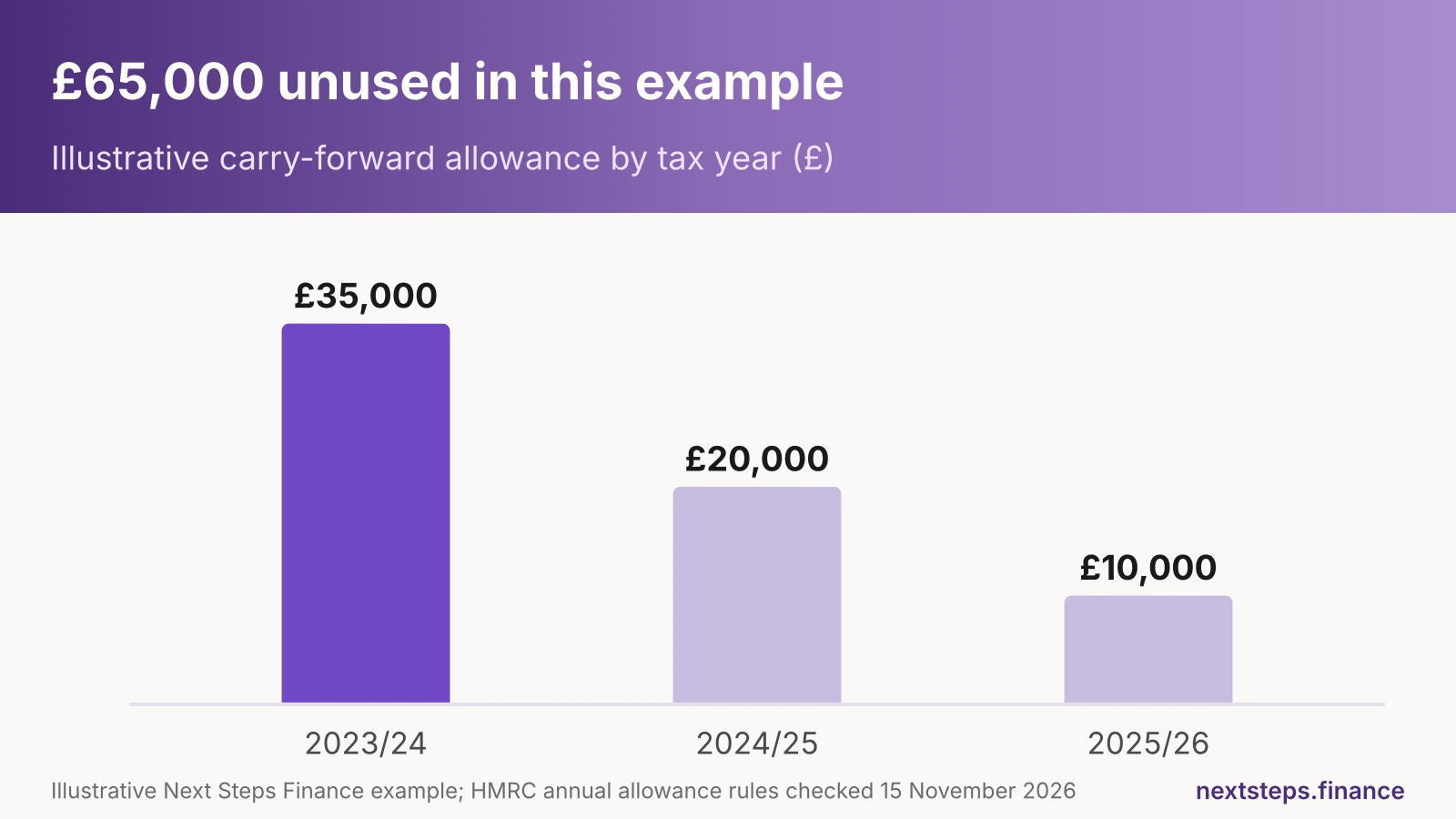
Adding £65,000 to the current £60,000 allowance gives £125,000 of available annual allowance in this simplified example. If total pension input in 2026/27 were £100,000, the first £60,000 would use the current year, then £35,000 from 2023/24 and £5,000 from 2024/25.
This illustrates the annual allowance calculation, not a recommendation to contribute £100,000. Personal tax relief has a separate earnings limit, and this example assumes no taper, MPAA or earlier excess.
Do employer contributions and defined benefit pensions count?
Yes. The annual allowance looks at pension saving from all relevant sources, not just what leaves your bank account. Employer contributions count too, including payments made through salary sacrifice.
For defined contribution pensions, add your gross personal contributions, provider-added tax relief, employer contributions and payments made by someone else on your behalf. For defined benefit schemes, use the pension input amount based on the increase in promised benefits. If you have several pensions, combine the input amounts across them.
Ask each administrator for the figures for 2023/24, 2024/25 and 2025/26, plus the current year to date. Our employer pension guide explains workplace contributions and salary sacrifice; HMRC's pension tax manual explains the calculation.
Can high earners or people who have accessed a pension use carry forward?
They may be able to, but taper and MPAA rules can make the calculation more complex.
For 2026/27, the tapered annual allowance applies if both your threshold income is above £200,000 and your adjusted income is above £260,000. The £60,000 allowance is reduced by £1 for every £2 of adjusted income above £260,000, down to a minimum of £10,000. The same thresholds applied in 2023/24, 2024/25 and 2025/26, but you must work out the allowance for each year separately. See HMRC's tapered annual allowance guidance.
The money purchase annual allowance (MPAA) is £10,000 in 2026/27. It can apply after you flexibly access taxable money from a defined contribution pension. You cannot carry forward unused MPAA to increase that £10,000 limit. If you also have other pension inputs, such as defined benefit accrual, an alternative annual allowance may apply; unused alternative allowance can sometimes be carried forward. Check the rules carefully before relying on it.
How do you use carry forward and check for a tax charge?
There is no separate form to claim carry forward. HMRC says unused annual allowance is carried forward automatically, and you do not need to notify HMRC or your scheme just because you are using it. Keep records showing how you calculated the amount.
Before making a large payment:
- Ask every provider for pension input amounts for the three previous tax years and the current year to date.
- Confirm you were a member of a registered scheme in each year you want to use.
- Check whether taper or MPAA applied in any year.
- Check the tax-relief limit separately. Relief on your own contributions is normally limited to 100% of relevant UK earnings, or £3,600 gross if higher. Carry forward does not increase that limit. Employer contributions are not capped by your relevant earnings, but still count towards the annual allowance.
Use HMRC's annual allowance tax-charge calculator to check whether a charge is due. You need your scheme types, pension input amounts, flexible-access details and income figures. The calculator cannot be used for hybrid schemes that combine defined benefit and defined contribution features.
Any excess remaining after carry forward is subject to an annual allowance tax charge at your marginal Income Tax rate (HMRC rates) and must be reported in the pension savings tax charges section of a Self Assessment tax return, even if your scheme pays some or all of it. Under Scheme Pays rules, you can elect for the scheme to pay if your charge for the year is more than £2,000 and your pension input in that scheme is above the standard annual allowance. The scheme then reduces your pension benefits to cover it. If you have taper, MPAA or a defined benefit scheme, consider getting a regulated adviser or tax professional to check the calculation, or start with a personal finance review. Our guided retirement guide and retirement planning topic page cover the wider decisions around using a pension.
Frequently asked questions
How far back can I carry forward pension allowance?
You can normally carry forward unused allowance from the three previous tax years, if you were a member of a registered pension scheme in each one. In 2026/27, those years are 2023/24, 2024/25 and 2025/26. The oldest year drops out of the window after 5 April 2027.
Do I need to have paid into a pension in the previous three years?
No. You must have been a member of a registered pension scheme at some point in the relevant year, but you do not necessarily need to have contributed. Active, deferred and pensioner members can qualify, but the State Pension does not count. If you were a member but had no pension input, you may have the full allowance available.
Do employer pension contributions count towards carry forward?
Yes. Employer contributions count towards the annual allowance, including payments made through salary sacrifice. For defined contribution pensions, include employer contributions with your gross personal contributions and tax relief. For defined benefit schemes, use the pension input amount calculated under the scheme rules.
Can I carry forward pension allowance if I earn over £200,000?
Yes, but the tapered annual allowance may apply. For 2026/27, both threshold income above £200,000 and adjusted income above £260,000 are needed. The £60,000 limit is then reduced by £1 for every £2 of adjusted income above £260,000, down to £10,000.
Does carry forward let me get tax relief on more than I earn?
No. Carry forward increases the annual allowance available for testing pension input, but it does not increase the separate limit for tax relief on your personal contributions. That limit is normally 100% of relevant UK earnings, or £3,600 gross if higher. Employer contributions follow different rules but still count towards the annual allowance.