The tax on savings interest is going up for the second Budget in a row. Chancellor John Healey's Budget on 28 October 2026 raised the rates on savings and property income by a further two percentage points from April 2027, taking the top rate on savings interest to 49%.
Most people won't pay a penny more, thanks to the Personal Savings Allowance and ISAs. But if you have a decent pot sitting in an ordinary savings account, or you're a higher-rate taxpayer, this is worth ten minutes. Here's exactly who pays, how much, and how to avoid it legally.
Key takeaways
- New savings tax rates from April 2027: 24% basic rate, 44% higher rate, 49% additional rate, up from 20%, 40% and 45% today (Unbiased).
- Last year's Budget had already set 22%, 42% and 47% for April 2027. This Budget adds another two points.
- The Personal Savings Allowance is unchanged: £1,000 of interest for basic-rate taxpayers, £500 for higher-rate and £0 for additional-rate.
- 84% of income taxpayers won't be affected, according to Treasury figures reported by Mouthy Money.
- ISA interest stays tax-free, and the £20,000 cash ISA limit has been kept.
What are the new savings tax rates from April 2027?
Savings interest above your allowances will be taxed at 24%, 44% or 49%, depending on your income tax band, from April 2027.
The Budget 2026 document confirms the government will "increase tax on income from property and savings". The same two-point rise applies to rental profits, so landlords are hit too. Dividend tax rates are unchanged this time, at 10.75%, 35.75% and 39.35% after April 2026's rise.
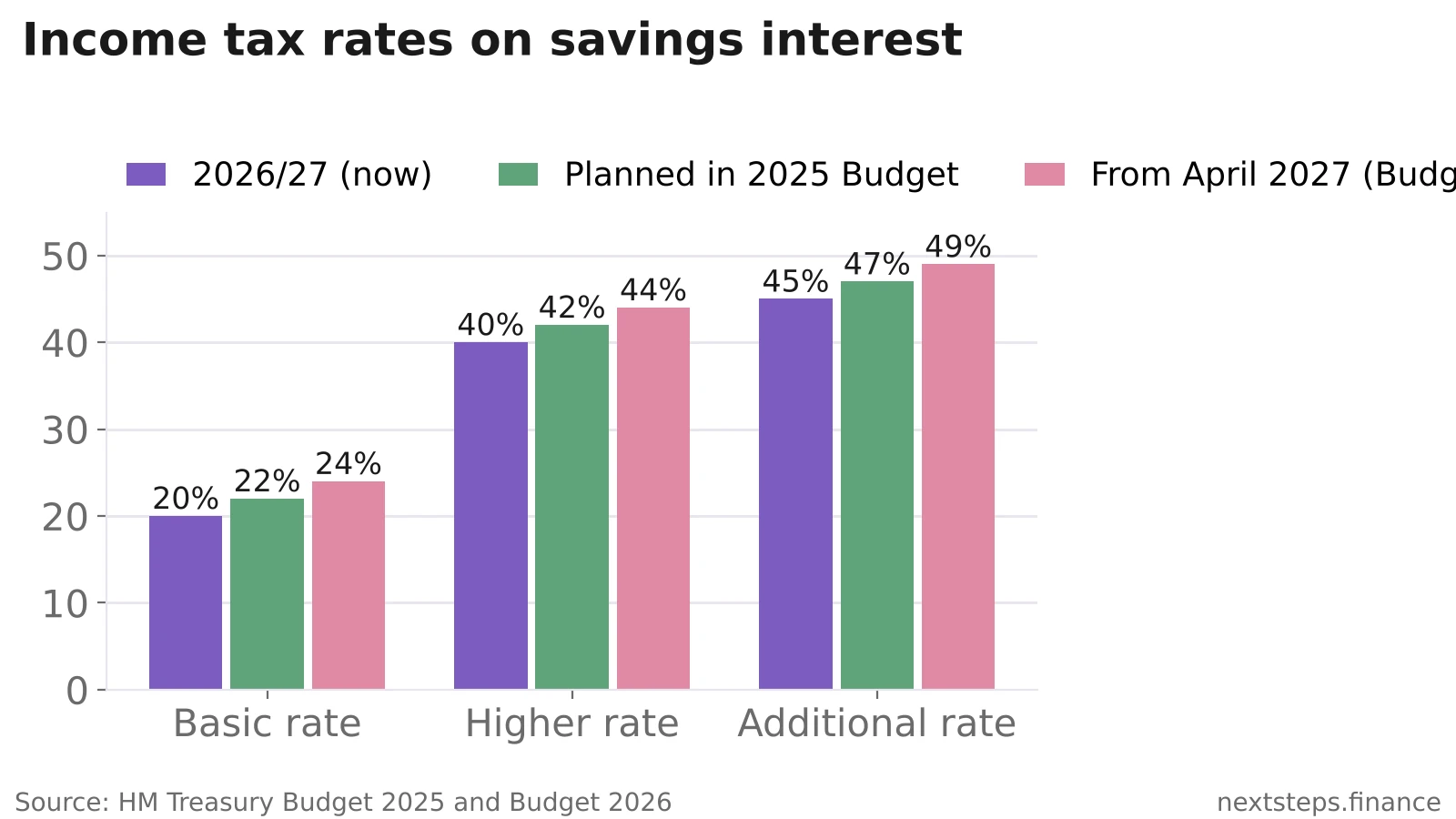
| Income tax band (England, Wales, NI) | Taxable income | Savings tax now (2026/27) | From April 2027 |
|---|---|---|---|
| Basic rate | £12,571 to £50,270 | 20% | 24% |
| Higher rate | £50,271 to £125,140 | 40% | 44% |
| Additional rate | Over £125,140 | 45% | 49% |
Income tax bands are frozen until the end of 2030/31, so as wages rise, more savers will drift into the higher band and lose half their allowance. Scotland sets its own income tax rates on earnings, but savings income is taxed at the UK rates above.
Will I pay tax on my savings interest?
Only if your interest goes over your tax-free allowances. For most people, it won't.
You get a Personal Savings Allowance each tax year:
- Basic-rate taxpayers: £1,000 of interest tax-free
- Higher-rate taxpayers: £500
- Additional-rate taxpayers: £0
Some people on low incomes also get the starting rate for savings, which lets part of your interest be taxed at 0% if your other income is low. Check GOV.UK for the current limits if your earnings are close to the Personal Allowance.
According to the Budget, a basic-rate taxpayer would need more than £25,000 in savings outside an ISA before paying any tax on the interest (Prepared Britain). That's based on a rate of about 4%. Higher rates mean you hit the limit sooner.
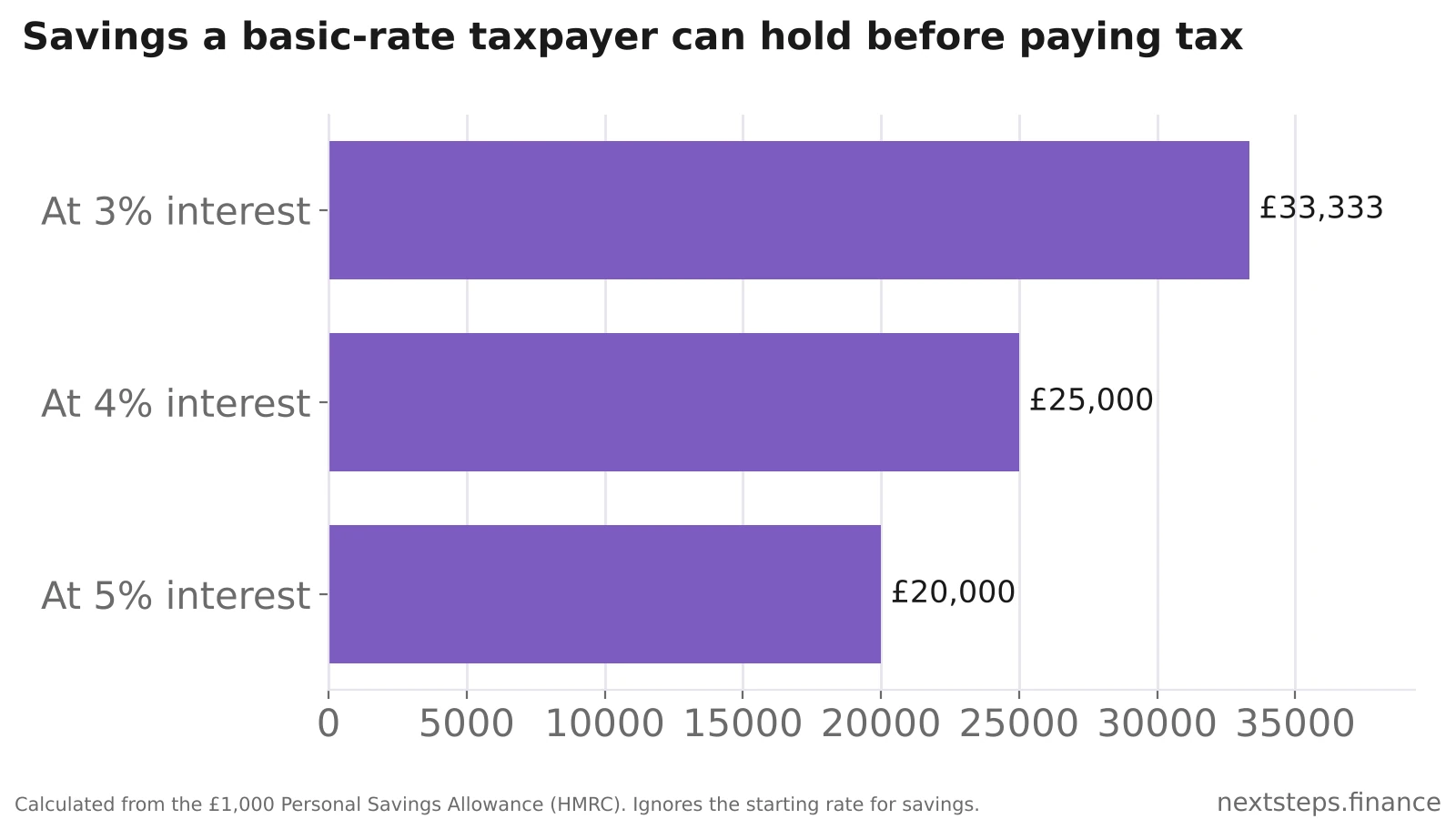
For a higher-rate taxpayer, the £500 allowance runs out at about £12,500 of savings at 4%. Additional-rate taxpayers pay tax on every pound of interest outside an ISA.
Take Action: Add up the interest you expect across all your non-ISA accounts this tax year. Your bank's annual interest statement or app will show it.
How much more tax will I pay? Five examples
Here's what the change means in pounds. Each example assumes the saver uses no ISA and the stated income tax band.
| Saver | Interest a year | Tax now (20/40/45%) | From April 2027 | Extra a year |
|---|---|---|---|---|
| Basic rate, £20,000 at 4% | £800 | £0 | £0 | £0 |
| Basic rate, £40,000 at 4% | £1,600 | £120 | £144 | £24 |
| Higher rate, £20,000 at 4% | £800 | £120 | £132 | £12 |
| Higher rate, £60,000 at 4.5% | £2,700 | £880 | £968 | £88 |
| Additional rate, £100,000 at 4.5% | £4,500 | £2,025 | £2,205 | £180 |
Nextsteps calculations using the rates and allowances above. Interest rates are illustrative.
The increases aren't huge for most people, but they add up across years, and they come on top of frozen thresholds. The basic-rate £40,000 example matches the Budget's own illustration: £24 a year more, half from this Budget and half from last year's.
How do I avoid tax on my savings interest?
Shelter your savings so interest falls within your allowances. These five steps are all legal and simple.
1. Use your cash ISA allowance
Interest in a cash ISA is tax-free and doesn't use your Personal Savings Allowance. The Budget kept the cash ISA limit at £20,000 for everyone. Competitive options include the Plum Cash ISA, at 4.29% variable plus a 0.88% bonus for the first 12 months on money paid in through the app (keep at least £100 in, and more than three withdrawals in a tax year drops it to 3.00%), and the Trading 212 Cash ISA, which tracks 0.15% below Bank Rate (3.60% today). Rates checked 28 October 2026 on Plum's and Trading 212's help centres.
2. Use two tax years' allowances
The 2026/27 allowance resets on 6 April 2027, which is also when the higher rates start. Fill this year's £20,000 before 5 April 2027 and next year's soon after, and a couple could shelter up to £80,000 in cash within a few weeks.
3. Spread savings between partners
Each person has their own allowances. If one partner is a basic-rate taxpayer with an unused £1,000 allowance and the other pays higher-rate tax, holding savings in the lower earner's name can cut the tax bill. Gifts between spouses and civil partners don't trigger tax, but the money then legally belongs to them.
4. Think about Premium Bonds
Premium Bond prizes are tax-free. You won't get a guaranteed return, and the average return is usually below the best savings rates, but they can suit higher and additional-rate taxpayers who've used their ISA allowance.
5. Invest for the long term
Money you won't need for five years or more could go into a stocks and shares ISA or pension, where growth and income are tax-free. For example, InvestEngine offers a stocks and shares ISA with managed portfolios at 0.25% a year plus average ETF costs of about 0.11% (InvestEngine). Capital at risk - the value of investments can go down as well as up.
Take Action: If your interest is close to your allowance, move enough into a cash ISA now so that next tax year's interest stays below it.
Do landlords pay more tax too?
Yes. Property income gets the same two-point rise from April 2027: 24% basic rate, 44% higher and 49% additional.
Unbiased gives the example of a basic-rate landlord with £10,000 of taxable rental profit. They'd pay £2,400 from April 2027, compared with £2,200 under last year's plan and £2,000 today.
If you let property, it's worth tracking income and costs properly now so you claim every allowable expense. Our UK Landlord Tax Tracker is a Google Sheet built by a Chartered Accountant that tracks rent and costs by property, works out mortgage interest relief, gives a live tax estimate and produces your SA105 figures.
What about fixed-rate bonds and tax?
Interest on a fixed-rate bond is generally taxed in the tax year it's paid or made available to you. For a bond that pays all its interest at maturity, that can push a large sum into a single tax year and over your allowance.
If you're opening a fix that matures after April 2027, consider one that pays interest monthly or annually, or a fixed-rate cash ISA, so interest is spread out or sheltered. Our guide to fixed savings rates above 5% compares the options.
More Budget 2026 guides
For the full picture of what changed on 28 October 2026, start with our Budget 2026 summary, then dig into the details:
- Cash ISA limit stays at £20,000
- Lifetime ISA penalty cut and the new First Time Buyer ISA
- £100 energy payment: who gets it and when
FAQ
How much tax will I pay on savings interest from April 2027?
From April 2027, interest above your Personal Savings Allowance is taxed at 24% if you're a basic-rate taxpayer, 44% if higher-rate and 49% if additional-rate. That's up from 20%, 40% and 45% in 2026/27. Interest inside an ISA remains completely tax-free.
What is the Personal Savings Allowance for 2026/27?
The Personal Savings Allowance lets basic-rate taxpayers earn £1,000 of interest a year tax-free and higher-rate taxpayers £500. Additional-rate taxpayers get no allowance. Budget 2026 didn't change these amounts. ISA interest doesn't count towards the allowance.
How much can I save before paying tax on interest?
A basic-rate taxpayer can hold about £25,000 outside an ISA at 4% before interest goes over the £1,000 allowance. A higher-rate taxpayer can hold about £12,500. The higher your interest rate, the lower these amounts. ISA savings don't count at all.
Do I need to tell HMRC about my savings interest?
Usually not. Banks report interest to HMRC, which normally collects any tax by adjusting your tax code. If you complete a Self Assessment tax return, you include savings interest there. If your interest is over £10,000, you must register for Self Assessment.
Are ISAs still tax-free after Budget 2026?
Yes. Interest, dividends and gains inside ISAs remain tax-free, and the Budget kept the £20,000 cash ISA limit for all ages. That makes ISAs more valuable from April 2027, when tax on savings interest outside ISAs rises to 24%, 44% or 49%.
Bottom line
The savings tax rise won't touch most savers, but higher-rate taxpayers and anyone with a big balance outside an ISA should act before April 2027. Start by checking how much interest you earn, then fill your cash ISA. To see how much you can actually afford to save each month, try our UK Budget Planner, or book a personal finance review for a tailored plan.