
Mortgage rates have climbed to their highest level since late 2023, the day before a Bank of England decision that most economists expect to push Bank Rate up to 4%. If you're remortgaging or buying in the next few months, the question is simple: lock in now, or wait and hope?
This guide sets out the latest Moneyfacts figures, what the rise costs on a typical mortgage, and a step-by-step plan if your fixed rate is ending.
Key takeaways
- The average two-year fixed mortgage is 5.97%, up from 4.83% in January 2026 (Moneyfacts, 4 November 2026).
- The average five-year fix has reached 6.00%, up from 5.95% in October, and the average standard variable rate (SVR) is 7.13%.
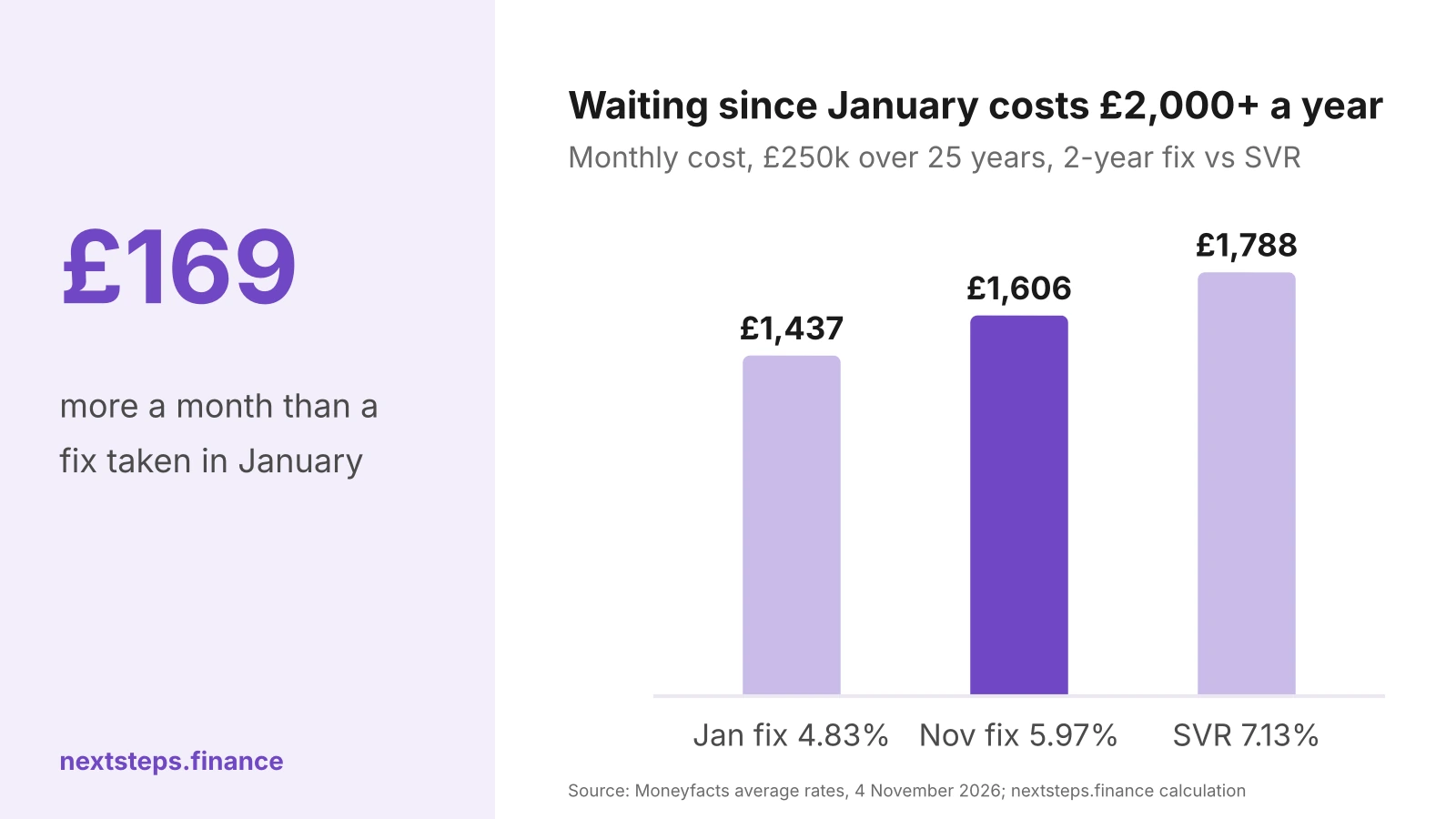
- On a £250,000 repayment mortgage over 25 years, today's average two-year fix costs about £169 a month (over £2,000 a year) more than January's.
- Rolling onto the average SVR instead of a new two-year fix costs another £182 a month on the same mortgage.
- The Bank of England announces its next decision on Thursday 5 November 2026, with a rise from 3.75% to 4% widely expected.
Why are mortgage rates at a three-year high?
Rates are up because lenders price fixed deals off swap rates, and swap rates have jumped as markets bet on several Bank Rate rises. According to Moneyfacts figures reported by Property Industry Eye on 4 November, the Average New Mortgage Rate across all deals is 5.89%, up from 5.83% at the start of October. The last time it was higher was November 2023.
Rachel Springall of Moneyfacts said rates "have risen to a three-year high as a result of lenders grappling to re-adjust rates amid swap rate volatility". The same report puts five-year swaps at around 4.62%. The cheapest two-year fixes from Barclays, HSBC, Lloyds Bank, NatWest and Santander are on average 0.44 percentage points higher than at the start of September.
The trigger was inflation. UK CPI rose to 3.5% in September, and economists swung from expecting no change in 2026 to expecting rises. Our explainer on what 3.5% inflation means for your money covers the background.
What are the average mortgage rates in November 2026?
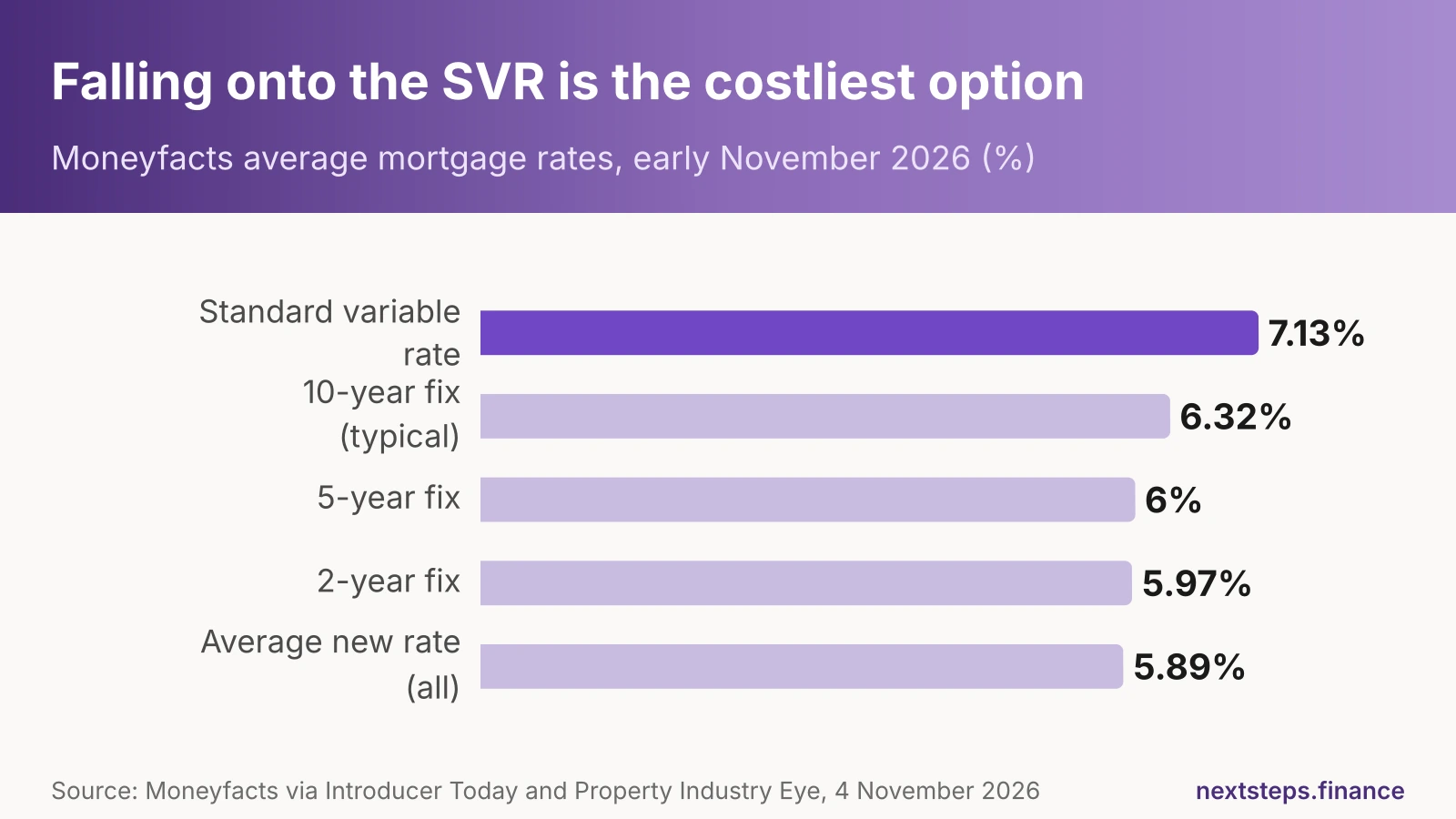
The average two-year and five-year fixes are now almost level at around 6%, and both sit more than a point below the average SVR. These are the Moneyfacts figures published on 4 November:
| Mortgage type | Average rate | Earlier comparison |
|---|---|---|
| Two-year fixed | 5.97% | 4.83% in January 2026 |
| Five-year fixed | 6.00% | 5.95% in October 2026 |
| Typical 10-year fixed | 6.32% | - |
| Standard variable rate (SVR) | 7.13% | - |
| Average new mortgage rate (all deals) | 5.89% | 5.83% at the start of October |
Averages include deals at every loan-to-value (LTV). If you have plenty of equity you can do much better: on Moneyfacts' remortgage comparison on 4 November the lowest headline two-year fix was 4.99% and the lowest five-year fix 4.95%, both at a maximum 60% LTV. Headline rates often come with large fees, so compare the total cost over the deal, not just the rate.
How much more will my mortgage cost?
On a typical mortgage, the rise since January adds well over £100 a month, and drifting onto the SVR adds more again. Moneyfacts worked this out for a £250,000 repayment mortgage over 25 years, and our own calculation matches:
| Rate | Monthly payment | Difference |
|---|---|---|
| 4.83% (average two-year fix, January 2026) | £1,437 | - |
| 5.97% (average two-year fix, November 2026) | £1,606 | +£169 a month vs January |
| 7.13% (average SVR) | £1,788 | +£182 a month vs a new two-year fix |
If tomorrow's decision is a quarter-point rise and lenders pass it on, Moneyfacts estimates that moving from 5% to 5.25% adds about £37 a month, or £444 a year, on the same £250,000 mortgage.
Try it with your own balance, rate and term:
- Mortgage amount£250,000
- Interest rate5.97%
- Term25 yrs
- Monthly overpayment£0
Take Action: Find your current rate, balance and the exact date your fix ends (it's on your annual statement or your lender's app). That's all you need to compare deals.
Will mortgage rates go up again?
Probably, but much of the expected rise is already priced in. The Bank of England's next decision is on Thursday 5 November 2026. According to the HomeOwners Alliance round-up (updated 3 November), 54 of 63 economists in a Reuters poll expect Bank Rate to rise from 3.75% to 4%, and Oxford Economics, Fidelity International and Bank of America expect another rise in February 2027, to 4.25%.
Markets expect three to four more quarter-point rises during 2027, taking Bank Rate to between 4.75% and 5%, Reuters reported on 2 November. Not everyone agrees: Governor Andrew Bailey has stressed rises are not inevitable, and Capital Economics expects cuts to start in late 2027.
Why "priced in" matters: fixed rates follow swap rates, which move on expectations. A 4% decision on Thursday may not move fixed deals much on its own. A surprise (no rise, or hints of faster rises) could. Moneyfacts' Rachel Springall said lenders "could well pivot away from making aggressive rises over the coming weeks", but warned "most of the damage is unlikely to unwind entirely".
| Date | Bank of England decision |
|---|---|
| Thursday 5 November 2026 | Rise from 3.75% to 4% widely expected |
| Thursday 17 December 2026 | Next decision |
| Thursday 4 February 2027 | Several forecasters expect a rise to 4.25% |
| Thursday 18 March 2027 | Decision |
For what a 4% Bank Rate means for trackers and savings, see our Bank of England rate rise guide.
Should I fix my mortgage now or wait?
If your fix ends within about six months, securing a deal now is the lower-risk choice for most people, because you can often still look again if rates fall. Nobody knows where rates will be in March, but you can cap the downside today.
Here's why locking in tends to win in a rising market:
- A mortgage offer usually lasts three to six months, depending on the lender (Habito), so you can secure a rate well before your fix ends.
- You can keep reviewing before it starts. A broker can agree to review your rate and look again shortly before your current deal expires (SPF Private Clients). With a product transfer, the lender won't tell you if a cheaper rate appears, so check yourself. Ask before applying whether switching again means a new fee.
- Waiting has a known cost. Moneyfacts estimates someone securing a two-year fix now pays over £2,000 a year more than in January. Springall: "Delaying plans to get a mortgage this year has already come to haunt borrowers."
Two-year or five-year? With both averaging around 6%, the choice is about flexibility, not price. A two-year fix suits you if you expect to move, or think rates will fall by 2028. A five-year fix suits you if you want certain payments through a run of possible rises. Tracker deals suit people who can absorb rises and want no early repayment charges. This is a decision that depends on your circumstances, so it's worth speaking to a whole-of-market mortgage broker, or booking a personal finance review.
Product transfer or remortgage: which is better?
A product transfer (a new deal with your current lender) is quicker and cheaper to arrange; a remortgage (moving lender) gives you the whole market. Compare both before you choose.
| Product transfer | Remortgage to a new lender | |
|---|---|---|
| Speed | Can be done within a week (Habito) | Usually several weeks |
| Valuation and legal fees | Usually none (Yorkshire Building Society) | Valuation typically under £400; legal fees around £300 (Habito) |
| Affordability check | Usually none if you don't borrow more | Full new application |
| Choice | Only your lender's deals | Whole market |
| Best for | Low equity, changed income, speed | Lots of equity, lender's rates uncompetitive |
Habito notes that arrangement fees on a new lender's deal are typically £1,000 to £2,000. A deal with a lower rate and a big fee is only cheaper if the interest saved over the fix beats the fee, which is less likely on smaller balances.
How do I switch my mortgage before my fix ends?
- Check your end date and any early repayment charge (ERC). Leaving before the fix ends can trigger an ERC, often a percentage of the balance.
- Get your lender's product transfer rates online or by phone.
- Compare the whole market with a broker or a comparison site, using the total cost over the deal (rate plus fees).
- Secure the best deal now, timed to start the day after your current fix ends.
- Keep checking until completion. If a cheaper deal appears, ask your broker or lender whether you can switch and what it would cost.
- Don't drift onto the SVR. At 7.13% on average, it's the most expensive place to sit.
What if I can't afford higher mortgage payments?
Talk to your lender before you miss a payment, and ask what support it can offer. Any change that lowers payments now, such as a longer term, usually increases the total you pay. Free, confidential help is available from MoneyHelper, StepChange and Citizens Advice.
Then rebuild your monthly plan around the new payment. Our free UK Budget Planner helps you find the extra £100 to £200 a month a remortgage can demand. If you have spare cash, our guide on whether to overpay your mortgage shows when overpaying beats saving, and most fixed deals let you overpay up to 10% of the balance a year without a charge.
Take Action: If you're buying rather than remortgaging, rerun your numbers at today's rates. Our renting vs buying guide shows the full cost comparison.
FAQ
What is the average mortgage rate in the UK right now?
Moneyfacts figures published on 4 November 2026 put the average two-year fixed mortgage at 5.97% and the average five-year fix at 6.00%. The Average New Mortgage Rate across all deals is 5.89%, its highest since November 2023. The average standard variable rate is 7.13%, which is why letting a fix lapse is expensive.
Will mortgage rates go down in 2027?
It's unlikely in the first half of 2027. Markets expect three to four more Bank Rate rises during 2027, to between 4.75% and 5%. Some forecasters, including Capital Economics, expect cuts from late 2027. Fixed rates could ease earlier if swap rates fall, but most lenders' rises are unlikely to unwind fully.
How early can I lock in a mortgage rate?
Most mortgage offers last three to six months, depending on the lender, so you can usually secure a new deal around six months before your current fix ends. Product transfer windows vary by lender, and many have shortened to three or four months, so check yours. A broker can review the rate before it starts if prices fall.
Is it better to fix for two or five years?
In November 2026 there is little price difference: Moneyfacts averages are 5.97% for two years and 6.00% for five. A two-year fix gives flexibility if rates fall or you plan to move. A five-year fix gives certainty if rates keep rising. The right choice depends on your plans, so consider regulated mortgage advice.
What happens if my fixed-rate mortgage ends and I do nothing?
You'll usually move onto your lender's standard variable rate, which averages 7.13% according to Moneyfacts. On a £250,000 repayment mortgage over 25 years, that costs about £182 a month more than an average new two-year fix. SVRs typically have no early repayment charge, so you can switch to a new deal at any time.
Does a Bank of England rate rise affect my fixed mortgage?
No. A fixed-rate mortgage stays at the same rate until the fix ends, whatever happens to Bank Rate. A rise affects trackers almost immediately, and standard variable rates if your lender passes it on. It also affects the rates you'll be offered on your next fixed deal, which is why remortgaging borrowers feel it most.