
The leasehold reform bill the government has promised for years is finally in Parliament. If you own a leasehold flat or house in England or Wales, it could cut your ground rent, make a lease extension cheaper and stop a freeholder threatening your home over a small disputed bill. None of it is law yet, though, so here is what's proposed, what's already in force and what you can do now.
Key takeaways
- The Commonhold and Leasehold Reform Bill (Bill 189, 2026-27) was introduced in the House of Commons on 19 November 2026.
- Ground rent on existing leases would be capped at £250 a year in 2028, then fall to zero after 40 years. The government says this cuts bills for up to one million leaseholders.
- Existing blocks could convert to commonhold with 50% support, down from 100% today.
- Leasehold would be banned for most new flats, with narrow exceptions such as shared ownership.
- Service charge rights from the 2024 Act start on 1 April 2027 and 1 November 2027, whatever happens to the new bill.
What is the Leasehold Reform Bill?
The leasehold reform bill is a government bill that aims to replace leasehold with commonhold as the normal way to own a flat in England and Wales. Its full name is the Commonhold and Leasehold Reform Bill, and the Parliament bill page lists it as Bill 189 of the 2026-27 session, sponsored by the Ministry of Housing, Communities and Local Government.
With leasehold you own the right to live in a property for a fixed number of years, while a freeholder owns the building and the land. You usually pay ground rent and service charges, need permission for some changes, and the lease loses value as the years run down. With commonhold you own your flat outright and the owners jointly run the building through a commonhold association, so there's no separate landlord.
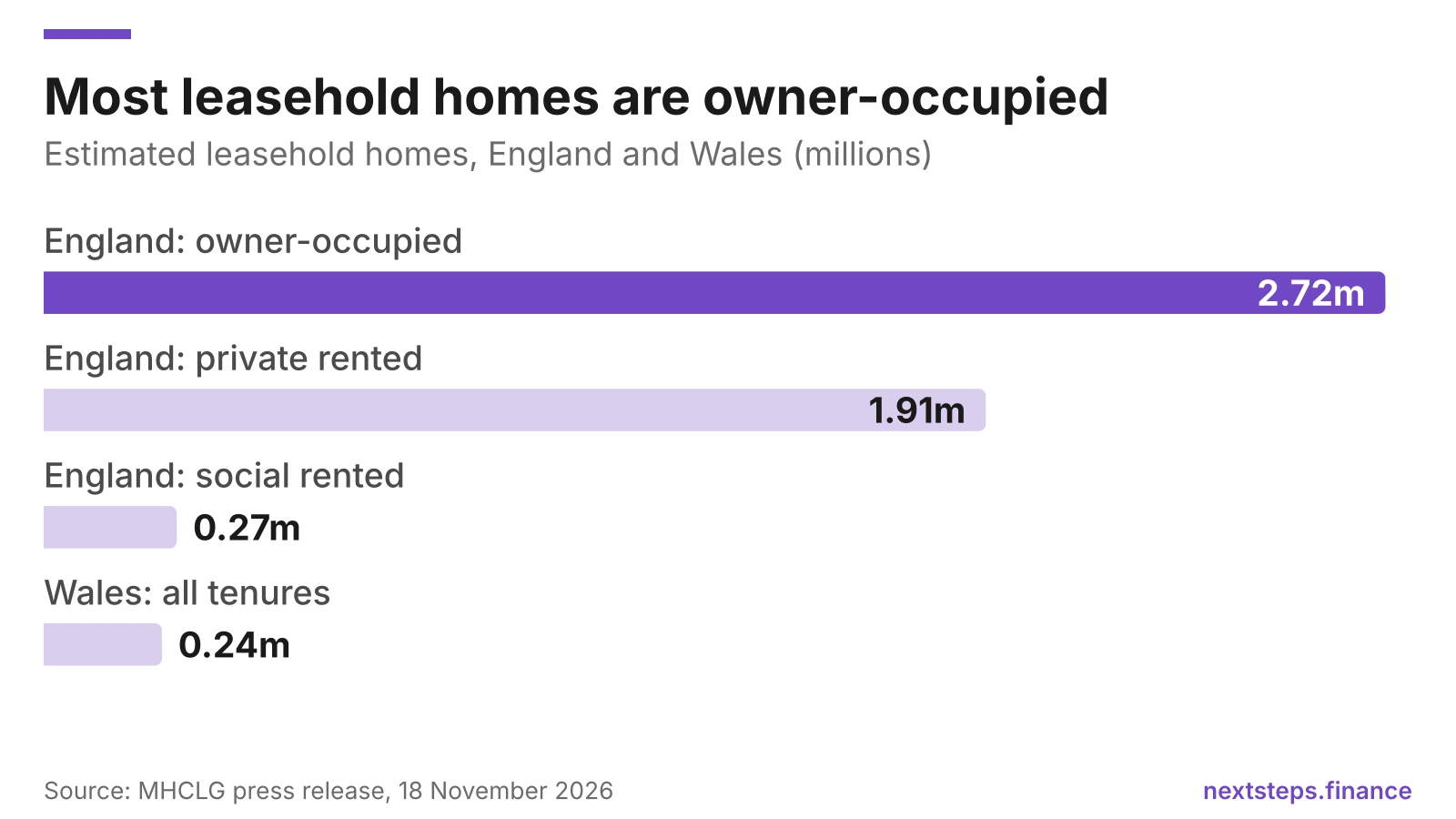
The government's press release of 18 November 2026 estimates there are about 5.1 million leasehold homes across England and Wales: roughly 4.9 million in England and 235,000 in Wales. Housing Minister Matthew Pennycook called the bill "the beginning of the end for the feudal leasehold system".
How much will the ground rent cap save?
Ground rent on existing residential leases would be capped at £250 a year in 2028, then reduced to zero after 40 years. Anyone paying more than £250 today would save the difference every year once the cap starts.
So if your lease charges £400 a year, the cap would save you £150 a year from 2028. If your ground rent doubles every 10 or 15 years, the saving grows each time it would have doubled. If you already pay £250 or less, the cap doesn't cut your bill straight away, but the fall to zero after 40 years still applies.
Ground rent was already banned on most new leases from 2022, so this part of the bill is about older leases. MoneySavingExpert reports that the cap is planned to start six months after the bill becomes law, which the government expects to be 2028.
Try it with your own lease:
- Your ground rent per year (£)£400
Landlord investors have pushed back. Real Estate:UK told The Negotiator the cap affects up to £12 billion of investments, including pension funds, so expect amendments to be argued over as the bill goes through.
Take Action: find your lease and check the ground rent clause, including any review or doubling dates. If you don't have a copy, you can usually download one from HM Land Registry for a small fee.
What changes for lease extensions and marriage value?
The bill fixes parts of the Leasehold and Freehold Reform Act 2024 so that leaseholders can get a 990-year lease extension, stop paying the freeholder's costs in most cases and no longer pay marriage value when 80 years or fewer are left. These changes need the bill to pass first, and no start date has been set.
Marriage value is the extra cost added to a lease extension or freehold purchase once a lease drops to 80 years or below. It can add thousands of pounds, which is why advisers have long said to extend before you hit 80 years. Today the statutory right is usually a 90-year extension for a flat or 50 years for a house.
The rule that you had to own a home for two years before extending was scrapped on 31 January 2025, so eligible leaseholders can already start the process. The awkward question is timing. If you're above 80 years, waiting for the new rules may save money, but MSE notes the key valuation rates aren't in the bill, so nobody can say yet how much cheaper extensions will be.
| Your lease | Under today's rules | Under the bill (once in force) |
|---|---|---|
| Over 80 years left | No marriage value; 90-year extension for a flat | 990-year extension, freeholder's costs mostly not paid by you |
| 80 years or fewer | Marriage value added to the price | Marriage value scrapped |
| Short lease and selling or remortgaging soon | Many lenders won't lend on short leases | Rules not in force yet, so lenders still judge the current lease |
If you're buying a flat, the lease length still matters for your mortgage. Our guide to the 4.5x mortgage rule covers how lenders size loans, and a short lease can rule a property out entirely.
How does switching to commonhold work?
Existing blocks could convert to commonhold with the support of 50% of flat owners, down from the 100% needed today. Owners who don't agree can stay on modified leases until they sell, so one or two holdouts can no longer block the whole building.
Converting still means buying the freehold of the building, so owners need to agree how to split that cost and the legal fees. Commonhold also brings responsibility: the owners run the building together, so you're the ones planning repairs and setting the budget. MSE reports that the modernised commonhold system is expected around 2029, subject to Parliament.
If your block is thinking about it, start a fund early. Our guide to sinking funds shows how to set money aside for large, predictable costs like a share of a freehold purchase or major works.
Will new flats still be sold as leasehold?
No, for most new flats. The bill bans leasehold for new flats and makes commonhold the standard, with narrow exceptions such as shared ownership. MSE reports the ban is expected around 2031, about two and a half years after the new commonhold model is available, although the government hasn't confirmed a date.
That matters if you're saving for your first home now. A new-build flat bought before the ban will most likely still be leasehold, so read the lease, the service charge history and any ground rent terms before you commit. If you're weighing your options, our renting vs buying guide runs through the costs on both sides.
If you're saving for a deposit and want to see when you'll get there: