
Sinking funds (sometimes called bill pots) are the budgeting habit that stops "unexpected" bills being unexpected. Most budgets don't fail on rent or food. They fail in the month the car tax, a wedding present and the home insurance renewal all land at once. This sinking funds UK guide shows how they work, which costs to cover, how much to save using real 2026/27 GOV.UK figures, and where to keep the money so it earns interest without being spent.
Foundations
Sinking Funds UK: How to Set Them Up
Sinking funds UK guide: how to save monthly for Christmas, car costs and yearly bills, with a worked £311-a-month example and where to keep the money.
In this article
- 01Key takeaways
- 02What is a sinking fund in the UK?
- 03What should you have sinking funds for?
- 04How much should you put in a sinking fund each month?
- 05Is a sinking fund the same as an emergency fund?
- 06Where should you keep sinking funds in the UK?
- 07How do you set up sinking funds step by step?
- 08Do sinking funds actually work?
- 09FAQ
- 10The bottom line
Key takeaways
- A sinking fund is a small monthly saving for one known future cost. Yearly cost ÷ 12 = what to save each month.
- Real fixed costs to plan for: the TV licence is £180 a year from 1 April 2026, standard-rate car tax is £200 for 12 months (or £210 by 12 monthly Direct Debits), and an MOT costs up to £54.85 for a car.
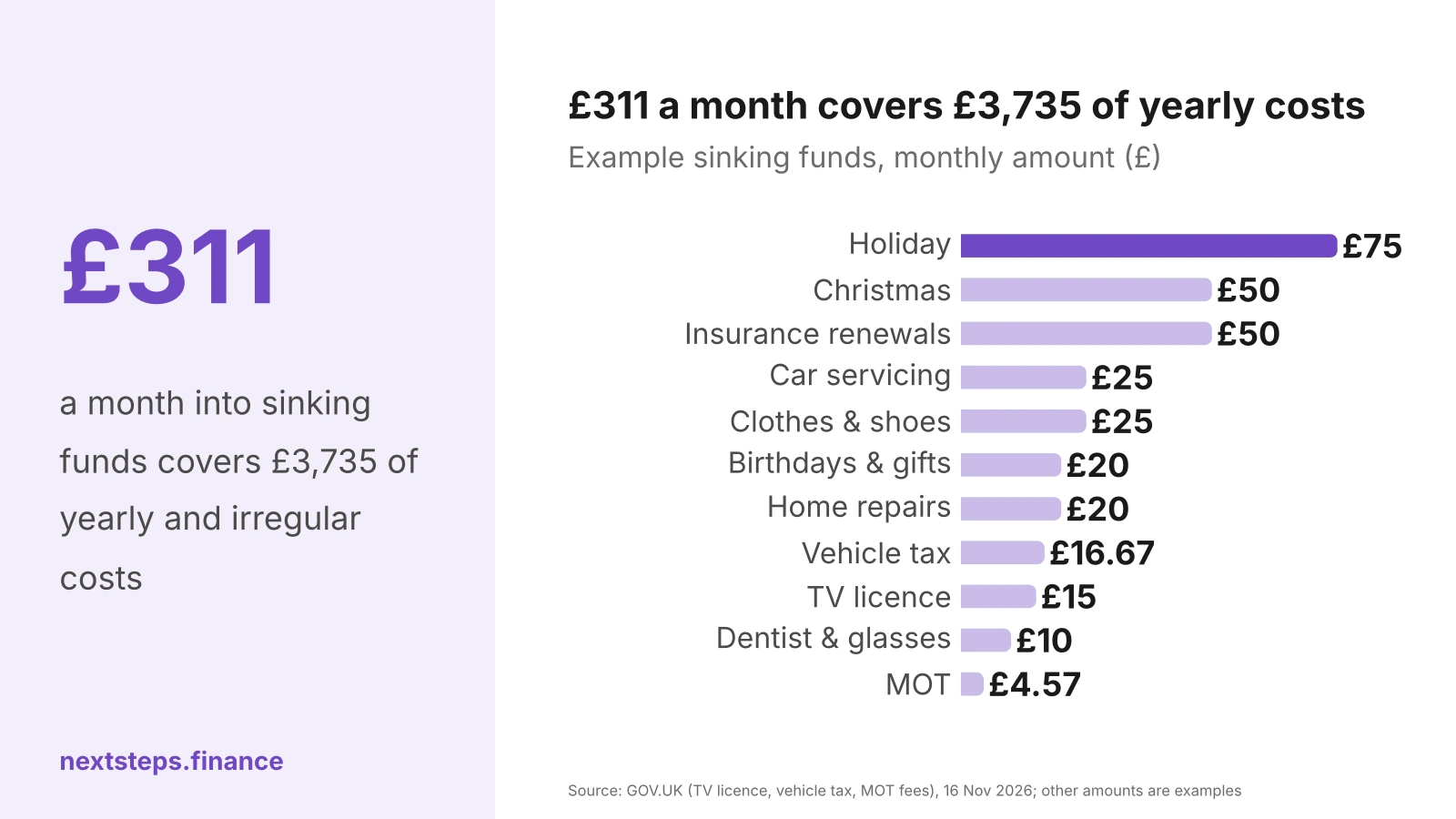
- Our worked example sets aside £311 a month to cover £3,735 of yearly and irregular costs, from Christmas to dentist bills.
- Paying yearly from a sinking fund can cost less: spreading car tax over 12 Direct Debits costs £10 more a year than paying £200 in one go.
- A sinking fund isn't an emergency fund. One is for costs you know are coming; the other is for things you can't predict, like losing your job.
If you want sinking funds built into a full-year plan, the UK Budget Planner has a sinking funds section that works out the monthly amount for each goal.
What is a sinking fund in the UK?
A sinking fund is a separate pot of money you build up gradually for one planned expense, so the full cost is ready when the bill arrives. Instead of finding £600 for Christmas in December, you save £50 a month from January.
The term comes from company and government finance, where a "sinking fund" is money set aside to repay a debt. In personal budgeting it means the same idea in reverse: you're paying your future self in advance.
What makes something a sinking fund:
- You know it's coming. Christmas, birthdays, car tax and annual subscriptions are all predictable, even if they feel like surprises.
- You can estimate the cost. Last year's bill, a quote or an official fee is enough.
- It has its own label. Each fund has one job, so you can see when it's full and you don't raid it for something else.
Sinking funds work with any budgeting method. In a zero-based budget they're one of the "jobs" you give your pay, and in the 50/30/20 rule they usually sit inside the 20% savings share.
What should you have sinking funds for?
Have a sinking fund for any cost that is bigger than your monthly budget can absorb and arrives less often than once a month. For most UK households that means Christmas, car costs, insurance renewals, holidays, gifts and household repairs.
Here's a checklist of the most common ones, with official UK fees where there is one:
| Sinking fund | Typical yearly cost | Monthly saving | Where the figure comes from |
|---|---|---|---|
| TV licence | £180 | £15 | GOV.UK, colour licence from 1 April 2026 |
| Vehicle tax | £200 | £16.67 | DVLA V149, standard rate, cars registered from April 2017 |
| MOT | £54.85 | £4.57 | GOV.UK maximum fee for a car |
| Car servicing and repairs | £300 | £25 | Example; use your last two years' bills |
| Insurance renewals (car, home) | £600 | £50 | Example; use your last renewal letters |
| Christmas | £600 | £50 | Example; see our Christmas budget guide |
| Birthdays and gifts | £240 | £20 | Example |
| Holiday | £900 | £75 | Example |
| Clothes and shoes | £300 | £25 | Example |
| Dentist and glasses | £120 | £10 | Example |
| Home and appliance repairs | £240 | £20 | Example |
| Total | £3,735 | £311 |
Two official figures are worth knowing. If your car was first registered on or after 1 April 2017 with a list price over £40,000, the DVLA adds a £440 additional rate for five years from the second time you tax it, taking a single 12-month payment to £640. And if you only watch on a black and white set, the licence is £60.50. Our guide to average household bills in the UK covers the regular monthly bills that sit alongside these.
Take Action: Go through the last 12 months of your bank statements and highlight every payment that didn't happen every month. That list is your sinking funds.
How much should you put in a sinking fund each month?
Divide the expected cost by the number of months until it's due. For a yearly bill that's ÷12; for a cost due sooner, divide by the months you have left. If Christmas is six weeks away and you need £300, that's £200 a month for the next month and a half, not £25.
A few practical rules make the maths easier:
- Use last year's real cost, plus a little. Prices rise. The TV licence went up £5.50 this April, so round up rather than down.
- Start with the biggest and soonest. If £311 a month isn't realistic, fund Christmas, car costs and insurance first, then add the rest.
- Sort out costs that are already close. For a bill due in two months with nothing saved, consider paying it monthly this year and starting the sinking fund for next year.
- Review every three months. Renewal letters and new quotes change the numbers.
Try it with your own numbers. This shows how much a £311 monthly sinking fund grows over a year in an easy access account at 3.15% AER (Plum's Basic plan rate):
Calculator
How much will your sinking funds build up?
- Starting balance£0
- Monthly sinking fund saving£311
- Interest rate (AER)3.15%
- Years1 yrs
Balance after 1 year£3,786
You pay in£3,732
Interest earned£54
Assumes the rate stays the same and interest is added monthly. Variable rates can change, and interest above your Personal Savings Allowance may be taxable outside an ISA.
In real life you'll spend from the funds during the year, so the balance goes up and down. The point is that the money is there when each bill arrives.
Is a sinking fund the same as an emergency fund?
No. A sinking fund is for costs you know are coming; an emergency fund is for costs you can't predict, such as a job loss, a big boiler repair or sudden illness. You need both, and they should be kept separate.
| Sinking fund | Emergency fund | |
|---|---|---|
| What it's for | Planned, predictable costs | Unplanned shocks |
| How much | The cost of each item | Often 3-6 months of essential spending |
| How often you spend it | Regularly, through the year | Rarely, ideally never |
| How it's built | A set amount for each goal every month | Steadily, until it reaches the target |
| Example | £50 a month for Christmas | £4,500 for three months of bills |
The overlap is "irregular but certain" costs like car repairs. If your car is older, a car repairs sinking fund means a £400 repair is a planned cost, not an emergency. That keeps your emergency fund for real emergencies. Our emergency fund guide explains how big it should be and where to keep it.
Where should you keep sinking funds in the UK?
Keep sinking funds in an easy access account or banking pots, separate from your current account, so the money is out of sight but available the day a bill arrives. Avoid notice or fixed-term accounts for money you'll spend within the year.
Option 1: pots in a banking app
Banking pots are the simplest way to run several sinking funds, because you can name a pot for each goal and see the balances side by side. With Monzo, you can open an Instant Access Savings Pot that pays from 2.80% to 3.80% AER variable, depending on your plan (paid plans start at £3 a month), with no withdrawal limits and no minimum deposit. Monzo says eligible deposits, including money in Savings Pots, are protected by the FSCS up to £120,000 per person. You need a Monzo current account to open one.
Option 2: an easy access savings account
Plum offers an Easy Access Savings account provided by Lloyds Bank PLC. According to Plum's plans page, it pays 3.15% AER variable on the free Basic plan, rising to 3.35% on Plus (£3.99 a month), 3.50% on Boost (£7.99 a month) and 3.90% on Max (£14.99 a month). Paid plans are free for the first month. Interest is paid on the first business day of each month, and the rate depends on the plan you're on when you open the pocket.
Comparing the options
| Where to keep it | Rate (AER variable) | Cost | May suit you if |
|---|---|---|---|
| Monzo Instant Access Savings Pot | 2.80%-3.80% by plan | Free account; paid plans from £3 a month | You want several labelled pots next to your spending account |
| Plum Easy Access (Lloyds Bank) | 3.15% Basic to 3.90% Max | Basic free; paid plans £3.99-£14.99 a month | You want automatic saving rules and are happy with an app |
| Your own bank's savings pots or spaces | Varies | Usually free | You'd rather not open a new account |
| A spreadsheet plus one savings account | Varies | Free | You're happy to track each fund yourself |
On a few hundred pounds, a paid plan's monthly fee can easily wipe out the extra interest, so compare the fee with what you'd actually earn. Both apps' rates are variable and can change. For how deposit protection works across banks and apps, see our guide to the FSCS protection limit.
Take Action: Whichever account you use, set up a standing order for the total on payday, so the money moves before you can spend it.
How do you set up sinking funds step by step?
You set up sinking funds in five steps: list your irregular costs, price each one, work out the monthly amount, open separate pots, and automate the transfer on payday.
- List every irregular cost. Use 12 months of bank statements and your calendar (birthdays, renewals, school trips, your MOT due date).
- Price each one. Use official fees where they exist (£180 TV licence, £200 car tax, up to £54.85 for an MOT) and last year's bills for the rest.
- Work out the monthly amount. Divide each cost by the months until it's due, then add them up.
- Open a pot for each fund, or one savings account with a spreadsheet tracking each fund's balance.
- Automate it. A standing order on payday, then pay each bill straight from its pot when it arrives.
The free budget template has a sinking funds tab you can copy, and the UK budget calculator shows how the monthly total fits around your take-home pay. If you'd rather not build it yourself:
Do sinking funds actually work?
Yes, for most people, because they turn big irregular bills into small monthly ones you've already planned for. The main ways they fail are setting amounts too high to keep up and dipping into one fund for another goal.
Pros
- No more "bad months" when several yearly bills land together.
- Less need for credit cards or overdrafts for predictable costs.
- Paying in one go can be cheaper: car tax costs £200 as a single payment but £210 over 12 monthly Direct Debits.
- Easier to see what you can really afford, because the true cost of the year is visible.
Cons
- It needs money up front. £311 a month is a lot if your budget is already tight, so start smaller.
- Too many pots can feel complicated. Five or six covers most households.
- Interest on easy access accounts is variable and can fall.
If money is tight, start with the one or two costs that cause the most stress. Our complete guide to budgeting in the UK explains how sinking funds fit into a full plan, and the budgeting hub has guides for every situation.
FAQ
What is the difference between a sinking fund and savings?
A sinking fund is savings with one specific, planned purpose and a target amount, such as £600 for Christmas or £180 for the TV licence. General savings have no set use. Sinking funds are meant to be spent when the cost arrives, while longer-term savings and emergency funds are meant to stay put.
How many sinking funds should I have?
Most UK households manage well with five to eight sinking funds: Christmas, car costs, insurance renewals, gifts, holidays, home repairs and annual subscriptions. Fewer is fine if you're starting out. Group small costs together, such as the TV licence and subscriptions in one "yearly bills" fund, to keep it simple.
Should sinking funds be in a separate account?
Yes, ideally. Keeping sinking funds separate from your current account stops you spending them by accident. An easy access savings account or banking pots work well because you can withdraw instantly when a bill arrives. Avoid fixed-term or notice accounts, as the money needs to be available within the year.
How much should I have in my sinking fund?
Each sinking fund should hold the full cost of its bill by the date it's due. To get there, divide the cost by the months left. For example, the £180 TV licence needs £15 a month over a year. Our worked example totals £311 a month to cover £3,735 of yearly and irregular costs.
Is a sinking fund the same as an emergency fund?
No. A sinking fund covers costs you know are coming, such as car tax or Christmas, and is spent regularly. An emergency fund covers unpredictable shocks, such as losing your job, and should ideally stay untouched. Keep them in separate pots so planned spending never eats into your safety net.
The bottom line
Sinking funds in the UK turn yearly and irregular bills into planned monthly savings: divide each cost by 12, save it on payday and keep it in a separate easy access pot. With the TV licence at £180, car tax at £200 and an MOT up to £54.85, even the fixed costs add up, and a full plan in our example comes to £311 a month.
To plan every sinking fund alongside your monthly budget, the UK Budget Planner does the maths for you, or start with the free budget template.
Found this useful? Add Next Steps Finance as a preferred source and Google will show you more of our guides in search and AI answers.
Put this into practice
Build your budget in one sitting
The UK Budget Planner works out your take-home pay, splits it with the 50/30/20 rule, tracks spending through the year and forecasts five years ahead. Made for UK pay, tax and bills.