
The Bank of England is expected to raise interest rates next Thursday. Bank Rate has sat at 3.75% since December 2025, but inflation jumped to 3.5% in September and most economists now expect a quarter-point rise to 4% on 5 November.
Below is what a Bank of England rate rise would mean for your mortgage, your savings and your Cash ISA, with the numbers, and a short list of things worth doing before Thursday.
Key takeaways
- Bank Rate is 3.75% and the next decision is announced on Thursday 5 November 2026 (Bank of England).
- In a Reuters poll taken 12-14 October, 54 of 63 economists expected a rise to 4%, and 30 of 61 expected another rise in the first quarter of 2027 (HomeOwners Alliance).
- UK CPI inflation rose to 3.5% in September, up from 3.1% in August.
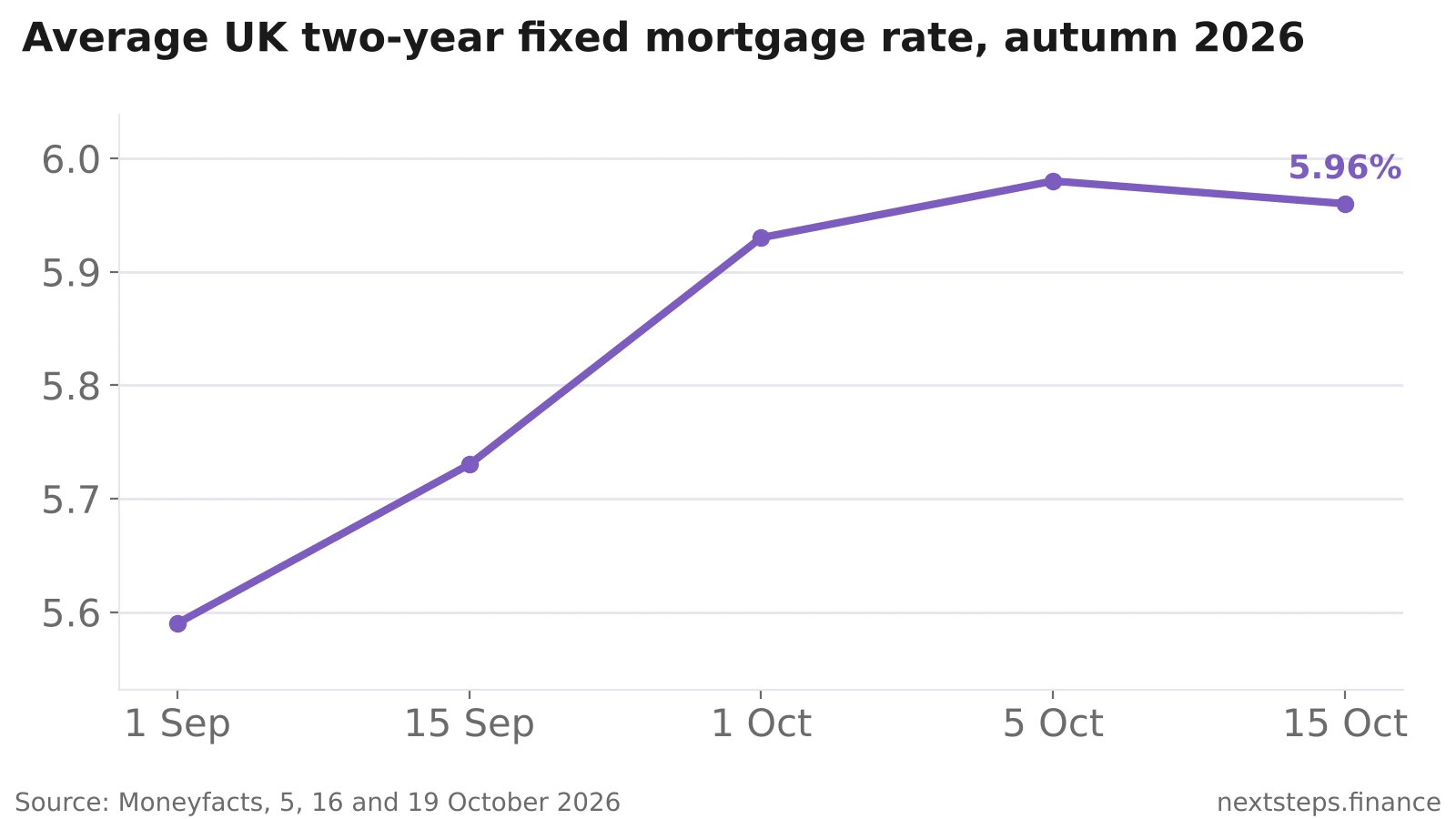
- The average two-year fixed mortgage was 5.96% on 15 October, up from 5.73% a month earlier (Moneyfacts via The Intermediary).
- On a £200,000 repayment tracker over 25 years, a 0.25-point rise adds about £29 a month, or £344 a year.
Will interest rates go up on 5 November 2026?
A rise to 4% is the most likely outcome, but it isn't certain. The Bank of England's own explainer confirms that Bank Rate is 3.75% and that "we will announce our next decision on Thursday 5 November 2026".
The case for a rise has built quickly. In September around 90% of economists expected no change for the rest of 2026. Then inflation rose to 3.5%, driven partly by motor fuel costs, and the mood flipped. According to the HomeOwners Alliance round-up (updated 28 October):
- Capital Economics, Oxford Economics, Fidelity International, Bank of America and ING all expect quarter-point rises in November and February.
- Barclays says November is "the most likely place we'll see the next increase".
- Markets are pricing in four quarter-point rises by summer 2027.
There are dissenting voices. The Bank's chief economist, Huw Pill, has been sceptical of what markets expect, and ING thinks rates could be cut again before the end of 2027 if energy costs ease. So treat 4% as the central forecast, not a done deal.
| Date | What happens |
|---|---|
| Thursday 5 November 2026 | MPC decision, expected rise from 3.75% to 4% |
| Thursday 17 December 2026 | Next MPC decision |
| Thursday 4 February 2027 | MPC decision, several forecasters expect a rise to 4.25% |
For the inflation backdrop, see our explainer on what 3.5% inflation means for your money.
What a 4% Bank Rate means for your mortgage
It depends on the type of mortgage you have. Trackers and many variable deals rise almost immediately; fixed-rate deals don't change at all until the fix ends.
| Mortgage type | Effect of a rise to 4% | When |
|---|---|---|
| Tracker | Rate rises by the full 0.25 points | Usually from the next payment, check your offer |
| Standard variable rate (SVR) | Lender decides, usually passes on most or all | Typically within weeks, with notice |
| Discount variable | Follows the lender's SVR | As above |
| Fixed rate | No change | Only when your fix ends |
How much more will my tracker mortgage cost?
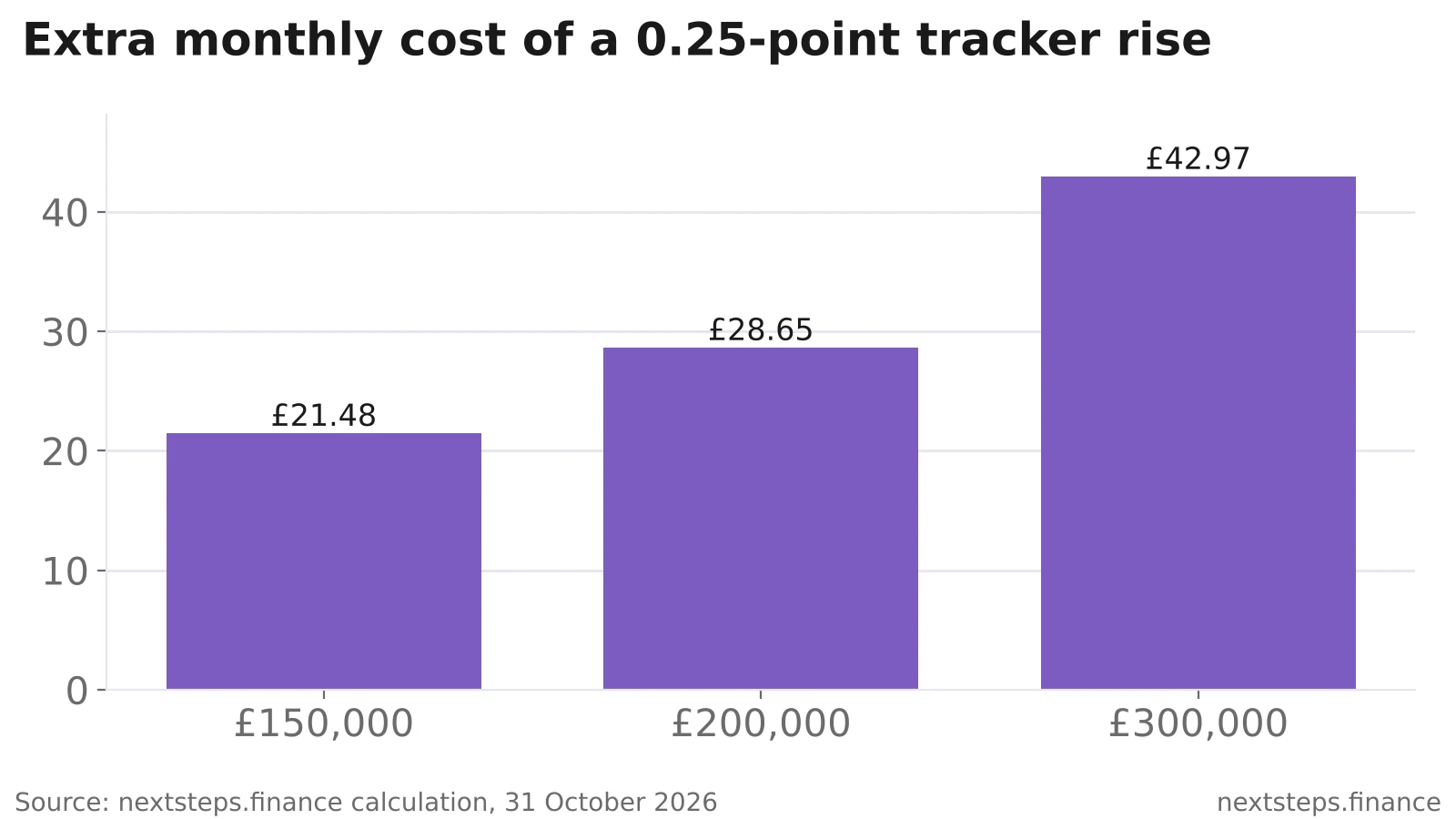
A quarter-point rise adds roughly £21 to £43 a month for typical loan sizes. We worked this out for a 25-year repayment mortgage moving from 4.55% (the Moneyfacts average two-year variable rate on 15 October) to 4.80%:
| Mortgage balance | Monthly payment at 4.55% | At 4.80% | Extra per month | Extra per year |
|---|---|---|---|---|
| £150,000 | £838 | £860 | £21 | £258 |
| £200,000 | £1,117 | £1,146 | £29 | £344 |
| £300,000 | £1,676 | £1,719 | £43 | £516 |
If two more rises follow by spring, as several forecasters expect, the £200,000 example would cost around £85 a month more than today. Our UK Budget Planner is a quick way to see where that would come from in your monthly spending.
Have fixed mortgage rates already gone up?
Yes. Fixed rates have already risen sharply because lenders price them off swap rates, which move on expectations rather than on the decision itself. Moneyfacts reported on 19 October that the average two-year fix rose from 5.59% at the start of September to 5.93% at the start of October. On 5 October the average five-year fix hit 6% for the first time in roughly three years, and only nine fixed deals were priced below 5%, down from nearly 1,500 at the start of September (Moneyfacts).
Because a November rise is largely priced in, a 4% decision may not push fixed rates up much further. A surprise hold, or a hint of more rises to come, could move them either way.
Take Action: If your fix ends in the next six months, many lenders let you secure a new rate up to six months ahead. Locking in a deal now and switching later if rates fall can protect you from further rises. Deals are lasting only 13 days on average, so speak to a fee-free broker early. Our guide on whether to overpay your mortgage covers the other side of the decision.
What a rate rise means for your savings
A rise is good news for savers, but only on variable accounts. Easy access and variable-rate Cash ISAs usually rise within a few weeks; fixed bonds stay where they are.
How quickly providers pass it on varies a lot. Some accounts are linked directly to Bank Rate:
- Trading 212 Cash ISA: its help centre says the rate is set 0.15 points below Bank Rate and "will be updated immediately after BoE base rate change". At today's 3.75% that works out at 3.60% AER, rising to 3.85% if Bank Rate goes to 4%. Trading 212 is mainly an investment platform. If you invest rather than hold cash: capital at risk - the value of investments can go down as well as up.
- Plum Easy Access: pays 3.05% AER variable on the Basic plan up to 3.65% on Max (Plum). Plum says the account is provided by Lloyds Bank and eligible deposits are FSCS protected up to £120,000. Higher rates need a paid plan, so check the plan cost against the extra interest.
- Plum Cash ISA: 4.66% AER variable for the first 12 months (from 26 October), but that includes a 2.12% bonus. After a year it drops to 2.54% unless rates change, so set a reminder to move it.
| Account | Rate today (AER, variable) | Linked to Bank Rate? | Watch out for |
|---|---|---|---|
| Trading 212 Cash ISA | 3.60% (Bank Rate minus 0.15) | Yes, changes immediately | Rate shown in app; margin can change with 14 days' notice |
| Plum Easy Access | 3.05%-3.65% by plan | Not stated; Plum sets the rate | Best rates need a paid subscription |
| Plum Cash ISA | 4.66% for 12 months | Not stated; Plum sets the rate | Includes a 2.12% bonus; 2.54% after 12 months |
Fixed savings are a different call. If you think rates will keep rising into 2027, shorter fixes keep your options open. We looked at that trade-off in detail in should you fix your savings before November.
Take Action: Check what your current easy access account actually pays. Many high street accounts pay far below Bank Rate, and a rise is a good moment to move. Remember that from April 2027 the savings tax rules change, so a Cash ISA may matter more than before.
Should I fix my mortgage before the rate decision?
There's no single right answer, and it depends on when your current deal ends and how much payment uncertainty you can cope with. This may suit you if your deal ends within six months and a further rise would stretch your budget. It may not if you're on a tracker with no early repayment charges and expect rates to fall again in 2027.
A few points to weigh:
- Fixed rates already reflect a November rise, so waiting for Thursday's decision doesn't usually unlock a better fixed deal.
- Most forecasters expect more than one rise, which favours certainty for borrowers on tight budgets.
- Some, like ING, see cuts again by late 2027, which favours shorter fixes or trackers with no exit fees.
- Product fees matter. On a smaller loan, a lower rate with a £999 fee can cost more overall than a slightly higher fee-free deal.
Mortgage choices depend on your circumstances, so speak to a regulated mortgage adviser. If you want a wider look at your finances, our personal finance review can help.
What should I do before 5 November?
Use the next few days to check where you stand rather than to make rushed decisions.
- Find your mortgage type and end date. Tracker or SVR borrowers will feel a rise first.
- If your fix ends within six months, compare deals now and ask your lender or a broker about securing a rate early.
- Work out the extra cost using the table above and adjust your budget in the UK Budget Planner.
- Check your savings rate. If it's well below Bank Rate, move to a better variable account or a Bank Rate-linked Cash ISA.
- Keep an emergency fund in easy access. Rising rates make it more valuable, not less. See our emergency fund guide.
For the wider picture, including tax changes from last week's Budget, read Budget 2026: what it means for your money.
FAQ
Will interest rates go up in November 2026?
Most economists expect so. A Reuters poll taken 12-14 October found 54 of 63 economists expected the Bank of England to raise Bank Rate from 3.75% to 4% on 5 November 2026. It isn't guaranteed: the Bank's chief economist has questioned market expectations, so a hold remains possible.
When is the next Bank of England interest rate decision?
The Bank of England announces its next decision on Thursday 5 November 2026. The following decisions are on 17 December 2026 and 4 February 2027. Bank Rate has been 3.75% since December 2025, and forecasters expect rises at the November and February meetings.
Will my mortgage payments go up if interest rates rise?
Only if you're on a tracker or variable rate. A tracker rises by the full amount, usually from your next payment, adding about £29 a month on a £200,000, 25-year repayment loan for a 0.25-point rise. Fixed-rate payments stay the same until your fix ends.
Do savings rates go up when the Bank of England raises rates?
Usually, but not automatically. Accounts linked to Bank Rate, such as Trading 212's Cash ISA (Bank Rate minus 0.15 points), change straight away. Other providers decide for themselves and often pass on rises slowly or partly. Fixed-rate bonds don't change until they mature.
Should I fix my mortgage now or wait?
If your deal ends within six months, many lenders let you lock in a rate early and switch later if rates fall. Fixed rates already reflect an expected November rise, so waiting rarely helps. A regulated mortgage adviser can compare deals and fees for your situation.
The bottom line
A Bank of England rate rise to 4% on 5 November 2026 looks likely. Mortgage borrowers on trackers and variable rates face slightly higher payments straight away, while savers on variable accounts should see small gains. The biggest risk is doing nothing: an expensive SVR or a savings account paying far below Bank Rate costs much more than a quarter-point move. Check your deals this weekend, and if your savings are earning too little, a Bank Rate-linked Cash ISA such as Trading 212 or a flexible app like Plum may suit you.