
The government has confirmed the biggest change to UK settlement rules in decades, and it's built around income tax thresholds. How much you earn, and whether you've claimed benefits, will decide whether you wait 3, 5, 10 or 20 years to settle permanently in the UK.
Home Secretary Shabana Mahmood announced the policy in a Commons statement on 2 November 2026, alongside the government's consultation response (CP 1707). Here's what it means for your money and your plans.
Key takeaways
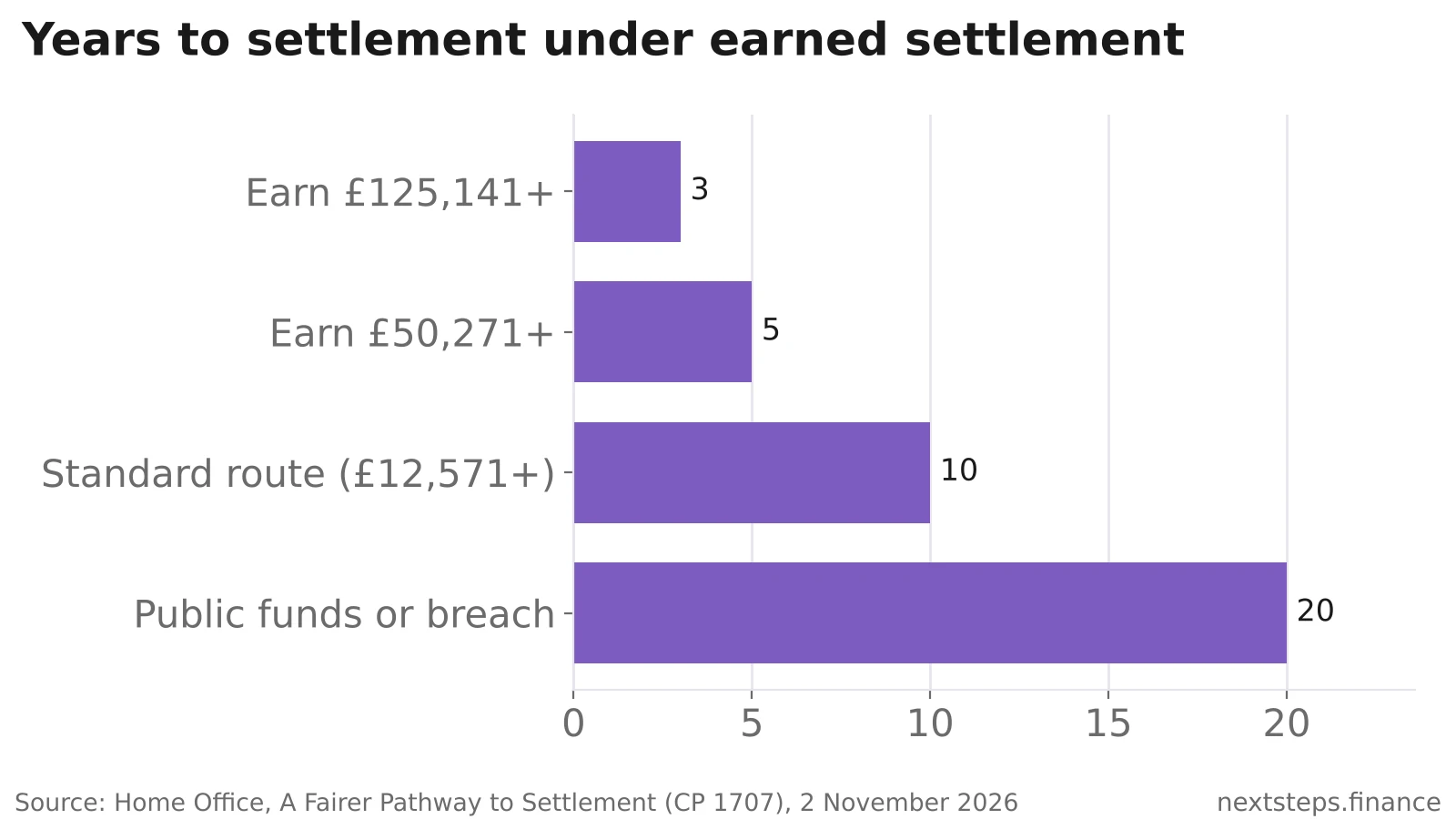
- The default wait for ILR doubles to 10 years, up from 5 on most work routes today.
- Higher-rate earners can settle in 5 years: at least £50,271 a year in 3 of the 5 years before applying.
- Additional-rate earners can settle in 3 years: at least £125,141 in 3 of the 4 years before applying.
- Everyone must earn at least £12,571 a year, with exemptions for children, people aged 65+ and some people with health conditions. Couples can share a £25,142 household threshold.
- Claiming specified public funds in the 5 years before applying, or an immigration breach as an adult, means a 20-year wait.
What was announced on 2 November 2026?
The government confirmed its "earned settlement" policy after a consultation that drew 204,667 responses. It sets out the final policy, but the detailed Immigration Rules still have to be published.
This matters for timing. The consultation response says "before implementation, the Government will publish further guidance", and law firm Adam Bernard notes "the government has not yet confirmed a single commencement date". So nothing changes today, but the direction is now fixed.
The other key point is when the rules apply. The Home Secretary said "the rules around settlement are determined when a settlement decision is made. Not at the point when someone arrives." So if you're already in the UK on a 5-year route, you'll generally be assessed under the new rules unless you fall into a protected group (see below).
Settlement itself isn't changing: once you have ILR, you still get access to public funds and social housing. The Home Office news release says "settled status will never be removed from anyone who already holds it".
What are the new earnings thresholds for ILR?
Each threshold is £1 above an income tax band limit, and the consultation response says they "will remain linked to the relevant income tax thresholds". If the tax bands rise, so do these.
| Earnings (per year) | Linked to | Qualifying period | How many years you need it |
|---|---|---|---|
| £125,141 or more | Additional rate | 3 years | 3 of the 4 years before applying |
| £50,271 or more | Higher rate | 5 years | 3 of the 5 years before applying |
| £12,571 or more | Basic rate | 10 years | Minimum contribution (see below) |
| £25,142 household | Twice the basic minimum | 10 years | For couples sharing income |
A few points worth knowing:
- "Best years" count. You don't need to hit the threshold every year. The government says gaps for maternity or parental leave, caring or ill health won't on their own push you onto a longer route.
- The minimum contribution period isn't fully settled. The consultation response refers to £12,571 a year "for at least three years", while its "best years" approach uses 5 of the last 7 years for the 10-year route. Check the final rules when they're published.
- Exemptions from the £12,571 minimum apply to children, people aged 65 or over and people who can't meet it because of a physical or mental condition.
- Evidence rules aren't published yet. The government hasn't said exactly how earnings will be checked.
Scottish taxpayers have different income tax bands, and the government hasn't yet spelled out how the thresholds apply in Scotland. If that affects you, watch for the detailed rules.
Take Action: Check your last five years of gross pay on your P60s or your HMRC personal tax account. Knowing how many "best years" you already have tells you which route you're likely to be on.
Who can still settle in 5 years?
Several groups keep or get a 5-year route regardless of earnings:
- Partners, parents and children of British citizens (the government estimates 223,000 people keep the 5-year route here, while 39,000 move to a longer one)
- UK Ancestry visa holders (Commonwealth citizens with a UK-born grandparent)
- Public service workers with 5 years in eligible health or education jobs on national pay scales, such as doctors, nurses and teachers
- Care workers who arrived or switched before the May 2025 immigration white paper, who earn at least £25,000 and meet sponsorship and employment conditions
- Hong Kong BN(O) visa holders, who keep "their current pathways"
- Refugees on safe and legal routes
Care workers who don't qualify for the transitional route will be offered a further 5-year Health and Care visa, not tied to their old employer, before applying again. The government says up to 196,000 care workers could be affected.
What about benefits and public funds?
This is the biggest money issue in the new rules. To use the 3, 5 or 10-year routes, you must not have received "specified public funds" in the 5 years before applying. Otherwise you go onto the 20-year route.
The government hasn't yet said which benefits count. The consultation response says it "will then determine which benefits and forms of support are taken into account", starting from the existing definition of public funds in the Immigration Rules. Until that list is published, get advice before claiming anything you're unsure about.
There are other requirements for everyone:
- No UK criminal record. Any adult with a UK criminal record, including court fines and conditional cautions, will be refused settlement.
- No government debt: no outstanding NHS charges, unpaid tax, National Insurance or Home Office litigation debt.
- English at B2 level, up from B1, roughly equivalent to A level in a foreign language.
- The Life in the UK test stays.
The debt rule makes basic tax admin important. If you're self-employed or have a side income, an unpaid tax bill could block your application. Our Self Assessment deadline guide covers the 31 January 2027 deadline.
Take Action: Clear any NHS, HMRC or other government debts now, and keep proof of payment.
How does this affect your finances?
The rules reward higher earnings and a clean record, so planning ahead can save years.
- Know your number. If you earn close to £50,271, a pay rise, bonus or overtime could move you from a 10-year to a 5-year route. The rules haven't yet confirmed whether salary sacrifice (for example pension contributions) reduces the earnings that count, so check before changing your pay.
- Budget for a longer wait. A 10-year route can mean more visa extensions, with their fees and the Immigration Health Surcharge. Build these into your plans with our UK Budget Planner.
- Build an emergency fund so a job loss doesn't push you towards benefits that could affect settlement. Our emergency fund guide explains how much to aim for.
- Understand your tax band. Our income tax guide explains how the bands work, and the Budget 2026 guide covers the latest tax changes.
Immigration decisions depend on your exact circumstances, so get regulated immigration advice from a solicitor or an OISC-registered adviser before making big decisions. For help with the money side, see our personal finance review.
When do the new settlement rules start?
No start date has been confirmed. The government will publish detailed Immigration Rules and guidance first.
Changes to the Immigration Rules are made through a "statement of changes" laid before Parliament. The House of Commons Library explains these take effect unless either House votes against them within 40 days. One date is already set: care workers whose sponsor loses its licence will have 120 days from 1 February 2027 to find a new job offer.
The government estimates over 500,000 people will now wait longer than 5 years to settle.
Take Action: If you're close to qualifying for ILR under today's rules, get advice now on whether you can apply before the new rules take effect.
FAQ
What is earned settlement in the UK?
Earned settlement is the UK government's new system for indefinite leave to remain, confirmed on 2 November 2026. The standard wait rises to 10 years, but you can settle sooner through higher earnings, public service or a British family connection. Claiming specified public funds or an adult immigration breach can extend the wait to 20 years.
How much do I need to earn to get ILR in 5 years?
You need to earn at least £50,271 a year, the higher-rate tax threshold, in 3 of the 5 years before you apply. Earning at least £125,141 in 3 of the 4 years before applying cuts the wait to 3 years. Everyone must earn at least £12,571, with some exemptions.
Does earned settlement apply to people already in the UK?
Generally yes. The Home Secretary said settlement rules are decided when your application is decided, not when you arrived. Some groups keep shorter routes, including partners of British citizens, Hong Kong BN(O) visa holders and care workers who arrived before May 2025 and earn at least £25,000. Anyone who already has ILR keeps it.
When do the new ILR rules come into force?
No start date has been confirmed yet. The government confirmed the policy on 2 November 2026 and will publish detailed Immigration Rules and guidance before it takes effect. Changes are made through a statement of changes laid before Parliament, so watch GOV.UK for the date.
Will claiming benefits affect my settlement?
Yes. Under earned settlement, receiving specified public funds in the 5 years before applying moves you onto a 20-year route. The government hasn't yet confirmed which benefits count, so get advice before claiming. Once you have ILR, you can access public funds as now.
Can couples combine income for ILR?
Yes, for the minimum threshold. The government says couples in a genuine and subsisting relationship can meet a household threshold of £25,142, twice the £12,571 individual minimum. Only one partner can rely on the other's income. Check the final rules for how this works with the higher thresholds.
This article is general information, not immigration, legal or financial advice. Rules may change before they come into force.