
Trading 212 vs Freetrade is one of the most common questions from people opening their first stocks and shares ISA. Both apps let you buy shares and ETFs with no dealing commission, and both have a free ISA. The real differences are in what you pay to buy US shares, what happens to cash you haven't invested, and which accounts and investments each one offers. We checked both providers' own pages on 28 November 2026.
Growth
Trading 212 vs Freetrade: Best for an ISA?
Trading 212 vs Freetrade compared: ISA fees, FX costs, interest on cash, SIPPs and free shares, so you can see which app suits how you invest.
In this article
- 01Key takeaways
- 02Trading 212 vs Freetrade: how do they compare?
- 03Which is cheaper, Trading 212 or Freetrade?
- 04Is Trading 212 or Freetrade better for a stocks and shares ISA?
- 05Which pays more interest on uninvested cash?
- 06Trading 212 vs Freetrade for a SIPP
- 07Are Trading 212 and Freetrade safe?
- 08How do the free share offers work?
- 09Which should you choose?
- 10FAQ
Key takeaways
- Neither app charges dealing commission on shares or ETFs, and both ISAs have no account fee on the free plan.
- Currency conversion costs 0.15% at Trading 212 (Help Centre) against 0.99% on Freetrade Basic, 0.59% on Standard and 0.39% on Plus (Freetrade pricing).
- Freetrade Standard costs £5.99 a month (£59.88 a year if paid annually) and Plus £11.99 a month (£119.88 a year).
- Trading 212's Cash ISA tracks Bank Rate minus 0.15 points, which is 3.85% while Bank Rate is 4%. Freetrade pays 1% to 3.5% AER on uninvested cash, capped at £1,000 to £3,000 depending on plan.
- Freetrade's referral gives you and the friend who invited you a free share worth £10 to £100.
Trading 212 vs Freetrade: how do they compare?
Trading 212 is cheaper if you buy US or European shares, while Freetrade offers a wider range of investments and accounts. Here's how they line up on the things that cost you money or limit what you can do.
| Trading 212 | Freetrade | |
|---|---|---|
| Plans | One free plan | Basic £0, Standard £5.99/month, Plus £11.99/month (cheaper if paid yearly) |
| Dealing commission | £0 | £0 on every plan |
| FX fee on non-GBP trades | 0.15% | 0.99% Basic, 0.59% Standard, 0.39% Plus |
| Stocks and shares ISA | Yes, free | Yes, on every plan, no account fee |
| Cash ISA | Yes, Bank Rate minus 0.15 points | Not listed on Freetrade's pricing page |
| SIPP | Yes | Yes, included in every plan |
| Junior ISA | Check Trading 212's app | Yes |
| Interest on uninvested cash | Yes, rate shown in the app | 1% / 2.5% / 3.5% AER on up to £1k / £2k / £3k |
| Range | Shares and ETFs, with Pies and AutoInvest | 9,000+ including shares, ETFs, 1,200+ funds, gilts and Treasury bills |
| Referral | Campaigns vary, none verified today | Free share worth £10 to £100 each |
If you're comparing more widely, our guide to the best stocks and shares ISAs covers platforms that charge a percentage fee as well, and best commission-free investing apps covers the rest of the app-based field.
Take Action: Decide first whether you'll mainly buy UK or global investments. That single choice drives most of the cost difference.
Which is cheaper, Trading 212 or Freetrade?
For most people buying global shares, Trading 212 is cheaper, because its FX fee is 0.15% and it has no paid plan. Freetrade's free Basic plan costs nothing to hold, but charges 0.99% every time you buy or sell in another currency.
Both platforms pass on the same government and exchange charges. You pay 0.5% stamp duty when you buy UK-listed shares (not ETFs or AIM shares) on either, as Freetrade's SIPP charges schedule sets out. These don't make one cheaper than the other.
The gap shows up when you buy US shares or US-listed ETFs. On £5,000 of US share purchases in a year:
- Trading 212: 0.15% FX = £7.50
- Freetrade Basic: 0.99% = £49.50
- Freetrade Standard: 0.59% = £29.50, plus £59.88 for the annual plan = £89.38
- Freetrade Plus: 0.39% = £19.50, plus £119.88 for the annual plan = £139.38
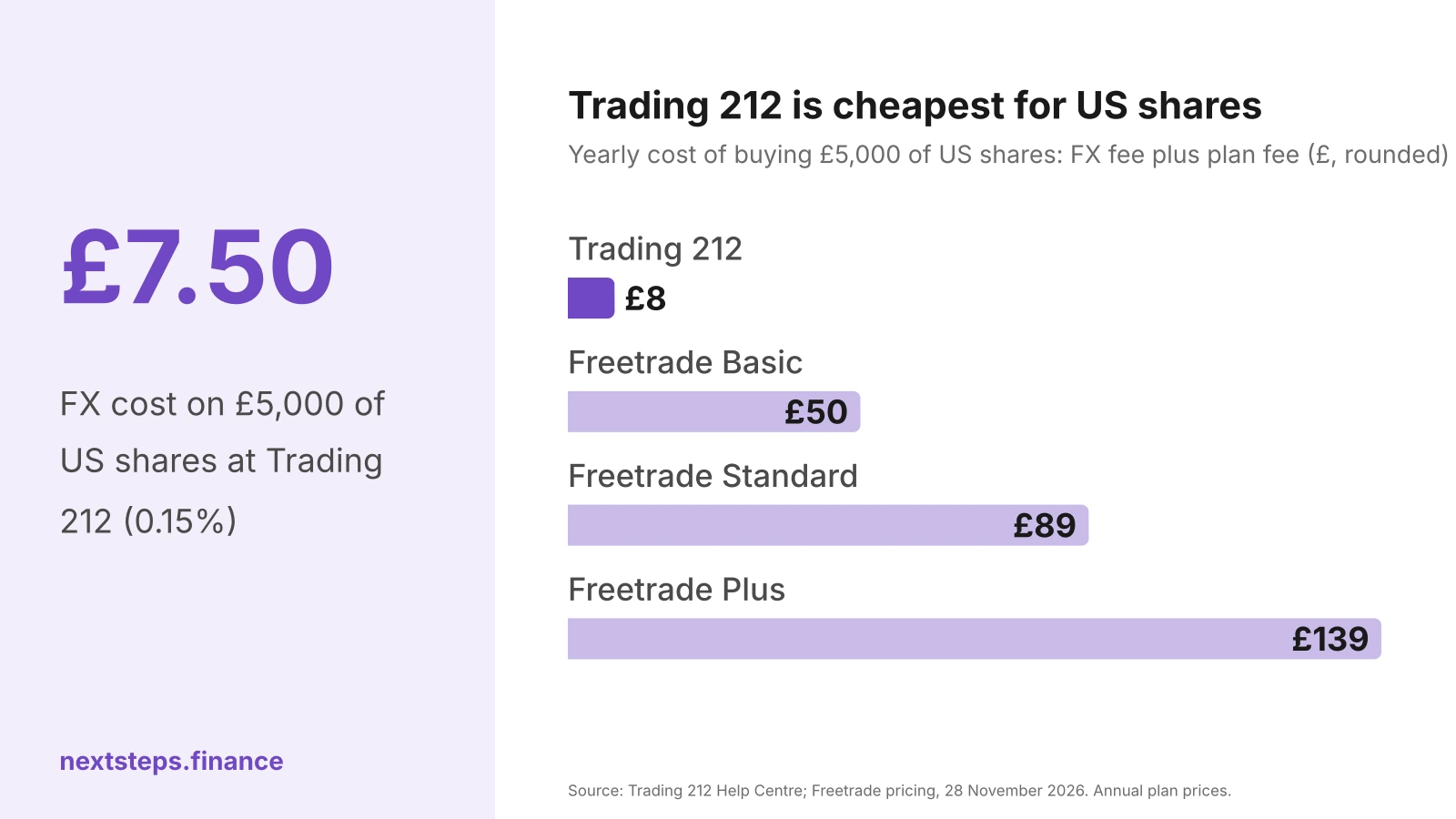
The FX fee applies when you sell as well, so a round trip costs roughly double. Paid Freetrade plans earn some of their cost back through interest on cash (see below), but at £5,000 a year of US buying, the subscription costs more than the FX it saves.
If you mainly buy UK shares or UK-listed ETFs priced in pounds, no FX fee applies on either app, and Freetrade Basic and Trading 212 cost the same: nothing beyond stamp duty where it applies.
Take Action: Add up how much you expect to invest in non-GBP assets each year and multiply by each FX rate. That's your real cost on each app.
Is Trading 212 or Freetrade better for a stocks and shares ISA?
Trading 212 may suit you if you want a free, low-cost ISA for global shares and ETFs, and Freetrade may suit you if you want funds, gilts or a family set-up with a Junior ISA. Both ISAs are free to hold and both take ISA transfers in.
The ISA allowance for 2026/27 is £20,000, and Freetrade confirms you can split it across more than one ISA in the same tax year. That means you can hold both a Trading 212 ISA and a Freetrade ISA and pay into both, as long as your total stays within £20,000. Freetrade's ISA is flexible, so you can withdraw and replace money in the same tax year without using up more allowance. The cash ISA limit also stays at £20,000 for now, as our Budget 2026 cash ISA guide explains.
Trading 212's Pies and AutoInvest let you build a portfolio of shares and ETFs and add money automatically, which suits regular monthly investing. If you hold pies with assets in other currencies, Trading 212 says conversions are charged at its standard 0.15% FX fee.
Freetrade's ISA gives access to its full range, including more than 1,200 funds, gilts and investment trusts. If you want a traditional index fund rather than an ETF, check your chosen fund is available before opening an account.
We've reviewed Trading 212's ISA in more depth in our Trading 212 ISA review. If you're deciding between an ISA and a pension for long-term money, our ISA vs pension calculator shows how tax relief changes the numbers.
Take Action: If you invest monthly in a handful of global ETFs, compare the FX cost first. If you want funds, check Freetrade's search for your fund before you sign up.
Which pays more interest on uninvested cash?
Trading 212 has the edge for larger cash balances, because Freetrade caps the balance that earns interest at £1,000 to £3,000. Trading 212 pays interest on uninvested cash with no minimum balance, and its Cash ISA rate is set by formula.
Trading 212's Cash ISA tracker page says the rate is "0.15% below the BoE's base rate", updates immediately when Bank Rate changes, accrues daily and is paid monthly. The Bank of England raised Bank Rate to 4% at its meeting ending 4 November 2026 (Monetary Policy Report), so the Cash ISA rate works out at 3.85%. For uninvested cash in the Invest and Stocks and shares ISA accounts, Trading 212 shows new customers' rates in its terms and existing customers' rates in the app, so check there.
Freetrade pays:
| Plan | Interest on cash | Limit |
|---|---|---|
| Basic (£0) | 1% AER | Up to £1,000 |
| Standard (£5.99/month) | 2.5% AER | Up to £2,000 |
| Plus (£11.99/month) | 3.5% AER | Up to £3,000 |
The most a Plus customer can earn from this is about £105 a year (3.5% of £3,000), which is less than the £119.88 the plan costs on annual billing. Freetrade's SIPP schedule also says cash in the SIPP doesn't earn interest. If you want to hold a large cash buffer, a dedicated savings account or cash ISA will usually pay better than either app's investing cash; see our comparison of cash ISAs and savings accounts.
Take Action: Don't pick an investing app for its cash rate. Keep larger cash sums in a savings account and invest from there.
Trading 212 vs Freetrade for a SIPP
Both apps now offer a SIPP, and Freetrade's is included in every plan, including the free Basic plan. Freetrade's SIPP charges schedule (version 7.2, April 2026) says there are no other SIPP fees beyond the plan and standard investment charges such as stamp duty and FX. Transfers in and out are free.
The catch is at retirement: Freetrade charges £240 for each UFPLS withdrawal (an uncrystallised funds pension lump sum). If you plan to take regular lump sums that way, that adds up. Freetrade also notes the minimum pension age rises from 55 to 57 from 6 April 2028.
Trading 212's Help Centre confirms it offers a SIPP and that SIPP cash can earn interest. We couldn't verify its SIPP fee schedule today, so check its pension terms before transferring a pension. Pension transfers can mean giving up valuable guarantees, so if you hold a final salary scheme or older policy, get regulated advice or a personal finance review first.
Are Trading 212 and Freetrade safe?
Both are authorised and regulated by the Financial Conduct Authority. Freetrade Limited is a member firm of the London Stock Exchange and authorised by the FCA; Trading 212's UK customers are served by Trading 212 UK Ltd, also FCA authorised.
FSCS protection can step in if an investment firm fails and can't return your assets, but it doesn't cover losses because your investments fall in value. Capital at risk: the value of investments can go down as well as up, and you may get back less than you put in.
Trading 212 also offers CFDs in a separate account. These are leveraged products where most retail accounts lose money, so keep long-term investing in the Invest or ISA account and leave CFDs alone unless you fully understand them.
How do the free share offers work?
Freetrade's referral gives both you and your friend a free share worth between £10 and £100, according to its pricing page. You need to be invited from an existing customer's app.
Trading 212 has run free-share invite campaigns in the past, but we couldn't verify a live amount or end date today, so we won't quote one. If you're joining, check the offer shown when you sign up through Trading 212. Capital at risk.
A free share is a nice bonus, but it's worth tens of pounds at most. Over years of investing, the FX fee and any monthly plan cost matter far more.
If you only want to invest in ETFs and don't need individual shares, InvestEngine is another free option with no platform fee on its DIY portfolios. Capital at risk. We compare it with Trading 212 in Trading 212 vs InvestEngine.
Which should you choose?
This may suit you, depending on how you invest:
| If you... | Trading 212 may suit you | Freetrade may suit you |
|---|---|---|
| Buy mostly US shares or US ETFs | Yes, 0.15% FX | Only on Plus, and the fee usually outweighs the saving |
| Want funds, gilts or Treasury bills | Limited | Yes |
| Want a Junior ISA alongside your own | Check the app | Yes |
| Want automated monthly investing | Yes, Pies and AutoInvest | Check the app |
| Want a free SIPP | Yes, check terms | Yes, Basic plan |
Many investors end up using both: Trading 212 for global shares and ETFs, Freetrade for funds or a Junior ISA. That's allowed within one £20,000 ISA allowance.
Bottom line: For a low-cost ISA of global shares and ETFs, Trading 212 is cheaper because of its 0.15% FX fee and no paid plans. Freetrade costs the same for UK-only investing and wins on range. Capital at risk.
FAQ
Is Trading 212 better than Freetrade?
Trading 212 is cheaper for buying non-GBP shares, with a 0.15% FX fee against 0.99% on Freetrade's free plan, and it has no paid tiers. Freetrade is better if you want mutual funds, gilts, Treasury bills or a Junior ISA. For UK shares bought in pounds, both cost the same.
Does Freetrade charge fees?
Freetrade charges no dealing commission. Its Basic plan is free, Standard costs £5.99 a month (£59.88 a year if paid annually) and Plus £11.99 a month (£119.88 a year). It charges 0.99%, 0.59% or 0.39% FX on non-GBP trades depending on plan, and £240 per UFPLS pension withdrawal.
Can I have a Trading 212 ISA and a Freetrade ISA?
Yes. Since April 2024 you can pay into more than one ISA of the same type in a tax year. Your total across all ISAs must stay within the £20,000 allowance for 2026/27. Freetrade's ISA page confirms you can split the allowance across multiple ISAs.
What interest does Trading 212 pay on cash?
Trading 212's Cash ISA pays Bank Rate minus 0.15 points, so 3.85% while Bank Rate is 4%, accrued daily and paid monthly. Interest on uninvested cash in its Invest and ISA accounts is shown in the app and its terms, with no minimum balance.
How do I move my ISA from Freetrade to Trading 212?
Open the new ISA and ask the receiving provider to transfer it in, rather than withdrawing the money yourself. Withdrawing from a stocks and shares ISA loses its tax-free status unless the ISA is flexible and you put it back in the same tax year. Check exit charges first.
Found this useful? Add Next Steps Finance as a preferred source and Google will show you more of our guides in search and AI answers.