
The Lifetime ISA withdrawal first home process is not an ordinary bank transfer: your provider pays your conveyancer, and the purchase has deadlines. This guide explains the qualifying conditions, declarations, 90-day window and what happens if the sale fails. HMRC updated its guidance on 28 October 2026, including the new charge for higher-priced first homes.
Key takeaways
- The 12-month clock starts with the first payment into the LISA, not the date you decide to buy.
- Your provider pays your conveyancer directly and should do so within 30 days of receiving the required declarations.
- Completion is normally due within 90 days of the conveyancer receiving the money. Extensions of 60 days and then 30 days are possible.
- A qualifying home costing £450,000 or less can be bought without a withdrawal charge. A first-home purchase above £450,000 has a 20% charge from 29 October 2026.
- If the purchase fails, the money should be returned to the LISA. Any shortfall is treated as a withdrawal and charged.
Can I use a Lifetime ISA to buy my first home?
Yes, if you meet the LISA first-home conditions and use the money towards the purchase price of a qualifying residential property in the UK. At or below £450,000, a qualifying purchase can be charge-free; above that price, the new 20% withdrawal charge applies.
HMRC's current guidance says you must:
- Be buying a first residential property in the UK and intend to live there as your only or main home.
- Have made the first payment into that Lifetime ISA at least 12 months before withdrawing.
- Buy with a mortgage or other qualifying loan secured on the property. A buy-to-let mortgage does not qualify.
- Acquire a legal interest in land. A houseboat, for example, does not qualify.
- Use the withdrawal towards the purchase price, not unrelated costs.
Since 6 April 2024, a mortgage from a connected person (as defined in section 993 of the Income Tax Act 2007) does not qualify, and a withdrawal charge applies. Letting the property or using it as a holiday home also triggers a charge.
From 29 October 2026, a first-home purchase above £450,000 attracts a 20% withdrawal charge, under HMRC's policy paper on the reduced charge. This is different from an ordinary unauthorised withdrawal, which generally remains subject to 25%. Check the GOV.UK withdrawal rules and HMRC's first-home guidance. For the wider account rules, see our ISAs and LISAs guide. For the October policy change itself, see our Lifetime ISA penalty-cut guide.
How does the Lifetime ISA withdrawal process work?
Your LISA provider sends the money directly to your conveyancer after receiving declarations from both of you. You do not receive the money in your current account and then transfer it to the seller.
The process is:
- Tell your conveyancer early. Ask whether they can handle a LISA purchase withdrawal and which forms they need.
- Complete the investor declaration. You provide the requested amount, provider details, LISA account number, property address and purchase price, confirmation that you are a first-time buyer, and the seller's conveyancer details where known. You also confirm the money will only be used for the purchase price, that you have not claimed a Help to Buy ISA bonus, and that the information is true and complete.
- Your conveyancer sends their declaration. They confirm they are an eligible conveyancer, that they have received your information and have no reason to think it is untrue, and that the money will only go towards the purchase price. They also give the purchase price, details of the account that will receive the funds and their professional body registration number.
- The provider releases the funds. HMRC says the provider should pay within 30 days of receiving all the required information and declarations. Your provider may have its own forms and process, so confirm the current requirements directly.
HMRC says the withdrawal will not go ahead if the provider has reason to believe the information is untrue or incomplete. There is no minimum withdrawal and you can make more than one, but each must follow the full process; each buyer using a LISA also makes a separate declaration.
The money can only go towards the purchase price. Do not rely on it to pay your solicitor's bill, survey, mortgage fee, removals or other buying costs.
When should I ask my conveyancer to request my LISA?
Start the conversation when you instruct your conveyancer, not just before completion. The account must meet the 12-month rule when the withdrawal is made, and the provider needs time to process the declarations.
The 12 months run from the first payment into the LISA. If you transfer a LISA to another provider using the formal LISA-to-LISA process, HMRC says the original first-payment date carries over. A transfer from a different type of ISA is different: HMRC's digital-reporting guidance says the LISA first-payment date is when the new provider receives those funds.
The 90-day completion period starts when your conveyancer receives the withdrawn money, not when you first request it. If the purchase is progressing but will not complete in time, the conveyancer can request an extension of 60 days and then, if needed, a further 30 days.
The main dates to keep visible are:
| Milestone | Timing | Who acts |
|---|---|---|
| LISA age test | At least 12 months after first payment | You and provider |
| Provider payment | Should be within 30 days after complete declarations | LISA provider |
| Normal completion window | 90 days after the conveyancer receives funds | Buyer and conveyancer |
| First extension | 60 additional days | Conveyancer requests |
| Further extension | 30 additional days | Conveyancer requests |
| Completion notification | Within 10 business days after completion | Conveyancer |
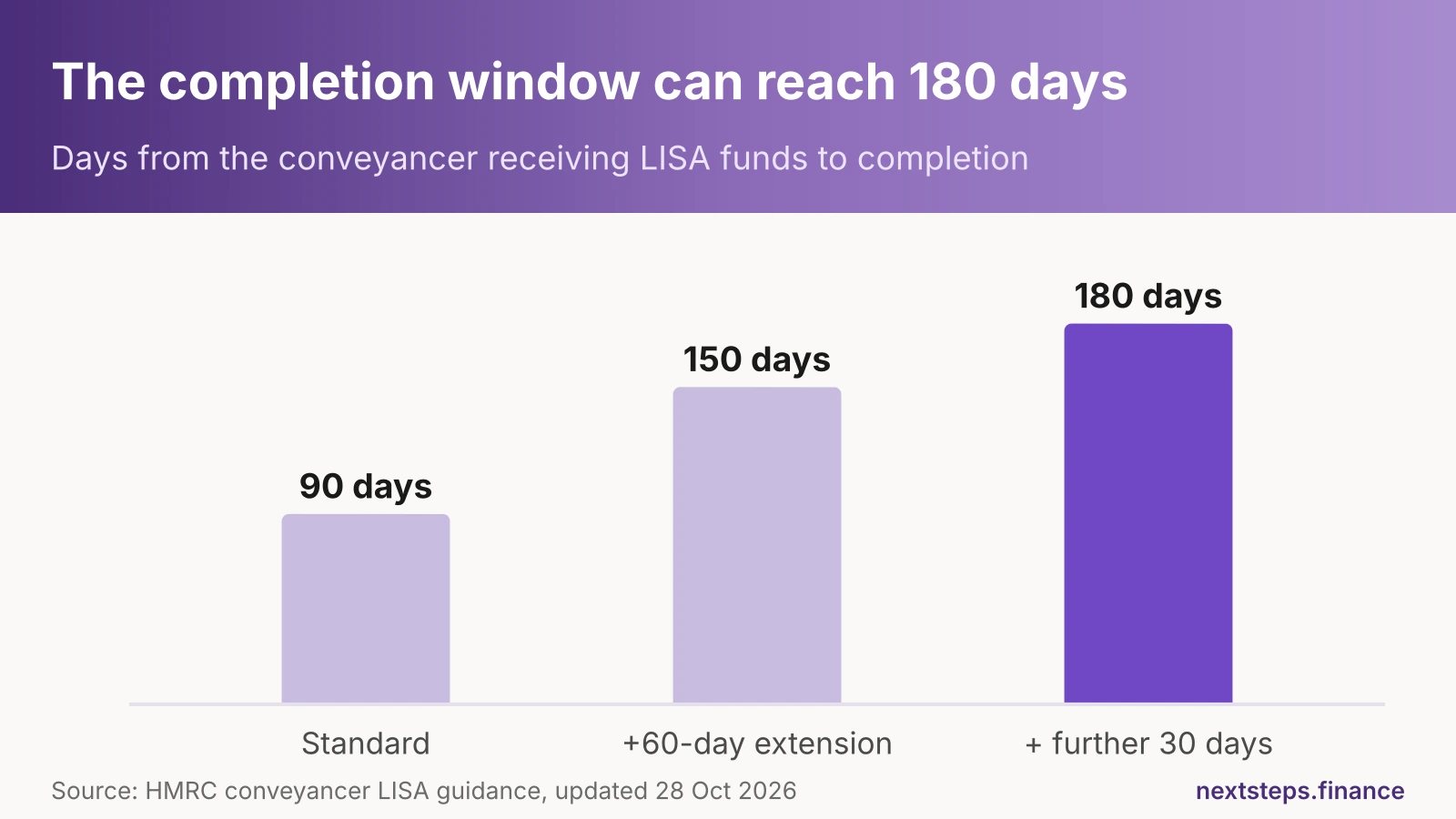
Extensions are not automatic: your conveyancer must ask the provider, which reports them to HMRC. After completion, the conveyancer must notify the provider within 10 business days. This is why it helps to agree the withdrawal date with your conveyancer's timetable rather than treating the LISA like an instant cash transfer.
What happens if the house purchase falls through?
If the purchase does not complete, the withdrawn money should go from the conveyancer back to the LISA provider and then into your Lifetime ISA. It is not meant to be paid to you as ordinary cash.
If the purchase has not completed, HMRC's conveyancer guidance says the conveyancer must send the provider a declaration within 10 business days after the 90 days (plus any extension) and return the full amount withdrawn. Any shortfall is treated as a withdrawal and is subject to a withdrawal charge. Interest earned while the conveyancer held the money belongs to you and doesn't count as a shortfall.
A failed purchase can be awkward if the LISA was closed after the withdrawal. HMRC says the money goes back to the original provider, and you can open a new Lifetime ISA to receive it, even if you have paid into another LISA in the same tax year. Your conveyancer and provider should coordinate this rather than sending the refund to your bank account.
If a chain collapses, contact both parties promptly and confirm who will request an extension or arrange the refund.
What if my LISA is under 12 months old or the home costs over £450,000?
If the first-payment date is less than 12 months before the planned withdrawal, you cannot use the normal charge-free first-home route yet. The provider cannot waive the statutory waiting period because your purchase is ready.
If you transferred from another LISA, ask the new provider to confirm the original first-payment date is recorded correctly. HMRC says a properly reported LISA transfer preserves the date. Do not close the old account or move the money yourself as a substitute for a formal transfer.
For a first home above £450,000, a 20% withdrawal charge applies from 29 October 2026. Other unauthorised withdrawals generally remain subject to 25%. If your agreed price is close to the cap, ask your conveyancer to confirm the purchase price used for the LISA rules before requesting funds.
Try it with your agreed price:
- Agreed purchase price£300,000
If you decide not to buy and keep the LISA for later life instead, our ISA vs pension calculator compares it with a pension.
Can I use a LISA when buying with a partner or through shared ownership?
You can buy jointly with someone who is not a first-time buyer and still use your own LISA, provided you personally meet the conditions. If both buyers want to use their own LISAs, each investor must qualify and make a separate declaration. HMRC sets no limit on the number of buyers.
Two other rules can catch buyers out:
- Help to Buy ISA: you can hold both accounts, but you can only use the government bonus from one of them to buy your first home. HMRC explains the permitted combinations in its conveyancer guidance.
- Shared ownership: the price test is not simply the initial share price. HMRC uses the full sale value, calculated from the share being bought. Its example is a 25% share costing £50,000, which gives a full sale value of £200,000. Ask your conveyancer to confirm the calculation for your lease and scheme.
The planner mentioned below does not cover shared ownership, so buyers using that route should not rely on it.
How should I plan my LISA withdrawal alongside the rest of my deposit?
Treat the LISA as one part of your completion funds, not the whole buying budget. Because the withdrawal can only be used towards the purchase price, keep separate cash for legal fees, surveys, moving costs, mortgage fees and any property tax due in your UK nation.
For a simple purchase, a free spreadsheet or dated checklist may be enough. Track each savings pot, the LISA first-payment date, contributions and bonuses, the declaration date and the expected completion date. Your conveyancer and provider remain responsible for the formal withdrawal.
If you want to map your deposit, LISA bonus, buying costs, mortgage and monthly bills after moving, the UK First-Time Buyer Planner is a Google Sheets option. It has seven connected tabs covering up to six savings pots, a LISA savings log that flags an account that won't be 12 months old in time, Stamp Duty, LBTT or LTT, fees and mortgage affordability.
It is a planning spreadsheet, not a withdrawal service: it does not contact your provider, send declarations, move money or guarantee mortgage approval. It is also not designed for shared ownership, Right to Buy, guarantor mortgages, buy-to-let or buyers who are not UK resident. If those limits matter to your purchase, use your conveyancer's process and appropriate specialist support instead.
If some of your deposit is a family gift, our gifted deposit mortgage guide explains the lender and conveyancer checks. The borrowing side matters too: our 4.5x mortgage rule guide explains why an income multiple is not a promise of approval.