
A Vinted profit calculator UK sellers can use should show what remains after every cost, not just the payout shown in the app. Calculate each item separately: sale proceeds less stock, packaging, postage you cover, platform charges and refunds. Our UK side hustles guide covers how to get started, and our best side hustles list compares reselling with other options.
Key takeaways
- Vinted's UK price list has no fee for listing or selling; Buyer Protection is charged to the buyer, and Bumps and Wardrobe Spotlight are optional paid extras for sellers.
- Include stock cost, packaging, seller-paid postage, platform fees, promotion and refunds.
- eBay doesn't charge UK private sellers a final value fee in most categories; Depop charges 2.9% + 30p payment processing; Etsy charges percentage fees on every order.
- A platform payout or report is not the same as profit or a tax bill. Keep your own records.
What should a Vinted profit calculator include?
A useful Vinted profit calculator separates the selling price, payout and costs. If you only record the amount that reaches your balance, you can mistake high turnover for a profitable business.
Use this formula:
Item contribution = sale proceeds − purchase cost − packaging − seller-paid postage − platform and payment fees − promotion − refunds and other direct costs.
If the buyer pays for delivery at checkout and you just print the label, there's no seller-paid postage to deduct. If you arrange delivery yourself or pay for an additional service, include the actual cost.
Keep these terms separate: the sale price is what the buyer pays for the item; the payout is what reaches your seller balance after platform deductions; and the item contribution is the payout less the item's purchase and direct selling costs. Overall business profit also includes other business running costs.
A £20 payout is not £20 of profit if the item cost £12 to source and £1 to package.
How do you calculate profit on a Vinted sale?
Start with the amount credited for the item, then subtract costs you actually paid. Vinted's UK price list sets out the Buyer Protection fee charged to buyers and two optional paid services for sellers (Bumps and Wardrobe Spotlight), but no fee for listing or selling an item.
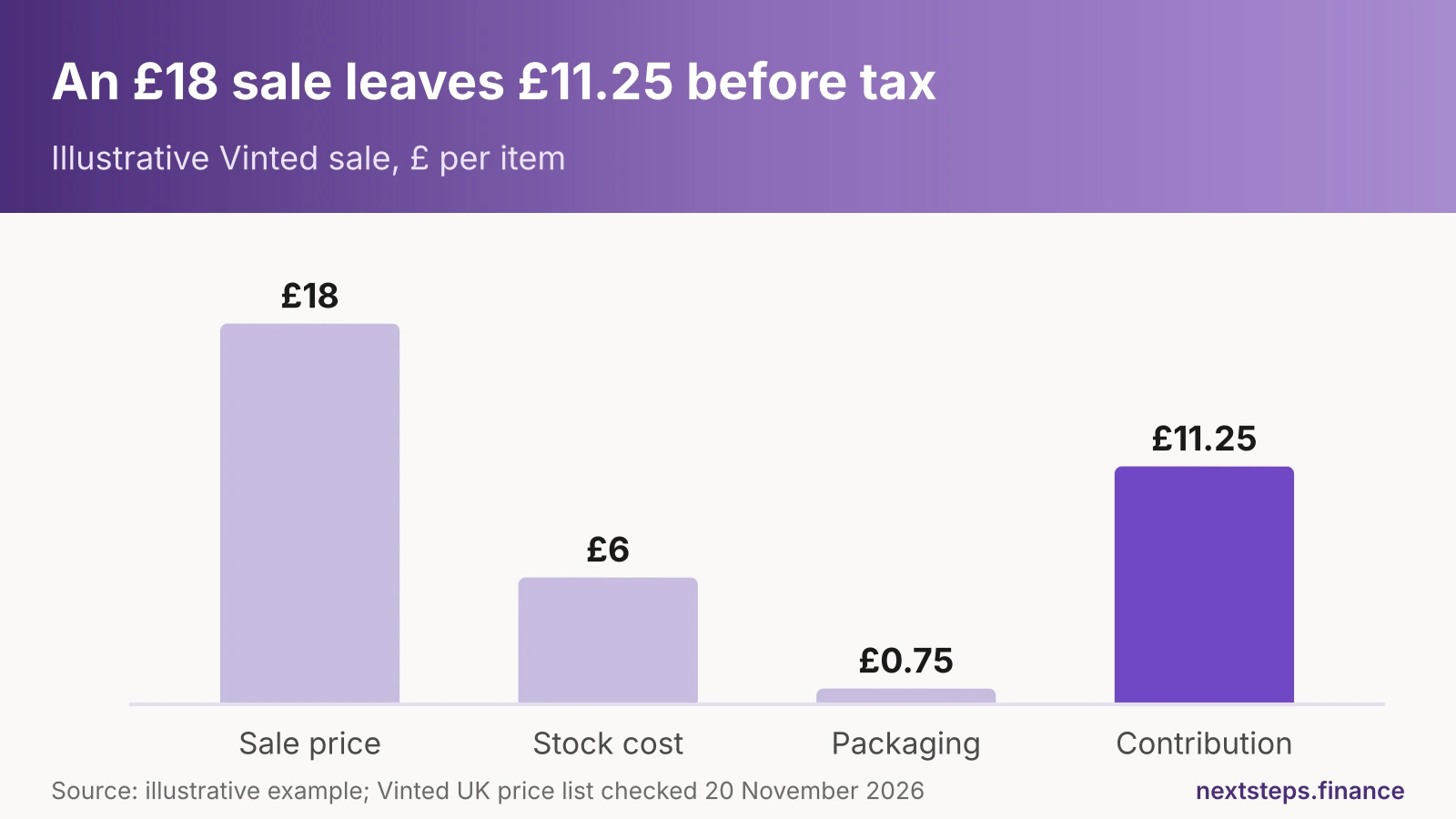
For example, assume you buy a second-hand jacket for £6, sell it for £18, spend 75p on packaging and the buyer pays for delivery:
| Item | Amount |
|---|---|
| Sale price | £18.00 |
| Vinted seller fee | £0.00 |
| Cost of jacket | −£6.00 |
| Packaging | −£0.75 |
| Seller-paid postage | £0.00 |
| Contribution before other costs and tax | £11.25 |
That is a 62.5% contribution margin against the £18 sale price. It is an illustration, not a typical return or earnings claim. It excludes your time, sourcing travel, storage, unsold stock and wider business costs.
For a bundle, allocate the total proceeds and shared costs across the items consistently. Keep the original bundle total so the figures reconcile to the platform statement.
Which costs should you subtract from each sale?
Record costs directly connected with buying, preparing and selling the item:
- Stock: what you paid at a charity shop, car boot sale, auction or supplier. Allocate job-lot costs consistently.
- Preparation: materials used to clean, repair or prepare an item for sale.
- Packaging: mailers, boxes, tape, labels and protective materials. For bulk purchases, calculate a reasonable per-order cost.
- Postage: the amount you actually pay, not the delivery amount displayed to the buyer. If the buyer paid for the label, there is nothing to deduct.
- Fees and promotion: platform, payment-processing, boosts, promoted listings and advertising charges shown on the transaction.
- Refunds and returns: record the original sale and later adjustment separately. If an item comes back and is relisted, do not deduct its stock cost twice.
If you're trading, goods bought to resell are one of the expense categories in GOV.UK's guide to self-employed expenses, alongside costs such as travel and marketing. The cost must be for the business, and you can't claim actual expenses as well as the trading allowance against the same income.
It can also help to record the time spent sourcing, photographing, listing and packing. Your time is not a cash expense in this calculation, but contribution per hour can show whether an item takes too long to sell.
What fees do Vinted, eBay, Depop and Etsy charge UK sellers?
Platform fees can change the result, and private and business sellers face different terms. These are the main published UK charges we could check on 20 November 2026; always check the live fee page and your transaction receipt before setting a price.
| Platform and seller type | Main published seller charges |
|---|---|
| Vinted UK | No fee to list or sell; Buyer Protection is charged to the buyer. Optional paid Bumps and Wardrobe Spotlight, priced at checkout. |
| eBay UK private seller | eBay made selling free for UK private sellers in almost all categories in October 2024 (no final value fee). Optional listing upgrades still cost money. |
| eBay UK business seller | Final value fee by category, charged on the total including postage, plus a 0.35% regulatory operating fee (plus VAT). |
| Depop UK | No selling fee. Payment processing is 2.9% + 30p on the item price plus shipping and any taxes. Boosted listings pay 12% when they sell (policy from 23 March 2026). |
| Etsy UK | A listing fee, a percentage transaction fee on the order including postage, payment processing and a UK regulatory operating fee. Check Etsy's current fee schedule before pricing. |
Sources: Vinted price list, eBay's 2024 announcement and fees page, Depop seller fees and Depop's Boosted Listings Policy.
Depop's processing fee applies to shipping as well as the item price, and the boosting fee is only charged when a boosted listing sells (it isn't charged on Depop Shipping labels). On Etsy, advertising and VAT on fees can add to the final cost.
Vinted's account rules matter if you buy stock to resell as a business. The Vinted Pro page says that to sell with a Pro account you need to be registered as a business; sole traders, non-profits and companies can sign up. If you're sourcing stock to sell at a profit, check Vinted's rules for private accounts before relying on the platform.
Use the actual fee shown on each receipt. Estimates help when pricing, but the transaction record is the figure to reconcile.
How do you set a price that leaves a profit?
Add your stock cost, packaging, any postage you pay, platform charges and the contribution you want to retain. Then check whether buyers are likely to pay that amount for the item in its current condition.
For a Vinted sale where the buyer pays for delivery, £6 stock cost + 75p packaging + £8 desired contribution gives a minimum item price of £14.75 before other overheads.
On a platform charging percentage fees, the fee rises with the order value. Use the current fee schedule or platform calculator, then replace the estimate with the actual receipt when the item sells.
Check comparable sold items rather than relying only on active asking prices. Allow for offers, bundle discounts, promotion, returns and later markdowns. If an item sits unsold, cash remains tied up in stock; a high theoretical margin is no use if it never sells.
How should you track refunds, bundles and unsold stock?
Log an item when you buy it, then update the same record when it sells, is refunded or returned. This keeps the purchase cost attached to the item and shows which stock is still tying up cash.
A simple routine is:
- Give each item a reference and record its source, purchase date and cost.
- Add the platform, listing date and asking price.
- When it sells, enter the sale amount, actual fee, seller-paid postage and packaging.
- Record refunds, returns, boosts or lost-parcel adjustments separately.
- Review monthly sales, fees, contribution, unsold stock and days to sell by platform.
A notebook or free spreadsheet can do this if you update it consistently. Platform statements help with reconciliation. High-volume sellers or people with VAT and complex stock accounting may need bookkeeping software and an accountant.
If you want a ready-made Google Sheets log, the UK Reseller Profit Tracker records purchase cost, platform, sale price, fees, postage and refunds. It has a 500-row item log, platform comparisons, monthly summaries and slow-stock flags. You enter transactions manually; it does not connect to selling accounts, and you can replace estimated fees with the actual fee from a receipt.