
Online marketplace VAT is changing for UK sellers, but it is not a new tax on every eBay or Vinted sale. The change was announced at the Budget on 28 October 2026, and HM Treasury's factsheet says the rules will apply from October 2027. For some sales, the marketplace will account for VAT instead of the UK business.
For the wider picture, see our UK side hustles guide and self-employment guide. This article explains who may be affected, how the two £90,000 tests differ and what sellers can prepare before the new rules begin.
Key takeaways
- The extension is intended to start in October 2027, subject to final legislation and implementation details.
- It covers qualifying business-to-consumer sales of goods by UK businesses where the goods are in the UK at the point of sale.
- Marketplaces will account for VAT on qualifying sales by VAT-registered businesses, whatever their sales value on that platform.
- For a business that is not VAT-registered, the announced minimum platform threshold is £90,000 of annual sales on an individual marketplace.
- Personal sales, second-hand goods and business-to-business transactions are excluded.
- The normal VAT registration test remains separate: it uses total taxable turnover, not just sales on one marketplace.
What is the new online marketplace VAT rule?
Under the new rule, a qualifying marketplace will account for VAT on some goods sold by a UK business. It extends rules that already apply to some overseas sellers and imported goods.
HMRC's policy paper on extending online marketplace liability says the measure covers sales by UK-established businesses where goods are in the UK when sold to a consumer. The marketplace will collect and account for VAT on relevant transactions. The policy is intended to improve compliance where some sellers have not accounted for VAT they already owe; it does not introduce a new VAT rate.
Not every website or app is an online marketplace for VAT. HMRC says a platform must let third parties offer goods and be involved in setting sale terms, payments, and ordering or delivery. A site that only advertises a listing, redirects a customer or processes a payment may not meet the full definition. See HMRC's online marketplace VAT guidance.
The announced extension concerns goods sold to consumers, not every service offered through a digital platform. The goods must be situated in the UK at the point of sale. Different existing rules continue to apply to overseas sellers and certain imported goods. HMRC also lists separate rules for goods moving between the EU and Northern Ireland in its online marketplace guidance.
The government intends the change to begin in October 2027. Some technical details will be set through secondary legislation, and HMRC says it will publish further guidance before implementation.
Who will marketplaces collect VAT from?
The rule is aimed at UK businesses selling qualifying goods to consumers through an online marketplace. Whether the marketplace accounts for VAT depends on the seller's VAT registration status and, for a seller that is not registered, sales on that platform.
| Seller's position | What the announced rule means |
|---|---|
| UK business already VAT-registered | The marketplace accounts for VAT on all qualifying sales through that marketplace, regardless of the value sold there |
| UK business not VAT-registered, with annual sales above £90,000 on one platform | The marketplace is expected to account for VAT on qualifying sales on that platform |
| UK business not VAT-registered, below £90,000 on each platform and below the normal VAT registration threshold overall | The extension is not expected to bring those sales into marketplace VAT collection |
| Individual occasionally selling personal belongings | Personal sales are outside the extension |
Check each sale under the normal VAT rules: it may be taxable, exempt, zero-rated or outside the scope. The marketplace must meet HMRC's definition and the goods must be in the UK when sold.
HM Treasury's factsheet confirms that if you are VAT-registered, the new rules apply to all of your qualifying sales on online marketplaces, and that the £90,000 threshold applies separately to your annual sales on each platform.
Does the £90,000 threshold apply per platform or across all sales?
An unregistered UK business has a £90,000 annual sales threshold on each marketplace. This is separate from the normal VAT registration test, which uses total taxable turnover.
HMRC looks at your total taxable turnover over the last 12 months. Count taxable sales from marketplaces, your own website, shops and other channels. The threshold is more than £90,000. You must also register if you expect to go over it in the next 30 days. See GOV.UK's VAT registration guidance.
For example, a seller makes £55,000 of taxable sales on one marketplace and £45,000 on another in the same 12 months. Each platform is below £90,000, but total taxable turnover is £100,000. The seller must consider VAT registration. Once registered, the marketplace rule applies to all qualifying sales, not just the larger platform.
A business with £50,000 of marketplace sales and total taxable turnover below £90,000 would be below both thresholds. The extension would not apply solely because it sells online. Voluntary registration and special VAT rules may still matter.
The platform threshold is not a tax-free allowance and does not change registration duties. HMRC's impact note says secondary legislation will set out how the threshold operates, so details such as how returns and refunds count are still to come.
Try it with your own numbers. Enter your total taxable turnover from every channel over the last 12 months:
- Your total taxable turnover, last 12 months£60,000
Are personal and second-hand sales included?
No. The government has confirmed that personal sales, second-hand goods and business-to-business transactions are outside the extension. This matters to people clearing out a wardrobe and businesses selling used or refurbished goods.
If you occasionally sell your own clothes or household items, the new marketplace VAT rule is not intended to apply. Digital platform reporting is separate: a report to HMRC does not automatically mean you owe tax.
Second-hand goods are also excluded. HM Treasury says businesses selling second-hand goods through marketplaces will keep charging VAT on those sales in the usual way. For eligible items, that can include a VAT margin scheme, where VAT is worked out on the profit margin rather than the full selling price.
This does not make every second-hand sale VAT-free. A VAT-registered dealer may still owe VAT under normal rules or an eligible margin scheme. HMRC's eligibility guide and list of goods explain which items and purchases qualify.
Business-to-business sales are also outside the extension. If you sell to another business, your normal VAT duties still apply. Keep evidence of the buyer's status and the sale.
Is marketplace VAT the same as HMRC's digital platform reporting?
No. These are separate systems. HMRC's digital platform guidance says the reporting rules started in the UK on 1 January 2024, and platforms share seller details and income with HMRC. The new VAT collection rules are intended to start in October 2027.
Platforms report your details and your yearly income (less their fees) by the following January. You aren't reported if you make fewer than 30 sales of goods in a calendar year and receive less than about €2,000 (around £1,700) for them. HMRC says being reported does not automatically mean you owe tax. The report is not a tax assessment and does not replace your own records or tax calculations.
The marketplace rules decide who accounts for VAT on qualifying goods sales. They do not decide whether you are trading for Income Tax, must file Self Assessment or have made a taxable capital gain.
The trading allowance is for small amounts of trading or miscellaneous income for Income Tax. It is not a VAT threshold. Our trading allowance guide explains the Income Tax rules; If you also file Self Assessment, our 31 January deadline guide covers the current filing and payment date.
What should UK sellers do before October 2027?
For now, map your sales channels and records; do not change prices or registration solely because the policy has been announced.
Start with this checklist:
- Separate personal selling from business activity. Record goods bought for resale, goods you make and personal possessions you occasionally sell.
- Track sales by channel. Record marketplace sales separately from your own website, shop, wholesale and direct sales. Keep a combined view of taxable turnover for the normal VAT registration test.
- Keep product records. Note whether goods are new or second-hand, where stock is held when sold, and whether a sale is to a consumer or another business.
- Reconcile transactions. Keep platform statements, invoices, refunds, fees, delivery charges and payout records. A bank payout alone may not show the full value or VAT treatment of each sale.
- Review your VAT status and platform messages. If total taxable turnover is over, or expected to go over, the normal threshold, check the current VAT registration rules. Watch for requests for VAT details or evidence about stock and sales.
The change may affect cash flow and bookkeeping. HMRC's impact note says some businesses may be brought into a repayment position and face extra compliance costs, and the factsheet says HMRC will publish detailed guidance, including on any accounting changes, before the rules start.
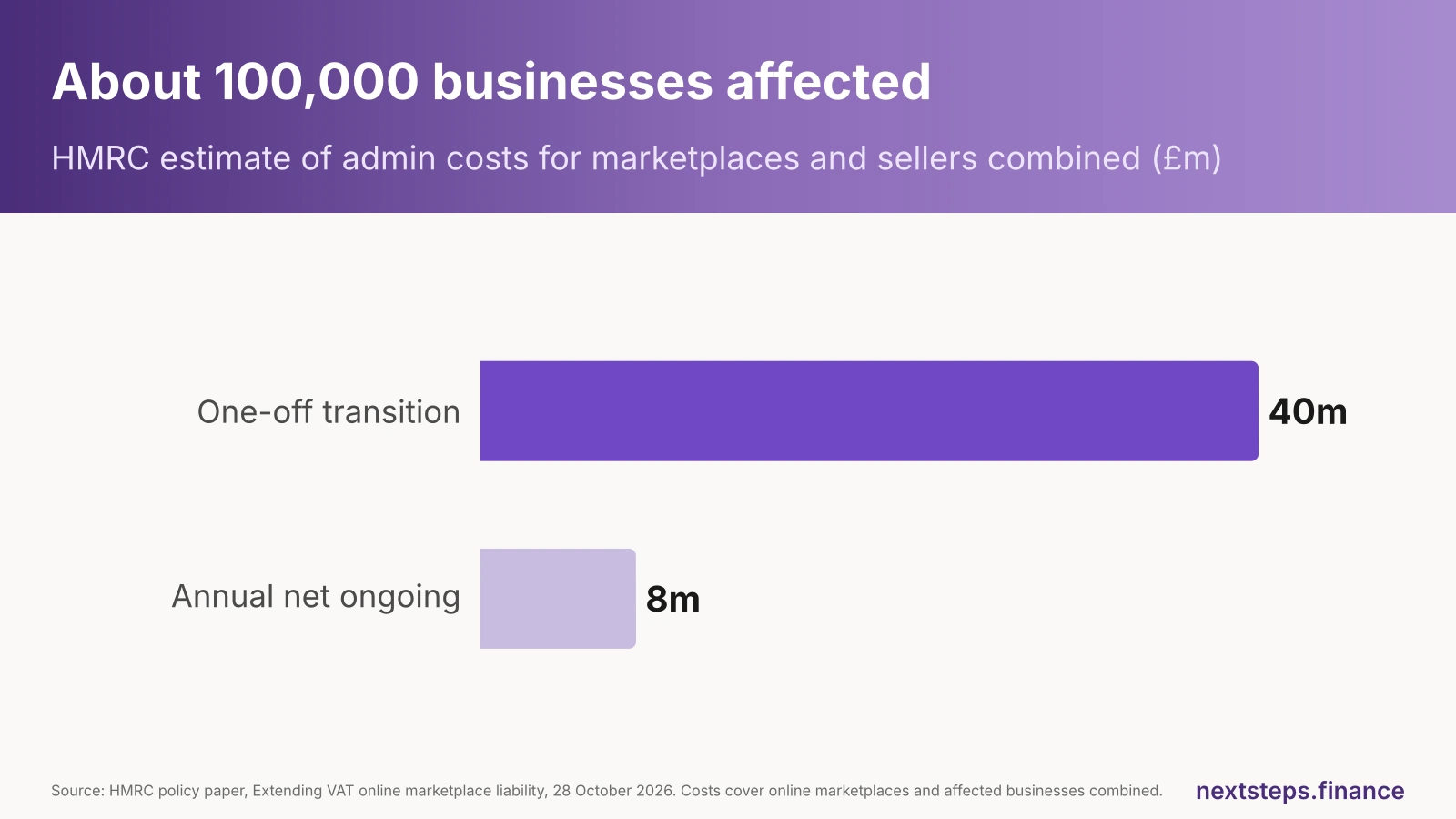
HMRC's impact assessment estimates that about 100,000 businesses could be affected. It estimates £40 million of combined one-off costs and an £8 million net annual increase in administrative costs. These are totals for marketplaces and businesses, not individual seller costs.
Ask your accountant how marketplace statements will fit with your VAT return. The marketplace may account for output VAT, but you still need to consider input VAT recovery, sales through other channels and excluded goods under the normal rules.
For the wider record-keeping picture, see our self-employed finance guide. If you resell on Vinted, eBay, Depop or Etsy, our UK Reseller Profit Tracker is an optional Google Sheets tool that logs each sale by platform, with fees and refunds, so you can see your sales on each marketplace at a glance; a simple free spreadsheet can do the same job. Treat this as a preparation guide rather than a final technical VAT manual.
Frequently asked questions
Will eBay collect VAT from UK sellers in 2027?
The rules are intended to apply to online marketplaces that meet HMRC's definition, rather than naming individual platforms in the legislation summary. A UK business selling qualifying goods to consumers through a marketplace may be in scope if it is VAT-registered or exceeds the £90,000 annual platform threshold.
Do I pay VAT when selling my own clothes on Vinted?
The extension does not apply to personal sales, such as occasionally selling your own clothes or household belongings. Selling personal items is different from buying goods to resell for profit. Separate digital platform reporting rules may still mean the platform shares seller information with HMRC.
Does the £90,000 threshold apply separately to each marketplace?
Yes. The announced minimum platform threshold is £90,000 of annual sales on an individual marketplace for a UK business that is not VAT-registered. However, the normal VAT registration test looks at total taxable turnover across all channels over a rolling 12-month period.
Do I need to register for VAT if my marketplace sales are below £90,000?
Possibly. The platform threshold does not replace the normal VAT registration test. If your total taxable turnover across marketplaces, your own website, shops and other channels exceeds £90,000 over a rolling 12-month period, you may need to register even when no individual marketplace reaches £90,000.
Can a second-hand goods business use the VAT Margin Scheme?
Eligible businesses can continue to use the VAT Margin Scheme where the goods and purchase conditions qualify. The new marketplace liability extension excludes second-hand goods, but that does not remove the seller's own VAT obligations. Check HMRC's current eligibility and record-keeping rules for each type of item.
This article is general information, not tax or accounting advice. VAT treatment depends on your business, goods, customers and sales channels. Check the latest HMRC guidance or speak to a qualified tax professional before changing your VAT registration, pricing or accounting arrangements.