
For most eligible individual landlords and partnerships, HMRC has made cash basis the default since 2017/18. The tax year runs from 6 April to 5 April. Payment dates can therefore change the year in which rent or costs are reported.
These are accounting rules, not tax rates. The method decides which tax year rent and costs fall into, while the rate you pay depends on your wider income and where in the UK you live. For wider context, see our investment property guide.
Key takeaways
- Cash basis counts rent when received and allowable costs when paid.
- It is the default for most eligible individual property businesses with receipts of £150,000 or less.
- Advance rent and agent-collected rent count when received; unpaid rent is generally counted later.
- The method changes timing, not the rules for repairs, improvements or mortgage finance costs.
- Switching methods can require adjustments to avoid counting income or costs twice.
What does cash basis for landlords mean?
Cash basis records rent when received and allowable costs when paid. Traditional accounting (accruals or GAAP) records income when earned and costs when incurred.
| Cash basis | Traditional accounting | |
|---|---|---|
| Rent | When received. | When earned or due. |
| Allowable costs | When paid. | When incurred. |
| Money owed at year end | Generally not included as a debtor or creditor. | Accrued or deferred where required. |
| Main records | Receipts, payment dates and bank records. | Invoices, amounts owed, accruals and prepayments. |
If rent is due on 1 March but paid on 8 April, cash-basis income falls into the tax year when the money arrives. Under traditional accounting, it normally belongs to the year the rent was earned.
Cash basis is not a tax rate or the £1,000 property allowance. The allowance is separate: if you claim it, you cannot also deduct actual allowable expenses for that income, and HMRC says you can't use it if you claim the tax reducer for residential mortgage interest. See HMRC's property allowance guidance.
Who can use cash basis for rental income?
Most individual landlords can use cash basis, and it is the default for eligible property businesses. HMRC says it generally applies to individuals and partnerships. Their receipts counted under cash basis must not exceed £150,000 in the tax year, a limit HMRC reduces proportionally if the business runs for only part of the year.
You must use traditional accounting if, for example:
- The property business is run by a company, a limited liability partnership (LLP), trustees or a partnership with at least one member who isn't an individual.
- Cash-basis receipts for the tax year exceed £150,000.
- Another statutory exclusion applies, or you elect to use generally accepted accounting practice (GAAP).
Jointly owned property has extra rules. Spouses or civil partners taxed on equal shares must both use the same basis. That condition doesn't apply where they own unequal shares and have declared that they want to be taxed on those shares. See HMRC's cash-basis eligibility guidance and our Form 17 rental income guide. Some partnerships of individuals may qualify, but the tracker below is not designed for partnerships.
Check where your own receipts fall:
- Rent and other property receipts you expect this tax year£24,000
When is rent counted under the cash basis?
Rent is normally counted when received, not when due. This matters when a tenant pays late, pays several months in advance or uses a letting agent.
HMRC's examples in PIM1094 cover these situations:
- Late rent: if March rent is not received until April, it is generally counted in the next tax year.
- Rent in advance: if a tenant pays six months' rent in one payment, the full amount is normally counted when received, even if the rental period crosses two tax years.
- Letting agent collections: rent is treated as received when the agent collects it for you, not when the agent transfers it to your bank. HMRC says it still counts even if the agent never passes it on.
- A retained deposit: a refundable tenancy deposit is not automatically rent. If you later become legally entitled to keep part of it, for example to cover damage, that amount is counted when you become entitled to it.
Keep the agent's statement and collection date.
When can landlords deduct expenses under cash basis?
An allowable expense is normally recorded when you pay it. An invoice dated 20 March but paid on 12 April falls into the next tax year. This applies even if the work was completed before 5 April.
The cost must still qualify. Under the cash basis, HMRC allows some capital expenditure to be deducted, but PIM1095 lists exceptions, including capital spending on an ordinary residential property, cars and assets that don't depreciate. For furniture and appliances in a residential let, replacement of domestic items relief applies instead, and capital allowances are generally not available. Our UK landlord allowable expenses guide explains the distinction.
Mortgage payments need separate treatment. Capital repayments are not a rental expense, and HMRC's finance-cost restriction limits relief for residential mortgage interest to the basic rate. Cash basis does not change those rules.
Log the payment date, property, category and whether a cost is a repair, replacement or improvement. Keep invoices as well as bank evidence.
Is cash basis better than traditional accounting for landlords?
Neither method is automatically better. Cash basis can be simpler for a small property business with regular rent and straightforward costs. You generally do not need year-end debtor, creditor, accrual or prepayment adjustments. Traditional accounting can give a clearer picture of rent earned and costs incurred in each period.
Here is an illustration for 2026/27, which runs from 6 April 2026 to 5 April 2027. A landlord has twelve monthly rent instalments of £1,200. The March 2027 instalment is paid late, on 8 April 2027. The landlord pays £2,400 of other allowable costs during 2026/27. A £900 boiler-repair invoice arrives in March and is paid on 12 April 2027.
| 2026/27 calculation | Cash basis | Traditional accounting |
|---|---|---|
| Rent counted | £13,200 (11 payments received). | £14,400 (12 months earned). |
| Other costs and repair | £2,400 paid. | £3,300 incurred. |
| Illustrative property profit | £10,800. | £11,100. |
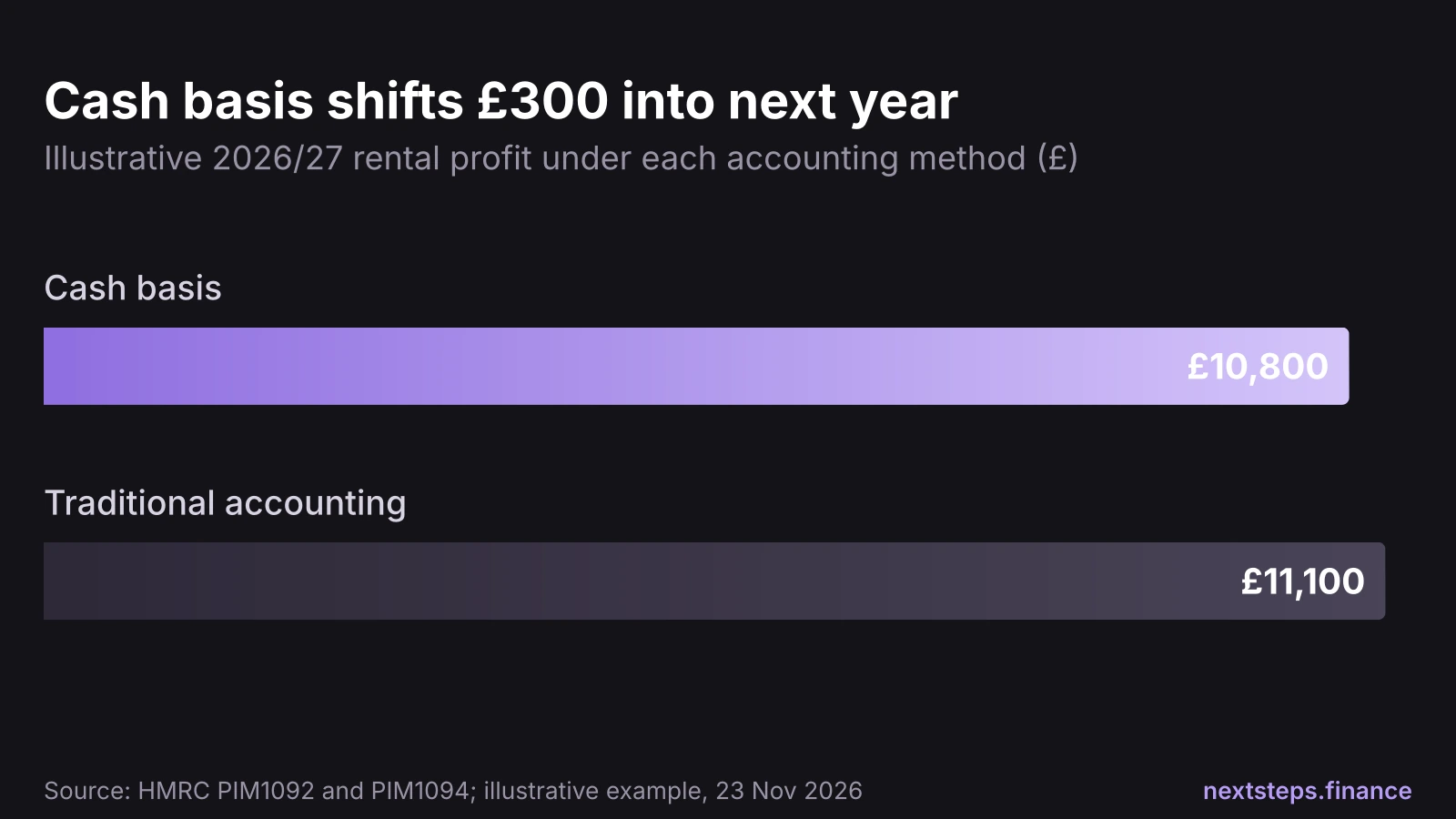
The £300 gap is a timing effect, not a tax saving. Under cash basis, the late rent and repair payment fall into 2027/28; under accruals, they fall into 2026/27. For separate property-income rate changes from April 2027, see our landlord tax rise guide.
Cash basis may suit a landlord with regular rent and simple costs. Traditional accounting may suit more complex arrangements or cases where you need to match income and costs to each period. An accountant can compare both methods using your records.
What records should landlords keep for cash-basis tax?
Keep records showing what was received and paid, when it happened and which property it relates to. HMRC's rental income record-keeping list includes the dates you let the property, all rent you get, allowable expenses, and rent books, receipts, invoices and bank statements.
A useful monthly routine is:
- Save the letting-agent statement and record gross rent collected, including amounts not yet transferred to your bank.
- Log each expense using its payment date, property and category.
- Keep repairs, replacement domestic items, improvements and mortgage finance costs separate.
- Record any deposit money you become entitled to keep, with the reason and date.
- Reconcile the log to bank and agent statements before preparing your Self Assessment figures.
The UK property pages of Self Assessment ask for rental income and allowable costs. A spreadsheet can organise the figures. It does not replace your tax return or HMRC's filing service. If MTD applies to you, use compatible software.
The UK Landlord Tax Tracker is a Google Sheets tool for landlords with one to three personally owned UK rental properties. It has seven connected tabs and a 500-row money log. It also tracks cash flow by property, joint ownership and figures for SA105 boxes 20 to 45. Mortgage interest is kept separate from capital repayments.