
HMRC Form 17 is often mentioned when a couple owns a buy-to-let property in unequal shares, but it is not a way to choose whichever tax split is cheapest. It only works where the beneficial ownership of the property and the entitlement to its income genuinely match.
Key takeaways
- Married couples and civil partners living together are usually taxed 50:50 on jointly owned property income, even if their beneficial ownership is unequal.
- Form 17 can replace that default only when the property shares and income shares are genuinely unequal and match.
- Both people must sign and date the declaration, and HMRC must receive it within 60 days.
- A valid declaration applies to income arising from the date of the last signature. It cannot be backdated.
- Unmarried co-owners, siblings and friends do not use Form 17; different rules apply to their actual entitlement.
What is HMRC Form 17?
HMRC Form 17 is a joint Income Tax declaration that lets a married couple or civil partners living together be taxed on their actual shares of income from jointly owned property, rather than the usual 50:50 split.
The normal rule treats jointly held property income as arising equally to each person, even where beneficial ownership is unequal. A valid Form 17 can override that treatment only where each person's beneficial share of the property matches their entitlement to its income.
The form tells HMRC about an existing position. It does not create a new ownership split, transfer part of the property or replace a deed of trust. It is not a general election to allocate rent to whichever partner has the lower tax rate. See HMRC's Form 17 guidance and TSEM9842 manual.
Who can use HMRC Form 17 for rental income?
Form 17 is only for married couples and civil partners who live together and jointly own property that would otherwise fall under the 50:50 Income Tax rule. Both people must make the declaration together.
The beneficial shares in the property and the entitlement to its rental income must be unequal and identical. A genuine 75:25 property split, for example, must also mean a 75:25 entitlement to the rent. You cannot declare 70:30 income if the property shares are 75:25.
The distinction between joint tenants and tenants in common matters. Beneficial joint tenants do not own defined separate shares, so HMRC says Form 17 cannot be used to declare unequal interests. Tenants in common can have defined shares, including unequal shares, but the documents must support them. See HMRC's guidance on the declaration reflecting the real ownership.
Form 17 is not for unmarried partners, siblings, friends or other co-owners. They are normally taxed on their actual shares, so they don't need Form 17. HMRC says separated couples are not subject to the 50:50 rule and so cannot make a Form 17 declaration. See its eligibility guidance and the Low Incomes Tax Reform Group's joint property income guide.
| Ownership situation | Usual Income Tax treatment | Form 17? |
|---|---|---|
| Spouses or civil partners living together, jointly owned | 50:50 unless a valid declaration applies | Yes, if beneficial property and income shares are unequal and match |
| Unmarried partners, siblings or friends | Their actual shares | No |
| Permanently separated spouses or civil partners | Actual entitlement rather than the living-together 50:50 rule | No |
| Company or partnership ownership | Separate company or partnership rules | No |
What evidence do you need for Form 17?
You need evidence that the beneficial interests in the property are unequal and that the income entitlement follows the same split. HMRC's manual gives a valid declaration of trust as an example, and says the couple should send evidence of beneficial ownership with the Form 17. Form 17 itself is not a deed and does not create an ownership arrangement that did not already exist.
Check the documents that explain who is beneficially entitled to the property and its rental income. Do not assume that the names on the title register, deposit contributions or the bank account receiving rent automatically prove the required beneficial split.
The percentages on Form 17 must match for each property: each person's share of the property must be the same as their share of its income. If they differ, or the shares are equal, a declaration can't be made. HMRC's evidence guidance explains what it expects.
Before completing the form:
- List each jointly owned rental property you want it to cover.
- Confirm the beneficial ownership shares from the relevant legal documents.
- Check that the entitlement to rental income follows those same shares.
- Gather the declaration or deed of trust and supporting evidence.
- Make sure both people can sign and date the form.
If the legal paperwork is unclear, ask a solicitor before changing beneficial ownership; the consequences can extend beyond rental Income Tax.
What is the Form 17 60-day deadline?
HMRC must receive Form 17 within 60 days of the declaration date. That date is when the last spouse or civil partner signs. HMRC's strict time-limit guidance says there is no power to extend it.
If the form is valid and received in time, the new split applies only to income arising on or after the last signature. It does not retrospectively change the split for rent received earlier in the tax year. HMRC explains the effective date in TSEM9860.
If one person signs on 4 December and the other on 9 December, the declaration date is 9 December. HMRC must receive it within the next 60 days, and the new split only affects income arising from that date onwards.
- Confirm the ownership and income shares before either person signs.
- Complete the official HMRC Form 17 and have both people sign and date it.
- Send it with supporting evidence using the instructions on the form, and keep a copy and proof of receipt.
A late form is invalid; a fresh declaration starts a new 60-day window and cannot repair the earlier period.
How is rental income split without Form 17?
For spouses and civil partners living together, the normal tax split is 50:50 if there is no valid Form 17, even where their beneficial interests are unequal. Other joint owners are normally taxed on their actual shares.
Take a married couple who own a buy-to-let 75:25 under a declaration of trust and make £6,000 of rental profit in a year. Without Form 17, £3,000 is attributed to each of them. With a valid declaration in place for the whole year, £4,500 is attributed to the 75% owner and £1,500 to the 25% owner.
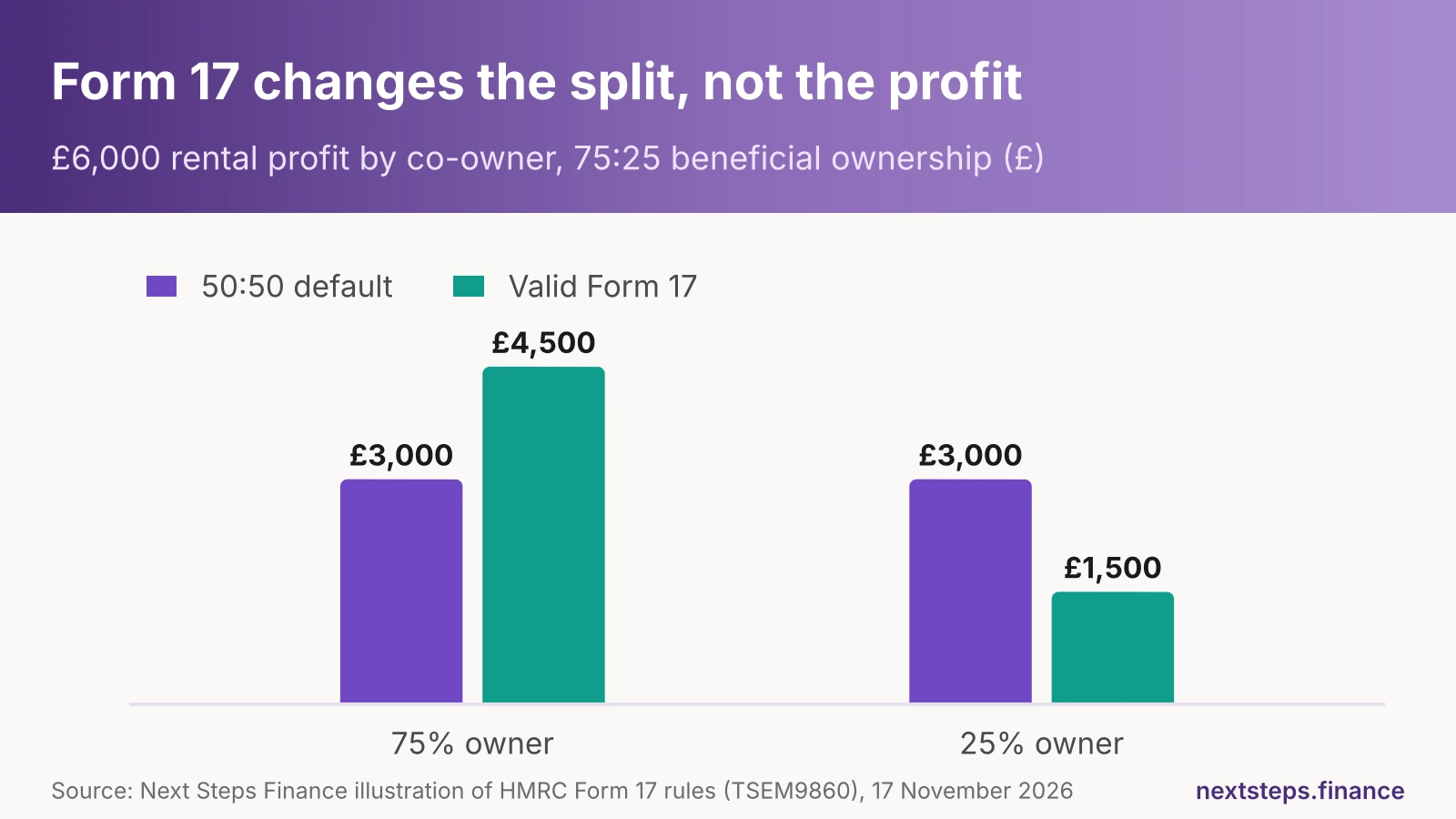
This is the share of rental profit attributed to each person, not the tax they will pay. Each person's final tax depends on their other income, allowances, expenses, losses and the rules for the relevant tax year. Form 17 does not change the property's total profit; it changes how qualifying income is allocated.
For co-owners who are not spouses or civil partners living together, each person normally reports their actual share, and each must be able to support it. Our buy-to-let and investment property guide covers other costs and tax rules that affect a rental investment.
How should joint landlords keep tax records?
Each co-owner reports their own share on their own tax return, even if one person keeps the records. Both should be able to access the figures and evidence.
Keep property-by-property records of rent, allowable costs, invoices and bank statements. Retain the ownership evidence, a copy of the signed Form 17 and proof of when HMRC received it, because the 60-day limit is strict.
A simple spreadsheet may be enough for one property, few transactions and a straightforward ownership split. If you manage several personally owned properties, a structured log can help keep each property's figures and each co-owner's share separate.
Our UK Landlord Tax Tracker is a Google Sheets tracker for up to three personally owned UK properties. It works out joint ownership shares, has a 500-row money log and lays figures out under SA105 boxes 20 to 45.
The tracker uses the cash basis. It is not Making Tax Digital software and does not submit anything to HMRC. If you fall within Making Tax Digital for Income Tax, you need compatible software to keep digital records and send updates. It is not designed for limited companies, partnerships, overseas property, non-resident landlords or Rent a Room in your own home. It is a recordkeeping and planning tool, not tax advice; it does not create a deed, decide whether Form 17 is valid or replace compatible MTD software where you are required to use it.
If you'd rather keep rent, costs and each co-owner's share together across up to three personally owned UK properties: