
If you rent out a property, keeping the receipt is only half the job. You also need to decide whether a payment is a running cost, repair, capital improvement, replacement item or finance cost.
This guide focuses on personally owned UK residential rental property for 2026/27. Company landlords, partnerships, overseas property, non-resident landlords and Rent a Room arrangements can have different rules. Scottish taxpayers have separate Income Tax bands. See our investment property guide.
Key takeaways
- A cost is normally deductible only if it is incurred wholly and exclusively for the property business.
- Repairs that restore the property are usually deductible; improvements and initial furnishings generally are not.
- Replacing qualifying domestic items may attract a separate relief, but buying the first item does not.
- Individual landlords receive a basic-rate tax reduction on qualifying residential mortgage finance costs, rather than deducting the interest from rent.
- The £1,000 property allowance is an alternative to actual expenses, not an extra deduction, and can't be used alongside the mortgage-interest tax reduction.
- Keep rental records for at least five years after the 31 January tax return deadline for the relevant year.
What counts as landlord allowable expenses?
Landlord allowable expenses are ordinary running costs of letting that you pay yourself for the rental business. HMRC's rental income guidance lists the main categories.
| Category | Examples that may qualify |
|---|---|
| Repairs and maintenance | Fixing a leak, replacing broken roof tiles, repairing a boiler or repainting to restore the property |
| Letting and management | Tenant-finding, rent collection and property-management fees |
| Insurance | Landlord buildings, contents and public liability policies |
| Bills and services | Water rates, gas, electricity, Council Tax, cleaning or gardening costs you pay |
| Property charges | Ground rent and service charges on a leasehold property |
| Professional fees | Accountancy fees and qualifying day-to-day legal costs |
| Direct administration | Advertising for tenants, property-related phone calls, stationery and postage |
| Business travel | The rental-business share of vehicle costs, supported by a mileage log |
If an insurer or tenant's deposit reimburses part of a repair, claim only the additional amount you actually pay. You cannot claim a tenant's bill or count the same cost twice.
If you use a phone or vehicle privately as well, only an identifiable business proportion can be considered. HMRC's guidance lists private phone calls and personal expenses among the costs you cannot claim.
Legal fees also need checking. Fees for a first letting on a lease longer than one year are normally capital. Legal costs for a let of one year or less, or renewing a lease of less than 50 years, may qualify. See HMRC's legal and professional costs guidance.
Are repairs and improvements both deductible?
Repairs are normally deductible when they restore an existing part of the property. Improvements are generally capital expenditure, so they cannot be deducted from rental income when calculating the year's property profit.
HMRC's capital-versus-revenue guidance (PIM2030) says it is "largely a question of fact and degree": what matters is what the work achieves, not the wording on the invoice.
| Work carried out | Usual treatment |
|---|---|
| Replacing roof tiles damaged by a storm | Repair; normally deductible |
| Replacing a broken boiler with a modern equivalent | Repair; normally deductible |
| Repainting between tenants to restore existing decoration | Repair; normally deductible |
| Adding an extension or a feature that was not there before | Capital improvement |
| Replacing a kitchen with a significantly higher-specification one | Usually capital to the extent it improves the property |
| Buying a run-down property and making it fit to let for the first time | Initial work is generally capital |
A modern equivalent does not automatically make work an improvement. HMRC says changes that come from advances in technology are generally treated as an allowable repair if the function and character stay broadly the same, giving single glazing replaced with double glazing as its example.
Keep capital-work invoices separately. Qualifying enhancement expenditure may be relevant to Capital Gains Tax when you sell, but it is not automatically deductible in full. Check the CGT rules at the time of sale.
Can landlords claim for replacing furniture and appliances?
Replacement of Domestic Items Relief may apply when you replace an item already provided for a tenant's use. It does not cover the initial cost of furnishing a property.
HMRC's PIM3210 guidance covers domestic items such as furniture, furnishings and appliances. Broadly, the old item must no longer be available to the tenant, the new item must be for the tenant's exclusive use, and the expense must meet the property-business rules.
If the new item is broadly the same quality or standard as the old one, you can deduct its full cost. A brand-new item is not an improvement just because it is new. If you upgrade, HMRC limits the deduction to the lower of the new item's cost and the cost of a like-for-like replacement.
Money from selling the old item is deducted. HMRC's example: sell an old sofa for £100 and buy an equivalent one for £600, and the deduction is £500. With a part-exchange, you deduct the cash you pay, not the trade-in value. Incidental costs such as delivery, installation and disposal of the old item can be added.
Fixtures such as baths, washbasins, toilets, boilers and built-in wardrobes are not domestic items for this relief. Replacing them may instead be an allowable repair to the building. A first-time purchase of appliances is not deductible simply because the property is rented.
Can you deduct mortgage interest from rental income?
If you own a residential rental property personally, you cannot deduct mortgage interest from rental income like an ordinary repair or letting-agent fee. HMRC's rental income guidance says relief on all residential property finance costs is restricted to the basic rate of Income Tax, so it works as a tax reduction at 20% for 2026/27 rather than an expense.
The restriction covers interest on mortgages, loans and overdrafts used for the property, plus fees for taking out or repaying them. Mortgage capital repayments are not deductible at all.
The reduction is not always 20% of every pound of interest: it can be limited in some cases. HMRC's PIM2058 guidance in the Property Income Manual sets out the full calculation.
Keep the interest and capital parts of each payment separate. If you enter the whole mortgage payment as a general expense, you overstate the costs that reduce rental profit. Company landlords and non-residential lets can be treated differently.
HMRC's policy paper confirms separate property rates from 6 April 2027 and notes that Scotland and Wales can set their own. Our landlord tax rise guide explains the wider change. Do not apply future rates to a 2026/27 return.
Is the £1,000 property allowance better than actual costs?
An eligible individual can use the property allowance to reduce property income by up to £1,000 in a tax year. HMRC's tax-free allowances guidance is clear that you use it instead of deducting expenses: you cannot claim both.
It is an allowance for each individual, not £1,000 for each property. Joint owners can each use it against their own share of the gross rent. You cannot use it on income from a company or partnership that you or someone connected to you controls or is part of, or from your employer or your spouse's employer. You also cannot use it if you claim the finance-cost tax reduction on a residential let, which rules it out for most mortgaged landlords.
The chart compares illustrative annual expense totals with the £1,000 allowance. It shows the deduction, not the tax saved:
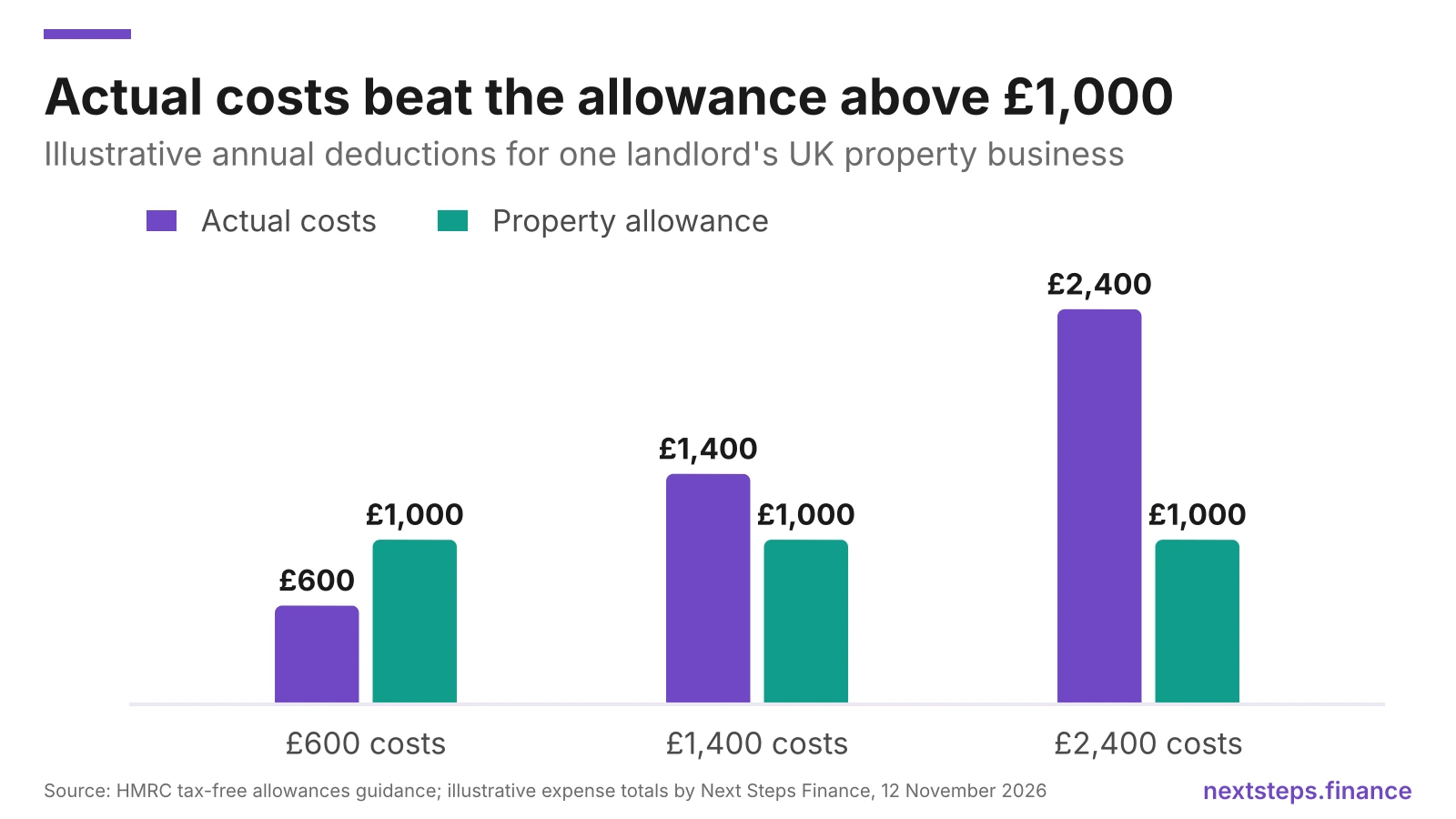
| Illustrative actual costs | Actual-cost deduction | Property allowance | Larger deduction |
|---|---|---|---|
| £600 | £600 | £1,000 | Property allowance |
| £1,400 | £1,400 | £1,000 | Actual costs |
| £2,400 | £2,400 | £1,000 | Actual costs |
This is only a starting comparison. HMRC says the allowance cannot create a loss, whereas actual expenses can produce a loss that is normally carried forward against future profits of the same property business. Your eligibility, any mortgage interest and any brought-forward losses can change the result.
How do joint ownership and multiple properties affect expenses?
HMRC generally treats your UK personally owned lettings as one property business. Add together the rental income and allowable expenses from your UK properties to calculate the overall profit or loss. Overseas property income is dealt with separately.
If one UK property makes a loss and another makes a profit, the figures are normally combined within that UK property business. An overall loss will usually be carried forward against future profits of the same property business, rather than set against your salary.
Joint ownership changes whose return includes the income and costs. Married couples and civil partners who live together are usually taxed on jointly owned property in equal shares. If you genuinely own unequal shares and are entitled to the income in those shares, you can be taxed that way by declaring your beneficial interests to HMRC on Form 17. Other co-owners are generally taxed on their ownership share unless they have agreed a different allocation.
Keep the full invoice and record the share attributable to each owner. The person who paid the contractor is not automatically entitled to claim the whole cost. Our property ownership structures guide explains some wider differences between personal and company ownership.
What records should landlords keep for Self Assessment?
Record each rent receipt and expense as it happens, rather than rebuilding the year from bank statements in January. HMRC lists rent books, receipts, invoices, bank statements and mileage logs as useful evidence. You must keep rental records for at least five years after the 31 January tax return deadline for each tax year.
For each payment, record the property, date, supplier, description, amount, category and any personal-use percentage or reimbursement. Keep the invoice or receipt with the entry. Store capital-improvement invoices separately because they may be relevant to a future CGT calculation.
A free spreadsheet may be enough for one property with few transactions. HMRC's guidance is free, and an accountant or property-software package may be better for complex affairs or features beyond a simple log. Our Self Assessment deadline guide covers the filing timetable.
If you want a structured way to record rent and costs, the UK Landlord Tax Tracker is a £19.99 one-off Google Sheets tool for up to three personally owned UK properties, including jointly owned properties. It has 500 transaction rows, maps categories to SA105 boxes, separates mortgage interest from capital repayments and keeps improvements out of rental profit.
The tracker uses the cash basis, does not submit anything to HMRC and is not Making Tax Digital software or tax advice. It is not designed for limited companies, partnerships, overseas property, non-resident landlords or Rent a Room in your own home. A free spreadsheet may be all you need; the paid tracker is optional.
For company structures, overseas income, major refurbishments or an uncertain repair-versus-improvement decision, speak to a qualified tax adviser or accountant. This guide is general information, not personal tax advice.
Frequently asked questions
Can I claim Council Tax and utility bills when my rental property is empty?
If you are responsible for the bills and they are incurred wholly and exclusively for the rental business, they may qualify. You cannot claim costs paid by the tenant or reimbursed by someone else. Keep the bills and evidence of the void period with your property records.
Can I claim the full mortgage payment as a landlord expense?
No. The capital repayment is not deductible. For a personally owned residential let, qualifying mortgage interest and other finance costs receive a separate basic-rate tax reduction, subject to HMRC's limits. Keep interest and capital repayments separate so you do not overstate rental expenses.
Can I claim for a new kitchen in my rental property?
A like-for-like repair may be deductible, but replacing a kitchen with a higher-specification one is generally capital expenditure rather than a rental expense. The answer depends on the work and the property's condition. Keep an itemised invoice and get tax advice if the project mixes repairs and improvements.
Can I claim for furniture bought before the first tenant moves in?
The initial cost of furnishing a rental property does not qualify for Replacement of Domestic Items Relief. The relief is generally for replacing an existing domestic item that was provided for the tenant's use and is no longer available to them. A later qualifying replacement may be treated differently.
How long do I need to keep landlord expense receipts?
HMRC says rental records must be kept for at least five years after the 31 January tax return deadline for the relevant tax year. Keep invoices, receipts, bank statements and mileage logs. Retain capital-improvement evidence separately because it may be relevant when calculating Capital Gains Tax on a later sale.
Next step: check each cost against HMRC's rules, keep the supporting evidence and separate repairs, capital improvements and finance costs before preparing your return.