A second income can be a useful buffer, but the tax is not calculated in isolation. If you have a PAYE job and also earn as a sole trader, your side-hustle profit can push part of your income into a higher tax band. The key is understanding one Personal Allowance, the Income Tax bands, National Insurance and Self Assessment.
Key takeaways
- One Personal Allowance: the standard allowance is £12,570 in 2026/27. It is usually allocated to your main job first, not repeated for each income stream.
- The £1,000 trading allowance is based on gross income, not profit. You can normally use it instead of claiming actual expenses, but not both against the same trading income.
- Income Tax follows your total taxable income. A side hustle can be taxed at 20%, 40%, 45% or a Scottish rate, depending on what your salary already uses.
- National Insurance is separate: your employer deducts Class 1 NI, and you may also owe Class 4 on self-employed profits. The combined position can affect the final NI calculation.
- PAYE can rule out payments on account: none are needed if last year's Self Assessment bill was under £1,000, or if more than 80% of your tax was already collected at source, for example through PAYE.
How does side hustle tax work when you're employed?
If your side hustle is genuinely self-employed work, you pay Income Tax on its taxable profit as part of your overall income for the tax year. Your employer continues to deduct tax from your wages through PAYE; you normally report the self-employed income and expenses through Self Assessment when required.
HMRC's guidance specifically covers casual self-employed work and side hustles alongside employment. It says you only get one Personal Allowance across your income, and your main job will usually use it first. If your employed income is already above the allowance, taxable side-hustle profit is generally added on top when your Income Tax is worked out.
HMRC's example is someone earning £22,000 from a job and £3,500 from dog walking. If they use the £1,000 trading allowance, £2,500 remains taxable. Because their total income stays within the basic-rate band, the extra Income Tax is £500 at 20%.
So side income is not automatically taxed at 20%: it depends on the space left in your tax bands.
For broader ideas and the basics, see our UK side hustles guide and self-employment guide. HMRC's additional income checker can help you work out whether you need to tell them.
Do you get a second Personal Allowance for a side hustle?
No. The standard Personal Allowance is £12,570 for 2026/27, even if you have a job, a side business and other taxable income. It is not £12,570 for your salary plus another £12,570 for your side hustle.
Your main employer usually applies the allowance through your tax code. If your salary is below £12,570, some may be unused; ask HMRC whether it can be set against your self-employed income.
The allowance is also reduced by £1 for every £2 of adjusted net income above £100,000 and can disappear at £125,140. A side hustle can therefore create an effective 60% marginal Income Tax rate in that range for taxpayers in England, Wales and Northern Ireland. The £100k tax trap calculator shows how the taper works.
How much tax will you pay on side hustle profit alongside a salary?
Your PAYE salary uses the tax bands first. In 2026/27, HMRC's rates for England, Wales and Northern Ireland are a £12,570 Personal Allowance, 20% basic rate on income up to £50,270, 40% up to £125,140 and 45% above.
Here is an illustration using £3,000 of taxable side-hustle profit. It assumes the salary has already used the full Personal Allowance and excludes National Insurance, student loans, pension adjustments and other income.
| Gross PAYE salary | How the extra £3,000 falls | Extra Income Tax |
|---|---|---|
| £30,000 | All at 20% | £600 |
| £49,000 | £1,270 at 20%; £1,730 at 40% | £946 |
| £52,000 | All at 40% | £1,200 |
| £100,000 | 60% effective marginal rate as the allowance tapers | £1,800 |
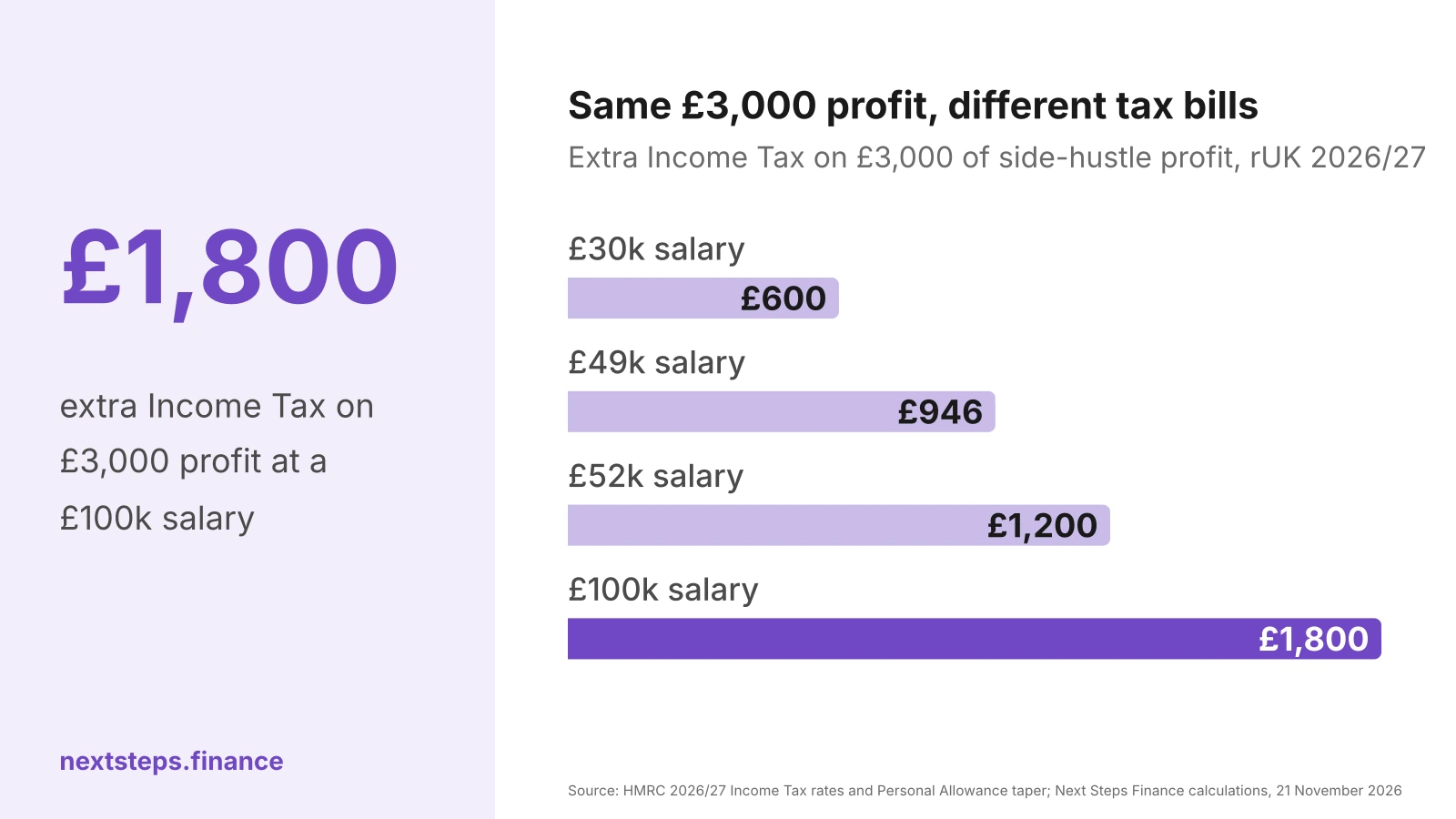
The £3,000 here is taxable profit, not the trading allowance. If you use the current £1,000 trading allowance, for example, you would need £4,000 of gross trading income to leave £3,000 taxable. If you claim actual allowable expenses instead, taxable profit is worked out using those costs.
Try it with your own numbers: enter your salary plus your taxable side-hustle profit to see which band the top slice falls in.
- Salary plus taxable profit (£)£52,000
Scottish taxpayers use different non-savings Income Tax bands. In 2026/27 the Scottish rates are 19%, 20%, 21%, 42%, 45% and 48%, with different thresholds. The Personal Allowance remains £12,570, but the marginal rate on extra profit can differ from the illustration above. For example, the 42% higher rate starts at £43,663 and the 45% advanced rate at £75,001. Check the 2026/27 Scottish rates on mygov.scot.
Our take-home pay calculator gives a salary-only estimate after PAYE deductions. It does not calculate your combined Self Assessment bill, so use it as a baseline rather than a combined estimate.
Do you pay National Insurance twice if you're employed and self-employed?
You may pay two different classes of National Insurance, but they are not simply the same charge collected twice. Your employer deducts Class 1 NI from wages through PAYE. If you are self-employed, you may also owe Class 4 NI on business profits through Self Assessment.
For 2026/27, Class 4 is 6% on profits over £12,570 up to £50,270, then 2% on profits above £50,270. If profits are £7,105 or more, Class 2 is treated as paid to protect your National Insurance record; below that, you can choose to pay voluntary Class 2 at £3.65 a week.
Class 4 is worked out on your self-employed profits through Self Assessment, separately from the Class 1 your employer deducts. If you have high earnings from both, the overall amount can be affected by special rules, so check with HMRC or an accountant rather than assuming. HMRC's self-employed National Insurance rates page sets out the current thresholds.
Do you need to tell HMRC if your side hustle earns less than £1,000?
The trading allowance covers up to £1,000 of gross trading income before expenses. If your total is £1,000 or less, you may not need to tell HMRC, but exceptions apply.
If gross trading income is over £1,000, you will usually need Self Assessment. Choose either the trading allowance or actual allowable expenses for the same income, not both. If costs exceed £1,000, actual expenses may leave a lower taxable profit.
The current allowance remains £1,000 for 2026/27. HMRC's Budget 2026 policy paper confirms it will rise to £3,000 from 6 April 2027, with the Self Assessment reporting threshold also rising to £3,000. That is a future change: do not use £3,000 for income earned in the current tax year. Our £3,000 trading allowance guide covers the transition.
Will PAYE wages affect payments on account or Making Tax Digital?
PAYE matters for payments on account but not for Making Tax Digital. HMRC's manual says no payments on account are needed if the tax left after deductions at source is under £1,000, or if more than 80% of your tax was already deducted at source. If PAYE has collected most of your Income Tax, you may fall within that 80% exception.
Otherwise you pay two instalments, on 31 January in the tax year and 31 July after it, each half of the previous year's tax left after deductions at source. Each one includes a payment towards Class 4 NI. Your HMRC statement shows the actual amounts. Our sole trader payments on account guide explains the cash-flow impact.
Making Tax Digital uses a different test based on your qualifying income from self-employment and property, not your salary. HMRC's thresholds are over £50,000 in 2024/25 (use MTD from 6 April 2026), over £30,000 in 2025/26 (from 6 April 2027) and over £20,000 in 2026/27 (from 6 April 2028).
The tracker below is not Making Tax Digital software and does not send updates to HMRC. If MTD applies, you need compatible software for the required digital records and updates; a spreadsheet tax estimate is not a substitute.
How can you keep your job and side-hustle tax organised?
Keep the two income streams visible throughout the year. Each month, record your PAYE salary and tax deducted, side-hustle sales or fees, refunds, allowable expenses and expected profit. Keep evidence behind each expense and review the estimate when your salary or business income changes.
A free spreadsheet, HMRC's online account and reminders may be enough for a simple side hustle. Consider an accountant if you have several trades, unusual expenses, overseas income or complex pension, student-loan or employment-status questions.
If you'd rather not build this yourself, our UK Self-Employed Tax Tracker is a Google Sheets workbook with seven connected tabs for income, expenses, mileage, working from home, payment dates and a Self Assessment summary. With a job alongside, it works out only the extra tax, including Scottish rates, Class 4 NI and student loans.