
The Bank of England has raised rates for the first time since 2023. About 87% of UK mortgages are fixed, so most homeowners won't notice anything yet. But if you're on a tracker or your lender's standard variable rate (SVR), your payments are going up. Here's how much, when, and what you can do about it.
Key takeaways
- Trackers rise by the full 0.25 points, usually within a month. UK Finance estimates an average increase of £30.72 a month across 510,000 tracker mortgages (PA via Yahoo News).
- SVRs are set by lenders, who don't have to pass the rise on. If they do in full, UK Finance estimates £14.28 a month more on average across 470,000 SVR mortgages.
- On a £250,000 repayment mortgage over 25 years, a 0.25-point rise adds about £36 to £37 a month.
- Fixed-rate borrowers see no change until their deal ends. Around 2.3 million fixed deals end in 2027.
- The next decision is 17 December 2026. Several forecasters expect one more rise by February (see will interest rates rise again?).
How much will my tracker mortgage go up?
A tracker mortgage follows Bank Rate plus a fixed margin, so when Bank Rate rises by 0.25 points, your rate rises by 0.25 points too. How much that adds to your payment depends on your balance and remaining term.
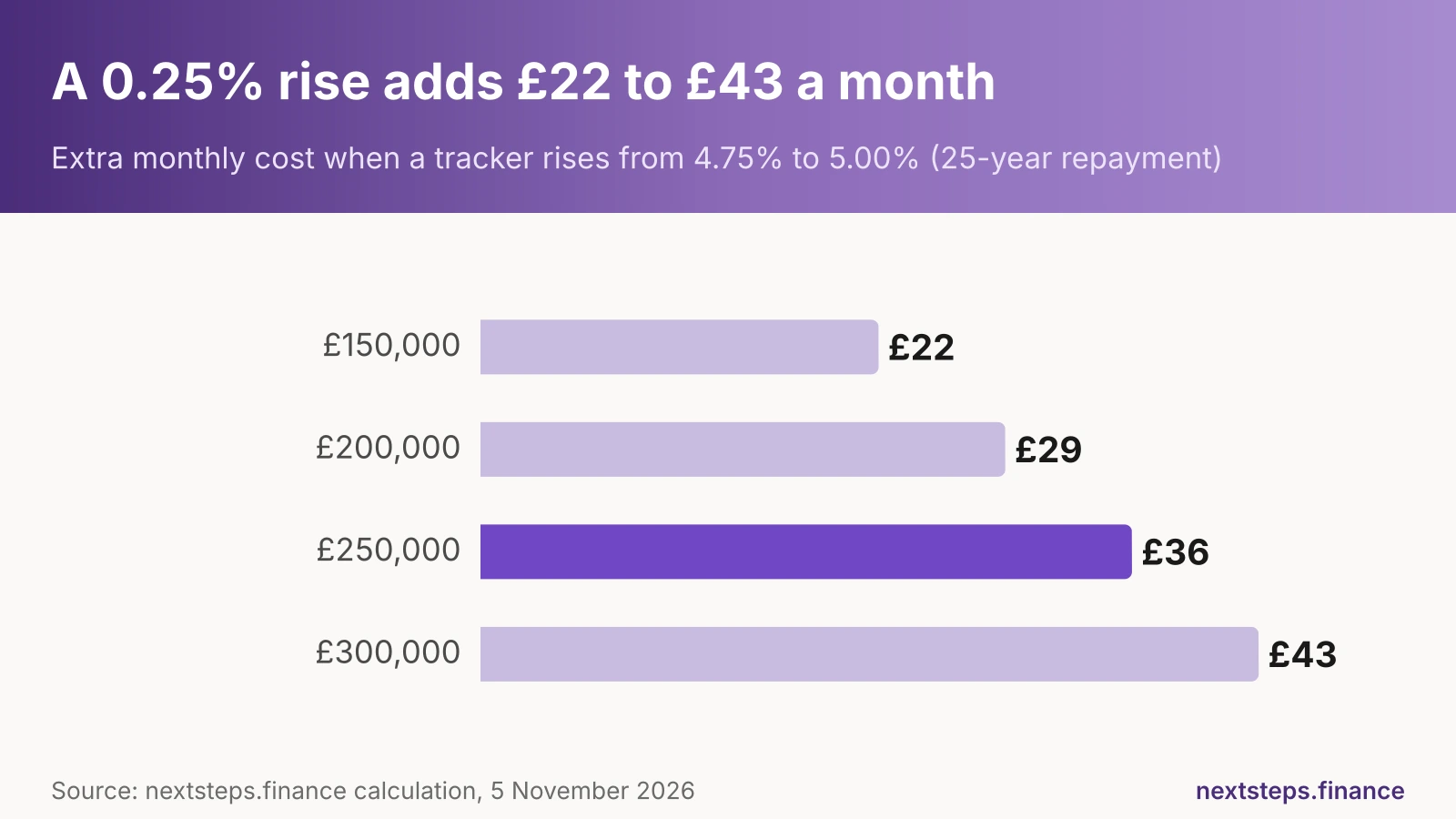
Here's what a 0.25-point rise does on a repayment mortgage over 25 years, going from 4.75% to 5.00%:
| Mortgage balance | Payment at 4.75% | Payment at 5.00% | Extra a month | Extra a year |
|---|---|---|---|---|
| £150,000 | £855 | £877 | £22 | £261 |
| £200,000 | £1,140 | £1,169 | £29 | £347 |
| £250,000 | £1,425 | £1,461 | £36 | £434 |
| £300,000 | £1,710 | £1,754 | £43 | £521 |
That's in line with Moneyfacts' estimate, reported by MoneyWeek, of about £37 a month extra on a £250,000 tracker over 25 years.
Work out your own figure. Put in your balance and your new rate (your old rate plus 0.25 points):
- Mortgage amount£200,000
- Interest rate5%
- Term25 yrs
- Monthly overpayment£0
If you have an interest-only tracker, the rise hits harder in proportion: 0.25 points on £200,000 is £500 a year, or about £42 a month.
When will my payment change?
Most tracker lenders change your rate within a few weeks of the Bank's decision, and your monthly payment from the next billing date after that. Your lender should write to you with the new amount. Check your mortgage offer or the lender's website for how quickly yours updates.
If you're on an SVR, your lender decides whether and when to raise it. Most lenders announce changes within a week or two of a Bank decision and give you notice before your payment changes.
Take Action: Log in to your mortgage account this week and check whether you're on a tracker, SVR or fixed rate, and when any deal ends. Many people on SVRs don't realise they've rolled off a fix.
What if I'm on a standard variable rate?
If you're on your lender's SVR, you're probably paying far more than you need to. The average SVR was 7.13% in early November according to Moneyfacts, against about 6% for the average two-year or five-year fix, as our mortgage rates post explains.
On a £200,000 balance over 25 years, a 0.25-point SVR rise from 7.13% to 7.38% adds about £32 a month. But the bigger saving is usually from moving off the SVR altogether. Most borrowers can switch to a new deal with their current lender (a product transfer) without a new affordability check, or remortgage elsewhere.
Should I switch from a tracker to a fixed rate?
It depends on what you value more: certainty or flexibility.
A tracker may still suit you if:
- You can absorb one or two more 0.25-point rises
- Your tracker has no early repayment charges, so you can switch later
- You expect rates to fall again in 2027-28, as the Bank's projections suggest
A fix may suit you if:
- A further rise would stretch your budget
- You want to know exactly what you'll pay
- Your lender offers a competitive fix without big fees
Lenders have already priced further rises into fixed rates, which is why fixes are higher than many trackers right now. If several more rises are coming, a fix protects you. If rates peak at 4.25% and start falling in 2027, a tracker could work out cheaper. No one knows which, so it comes down to how much risk you can live with.
Check your tracker's terms for early repayment charges before you switch. Many lifetime trackers have none, but two-year trackers often do.
What if my fixed rate ends soon?
If your fix ends in the next six months, you can usually secure a new deal now and still switch to a cheaper one before it starts if rates fall. Around 700,000 fixed deals end in the second half of 2026 and 2.3 million in 2027, according to UK Finance figures reported by PA via Yahoo News.
Our guide on whether to fix now covers this step by step. If you have spare cash, overpaying your mortgage can also reduce the impact of a higher rate.
How to cope with a higher mortgage payment
If the rise squeezes your budget:
- Rebuild your budget around the new payment. Our UK Budget Planner helps you see exactly where an extra £30 to £40 a month will come from, and our guide to protecting your budget as inflation heads to 5% has more ideas.
- Check your term. Extending your mortgage term lowers monthly payments, though you'll pay more interest overall.
- Talk to your lender early if you're struggling. Under the Mortgage Charter, lenders can offer options such as temporarily switching to interest-only or extending your term. Contacting them won't affect your credit file.
- Get free help from MoneyHelper or a debt charity such as StepChange if you're falling behind.
A mortgage is a big decision, and the right choice depends on your circumstances. A mortgage broker can compare the whole market for you. If you'd like help seeing how a higher payment fits with the rest of your finances, book a household finances review.
FAQ
How much will my mortgage go up after the rate rise to 4%?
If you're on a tracker, your rate rises by 0.25 points. On a £250,000 repayment mortgage over 25 years, that's about £36 to £37 a month more. UK Finance estimates the average tracker borrower pays £30.72 a month more. Fixed-rate payments don't change until your deal ends.
When will my tracker mortgage rate increase?
Most tracker rates change within a few weeks of the Bank of England's decision on 5 November 2026, and your payment changes from the next billing date after that. Your lender should write to confirm your new rate and payment. Check your mortgage terms for the exact timing.
Does the rate rise affect fixed-rate mortgages?
No. If you're on a fixed-rate mortgage, your rate and payment stay the same until the fixed period ends. The rise matters when you remortgage, because new fixed rates have already risen. About 87% of UK mortgages are on fixed rates, according to UK Finance.
Will my standard variable rate go up?
Probably, but it's up to your lender. SVRs aren't directly linked to Bank Rate, so lenders can choose whether and how much to raise them. If they pass on the full 0.25 points, UK Finance estimates the average SVR borrower would pay £14.28 a month more.
Should I fix my mortgage now?
It depends on your circumstances. Fixing gives certainty if more rate rises come, and forecasters expect at least one more. A tracker gives flexibility if rates fall in 2027-28. If your fix ends within six months, securing a new deal now is common. Consider speaking to a mortgage broker.
The bottom line
If you're on a tracker, expect to pay roughly £22 to £43 a month more on a typical mortgage, depending on your balance. SVR borrowers may pay more too, and should check whether a new deal would be cheaper anyway. Fixed-rate borrowers are protected until their deal ends.
Check which type of mortgage you have this week, work out your new payment with the calculator above, and adjust your budget now rather than waiting for the letter.