
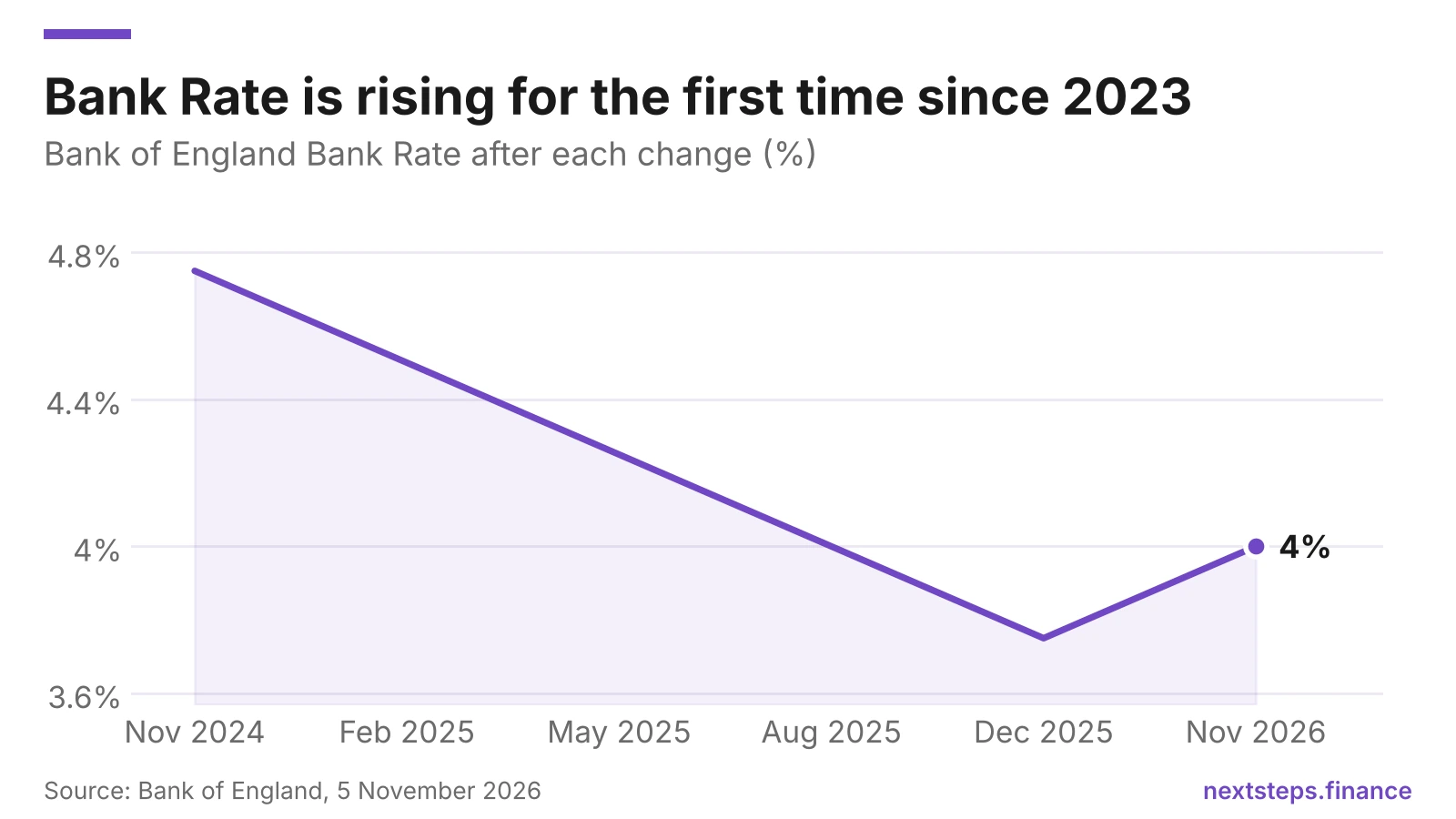
Today's rise was the Bank of England's first since August 2023. The obvious next question is whether it's a one-off or the start of a run of rises, because that decides whether to fix your mortgage now, lock in a savings rate or pay down debt faster. Here's what the Bank said, how the committee is split, what forecasters expect, and the dates to watch.
Key takeaways
- Bank Rate rose from 3.75% to 4% on 5 November 2026. Eight members voted for a 0.25-point rise; Catherine Mann wanted 0.5 points (MoneyWeek).
- The Bank expects inflation to peak at about 4.9% in spring 2027, up from 3.5% in September, mainly because of energy prices.
- Bailey: the rise "shouldn't be seen as the first in an inevitable long sequence of hikes", but it doesn't seem likely to be the last if the conflict continues.
- Forecasters lean towards one more rise to 4.25%, with Deutsche Bank pointing to December or February and Oxford Economics to February 2027.
- Next decisions: 17 December 2026 and 4 February 2027.
Why did the Bank of England raise rates?
The Bank raised rates because it expects inflation to climb well above its 2% target. UK CPI inflation rose to 3.5% in September from 3.1% in August, and higher energy prices linked to the conflict in the Middle East are expected to push it further.
According to Mortgage Soup's summary of the decision, the committee saw limited evidence so far that energy costs had spread into wider prices and wages, but judged that the risk of inflation becoming persistent had grown. Stronger-than-expected economic activity was also a factor.
The rise is an insurance move. The Bank is trying to stop higher energy costs turning into a lasting cycle of rising prices and wages, which would be harder to reverse later.
What did the Bank say about future rises?
The Bank said future decisions will depend on inflation, wage growth and the economy, and that rates are not on a predetermined path. But the message from individual members was mixed, which is why the outlook is uncertain.
ActionForex's summary of the Monetary Policy Report sets out where members stand:
| MPC member | View on what comes next |
|---|---|
| Andrew Bailey (Governor) | A further rise could be warranted unless news reduces inflation risks |
| Huw Pill | A single 0.25-point rise is "unlikely to be sufficient" |
| Megan Greene and Clare Lombardelli | More tightening is likely to be needed |
| Catherine Mann | Voted for 0.5 points today on credibility grounds |
| Alan Taylor | A "one-for-now" insurance rise; the next move could be up, down or unchanged |
So most of the committee seems open to at least one more rise, while a minority sees today's move as enough for now.
When is the next interest rate decision?
The next Bank of England decision is on Thursday 17 December 2026, and the first of 2027 is on Thursday 4 February 2027, according to the Bank's MPC dates. Decisions are announced at 12pm.
Between now and then, watch for:
- October inflation figures, due from the ONS on 18 November 2026
- The January energy price cap, which Ofgem confirms by 25 November. Forecasts point to a big rise (see our January energy price cap forecast)
- Wage growth and jobs data, which the Bank watches for signs of second-round effects
- Oil and gas prices, which move with the Middle East conflict
What are economists forecasting?
Most forecasters quoted after the decision expect one more rise, not a long run of them. From MoneyWeek's live coverage:
| Forecaster | Expected next move |
|---|---|
| Deutsche Bank | One more rise to 4.25%, in December or February |
| Oxford Economics | Rise to 4.25% in February 2027 |
| ICAEW (Suren Thiru) | Further rises "probable", February increasingly likely |
The Bank's own projection has inflation falling back to about 2% by late 2028, which would allow rates to come down again later. But that depends heavily on energy prices. In the Bank's adverse scenario, inflation reaches 5.5% at the end of 2027.
Forecasts change quickly. Treat these as a guide to the direction of travel, not a promise.
What could another rise cost you?
Another 0.25-point rise would add roughly the same again to variable borrowing. On a £200,000 repayment mortgage over 25 years, each 0.25-point rise adds about £29 a month. Test your own numbers by changing the rate:
- Mortgage amount£200,000
- Interest rate5.25%
- Term25 yrs
- Monthly overpayment£0
If you're on a tracker or standard variable rate, our guide to tracker mortgages after the rate rise shows how to work out your exact increase and your options.
What should you do now?
What makes sense depends on your situation, but these steps may help.
If your fixed mortgage ends in the next six months: lenders have already priced in further rises, and average fixed rates are at a three-year high. Securing a deal now protects you from further rises, and you can usually still switch if rates fall before it starts. See mortgage rates hit a 3-year high: should you fix now?
If you're a saver: variable savings rates should edge up, but banks don't have to pass the rise on. Accounts that track Bank Rate move automatically: the Trading 212 Cash ISA pays Bank Rate minus 0.15 points, so it moved to 3.85% today. If you expect rates to peak soon, fixing part of your savings can lock in today's higher rates. Our savings rates after the rise post lists the best deals, and our Cash ISA or savings account guide covers the April 2027 tax rise.
If you have credit card or overdraft debt: your rate can rise with Bank Rate, and it's already far higher. Our credit cards, loans and overdrafts guide covers what to do.
If your budget is already tight: inflation is forecast to near 5% next year. See how to protect your budget.
Take Action: Put 17 December in your diary. If you're weighing a big decision like fixing a mortgage, don't wait for it: decide on today's numbers.
Trading 212 also offers investing products. Capital at risk: the value of investments can go down as well as up. The Cash ISA itself is a cash account.
FAQ
Will the Bank of England raise interest rates again in December?
It's possible. The Bank raised rates to 4% on 5 November 2026 and Governor Andrew Bailey said further rises may be needed unless the Middle East conflict is resolved. Deutsche Bank sees a rise to 4.25% in December or February. The next decision is on 17 December 2026.
Why did the Bank of England put interest rates up?
The Bank raised rates to stop higher energy prices turning into persistent inflation. CPI inflation was 3.5% in September 2026, and the Bank expects it to peak at about 4.9% in spring 2027. Raising rates aims to bring inflation back to the 2% target over time.
How high will UK interest rates go?
Most forecasters quoted after the November 2026 decision expect Bank Rate to peak around 4.25%, with one more rise in December or February. But this depends on energy prices and wage growth. If inflation stays higher for longer, the Bank could raise rates further.
When will interest rates come down again?
Not soon. The Bank's November 2026 projections show inflation peaking in spring 2027 and returning to about 2% by late 2028. Rate cuts would usually follow once inflation is clearly falling, but no one can say exactly when. Watch the monthly inflation figures and MPC decisions.
How did the MPC vote in November 2026?
Eight members of the Monetary Policy Committee voted to raise Bank Rate by 0.25 points to 4%. Catherine Mann voted for a bigger 0.5-point rise to 4.25%. Some reports describe the decision as unanimous because all nine members voted for a rise of some size.
The bottom line
Today's rise to 4% may not be the last. The Bank isn't committing to a series of rises, but most of its members and most forecasters think at least one more is likely, probably to 4.25% by February. The deciding factors are energy prices and whether they feed into wider inflation.
If a decision depends on where rates go next, plan for one more rise rather than hoping for a fall. If you'd like help working through your mortgage, savings and budget together, book a household finances review.