
Welsh income tax rates 2027/28 became clearer on 17 November 2026, when the Welsh Government published its Draft Budget. In a written statement on devolved taxes, Cabinet Minister for Finance Elin Jones said the Welsh rates will "for the first time, include rates specific to property income", and proposed setting each of the six Welsh rates at 10p.
That keeps Welsh taxpayers in line with England and Northern Ireland. The bigger change for landlords is UK-wide: property income moves onto its own, higher rates from 6 April 2027.
Key takeaways
- The Welsh Government proposes 10p for all six Welsh rates in 2027/28 (three main bands and three property bands), subject to Senedd approval.
- Main rates on salary, pensions and self-employed profit would stay at 20%, 40% and 45%.
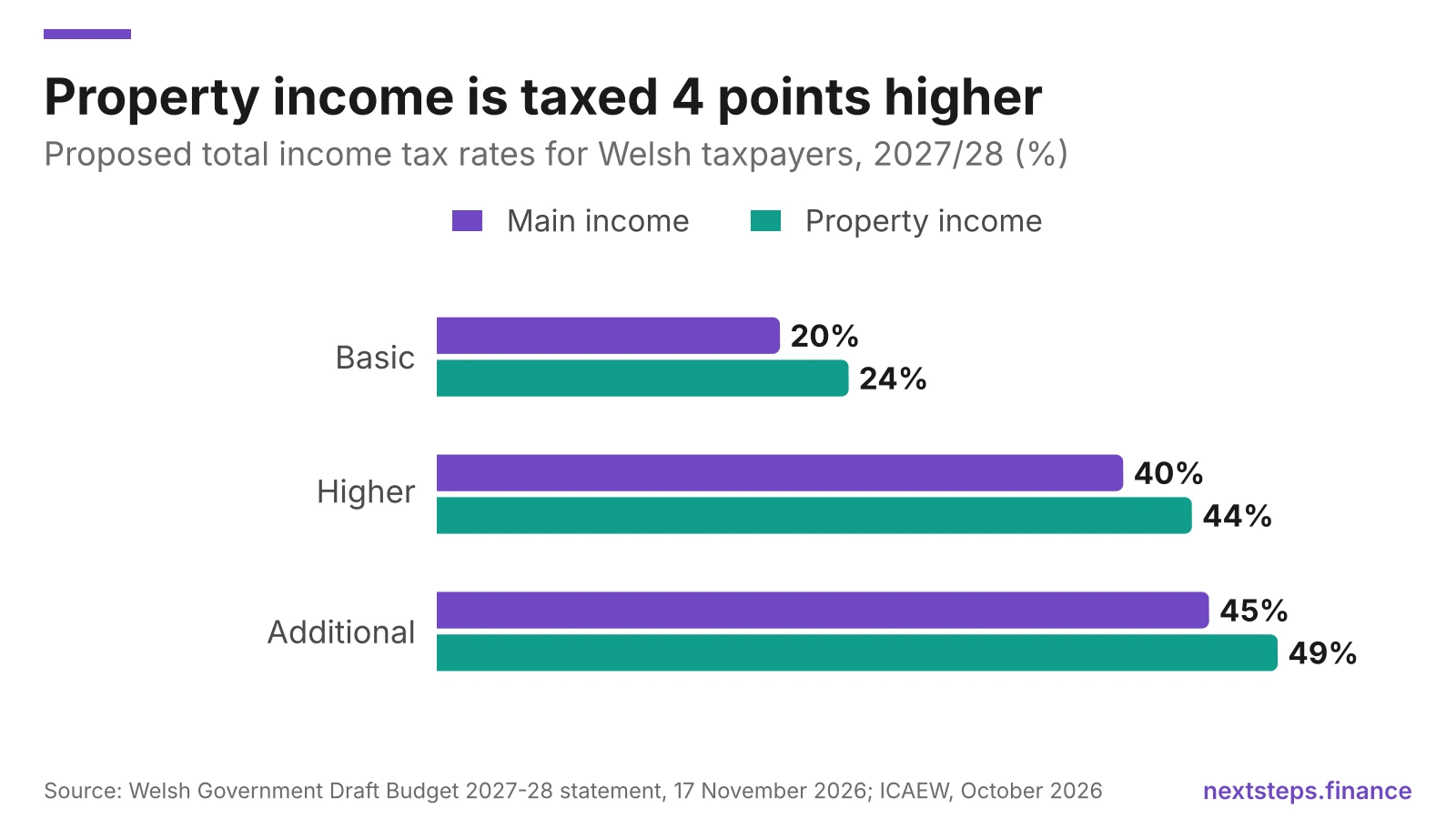
- Property income is taxed at 24%, 44% and 49% from 6 April 2027, with mortgage interest relief given at 24%.
- Savings and dividend rates are set UK-wide, not by Wales. Savings interest also moves to 24%, 44% and 49% from April 2027.
- Land Transaction Tax rates and thresholds stay unchanged for 2027/28.
What are the Welsh income tax rates 2027/28?
The proposed Welsh income tax rates for 2027/28 leave Welsh taxpayers paying the same total rates as people in England and Northern Ireland. The Welsh Government says its 10p proposal "will maintain parity" with those rates.
| Type of income | Basic rate | Higher rate | Additional rate | Who sets it |
|---|---|---|---|---|
| Salary, pension and other main income | 20% | 40% | 45% | UK + Wales (10p Welsh rate) |
| Property income (from 6 April 2027) | 24% | 44% | 49% | UK + Wales (10p Welsh rate) |
| Savings income (from 6 April 2027) | 24% | 44% | 49% | UK-wide |
The bands aren't moving. Income tax thresholds are frozen, so with the standard £12,570 Personal Allowance the basic rate applies from £12,571 to £50,270, the higher rate from £50,271 to £125,140, and the additional rate above that. HMRC's technical note on the new rates uses the same £37,700 basic rate band.
There are two approval points. The 10p Welsh rates are a draft proposal that the Senedd still has to approve. The 24%, 44% and 49% property and savings rates come from the UK Government's October 2026 Budget, which added two points to the 22%, 42% and 47% rates announced a year earlier, as ICAEW's Budget summary explains. Neither is a reason to change your PAYE tax code yourself today.
Try it with your own income to see which band you're in:
- Total taxable income (£)£40,000
What does the 10p Welsh income tax rate actually mean?
The 10p is the Welsh share of each overall rate, not an extra 10% on top. For Welsh taxpayers, the UK Government's rates are cut by 10p in each band and the Welsh rate is added back.
| Band | UK part | Proposed Welsh rate | Total main rate |
|---|---|---|---|
| Basic | 10p | 10p | 20% |
| Higher | 30p | 10p | 40% |
| Additional | 35p | 10p | 45% |
That's why a Welsh taxpayer doesn't pay 10% income tax on their salary. The total stays at 20%, 40% or 45%.
From 2027/28 the same approach covers property income. With a 10p Welsh rate in each property band, the totals match the 24%, 44% and 49% paid in England and Northern Ireland. The Senedd could in principle choose a different Welsh rate for landlords, but the draft proposes 10p in every band.
What changes for rental income in Wales from April 2027?
From 6 April 2027, rental profit in Wales is taxed at 24%, 44% or 49%, four points above the main rates, if the Senedd approves the 10p proposal. In 2026/27 rental profit is still taxed at 20%, 40% and 45%.
This isn't a flat tax on gross rent. The rate depends on which band your rental profit falls into once your other income is counted. HMRC's technical note says allowances and reliefs "must be set against income which is not property, savings or dividend income first", and income is taxed in the order: other income, then property, then savings, then dividends.
Landlords with a residential mortgage still can't deduct the interest as an expense. Instead they get a tax reduction at the property basic rate, which ICAEW's guide to the 2027/28 calculation changes confirms will be 24%. If you own a rental with your spouse in unequal shares, our HMRC Form 17 guide explains how the income is split for tax.
The Draft Budget also confirms that Land Transaction Tax rates and thresholds "will remain unchanged" for 2027/28. LTT is the Welsh tax on buying property, separate from income tax on rent; the main residential threshold stays at £225,000.
For worked examples, read our landlord tax rise guide. Our tax hub explains how property income fits alongside your other income.
Who counts as a Welsh taxpayer?
You're a Welsh taxpayer if you're UK resident and your main home is in Wales. Where you work, and where your employer is based, don't decide it.
The Low Incomes Tax Reform Group's guide to Welsh taxpayer status sets out the tests:
- One home: if your only UK home is in Wales, you're a Welsh taxpayer.
- Two or more homes: you're a Welsh taxpayer if your main home is in Wales for at least as long in the tax year as it is in any other single part of the UK. HMRC treats your main home as the one you have the strongest connection with, which isn't always where you spend most nights.
- No close connection anywhere: you're a Welsh taxpayer if you spend more days in Wales than in any other part of the UK.
Status applies to the whole tax year. If you move across the border, your PAYE code may change partway through the year, but that doesn't make you a Welsh taxpayer for only part of it.
A Welsh PAYE tax code starts with C, such as C1257L. Emergency codes for new starters don't carry the C, even for Welsh taxpayers. See GOV.UK's Income Tax in Wales page for the official overview.
Take Action: check that HMRC has your current address, especially if you've moved across the England-Wales border or keep a weekday address in one country and a family home in the other.
Are savings, dividends and pension income treated differently in Wales?
Yes for savings and dividends, no for pensions. Welsh rates only apply to non-savings, non-dividend income. Savings and dividend rates are set UK-wide, so Welsh taxpayers pay the same as everyone else in England and Northern Ireland.
From 6 April 2027, savings interest above your allowances is taxed at 24%, 44% or 49% across the UK. Dividend rates have been 10.75%, 35.75% and 39.35% since 6 April 2026, with a £500 dividend allowance, according to HMRC's technical note. Interest and dividends inside an ISA stay tax-free.
Pension income, including the State Pension and private pensions, is taxed as ordinary income, so Welsh main rates apply if you're a Welsh taxpayer. Your pension provider normally collects the tax through PAYE.
Scotland is different. Scottish taxpayers have their own bands and rates, and the Scottish Government can set its own property income rates too, so don't use the Welsh table if you live in Scotland. For the wider picture, see our UK income tax explained guide.
What should Welsh taxpayers check before April 2027?
Most employees won't need to do anything. PAYE collects Welsh income tax through your tax code, but a few checks now can save a wrong bill later.
- Confirm where your main home is. If you moved during the year or have more than one home, read the residence tests above rather than relying on your work address.
- Check your tax code. A Welsh code starts with C. If you think you're a Welsh taxpayer and your code doesn't, contact HMRC.
- Separate your income types. If you have rent, savings interest or dividends as well as a salary or pension, keep them apart. Different rates and allowances apply to each.
- Landlords: update your forecast. Use 24%, 44% and 49% and a 24% mortgage interest credit for 2027/28, but treat the Welsh rates as draft until the Senedd votes.
- Answer the Welsh taxpayer question on your Self Assessment return for the right tax year.
For everything else in the UK Budget, see our Budget 2026 summary. Our savings tax rise guide covers the UK-wide change to savings interest.
Frequently asked questions
Will Welsh income tax rates increase in 2027/28?
Not on salary or pension income, if the Senedd approves the Draft Budget. The Welsh Government proposes keeping all six Welsh rates at 10p for 2027/28, so main rates stay at 20%, 40% and 45%. Rental profit moves to 24%, 44% and 49% from 6 April 2027, matching England and Northern Ireland.
Is the Welsh 10p rate an extra 10% tax?
No. The 10p is the Welsh part of the overall rate. For Welsh taxpayers the UK rates are cut by 10p in each band and the Welsh rate is added back, so the totals stay at 20%, 40% and 45%. If approved, the same 10p applies in each new property income band.
Do Welsh landlords pay 24% tax on rental income?
From 6 April 2027, basic-rate landlords in Wales pay 24% on rental profit, with 44% and 49% in the higher and additional bands, if the Senedd approves the 10p proposal. It's charged on profit after allowable expenses, not gross rent, and mortgage interest relief is given at 24%.
Do Welsh taxpayers pay different tax on savings interest?
No. Savings and dividend rates are set UK-wide, not by the Welsh Government. From 6 April 2027, savings interest above your Personal Savings Allowance is taxed at 24%, 44% or 49% wherever you live in the UK, apart from interest inside an ISA, which stays tax-free.
How do I know if I am a Welsh taxpayer?
You're a Welsh taxpayer if you're UK resident and your main home is in Wales. With more than one home, it's the one you have the strongest connection with. Status covers the whole tax year, and a Welsh PAYE tax code starts with C. Your employer's location doesn't decide it.
This is general information, not personal tax advice. Cross-border moves, several homes or complex property arrangements may need advice from a qualified tax adviser, or you can book a personal finance review.