
Budgeting for couples in the UK comes down to three decisions: which accounts you use, how you split the shared bills, and what you each keep for yourselves. This budgeting for couples UK guide walks through all three with real 2026/27 take-home pay figures from GOV.UK, shows the maths for a 50/50 split versus splitting by income, and covers the tax and credit file rules couples often miss.
Foundations
Budgeting for Couples UK: Joint or Separate?
Budgeting for couples UK guide: joint, separate or both, how to split bills fairly by income, plus Marriage Allowance and joint account rules.
In this article
- 01Key takeaways
- 02What is the best way to budget as a couple in the UK?
- 03Should couples have a joint bank account?
- 04Does a joint account affect your credit score?
- 05How should couples split bills fairly?
- 06How do you set up a joint budget step by step?
- 07What tax breaks can UK couples use?
- 08How much protection do joint savings have?
- 09FAQ
- 10The bottom line
Key takeaways
- The hybrid system (one joint account for bills, two personal accounts) keeps shared costs visible while giving each of you money that's yours to spend.
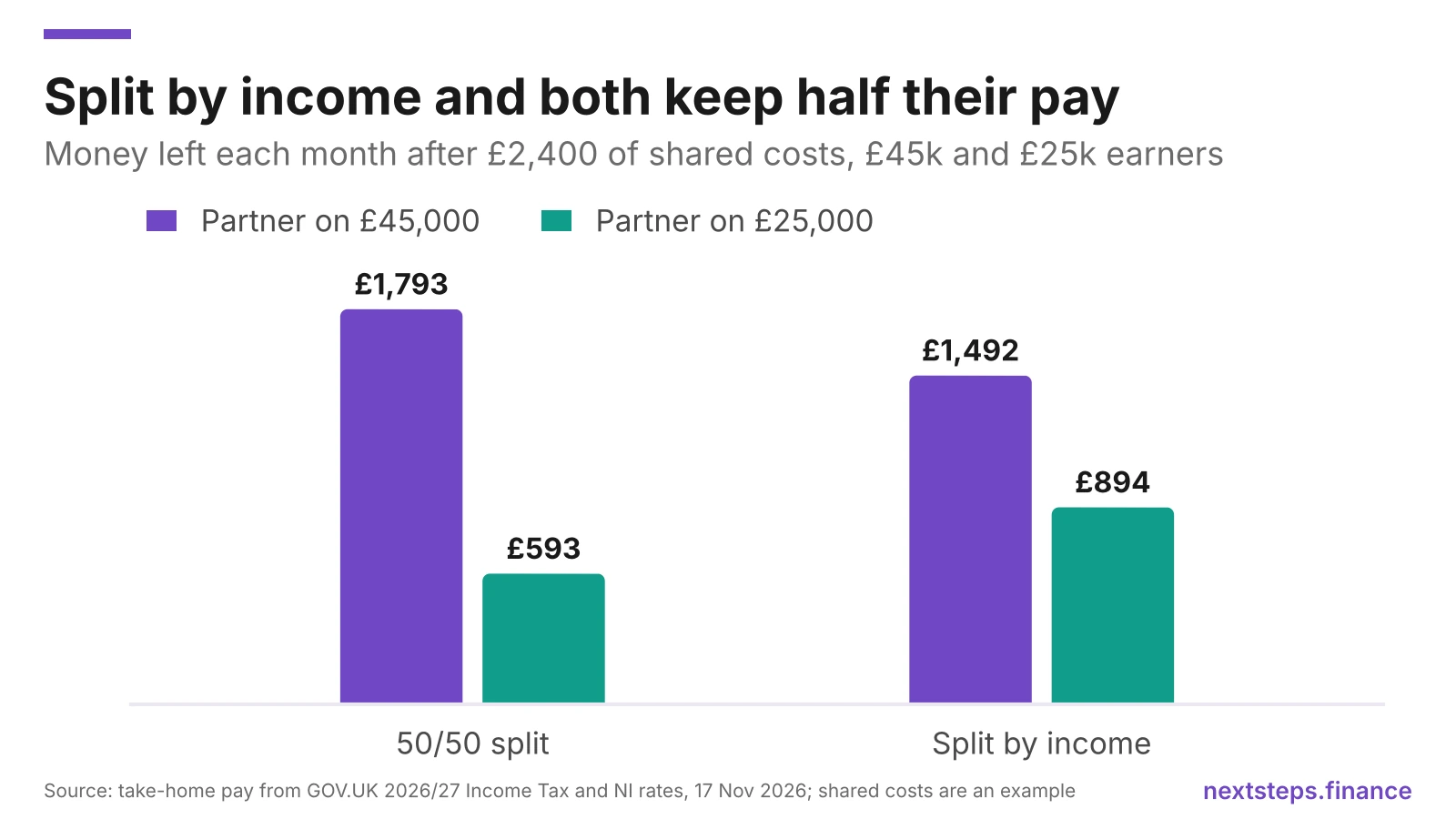
- Splitting by income changes the maths a lot: on £45,000 and £25,000 salaries, a 50/50 split of £2,400 bills leaves the lower earner £593 a month; splitting by income leaves them £894.
- Marriage Allowance lets a married couple or civil partners move £1,260 of Personal Allowance to the other partner, cutting their tax by up to £252 a year, and you can backdate to 6 April 2022.
- A joint account links your credit files. It creates a "financial association" that stays until the account is closed and you ask for it to be removed.
- FSCS protection is per person: a joint account at one banking licence is covered up to £240,000 (£120,000 each).
If you want one place to plan both incomes and your shared bills, the UK Budget Planner works for a household as well as for one person.
What is the best way to budget as a couple in the UK?
There isn't one right system, but the hybrid approach suits most couples: pay an agreed amount each into a joint account that covers shared bills, and keep the rest in your own accounts. It balances fairness, privacy and visibility.
Here are the three main options side by side:
| System | How it works | Suits couples who... | Watch out for |
|---|---|---|---|
| Fully joint | Both salaries go into one joint account; everything is paid from it | Are married or long-term, have similar spending habits and trust each other fully | No personal money; one person's overspending hits both |
| Fully separate | Each pays specific bills from their own account, or one transfers to the other | Have just moved in, value independence, or have very different incomes | Easy for one person to end up paying more; bills can be missed |
| Hybrid (joint + separate) | Each pays a set amount into a joint bills account; the rest stays personal | Want shared bills covered but some freedom to spend without asking | Agreeing the amounts; reviewing them when pay changes |
Whichever you choose, write the plan down. A simple shared budget with every bill listed avoids most money arguments, because you're discussing numbers rather than feelings. Our complete guide to budgeting in the UK covers the basics if you're starting from scratch.
Take Action: Sit down together, list every shared cost (rent or mortgage, council tax, energy, food, broadband, insurance) and agree which system you'll try for three months.
Should couples have a joint bank account?
A joint account may suit you if you share regular bills, because one account paying the rent, council tax and energy makes it obvious whether everything is covered. It isn't essential, and there are trade-offs to understand before you open one.
What a joint account means in practice:
- You're both responsible. Monzo's joint account terms say "With a joint account you're individually and jointly liable", which is standard. If the account goes overdrawn, the bank can ask either of you for the whole amount.
- Either of you can spend the money. Both holders can usually make payments without the other's say-so.
- Your credit files become linked. More on this in the next section.
- Closing it needs care. At Monzo, either holder can ask to close the joint account, but it can only be closed once it's empty.
Most high street banks and app banks offer joint current accounts. Monzo is one many couples use for budgeting, because a joint account sits next to each person's own account in the app. You each need a Monzo personal current account first; the terms say "You both must have a current account to have a joint account." Monzo's Joint Instant Access Savings pots pay from 2.80% to 3.80% AER variable, depending on your subscription plan, with the top rate needing both of you on a paid plan. Compare that with other easy access accounts before you commit, and see our Monzo plans comparison if you're weighing up a paid plan.
Does a joint account affect your credit score?
A joint account doesn't lower your score on its own, but it creates a "financial association" between you on your credit files. Lenders can then look at your partner's credit history when you apply for credit, so their missed payments could affect your applications.
The key rules, from the credit reference agencies:
- Marriage alone doesn't link you. Equifax says marrying someone "doesn't automatically make you financially linked with them". It's a joint account or joint credit application that does it.
- A joint current account counts. Checkmyfile lists opening a joint bank account as one of the things that creates an association, and Monzo's own terms say the same.
- It doesn't end on its own. Equifax says a financial association "cannot be removed while joint accounts are open". Once they're closed, you can ask each credit reference agency to add a notice of disassociation.
If one of you has a poor credit history, it may suit you to keep finances separate while they rebuild it, and split bills with transfers instead. Our guide on how to improve your credit score covers the steps.
How should couples split bills fairly?
The two common methods are 50/50 and splitting in proportion to income. 50/50 is simple and works when you earn similar amounts; splitting by income is usually fairer when one of you earns much more, because you each keep the same share of your pay.
Here's a worked example using GOV.UK's 2026/27 Income Tax rates (Personal Allowance £12,570, 20% basic rate up to £50,270) and the employee National Insurance rates (8% between £12,570 and £50,270). It assumes England, Wales or Northern Ireland tax, no pension contributions and no student loan.
| Partner A | Partner B | Together | |
|---|---|---|---|
| Salary | £45,000 | £25,000 | £70,000 |
| Income Tax | £6,486 | £2,486 | £8,972 |
| National Insurance | £2,594 | £994 | £3,589 |
| Take-home a month | £2,993 | £1,793 | £4,787 |
| Share of household take-home | 62.5% | 37.5% | 100% |
Now say shared costs (rent, council tax, energy, food, broadband, insurance) come to £2,400 a month:
| Method | A pays | B pays | A has left | B has left |
|---|---|---|---|---|
| 50/50 | £1,200 | £1,200 | £1,793 | £593 |
| Split by income (62.5% / 37.5%) | £1,501 | £899 | £1,492 | £894 |
With a 50/50 split, Partner B has about a third of what Partner A has left, and only 33% of their own take-home pay. Splitting by income leaves each of you with about half (49.9%) of your take-home pay, so you're both giving up the same proportion.
Some couples use a third method: each pays the same share, then everything left is pooled for joint goals. Whatever you pick, include irregular costs too. Setting up shared sinking funds for Christmas, car costs and insurance renewals stops one person footing a big annual bill.
Take Action: Work out your combined take-home pay, then divide each person's take-home by the total. Those percentages are your income-based split.
How do you set up a joint budget step by step?
Start with your combined take-home pay, list shared costs, agree how to split them, then set personal spending money for each of you. Review it whenever pay or bills change.
- Add up both take-home pays. Use payslips, not salaries. The UK budget calculator works out take-home pay if you don't have a payslip to hand.
- List every shared cost. Use bank statements from the last three months. Our guide to average household bills in the UK is a useful check that nothing's missing.
- Choose your split (50/50, by income, or fully pooled) and set up standing orders into the joint account for payday.
- Agree joint savings goals: an emergency fund, a holiday, a house deposit. Pay into these automatically, straight after bills.
- Set personal spending money for each of you, with no need to justify how it's spent.
- Agree a limit for checking in. Many couples agree to discuss any single purchase over, say, £200 from joint money.
- Hold a short money date each month to look at what was spent and adjust.
If you'd rather not build the spreadsheet yourself:
You can also start with our free UK budget template, or use a budgeting method you both like, such as the 50/30/20 rule or a zero-based budget.
What tax breaks can UK couples use?
The main one for lower earners is Marriage Allowance, which is only available to married couples and civil partners, not unmarried couples living together. Couples can also make better use of two sets of savings and tax allowances.
Marriage Allowance. GOV.UK says it lets you transfer £1,260 of your Personal Allowance to your husband, wife or civil partner, which "reduces their tax by up to £252 in the tax year". To qualify:
- the lower earner must normally have income below their Personal Allowance, usually £12,570
- the higher earner must pay basic rate tax, usually income between £12,571 and £50,270 (between £12,571 and £43,662 in Scotland)
- you can backdate a claim to 6 April 2022 for any years you were eligible
Example: if one partner works part-time on £10,000 and the other earns £35,000, a claim cuts the higher earner's tax by £252 this year. The couple in our split example wouldn't qualify, because both earn more than £12,570.
Two Personal Savings Allowances. GOV.UK's savings interest rules give basic rate taxpayers £1,000 of tax-free interest a year and higher rate taxpayers £500. If one of you is a higher rate taxpayer, keeping more savings in the basic rate partner's name may cut tax, but money in their name is legally theirs. This matters more from April 2027, when the government says tax on savings income rises by 2 percentage points, to 22% basic rate and 42% higher rate.
Tax planning between partners depends on your circumstances. If large sums or pensions are involved, regulated advice or a personal finance review may help.
How much protection do joint savings have?
Joint savings are protected per person, not per account. The Bank of England says "if it is a joint account, each account holder is protected up to £120,000", so a joint account for two people is covered up to £240,000 at one bank.
The limit rose from £85,000 to £120,000 on 1 December 2025. It applies per banking licence, so brands that share a licence share one limit. Our guide to the FSCS protection limit explains how to check which banks share a licence.
Try it with your own numbers. This shows what a joint savings pot could grow to at 2.80% AER, the lowest rate on Monzo's joint savings page:
Calculator
How much could your joint savings pot grow?
- Starting balance£1,000
- Monthly joint saving£300
- Interest rate (AER)2.8%
- Years3 yrs
Balance after 3 years£12,333
You pay in£11,800
Interest earned£533
Assumes the rate stays the same and interest is added monthly. Variable rates can change, and interest above your Personal Savings Allowance may be taxable outside an ISA.
Take Action: Build a joint emergency fund of three to six months of shared costs before saving for other goals.
FAQ
What is the fairest way for couples to split bills?
Splitting shared bills in proportion to take-home pay is usually fairest when incomes differ. If one partner brings home 62.5% of household pay, they cover 62.5% of shared costs, and both keep the same share of their income. When incomes are similar, a simple 50/50 split works and is easier to manage.
Should married couples have a joint bank account?
It's a personal choice, not a legal requirement. A joint account makes shared bills easy to track, but both holders are jointly and individually liable for it and it links your credit files. Many married couples use a joint account for bills and keep separate personal accounts for their own spending.
Does a joint account affect my credit score?
A joint account doesn't lower your score by itself, but it creates a financial association with the other holder. Lenders can then consider their credit history when you apply. Marriage alone doesn't link credit files, according to Equifax. Once joint accounts are closed, you can ask for a notice of disassociation.
Can unmarried couples claim Marriage Allowance?
No. GOV.UK says Marriage Allowance is only for married couples and civil partners. Unmarried couples living together can't transfer any Personal Allowance, even if one partner earns under £12,570. For eligible couples it's worth up to £252 a year in 2026/27, and claims can be backdated to 6 April 2022.
What happens to a joint account if you split up?
Both of you stay jointly liable until the account is closed, and either of you can usually still use it. Agree how to divide the money, move bills and salaries out, then close the account. Afterwards, ask the credit reference agencies to remove the financial association so your credit files are no longer linked.
The bottom line
Budgeting for couples works best when you agree the system before the bills arrive. A joint account for shared costs, split by income if your pay differs, plus personal money for each of you, suits most UK couples. Check Marriage Allowance if one of you earns under £12,570, and remember a joint account links your credit files. To plan both incomes and shared goals in one place, try the UK Budget Planner.
Found this useful? Add Next Steps Finance as a preferred source and Google will show you more of our guides in search and AI answers.
Put this into practice
Build your budget in one sitting
The UK Budget Planner works out your take-home pay, splits it with the 50/30/20 rule, tracks spending through the year and forecasts five years ahead. Made for UK pay, tax and bills.