The information on this website is not financial advice. We may earn a commission through affiliate links - see our Disclaimer.
Foundations
Send Money From South Africa to UK: Cheapest Ways
How to send money from South Africa to UK accounts within your R2 million SDA: bank fees vs forex specialists, the SARS AIT and why Wise can't send rand.
If you want to send money from South Africa to UK accounts, the rules are simpler than they were a year ago. The South African Reserve Bank doubled the single discretionary allowance (SDA) to R2 million on 8 April 2026, and it resets on 1 January. So anyone who hasn't used their 2026 allowance has about five weeks left to do so.
This guide covers the limits, what banks and forex specialists charge, the SARS paperwork for bigger sums, and how to receive the money in a UK account. Every figure was checked against the named sources on 27 November 2026.
Key takeaways
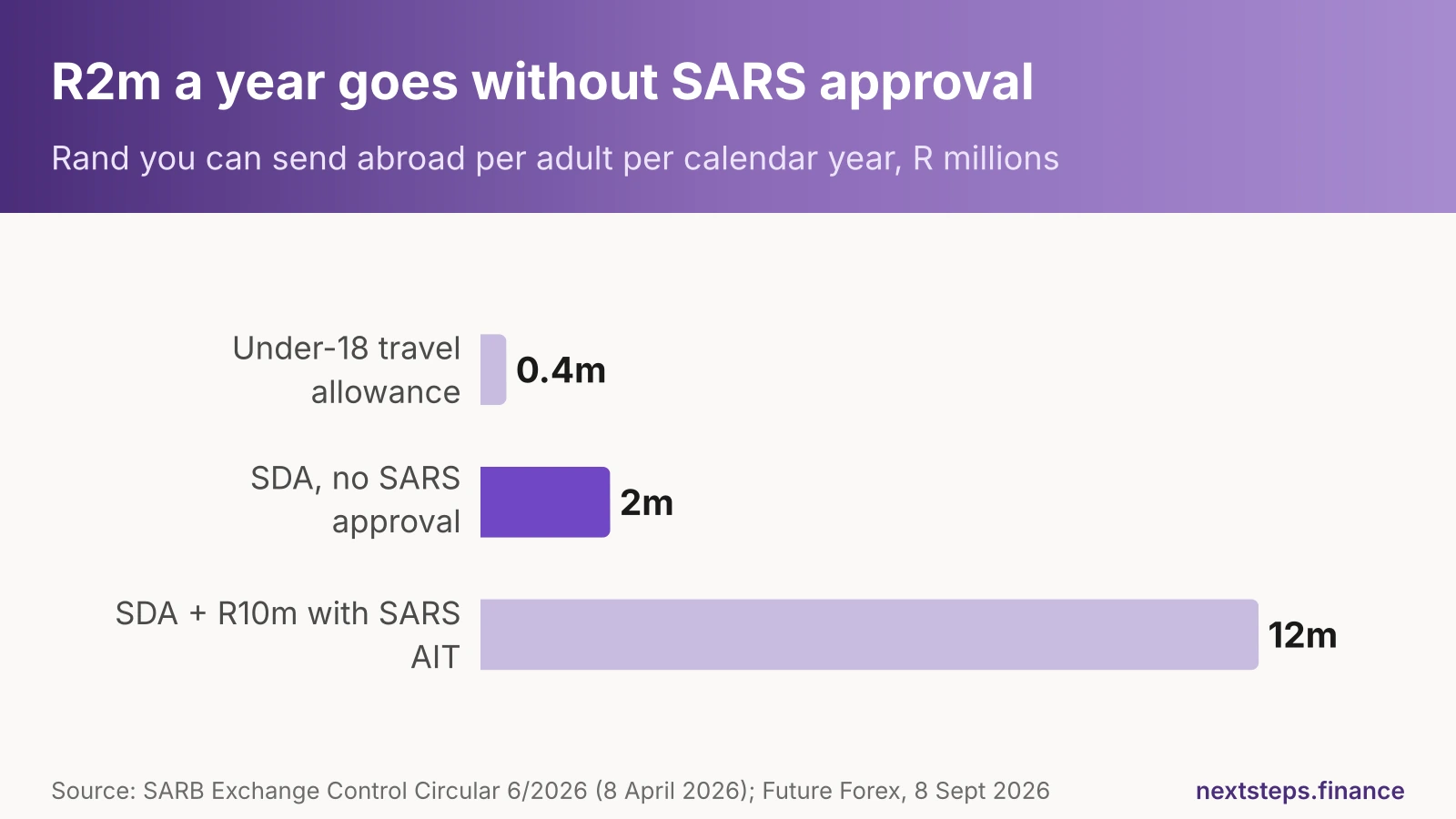
R2 million per adult per calendar year can go abroad under the SDA without SARS approval, after SARB Exchange Control Circular 6/2026 of 8 April 2026.
A further R10 million a year is possible with a SARS Approval for International Transfer (AIT), so up to R12 million in total before the Reserve Bank's Financial Surveillance Department gets involved.
Standard Bank charges 0.62% online (minimum R180, maximum R830) for an outward transfer in 2026, plus a R125 telecommunication fee.
Wise can't send from rand. Its help centre says "You can't currently send from ZAR", so you need a South African bank or a forex specialist for the rand side.
Unused SDA doesn't carry over. The 2026 allowance ends on 31 December and a new R2 million starts on 1 January 2027.
Source: SARB Exchange Control Circular 6/2026 (8 April 2026); Future Forex, 8 Sept 2026
How much money can you send from South Africa to the UK?
Each South African resident aged 18 or over can send up to R2 million a calendar year under the SDA, for "any legal purpose abroad", without asking SARS first. That covers savings, gifts, travel and paying for a UK flat deposit.
Circular 6/2026 raised the SDA from R1 million to R2 million and the under-18 travel allowance from R200,000 to R400,000, both effective from 8 April 2026. Moonstone's summary of the nine circulars issued that day confirms the change. Travel spending and foreign card use count towards the same R2 million, so a big holiday reduces what's left to transfer.
The limits by amount:
Amount per adult per calendar year
What you need
Who approves
Up to R2 million (SDA)
ID and a reason for the payment, given to your bank
Your bank (authorised dealer)
R2 million to R12 million
SARS Approval for International Transfer (AIT) PIN
SARS, then your bank
Above R12 million
Application through your bank
SARB Financial Surveillance Department
The allowance is per person, so a couple can each use their own R2 million. Splitting one large transfer into several small ones doesn't change what it is: Future Forex warns that it's treated as the same transaction.
Take Action: add up what you've already spent abroad this year, including card spend on trips, before you plan a December transfer.
What is the cheapest way to send money from South Africa to the UK?
The cheapest way is usually the provider that gives the best rand-to-pound rate on the day, not the one with the lowest fee. A 1% worse exchange rate on R500,000 costs R5,000, while a bank's capped commission tops out at a few hundred rand.
You have two main routes for the rand side:
Your South African bank. Standard Bank, FNB, Absa, Nedbank and Capitec all send international payments. They charge a commission plus a fixed fee, and set their own exchange rate.
A forex specialist. Companies such as Future Forex and Sable International work through authorised dealers and quote a rate for your transfer. Many handle the SARS AIT paperwork for bigger sums as part of the service.
Here's what Standard Bank's 2026 personal forex pricing guide charges for an outward transfer (fees include VAT, effective 1 January 2026):
Standard Bank outward transfer
Online or app
Branch
Commission
0.62%
0.9%
Minimum commission
R180
R340
Maximum commission
R830
R1,140
Additional telecommunication fee
R125
R188
On R100,000 sent online, that's R620 commission plus R125, or R745. On R500,000 the commission hits the R830 cap, so R955 in fees. Neither figure includes the exchange rate margin, which the guide doesn't state. FNB's personal page says only that fees are "competitive" and that eBucks members can earn back up to 50% of transaction charges; its fee guide wasn't available to check.
Why the exchange rate matters more than the fee
Banks rarely show their margin as a separate number. Before you send, compare the pounds you'd actually receive with the mid-market rate on a site such as Google or Reuters. Ask a forex specialist for a quote on the same day and amount, and go with whichever lands more pounds in your UK account after all fees.
Take Action: get two quotes on the same morning, one from your bank and one from a specialist, and compare the pounds received, not the fee.
Can you use Wise to send money from South Africa to the UK?
No, not from rand. Wise's ZAR transfers help article says "You can't currently send from ZAR". It only sends money to South African bank accounts.
That surprises many people, because Wise is the usual answer for cheap transfers. It still has a role once you're in the UK: it's a low-cost way to send pounds back to family in South Africa, and its GBP account can hold pounds alongside other currencies. If that's useful, you can open an account through our Wise invite. Wise is an e-money account, so your money isn't covered by the FSCS.
How do you send more than R2 million from South Africa?
Above the SDA, you need a SARS Approval for International Transfer (AIT), applied for through SARS eFiling. Once approved, you give the AIT PIN to your bank or forex provider and can send up to R10 million more in that calendar year.
SARS reviews your tax compliance and where the money came from. Its AIT supporting documents page (updated 22 October 2026) asks for:
Material showing the source of the capital, such as bank statements dated no more than 14 days before you apply
A statement of assets and liabilities for the previous three tax years
A power of attorney if someone else applies on your behalf
Future Forex says SARS has a 21-business-day service timeframe for AIT applications, and an approval must be used in the same calendar year. That makes a December application risky for 2026: it may not come through before the year ends.
Larger transfers, property sales and retirement savings are where mistakes cost most. A cross-border tax adviser or our personal finance review can help you plan the order of transfers.
What changes if you stop being South African tax resident?
Once you formally cease South African tax residency, you can no longer use the R2 million SDA, according to Future Forex. Transfers then generally go through the AIT route, or a Manual Letter of Compliance from SARS if you're not on its system.
Circular 6/2026 gives one exception: in the calendar year you cease to be resident, you can transfer up to R2 million as a travel allowance without a tax compliance PIN. It's a once-off and can't be used in later years. SARS also expects a capital gains tax calculation for the deemed disposal of your assets when you leave.
Bigger reform is coming. National Treasury published draft Capital Flow Management Regulations on 17 April 2026 to replace the 1961 Exchange Control Regulations, with fewer pre-approvals and more reporting. They were still a draft in that statement, so today's SDA and AIT rules apply until final regulations are in force.
How do you receive the money in the UK?
You need a UK account in your own name that accepts international payments, which is any UK current account. Give your South African bank or forex provider your name, sort code, account number and IBAN.
Most newcomers open a UK current account in their first week. Monzo is one of the quickest to open from an app. Under its referral terms (version 1.0, checked 27 November 2026), a UK resident aged 18 or over with no Monzo account gets £10 and a free month of Monzo Extra after downloading the app, applying, adding money and making a card payment within 30 days. Extra is a paid plan after that month unless you cancel. You do need to live in the UK to apply.
A large sum landing from abroad can trigger your UK bank's checks, so keep your SA bank statements and the transfer confirmation handy. Our guide to a UK bank account with no credit history explains what banks ask newcomers for.
Take Action: open the UK account before you send, then do a small test transfer to check the details are right.
Do you pay UK tax on money you bring from South Africa?
Moving your own savings to the UK isn't income in itself, so the transfer isn't taxed as income. What HMRC taxes is income and gains, such as interest on a South African savings account or profit when you sell shares or property.
Since 6 April 2025, people who become UK resident after at least 10 consecutive tax years of non-UK residence can claim the 4-year foreign income and gains (FIG) regime. It can exempt foreign interest, dividends, rental profits and gains for up to four years, but not foreign earnings. You claim it on a Self Assessment return and lose your Income Tax and Capital Gains Tax tax-free allowances in that year, so it doesn't suit everyone.
How much money can I transfer from South Africa to the UK per year?
Each resident adult can transfer up to R2 million a calendar year under the single discretionary allowance without SARS approval, after SARB Circular 6/2026 of 8 April 2026. With a SARS AIT you can send up to R10 million more, so R12 million in total. Above that, the Reserve Bank must approve.
Do I need SARS approval to send money to the UK?
Not for amounts within your R2 million single discretionary allowance in a calendar year. For more than that, you need a SARS Approval for International Transfer (AIT), applied for on eFiling with a statement of assets and liabilities and proof of where the money came from. SARS aims to decide within 21 business days.
Can I send rand to the UK with Wise?
No. Wise's help centre says you can't currently send from ZAR, so it can't convert rand in South Africa into pounds. Use a South African bank or a forex specialist for that leg. Wise can still be useful later for sending pounds from the UK back to South Africa.
What is the cheapest way to send money from South Africa to the UK?
Usually the provider that gives you the most pounds after all costs. Bank fees are capped (Standard Bank's online commission maxes out at R830 plus R125 in 2026), so the exchange rate margin matters more on large sums. Get a same-day quote from your bank and a forex specialist and compare the pounds received.
Does the SDA reset every year?
Yes. The single discretionary allowance runs per calendar year, from 1 January to 31 December, and unused allowance doesn't carry over. Anyone with SDA left for 2026 has until 31 December to use it, and a fresh R2 million becomes available on 1 January 2027.
The bottom line
Sending money from South Africa to the UK starts with the R2 million SDA, which needs no SARS approval and resets on 1 January. Above that, apply for an AIT well ahead, because it takes up to 21 business days and must be used in the same year. Wise can't send from rand, so compare your bank's rate with a forex specialist's on the same day.
Have a UK account such as Monzo ready to receive the money, then plan your first months in the UK Budget Planner.
Found this useful? Add Next Steps Finance as a preferred source and Google will show you more of our guides in search and AI answers.