Skip to content
Budgeting on Universal Credit: Monthly Plan
The information on this website is not financial advice. We may earn a commission through affiliate links - see our Disclaimer.
Foundations

Budgeting on Universal Credit: Monthly Plan

Budgeting on Universal Credit: how monthly payments work, 2026/27 rates, a worked budget, the Christmas payment gap and what changes in April 2027.

By How we fact-check13 min read

Budgeting on Universal Credit is different from budgeting on a weekly wage or fortnightly benefit: the whole household gets one payment a month, the amount can change each month if your earnings change, and the first payment takes about five weeks. This guide explains how the payment is worked out, gives two worked monthly budgets using GOV.UK's 2026/27 rates, and shows what changes when the proposed 2027/28 rates published by DWP on 11 November 2026 take effect in April.

Key takeaways

  • Universal Credit is paid once a month (twice a month is an option in Scotland), usually 7 days after each monthly assessment period ends, according to GOV.UK.
  • The 2026/27 standard allowance is £338.58 a month for a single person under 25, £424.90 at 25 or over, and £666.97 for a couple where either is 25 or over.
  • The two-child limit ended on 6 April 2026, so the child element of £303.94 a month is now paid for every child.
  • Earnings reduce your payment by 55p for every £1 above your work allowance of £427 or £710 a month, if you have one.
  • Proposed rates from April 2027 lift the standard allowance by more than 4%, to £443.21 a month for a single person aged 25 or over.

If you want one place to plan each monthly payment and track what's left, the UK Budget Planner is built for exactly that.

How does Universal Credit work for budgeting?

Universal Credit pays one amount a month for the whole household, based on what happened in your last assessment period. Your first assessment period starts on the day you claim, and GOV.UK says payment usually arrives 7 days after each period ends. Its own example: claim on 10 September and you're paid on 17 October.

That has three knock-on effects for your budget:

  1. The first payment takes about five weeks. You can ask for an advance to cover the gap, but it's a loan you repay from later payments.
  2. The amount can move month to month. If you're paid weekly or four-weekly, some assessment periods catch two pay packets and your Universal Credit drops that month. Our guide to budgeting on 4-weekly pay shows how to plan for the "extra" payday.
  3. Rent comes to you, not your landlord. The housing element is usually paid to you, and GOV.UK says you'll usually need to pay it to your landlord yourself.

The simplest habit is to treat payment day as "bills day". The moment the money lands, move rent and bills to where they'll be paid from, before anything else.

How much Universal Credit will I get in 2026/27?

Your payment is a standard allowance plus any extra elements you qualify for, minus deductions for earnings, savings and debts. These are the main monthly amounts from GOV.UK's what you'll get page for 2026/27:

Element Monthly amount 2026/27
Standard allowance, single under 25 £338.58
Standard allowance, single 25 or over £424.90
Standard allowance, couple both under 25 £528.34
Standard allowance, couple where either is 25 or over £666.97
Child element, each child £303.94 (plus £47.94 for a first child born before 6 April 2017)
Disabled child addition £164.79 lower or £514.71 higher
Health element (LCWRA) £217.26, or £429.80 for severe and lifelong conditions or nearing end of life
Carer element £209.34
Childcare costs Up to 85% of costs, max £1,071.09 for one child or £1,836.16 for two or more

Housing costs are added on top if you rent, depending on your rent and the Local Housing Allowance for your area.

GOV.UK's guidance on Universal Credit if you have children confirms that the 2-child limit ended on 6 April 2026, so families with three or more children now get the child element for each child.

How do earnings affect Universal Credit?

GOV.UK's page on how your wages affect your payments says your payment goes down by 55p for every £1 you earn. If you have children or limited capability for work, you get a work allowance first: £427 a month if you get help with housing costs, or £710 if you don't. Without a work allowance, the 55p reduction starts from your first pound of earnings.

Do savings affect Universal Credit?

Yes. Savings under £6,000 don't affect your payment. Between £6,000 and £16,000, GOV.UK says your payment drops by £4.35 for every £250, and above £16,000 you usually can't get Universal Credit at all. Try it with your own figure:

Calculator
Will your savings reduce your Universal Credit?
  • Your savings and capital£3,000
Your resultUnder £6,000, so your savings don't reduce your payment
£6,000 or moreBetween £6,000 and £16,000, so your payment drops by £4.35 for every £250
£16,001 or moreOver £16,000, so you usually can't get Universal Credit
You're £3,000 below the £6,000 threshold.
Based on GOV.UK's Universal Credit what you'll get page, checked 26 November 2026. Some capital, such as your home, is ignored. Couples' savings are added together.

What does a Universal Credit budget look like?

A Universal Credit budget works best when you plan around the payment, not the calendar month. Here are two worked examples using 2026/27 rates. They assume the housing element covers the full rent, which won't be true everywhere because of Local Housing Allowance limits.

Single, 25+, renting, working part-time Couple, 25+, 2 children, renting, one earner
Standard allowance £424.90 £666.97
Child element £0 £607.88
Housing element £650.00 £900.00
Maximum Universal Credit £1,074.90 £2,174.85
Take-home pay in the month £1,000.00 £1,800.00
Work allowance (with housing costs) £0 (no children or health element) £427.00
Earnings reduction at 55p per £1 £550.00 £755.15
Universal Credit paid £524.90 £1,419.70
Total household income £1,524.90 £3,219.70

The single person has no work allowance, so every pound of their £1,000 take-home pay reduces Universal Credit by 55p. The couple's work allowance protects the first £427 of earnings. Childcare costs and Child Benefit would be extra for the family.

Here is how the single person might split their £1,524.90 (illustrative figures, not averages):

Spending Monthly
Rent £650
Council Tax (after any Council Tax Reduction) £80
Energy £110
Food and household £250
Phone and broadband £45
Transport £100
Sinking funds (clothes, birthdays, Christmas) £60
Emergency savings £50
Personal spending £150
Buffer for a lower month £29.90
Total £1,524.90

Our UK budget calculator lets you run the same split with your own figures, and the average household bills guide shows what typical bills cost.

How do I make a budget on Universal Credit? (step by step)

The goal is to know, on payment day, exactly where every pound is going until the next payment. This is how to set it up:

  1. Check your statement in your online account. It shows how your payment was worked out, including earnings and any deductions. Use the actual amount paid, not the maximum.
  2. Pay priority bills first. Rent, Council Tax, energy and any court fines or arrears come before everything else, because the consequences of missing them are the most serious.
  3. Move bills money into a separate pot or account. Apps with savings pots, such as a Monzo account, let you ring-fence bill money on payment day so it isn't spent by mistake. Any bank account with a separate savings space does the same job.
  4. Split the rest into weekly amounts. A monthly payment is easier to manage as four weekly allowances for food and day-to-day spending. The envelope budgeting method works well here.
  5. Set up sinking funds for one-off costs. Small monthly amounts for clothes, school costs and Christmas stop these from turning into debt. Our sinking funds guide shows how.
  6. Keep a buffer for lower months. If your earnings vary, keep any surplus from a good month in your buffer rather than spending it.
  7. Review it after each statement. If your payment changes, adjust the weekly allowance straight away.

If you'd rather not build all of this from scratch:
How do I budget for the Christmas Universal Credit payment?

Plan for Christmas as a gap problem, not a spending problem. GOV.UK says that if your payment date falls on a weekend or bank holiday, you're paid on the working day before. In 2026, Christmas Day is a Friday, Boxing Day a Saturday and the substitute bank holiday is Monday 28 December. So if your usual payment date is anywhere from 25 to 28 December, expect the money on Thursday 24 December.

That early payment has to last until your normal date in January, which can feel like a very long month. Before you spend it:

  • Write down your January payment date and count the days the money has to cover.
  • Pay or set aside January's rent and bills first, before buying presents or food for Christmas.
  • Set a fixed Christmas amount. Our Christmas budget guide has a simple way to set one.

Energy costs are also rising in the new year. Ofgem's price cap goes up from 1 January 2027, and our guide on whether to fix your energy explains the options.

What deductions can be taken from Universal Credit?

Deductions are taken from your payment before it reaches you, so they need to be in your budget. Common ones are advance repayments, benefit overpayments, rent or energy arrears, and Council Tax arrears.

GOV.UK's advance on your first payment page says you usually repay an advance within 24 months, starting from your first payment. Its own example is a £344 advance repaid at £14.33 a month. You can ask to delay repayments for 3 months if you can't afford them.

DWP's 2027/28 rates document lists the overall maximum deduction rate as 15% of the standard allowance (previously 25%). For 2026/27 that is £63.74 a month for a single person aged 25 or over and £100.05 for a couple where either is 25 or over.

If deductions leave you short, contact the Universal Credit service through your online journal. Free debt charities like StepChange, National Debtline and Citizens Advice can help you negotiate. Our guide on how to get out of debt covers the main options.

What extra help is available on Universal Credit?

GOV.UK's get an advance or financial support page lists several kinds of help: an advance on your first payment, a hardship payment if your payment is stopped or reduced, an advance for unexpected costs, help with job expenses, and an advance if your circumstances change. These are mostly loans, so you usually repay them from future payments.

Other help worth checking:

  • Council Tax Reduction from your local council, which can cut your bill substantially.
  • Alternative payment arrangements, which GOV.UK says can include rent paid direct to your landlord, twice-monthly payments, or splitting the payment between partners. These are more likely if you have rent arrears or have experienced domestic abuse.
  • Help to Save, a government savings scheme for people on Universal Credit with earnings. Check GOV.UK for the current eligibility rules and bonus before you apply.
  • The £100 Household Energy Payment announced in Budget 2026 for homes in Council Tax bands A to D in England, covered in our energy payment guide.

How much will Universal Credit go up in April 2027?

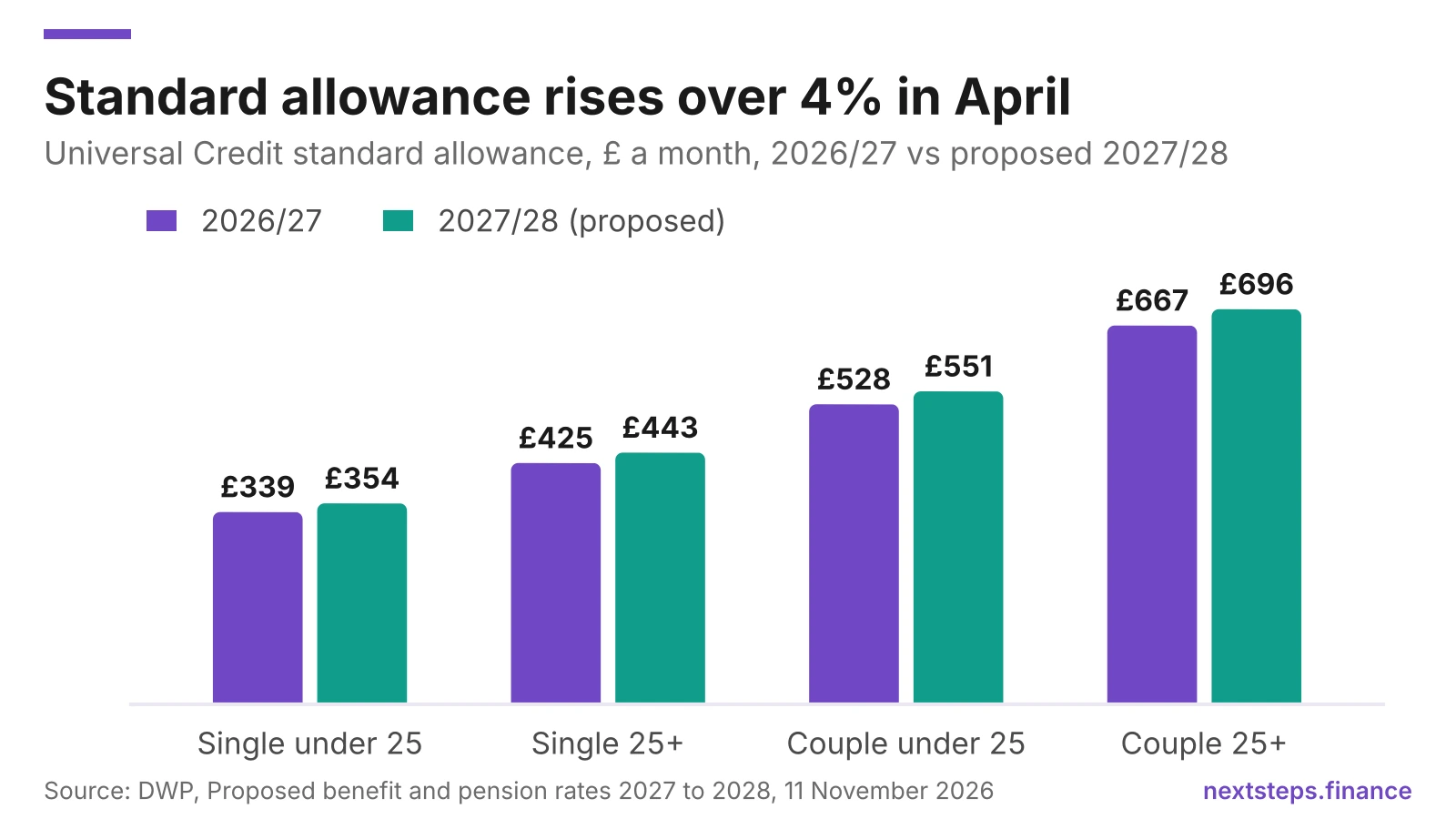
The standard allowance is set to rise by more than 4% in April 2027, and most other elements by 3.5%. These are DWP's proposed rates, published on 11 November 2026, and they still need to be approved by Parliament.

Bar chart comparing the Universal Credit standard allowance in 2026/27 and proposed 2027/28: single under 25 £338.58 to £353.87, single 25 or over £424.90 to £443.21, couple under 25 £528.34 to £551.11, couple 25 or over £666.97 to £695.71 a month
Source: DWP, Proposed benefit and pension rates 2027 to 2028, 11 November 2026
Element 2026/27 Proposed 2027/28
Standard allowance, single 25 or over £424.90 £443.21
Standard allowance, couple 25 or over £666.97 £695.71
Child element, each child £303.94 £314.58
Carer element £209.34 £216.67
Health element (LCWRA) for most new claims £217.26 £217.26 (frozen)
Work allowance with housing costs £427 £442
Work allowance without housing costs £710 £735

For a single person aged 25 or over, that's £18.31 a month more from April. The lower health element stays frozen at £217.26. Take Action: don't build the rise into your budget until your first statement on the new rates shows it.

Bottom line: budgeting on Universal Credit

A Universal Credit budget works best when payment day is bills day: rent and priority bills first, then weekly allowances, sinking funds and a small buffer. Check every statement, plan now for the early Christmas payment, and keep any advance repayments in your plan. The UK Budget Planner or our free budget template can do the tracking for you, and the complete guide to budgeting covers the basics if you're starting from scratch.

FAQ

How often is Universal Credit paid?

Universal Credit is paid once a month, usually into a bank, building society or credit union account. GOV.UK says payment is usually made 7 days after the end of each monthly assessment period. In Scotland you can choose to be paid twice a month, and an alternative payment arrangement can allow twice-monthly payments elsewhere.

How much is Universal Credit a month for a single person?

For 2026/27 the standard allowance is £338.58 a month for a single person under 25 and £424.90 for a single person aged 25 or over. You may get extra for housing costs, children, a health condition or caring. Earnings above any work allowance reduce your payment by 55p for every £1.

When will I get my Universal Credit at Christmas 2026?

If your payment date falls on a weekend or bank holiday, GOV.UK says you're paid on the working day before. Christmas Day 2026 is a Friday and Monday 28 December is a bank holiday, so payments due from 25 to 28 December should arrive on Thursday 24 December. That money then has to last until January's payment date.

How much can I earn on Universal Credit?

There's no fixed earnings limit. Your payment drops by 55p for every £1 you earn above your work allowance, which is £427 a month with housing costs or £710 without, if you have children or limited capability for work. Payments stop when earnings are high enough to reduce your entitlement to zero.

Can I save money while on Universal Credit?

Yes. Savings under £6,000 don't affect Universal Credit. Between £6,000 and £16,000 your payment drops by £4.35 for every £250, and above £16,000 you usually can't claim. Keeping a small emergency fund and sinking funds within those limits helps you avoid advances and borrowing.

Found this useful? Add Next Steps Finance as a preferred source and Google will show you more of our guides in search and AI answers.

Add as preferred source on Google

Put this into practice

Build your budget in one sitting

The UK Budget Planner works out your take-home pay, splits it with the 50/30/20 rule, tracks spending through the year and forecasts five years ahead. Made for UK pay, tax and bills.