Envelope budgeting UK style has moved on from stuffing notes into labelled envelopes. The idea is the same: when an envelope is empty, that category is done for the month. But with cash now used for only 8% of UK payments, according to UK Finance, most people now run their envelopes as bank pots or app budgets. This guide shows how the method works, a full worked example on a £30,000 salary, and how to set it up with cash, pots or an app.
Foundations
Envelope Budgeting UK: Cash, Pots and Apps
Envelope budgeting UK guide: split your pay into cash envelopes, Monzo Pots or Starling Spaces, with a worked £30,000 example and the rules that make it stick.
In this article
- 01Key takeaways
- 02What is envelope budgeting?
- 03How much goes in each envelope on a UK salary?
- 04Is cash envelope budgeting still worth it in the UK?
- 05How do you do envelope budgeting with Monzo Pots or Starling Spaces?
- 06Can you use a budgeting app for envelope budgeting?
- 07How do you set up envelope budgeting step by step?
- 08What should you watch out for this winter?
- 09Bottom line
- 10FAQ
Key takeaways
- Envelope budgeting gives every category a fixed amount on payday. When an envelope runs out, you stop spending in it or move money from another envelope on purpose.
- A £30,000 salary gives about £2,093 a month take-home in 2026/27, using GOV.UK's £12,570 Personal Allowance, 20% basic rate and 8% employee National Insurance.
- Cash made up just 8% of UK payments in 2025, down from 45% in 2015 (UK Finance), so digital envelopes suit most people better.
- Monzo lets you create up to 20 Pots per account and pay Direct Debits straight from a Bills Pot. Starling's Bills Manager does the same from a Regular Space.
- Energy bills are a moving envelope: Ofgem announces the January to March 2027 price cap on 25 November 2026, and suppliers expect a big rise.
If you'd like the whole system built for you, the UK Budget Planner sets your envelopes for the year and tracks each month against them.
What is envelope budgeting?
Envelope budgeting is a way of controlling spending by giving each category its own pot of money on payday. You only spend from the envelope that matches what you're buying, so overspending on one thing can't quietly eat into rent or bills.
The classic version uses physical cash: you withdraw your pay, split it into envelopes marked "food", "petrol", "fun" and so on, and pay for things from the right one. It works because you can see and feel the money running down, which a card tap doesn't give you.
It's a close cousin to zero based budgeting, where every pound gets a job on paper. Envelope budgeting adds the physical (or digital) separation, so the plan is enforced by where the money sits, not just by willpower.
The four rules
- Fill envelopes on payday, before you spend anything.
- Spend only from the matching envelope.
- When an envelope is empty, it's empty until next payday, unless you choose to move money from another envelope.
- Leftovers roll over or go to savings. Decide which at the start, not in the moment.
How much goes in each envelope on a UK salary?
Start from your real take-home pay, not your salary. On a £30,000 salary in 2026/27, GOV.UK's Income Tax rates give a £12,570 Personal Allowance and 20% tax up to £50,270, and the 2026 to 2027 employer rates set employee National Insurance at 8% between £12,570 and £50,270.
| Item | Yearly | Monthly |
|---|---|---|
| Salary | £30,000 | £2,500 |
| Income Tax (20% of £17,430) | £3,486 | £290.50 |
| National Insurance (8% of £17,430) | £1,394.40 | £116.20 |
| Take-home pay | £25,119.60 | £2,093.30 |
This ignores pension contributions and student loan repayments, which would lower the figure. Our take-home pay calculator works it out for your own salary and deductions.
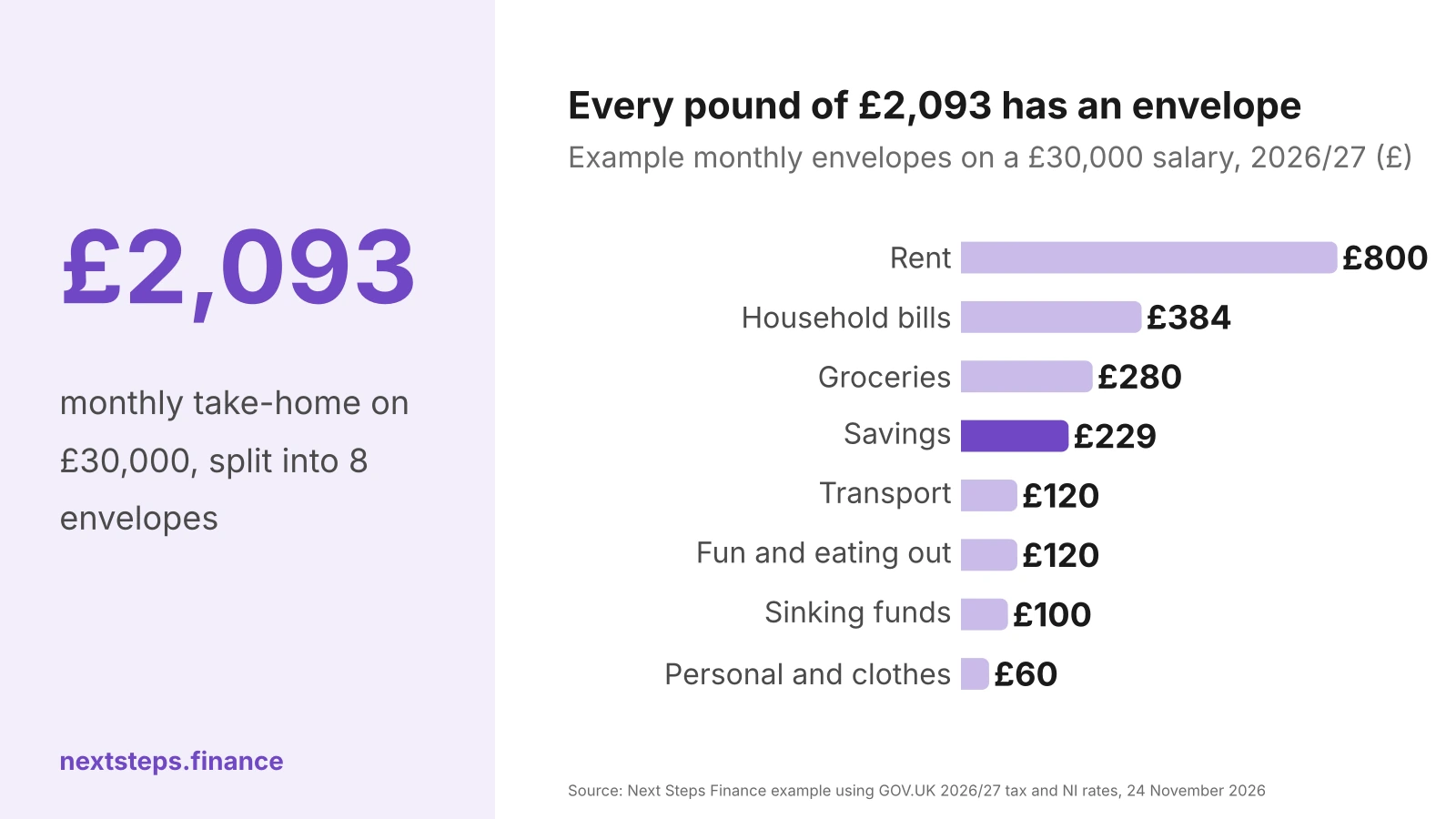
Here's one way to split that £2,093 into eight envelopes. The amounts are an example, not a target: rent and transport costs vary hugely across the UK.
| Envelope | Monthly | What it covers |
|---|---|---|
| Rent | £800 | Rent or mortgage |
| Household bills | £384 | Council tax, energy, water, broadband and phone |
| Groceries | £280 | Supermarket shops and toiletries |
| Savings | £229 | Emergency fund, then longer-term goals |
| Transport | £120 | Fuel, bus or train fares |
| Fun and eating out | £120 | Takeaways, meals out, hobbies |
| Sinking funds | £100 | Christmas, birthdays, car repairs, yearly bills |
| Personal and clothes | £60 | Clothes, haircuts, small treats |
| Total | £2,093 | Every pound allocated |
For more on setting realistic category amounts, see average household bills UK and average food shop cost UK. The UK budget calculator also gives you a quick starting split from your salary.
Take Action: write down your real monthly take-home pay, then list your envelopes until the total matches it exactly.
Is cash envelope budgeting still worth it in the UK?
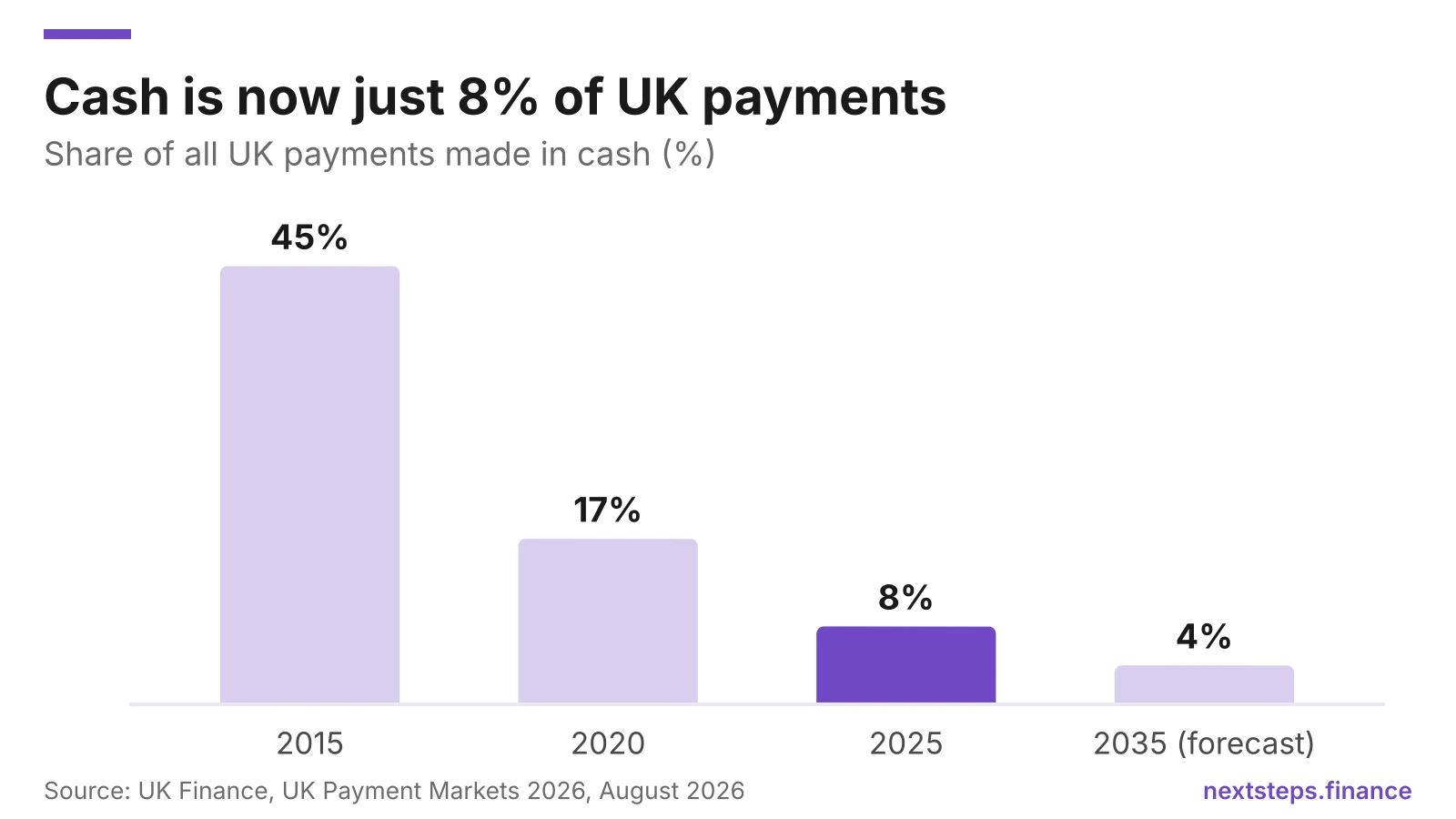
Cash envelopes still work well if you overspend on cards, but they're harder to run than they used to be. UK Finance's UK Payment Markets 2026 summary shows cash fell to 3.9 billion payments in 2025, 8% of the total, and forecasts around 4% by 2035. It also notes cash remains important for some people, "particularly for budgeting".
Where cash works well: groceries, fun money and anything you tend to overspend on in person. Handing over a £20 note feels different to tapping a phone.
Where it doesn't: rent, council tax, energy and subscriptions are paid by Direct Debit or online, so those envelopes have to stay in the bank anyway. Cash at home also earns no interest, isn't protected if it's lost or stolen, and is useless for online shopping.
A hybrid often works best: bills stay in the bank, and only the one or two categories you struggle with come out as cash.
How do you do envelope budgeting with Monzo Pots or Starling Spaces?
Digital envelopes do the same job without the cash. You open separate pots inside your current account, move each envelope's amount in on payday, and spend from the main balance only what's left for day-to-day use.
Monzo Pots
Monzo says you can create up to 20 Pots across each personal and joint account, and you can hide or lock Pots "so you're not tempted to dip in" (Monzo Pots). Two features make it work well as an envelope system:
- Bills Pots: you can set Direct Debits and standing orders to come straight from a Pot, and Monzo moves the exact amount across just before the payment is taken.
- Salary Sorter: splits your salary into Pots for bills, spending and anything else you budget for. It works on payments over £100, and you can save your preferences so it sorts each payday for you.
Monzo's current referral offer gives a new customer £10 and a free month of Monzo Extra if, within 30 days, they download the app, apply for an account, add money and make a card payment (no minimum). You must be a UK resident aged 18 or over without a Monzo account, and the referral terms say there's no end date at the moment. Eligible deposits are FSCS protected up to £120,000 per person. Our Monzo referral bonus guide walks through the steps.
Starling Spaces
Starling's Spaces are pots kept separate from your main balance. You can attach virtual debit cards to up to five personal account Spaces, so a "groceries" card can only spend the groceries money. Bills Manager pays Direct Debits and standing orders from a designated Regular Space. One catch: if that Space is short on the day, Starling says the payment will fail, so keep a small buffer in it.
| Feature | Cash envelopes | Monzo Pots | Starling Spaces |
|---|---|---|---|
| Number of envelopes | Unlimited | Up to 20 per account | No limit stated |
| Pay bills from an envelope | No | Yes, Bills Pots | Yes, Bills Manager |
| Spend straight from an envelope | Yes | Virtual cards need a paid plan | Virtual cards on up to 5 Spaces |
| Auto-split on payday | No | Salary Sorter (payments over £100) | Automatic transfers into Spaces |
| Works online | No | Yes | Yes |
| Protection | None if lost | FSCS up to £120,000 | Held in your bank account |
To compare the two banks in more detail, see Monzo vs Starling vs Revolut.
Can you use a budgeting app for envelope budgeting?
Yes. Budgeting apps work as "virtual envelopes": your money stays in one account, but the app tracks spending against a limit for each category. That's less strict than pots, because nothing stops you overspending, but you see it straight away.
- Emma connects to your accounts through Open Banking, groups spending by category and tracks bills and subscriptions.
- Snoop sets up instant budgets by category and alerts you when a bill goes up.
Both offer paid plans with extra features, so check what the free version covers and the current prices in each app before you upgrade. Our best budgeting apps UK guide compares them in more depth.
Which to pick? Pots suit people who need a hard stop. Apps suit people who mainly need visibility, or who have accounts at several banks. Many people use both: pots for bills and savings, an app to watch day-to-day spending.
How do you set up envelope budgeting step by step?
Setting up takes about an hour, and the first three months are when it settles in.
- Find your true monthly take-home pay from your last three payslips.
- List fixed bills with exact amounts: rent, council tax, energy, phone, insurance, subscriptions.
- Set variable envelopes (groceries, transport, fun) from your last three months of bank statements, not guesses.
- Add a sinking funds envelope for yearly costs. Our sinking funds guide shows how to work out the monthly amount.
- Pay yourself first: put savings in on payday, before spending envelopes. If you don't have one yet, build an emergency fund first.
- Open the pots or label the envelopes, and move the money in on payday.
- Review each month. Move unused money to savings and adjust envelopes that keep running dry.
If you'd rather not build this yourself:
What should you watch out for this winter?
Energy is the envelope most likely to change in the next few months. Ofgem's October to December 2026 cap raised prices by 4% for a typical dual fuel household paying by Direct Debit, and Ofgem announces the January to March 2027 cap on 25 November 2026.
Octopus Energy, writing on 19 November, put the current typical bill at about £1,723 a year (around £144 a month) and expects the cap to rise by about 25%, to roughly £2,160 (Octopus Energy). That's a forecast, not the official figure, but it would add around £36 a month to the energy part of your bills envelope from January. Check Ofgem's announcement and your supplier's letter, then top up the envelope before your Direct Debit changes.
Christmas is the other pressure point. Give it its own envelope rather than letting it raid groceries and fun money; our Christmas budget UK guide has a worked plan.
Bottom line
Envelope budgeting works because it makes overspending visible and gives every pound a job before you can spend it. Cash is still the most tangible version, but with cash now just 8% of UK payments, pots such as Monzo Pots or Starling Spaces give you the same hard limits while still paying your Direct Debits.
Start with your real take-home pay, set eight or so envelopes, and review them monthly. The UK Budget Planner does the yearly maths for you, or start free with the budget template. For more methods, see the complete guide to budgeting in the UK and the budgeting hub.
FAQ
Does envelope budgeting really work?
Envelope budgeting works for many people because it puts a hard limit on each category and makes running low visible before you overspend. It's most effective for variable spending like groceries and eating out. It works less well if your income swings a lot, unless you budget from your lowest typical month.
How do you do envelope budgeting without cash?
Use pots or spaces in your bank account. Monzo lets you create up to 20 Pots per account and pay bills from them, and Starling's Spaces work the same way. Move each envelope's amount in on payday and spend only what's left in your main balance.
What categories should be in an envelope budget?
Most UK envelope budgets use six to ten categories: rent or mortgage, household bills, groceries, transport, savings, sinking funds for yearly costs, fun and eating out, and personal spending. Keep fixed bills in the bank so Direct Debits are paid, and use envelopes mainly for what you overspend on.
What happens if an envelope runs out?
If an envelope runs out, you stop spending in that category until next payday or move money in from another envelope on purpose. If the same envelope keeps running dry, the amount is probably unrealistic, so raise it next month and cut a different envelope to match.
Is cash stuffing a good idea in the UK?
Cash stuffing can help if you overspend on cards, but it has downsides in the UK. Cash made up just 8% of payments in 2025, so many bills and online purchases can't use it. Cash at home also earns no interest and isn't protected if lost, so most people use it only for one or two categories.
What is the best app for envelope budgeting in the UK?
For hard limits, a bank with built-in pots such as Monzo or Starling works best, because the money is physically separated. For tracking across several banks, budgeting apps like Emma and Snoop set category budgets through Open Banking. The right choice depends on whether you need a hard stop or just visibility.
Found this useful? Add Next Steps Finance as a preferred source and Google will show you more of our guides in search and AI answers.
Put this into practice
Build your budget in one sitting
The UK Budget Planner works out your take-home pay, splits it with the 50/30/20 rule, tracks spending through the year and forecasts five years ahead. Made for UK pay, tax and bills.