
Getting paid every four weeks (or every week) is common in retail, warehousing, care, the NHS bank and hospitality, but almost every bill you pay is monthly. That mismatch is why a 4 weekly pay budget can feel tight in some months and flush in others. This guide shows how the maths works, two simple ways to budget around it, what happens to tax and Universal Credit, and a worked example using GOV.UK's 2026/27 tax and National Insurance figures.
Foundations
4 Weekly Pay Budget: Plan for 13 Paydays
4 weekly pay budget guide: why you get 13 paydays a year, how to budget monthly bills on four-weekly or weekly wages, and what the double-pay month means.
In this article
- 01Key takeaways
- 02Why do you get 13 paydays a year on 4 weekly pay?
- 03How do you convert 4 weekly pay to a monthly amount?
- 04How do you budget on 4 weekly pay? Two methods that work
- 05What does a 4 weekly pay budget look like? A worked example
- 06How do you pay monthly bills when you're paid every 4 weeks?
- 07How do you budget on weekly pay?
- 08Does 4 weekly pay affect Universal Credit?
- 09What is week 53, and can it change your tax?
- 10Bottom line
- 11FAQ
Key takeaways
- Four-weekly pay means 13 paydays a year. 52 weeks ÷ 4 = 13, so one month each year has two paydays.
- Weekly pay means 52 paydays a year. Most months have four paydays, but four or five months a year have five. In 2027, January, April, July, October and December each have five Fridays.
- On £25,000 a year in 2026/27, take-home pay is about £1,655 every four weeks, £414 a week, or the equivalent of £1,793 a month (before pension contributions and student loan).
- Budget on 12 paydays and give the 13th payday a job, such as Christmas, insurance renewals or your emergency fund.
- Universal Credit can drop in the assessment period that catches two four-weekly paydays, so plan for a smaller payment that month.
If you want this set up for a full year, the UK Budget Planner lets you plan income and bills month by month, so the double-pay month stands out before it arrives.
Why do you get 13 paydays a year on 4 weekly pay?
You get 13 paydays because a year has 52 weeks, and 52 divided by 4 is 13. A month averages about 4.33 weeks, so four-weekly pay runs slightly ahead of the calendar and catches up a whole extra payday once a year.
Here's how that plays out. Four weeks is 28 days, but the average month is about 30.4 days. Each month your payday arrives roughly two to three days earlier than the month before. After about 11 months it has slipped far enough that two paydays land in the same calendar month.
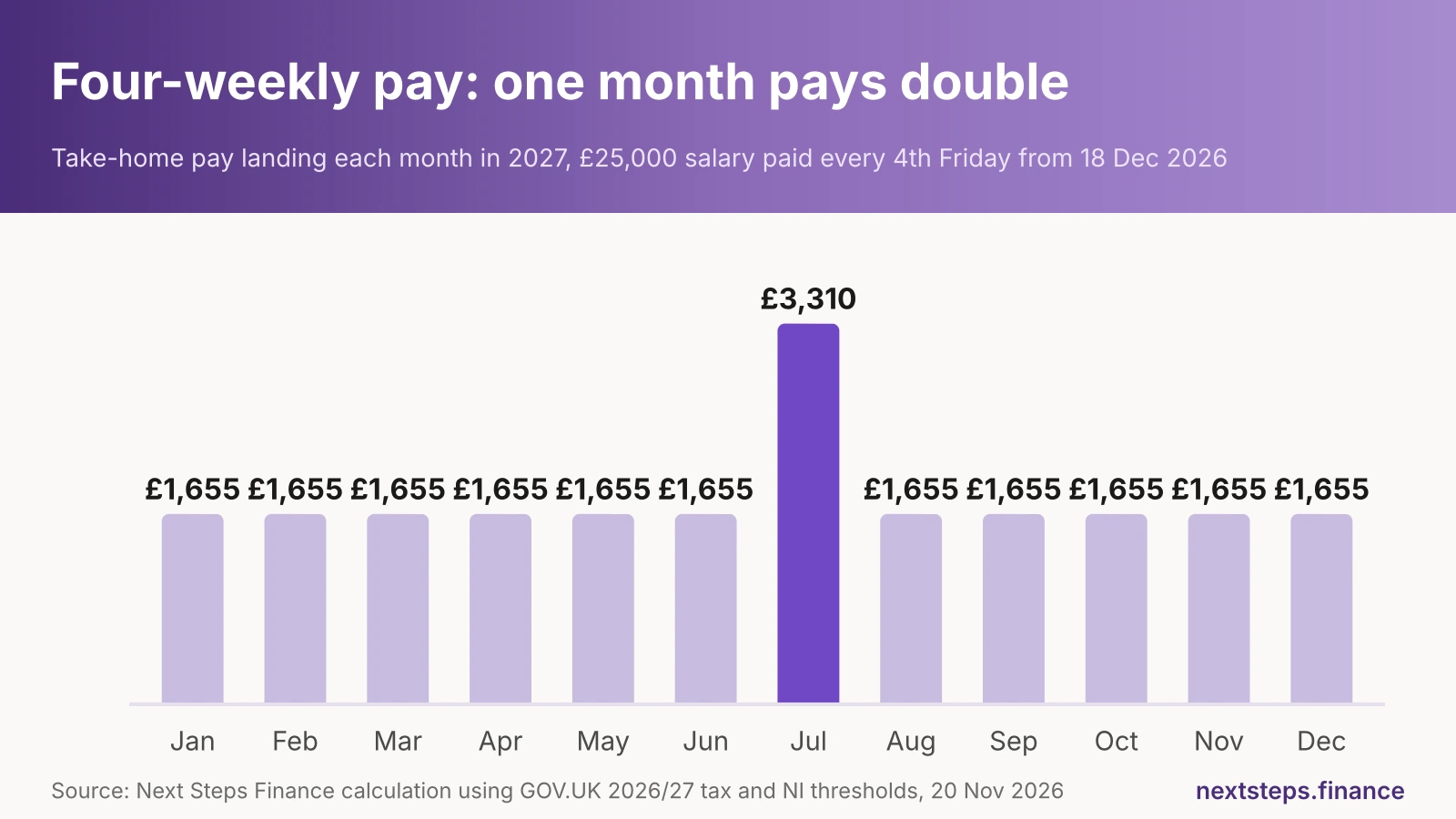
Take someone paid every fourth Friday, starting on 18 December 2026. Their paydays in 2027 fall on 15 January, 12 February, 12 March, 9 April, 7 May, 4 June, 2 July, 30 July, 27 August, 24 September, 22 October, 19 November and 17 December. July has two. Your double month depends entirely on your own pay cycle, so check your employer's pay calendar or count forward 28 days from your last payday.
The same thing happens on other pay patterns:
| Pay frequency | Paydays a year | What changes month to month |
|---|---|---|
| Monthly | 12 | Nothing. One payday a month |
| Four-weekly | 13 | One month a year has two paydays |
| Fortnightly | 26 | Two months a year have three paydays |
| Weekly | 52 | Four or five paydays a month |
Take Action: write down your next 13 paydays and circle the month with two. That's the month your budget has to plan for.
How do you convert 4 weekly pay to a monthly amount?
To convert four-weekly pay to a monthly figure, multiply it by 13 and divide by 12. For weekly pay, multiply by 52 and divide by 12. This gives your true average monthly income, but you won't actually receive that amount in most months.
Using a £25,000 salary in England, Wales or Northern Ireland and GOV.UK's 2026/27 rates and thresholds: the Personal Allowance is £12,570, basic rate tax is 20%, and employee National Insurance is 8% on earnings above the Primary Threshold of £12,570 a year (£242 a week).
| £25,000 salary, 2026/27 | Every 4 weeks | Weekly | Monthly equivalent | Year |
|---|---|---|---|---|
| Gross pay | £1,923 | £481 | £2,083 | £25,000 |
| Income tax | £191 | £48 | £207 | £2,486 |
| National Insurance | £76 | £19 | £83 | £994 |
| Take-home pay | £1,655 | £414 | £1,793 | £21,520 |
Rounded to the nearest pound. Before workplace pension contributions, student loan repayments and any other deductions. Scottish taxpayers pay different income tax rates.
The gap matters. If you budget as though £1,793 lands every month, you'll be about £138 short in 11 months out of 12, then have £1,517 more than expected in the double month. Our take-home pay calculator works out the numbers for your own salary; then divide the yearly figure by 13 (four-weekly) or 52 (weekly).
How do you budget on 4 weekly pay? Two methods that work
The simplest way to budget on four-weekly pay is to plan your month on one payday and treat the 13th payday as extra. The second option, a one-off buffer, smooths your income into equal monthly amounts. Both work; the right one depends on whether you can build a buffer first.
Method 1: Budget on 12 paydays, give the 13th a job
Build your monthly budget around one payday (£1,655 in our example). Every bill, pot and spending limit has to fit inside that figure. When the double month arrives, the second payday is spare, and you decide in advance what it's for. Common jobs for it:
- Christmas or birthday spending, so December isn't paid for by credit card
- A yearly bill such as car insurance, home insurance or a TV licence
- Topping up your emergency fund or paying down a debt
- Seeding the sinking funds described in our sinking funds guide
This is the method most people find easiest because it never asks you to spend money you haven't been paid yet. It fits naturally with zero-based budgeting, where every pound of each payday gets a job.
Method 2: Build a one-payday buffer, then pay yourself monthly
If you want the same amount every month, save one full payday into a separate holding pot first. Then, on the 1st of each month, move your monthly equivalent (£1,793 in our example) into your main account and budget on that. Each four-weekly payday tops the holding pot back up.
It takes discipline to build the buffer, which is why many people start with Method 1 and switch later. The double-pay month is often the easiest moment to do it, because it gives you a whole payday you weren't relying on.
Take Action: pick one method and write the 13th payday's job into your budget today, before the money arrives.
What does a 4 weekly pay budget look like? A worked example
Here's an example budget for someone on £25,000 paid every four weeks, using Method 1. Monthly bills still have to be paid monthly, so the budget is built on one £1,655 payday. The amounts are illustrative; your own bills will differ.
| Budget line | Per month | Notes |
|---|---|---|
| Rent (room or shared house) | £650 | Paid monthly by standing order |
| Council tax, energy, water, broadband | £240 | Monthly Direct Debits |
| Phone and subscriptions | £45 | |
| Food shopping | £250 | |
| Transport | £120 | |
| Sinking funds (gifts, renewals, car) | £100 | |
| Emergency fund | £100 | |
| Personal spending | £150 | |
| Total | £1,655 | Uses one payday |
| 13th payday (July in our example) | £1,655 | Its own plan: e.g. £600 Christmas, £555 emergency fund, £500 insurance renewal |
For more salary-based examples, our £25k salary budget breaks down a full monthly plan, and the free UK budget calculator lets you test your own figures.
If you'd rather not build this yourself:
How do you pay monthly bills when you're paid every 4 weeks?
Pay monthly bills from a separate bills account or pot, filled on each payday. Because a four-weekly payday drifts two to three days earlier every month, a bill fixed to the same date will sometimes fall just before payday and sometimes just after. A bills pot removes that timing problem.
Three practical fixes:
- Use a bills pot. On payday, move the total of your monthly bills into one place and let the Direct Debits come from there. Monzo's Bills Pot lets you choose which Direct Debits and standing orders are paid from the pot, and its Salary Sorter can split any incoming payment over £100 into up to 20 Pots. It prompts you when pay lands and can remember your split for next time.
- Move bill dates. Ask your energy supplier, broadband provider and council to change the collection date to a few days after the earliest payday in your cycle. Most allow this.
- Keep a small float. A balance of a week's spending in your current account covers the odd month where a bill and payday don't line up.
Monzo isn't the only option. Most UK banks now offer savings spaces or pots, and our guide to the best budgeting apps UK compares apps that work with any bank. If you're opening a Monzo account anyway, our referral link gives you £10 plus a free month of Monzo Extra if you're a UK resident aged 18 or over without a Monzo account, and within 30 days you download the app, apply, add money and make a card payment (no minimum), under Monzo's referral terms. Monzo says it can change or replace the bonus at any time.
Take Action: total your monthly Direct Debits, then move that amount into a bills pot on every payday.
How do you budget on weekly pay?
Budget weekly pay on four paydays a month and treat the fifth payday as extra. On £25,000 that's about £414 a week, or £1,655 for four weeks, the same as one four-weekly payday. Four or five months a year will bring an extra £414.
In 2027, the months with five Fridays are January, April, July, October and December. If you're paid on a different weekday, count your own. Weekly pay also suits a weekly spending limit: move a fixed amount for food, transport and fun into a spending pot each payday, and send everything else to bills and savings.
If your hours change week to week, base your budget on your lowest normal week, not your average. Anything above that goes to savings or a buffer first.
Does 4 weekly pay affect Universal Credit?
Yes. Universal Credit uses monthly assessment periods and counts the wages paid within each one. If you're paid four-weekly, LITRG explains that there will be one assessment period each year where two payments of earnings are counted, so your Universal Credit for that month will usually be lower.
Weekly-paid claimants see this more often: LITRG says some assessment periods will include four weeks of pay and some five, so the monthly award goes up and down. You can't change your assessment period dates, so the fix is in the budget:
- Mark the assessment period that will catch your double payday.
- Hold back part of the second payday to cover the lower Universal Credit payment that follows.
- If your award seems lower than expected, check the earnings shown on your statement against your payslips. Free advice is available from Citizens Advice.
What is week 53, and can it change your tax?
Week 53 is the extra payday some employees get in a tax year with 53 of their paydays in it. HMRC's PAYE manual calls it week 53 for weekly pay, week 54 for fortnightly and week 56 for four-weekly. Four-weekly employees may get 14 paydays in a tax year instead of 13.
The 2026/27 tax year runs from Monday 6 April 2026 to Monday 5 April 2027, so it contains 53 Mondays. If you're paid weekly on a Monday, you may get a 53rd payday on 5 April 2027. HMRC tells employers to tax the extra payment on a non-cumulative basis, using the week 1 table (week 4 for four-weekly pay). In practice that can mean slightly more tax on that one payment than you'd expect, because it doesn't get the benefit of the year's running total. Any overpayment is usually sorted out by HMRC after the year ends.
It's a small effect for most people, but if your payslip for that week looks low, this is usually why.
Bottom line
Four-weekly pay gives you a 13th payday every year, and weekly pay gives you a few five-payday months. Both are an advantage if you plan for them: budget on 12 paydays (or four weeks), pay monthly bills from a bills pot, and decide in advance what the extra payday is for. If you claim Universal Credit, set some of the double payday aside for the smaller payment that follows. To map all 13 paydays against your bills for the year, try the UK Budget Planner, or start with our free budget template and the complete guide to budgeting in the UK.
FAQ
How many paydays a year if paid every 4 weeks?
You get 13 paydays a year if you're paid every four weeks, because 52 weeks divided by four is 13. That means one calendar month each year has two paydays. Occasionally a tax year contains 14 four-weekly paydays, which HMRC calls week 56, depending on where your pay cycle falls.
Is 4 weekly pay better than monthly pay?
Four-weekly pay gives the same yearly salary as monthly pay, just split 13 ways instead of 12. Each payday is smaller, about 8% less than a monthly payment, but you get one extra. It can be easier for saving because the 13th payday can go straight to a goal, though monthly bills need more planning.
How do I convert 4 weekly pay to monthly?
Multiply your four-weekly pay by 13, then divide by 12. For example, £1,655 every four weeks is £21,515 a year, or about £1,793 a month on average. Remember you won't receive that monthly figure in most months, so budget on a single payday unless you've built a buffer.
Which month do I get paid twice on 4 weekly pay?
It depends on your pay cycle. Count forward 28 days from each payday: the month where two paydays fall is your double-pay month. For someone paid every fourth Friday from 18 December 2026, it's July 2027, with paydays on 2 July and 30 July.
Does getting paid twice in a month affect Universal Credit?
Usually yes. Universal Credit counts the wages paid in each monthly assessment period, so an assessment period with two four-weekly paydays will normally reduce your award for that month. LITRG notes this happens once a year on four-weekly pay. Setting aside part of the second payday helps cover the lower payment.
How do you budget on weekly pay?
Build your budget on four paydays a month and treat any fifth payday as extra money for savings, debts or yearly bills. Moving a fixed weekly amount into a spending pot each payday helps keep day-to-day spending on track, while monthly bills are paid from a separate bills pot.
Found this useful? Add Next Steps Finance as a preferred source and Google will show you more of our guides in search and AI answers.
Put this into practice
Build your budget in one sitting
The UK Budget Planner works out your take-home pay, splits it with the 50/30/20 rule, tracks spending through the year and forecasts five years ahead. Made for UK pay, tax and bills.