The average food shop cost UK households face is £33.63 per person per week for food and soft drinks bought to eat at home, according to the government's latest Family Food FYE 2025 survey. That's about £146 a month each, before takeaways, meals out and alcohol. The good news this month is that food inflation has dropped to its lowest level in five years, and where you shop still changes your bill by up to 40%.
Foundations
Average Food Shop Cost UK: How to Cut It
Average food shop cost UK: £33.63 a person a week, about £146 a month. See costs by household size, the cheapest supermarket and ways to cut it.
In this article
- 01Key takeaways
- 02What is the average food shop cost in the UK?
- 03How much should a food shop cost per week for 1, 2 or 4 people?
- 04Which supermarket is cheapest in the UK right now?
- 05Are food prices still rising?
- 06How do you set a realistic food budget?
- 07How can you cut the cost of your weekly shop?
- 08Can cashback apps cut your supermarket bill?
- 09Bottom line
- 10FAQ
Key takeaways
- £33.63 per person per week is the UK average spend on food and non-alcoholic drinks for the home (DEFRA, year to March 2025), about £146 a month.
- Eating out adds £12.69 a week per person on average. Including alcohol, total food and drink spending is £50.03 a week, about £217 a month.
- Aldi was the cheapest supermarket in October 2026 at £154.34 for an 87-item Which? basket, against £215.87 at Waitrose.
- Food inflation fell to 0.9% in the 12 months to October 2026, the lowest since September 2021, according to the ONS.
- Food takes 10.9% of the average household's spending, rising to 15.2% for the lowest-income fifth of households.
If you want to see where your food shop sits next to rent, bills and savings, the UK Budget Planner tracks every category month by month.
What is the average food shop cost in the UK?
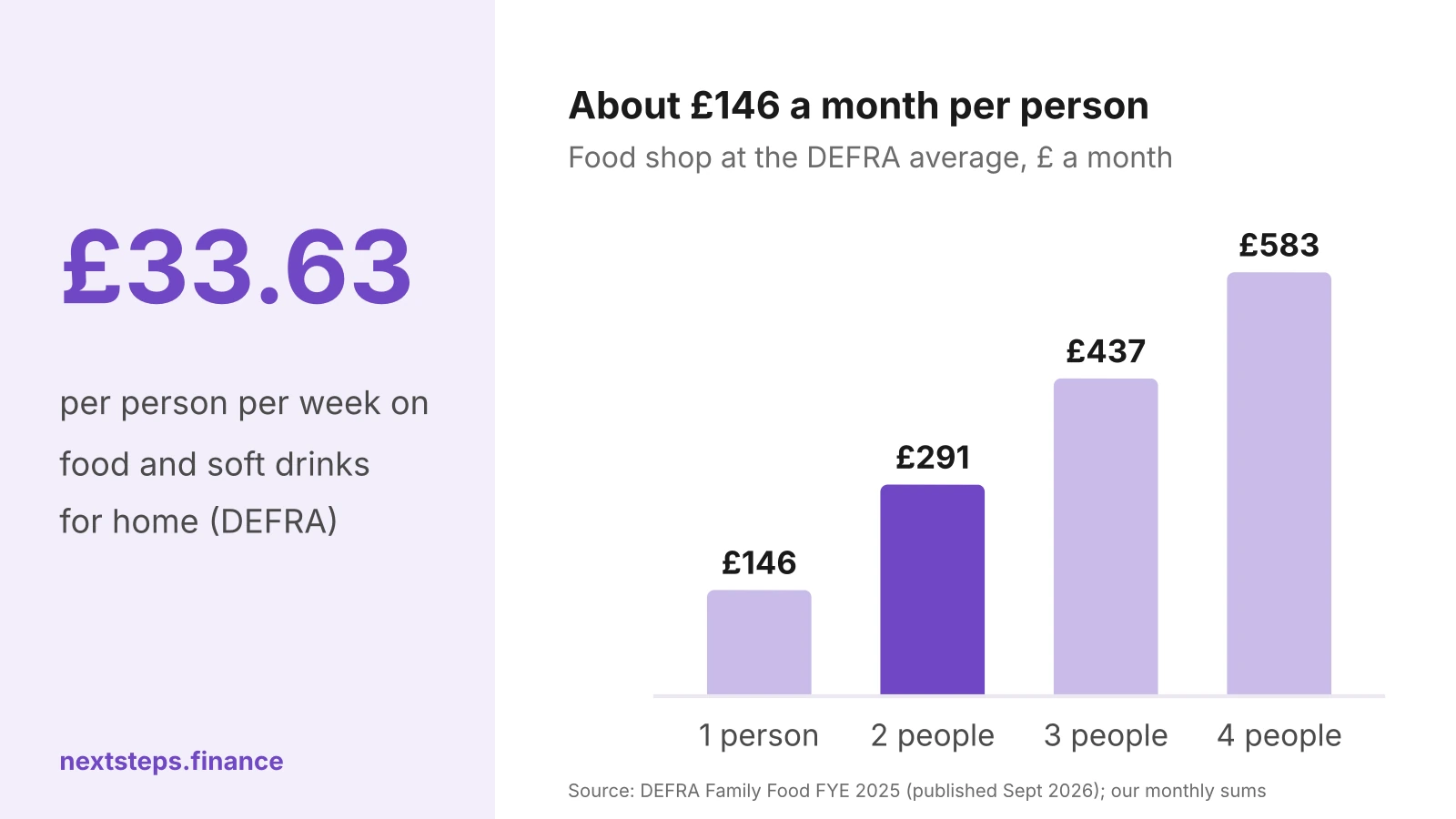
The average UK food shop costs £33.63 per person per week, which works out at about £146 a month or £1,749 a year. That's the figure DEFRA publishes for food and non-alcoholic drinks bought for the home.
DEFRA's Family Food FYE 2025 report, published in September 2026, covers April 2024 to March 2025. It's based on the Living Costs and Food Survey, where around 5,000 households record what they buy. The key figures:
| Spending per person per week | Amount | Change on year before |
|---|---|---|
| Food and soft drinks for the home | £33.63 | +4.1% (up from £32.30) |
| All food and drink eaten out | £12.69 | +12.8% (up from £11.25) |
| All food and drink, including alcohol and eating out | £50.03 | +6.0% (up from £47.19) |
Two things stand out. Most of the rise in the home food bill came from higher prices: after inflation, DEFRA says household food and soft drink spending rose just 0.9%. And eating out grew much faster, up 9.2% even after inflation, so a quarter (25.4%) of all food and drink money now goes on meals, takeaways and snacks bought outside the home.
The ONS Family spending in the UK report for the same year tells a similar story: food and non-alcoholic drink spending rose by £3.20 a week per household, and the ONS says most of that reflected higher prices rather than people buying more.
How much should a food shop cost per week for 1, 2 or 4 people?
At the DEFRA average, a weekly food shop costs about £34 for one person, £67 for two and £135 for a family of four. Monthly, that's roughly £146, £291 and £583.
| Household | Per week | Per month | Per year |
|---|---|---|---|
| 1 person | £33.63 | £146 | £1,749 |
| 2 people | £67.26 | £291 | £3,498 |
| 3 people | £100.89 | £437 | £5,246 |
| 4 people | £134.52 | £583 | £6,995 |
These are simple multiples of the per-person average, so treat the larger households as an upper guide. Young children eat less than adults, and bigger households tend to waste less and buy in bulk, so many families of four spend less than £583 a month. A household of teenagers can easily spend more.
Use the numbers as a starting point, then check your own bank statements for the last three months. Your real average beats any national figure. Our average household bills guide shows the other fixed costs that sit alongside the food shop, from council tax to broadband.
Take Action: Add up your supermarket spending for the last 12 weeks and divide by 12. That's your real weekly food shop.
Which supermarket is cheapest in the UK right now?
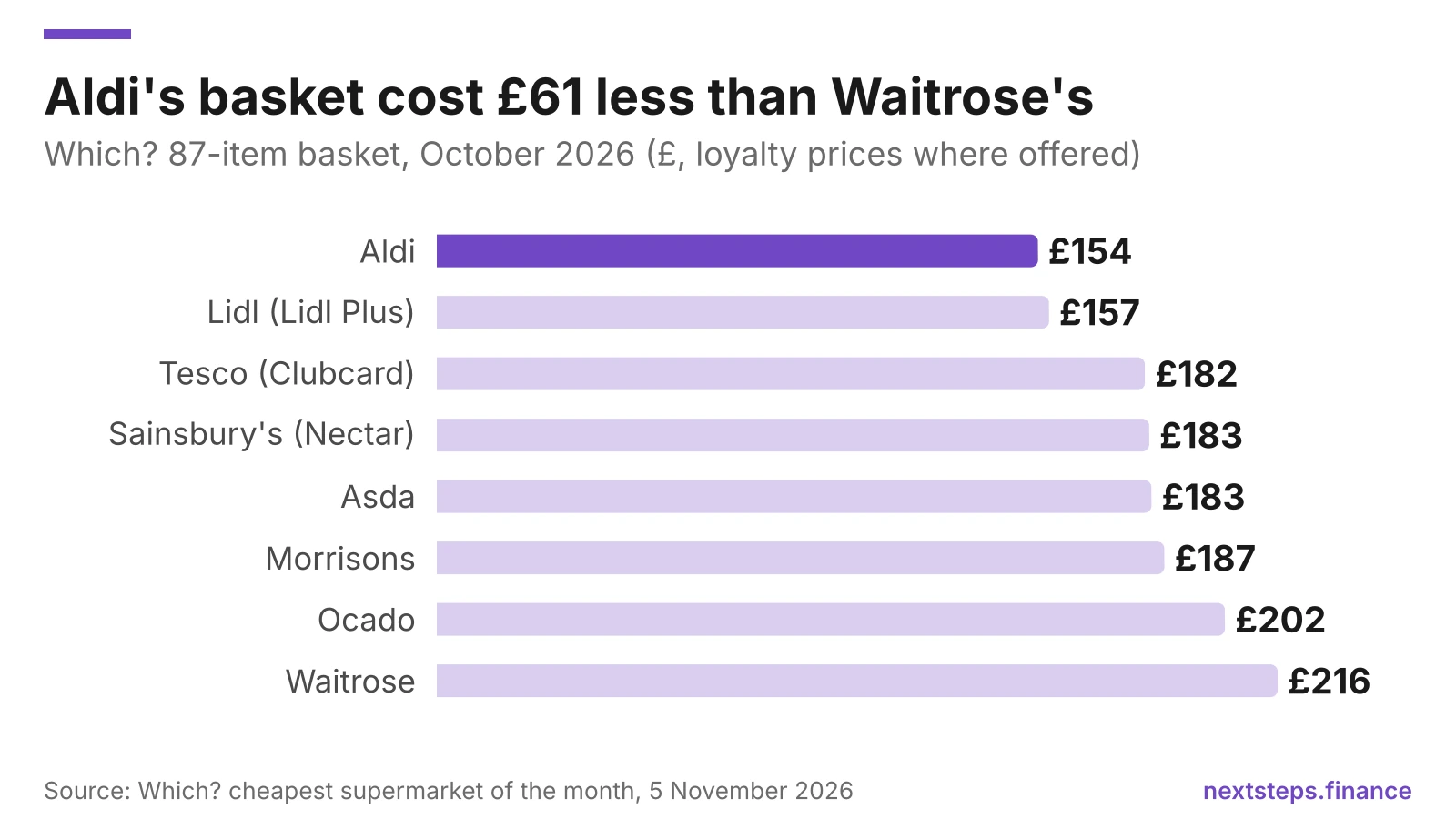
Aldi was the cheapest UK supermarket in October 2026, according to Which?'s monthly price comparison, published on 5 November. Its 87-item basket cost £154.34, just ahead of Lidl at £157.17 with Lidl Plus.
| Supermarket (October 2026) | 87-item basket | Without loyalty prices |
|---|---|---|
| Aldi | £154.34 | n/a |
| Lidl (Lidl Plus) | £157.17 | £157.21 |
| Tesco (Clubcard) | £181.77 | £187.31 |
| Sainsbury's (Nectar) | £182.90 | £191.56 |
| Asda | £183.47 | n/a |
| Morrisons | £186.77 | n/a |
| Ocado | £202.33 | n/a |
| Waitrose | £215.87 | n/a |
The same basket cost £61.53 more at Waitrose, about 40% extra, and £27.43 more at Tesco even with a Clubcard. Loyalty cards matter at the big four: Nectar prices cut the Sainsbury's basket by £8.66 and Clubcard prices cut Tesco's by £5.54.
Which? changes the list each month, so the totals aren't directly comparable from one month to the next. The ranking is the useful part: the discounters led comfortably in October, while Waitrose was again the most expensive.
Are food prices still rising?
Yes, but much more slowly. The ONS reported on 18 November 2026 that food and non-alcoholic drink prices rose 0.9% in the 12 months to October, down from 1.3% in September and the lowest rate since September 2021.
Chocolate was the biggest drag on the rate, with discounting almost doubling between September and October and cocoa prices lower. That's welcome, but overall CPI inflation actually rose to 3.6%, driven by fuel. We explain the wider picture in our October 2026 inflation guide.
Shoppers' own receipts show slightly higher grocery inflation. Worldpanel by Numerator measured like-for-like grocery price inflation of 2.6% in the four weeks to 1 November 2026, up from 2.5% a month earlier. Its figure includes household goods such as cleaning products and toiletries, and tracks what people actually paid, which is why it differs from the ONS food rate.
The practical point: prices are broadly stable for now, so cutting your bill depends on what and where you buy, not waiting for prices to fall.
How do you set a realistic food budget?
Start with what you actually spend, then set a weekly or monthly limit about 10% lower and track it. A food budget only works if it's based on real numbers rather than a national average.
- Find your baseline. Add up the last three months of supermarket, top-up shop and online grocery spending from your bank app. Keep takeaways and eating out separate.
- Pick a weekly or monthly figure. If you're paid monthly, a monthly food pot is easier. If you shop weekly, divide it by 4.33, not 4.
- Separate the extras. Lunches out, coffees and takeaways are where the DEFRA figures show spending growing fastest, so give them their own line.
- Plan for the expensive months. December, birthdays and school holidays push the food shop up. A sinking fund spreads those costs across the year, and our Christmas budget guide covers the festive food shop.
- Review monthly. Compare what you spent with your budget and adjust either the plan or your habits.
If you'd rather not build this from scratch, our free budget template and UK budget calculator give you a quick starting point.
If you want the food shop tracked alongside every other bill and savings goal:
How can you cut the cost of your weekly shop?
The biggest saving usually comes from switching supermarket, then from planning meals and cutting waste. Small changes stack up when you shop every week.
- Try a discounter for the basics. On the Which? October basket, Aldi was 15% cheaper than Tesco with a Clubcard. For a couple spending the average £291 a month, a similar gap would save about £44 a month, or around £527 a year.
- Use the free loyalty schemes. If you shop at Tesco, Sainsbury's or Lidl, scan Clubcard, Nectar or Lidl Plus every time. Which? found 18 Clubcard and 21 Nectar price discounts on its basket.
- Plan meals before you shop. A written list built around what's already in the fridge cuts impulse buys and food waste.
- Drop down a brand level. Own-label and value ranges are usually cheaper than branded products, and many households barely notice the difference on basics like pasta, tins and cleaning products.
- Cut one takeaway a week. With eating out at £12.69 per person per week on average, swapping even one meal for a home-cooked one can free £30 to £50 a month.
- Check the unit price. Shelf labels show price per kg or per litre, which shows when a multibuy or big pack isn't the bargain it looks.
For more budgeting habits that free up cash, see our complete guide to budgeting in the UK or the budgeting hub.
Can cashback apps cut your supermarket bill?
Yes. Gift card cashback apps can knock 2% to 4.5% off your supermarket spending. You buy a supermarket gift card in the app for the exact amount just before you pay, and get a percentage back.
| App | Tesco | Sainsbury's | Asda | Morrisons | How it pays |
|---|---|---|---|---|---|
| Cheddar | Up to 4.5% (in store) | Up to 3.5% | Up to 3.5% | Not listed | Instant to your Cheddar balance, withdraw from £5 with no fees |
| JamDoughnut | 2.25% (in store) | 2.25% | 2.25% | 2% | Instant cashback to your JamDoughnut wallet |
Rates are from each app's own website on 19 November 2026 and change often. Rate trackers have shown higher JamDoughnut rates earlier this month, and the app can differ from the website, so check in the app before you buy. Cheddar also lists up to 4% at M&S and up to 3.5% at Waitrose, and JamDoughnut 2.25% at Waitrose, M&S and Iceland. Neither app listed Aldi or Lidl at a percentage rate when we checked, so they suit the big supermarkets more than discounters.
On a £291 monthly shop at Tesco, 4.5% back would be about £13 a month, or £157 a year. Try it with your own numbers:
Calculator
How much could cashback take off your food shop?
- Monthly spend£291
- Cashback rate4.5%
- Yearly fee£0
Cashback a year£157
Per month£13.10
Over 5 years£786
Rates vary by supermarket and change often. Cheddar's Tesco rate is up to 4.5%, in store only.
The downsides are real. You need to buy the gift card for the exact amount at the till, which takes a few seconds and a phone signal. Cheddar's Tesco gift card works in store only. And a gift card is less protected than paying by card if something goes wrong with a purchase. Cheddar Payments Limited says it is authorised and regulated by the FCA (FRN 940075), but a cashback balance isn't a bank account. For a full comparison, see our guides to the best cashback apps and how to stack cashback apps.
Take Action: If you shop at one of the big four, compare Cheddar and JamDoughnut for your supermarket before your next shop, and keep scanning your loyalty card on top.
Bottom line
The average UK food shop costs £33.63 per person per week, about £146 a month, with eating out adding roughly £55 a month on top. Food inflation is at a five-year low, so the biggest savings come from where you shop, planning meals and a gift card cashback app at the till. Start from your own bank statements, set a monthly food budget and track it in the UK Budget Planner so the food shop has a clear place next to your bills and savings.
FAQ
What is the average weekly food shop for one person in the UK?
The average weekly food shop for one person in the UK is £33.63 for food and non-alcoholic drinks bought for the home, according to DEFRA's Family Food FYE 2025, published in September 2026. That's about £146 a month. Eating out adds a further £12.69 a week on average.
How much does a family of 4 spend on food per week in the UK?
At DEFRA's average of £33.63 per person, a family of four would spend about £135 a week, or £583 a month, on food and soft drinks for the home. Treat that as an upper guide: young children eat less than adults and families buy in bulk, so many spend less.
What is a reasonable food budget per month in the UK?
A reasonable monthly food budget is about £146 per adult at the UK average, based on DEFRA's £33.63 per person per week. Couples spend around £291. Shopping at Aldi or Lidl, planning meals and using loyalty prices can bring that down. Base yours on your own last three months of spending.
Which is the cheapest supermarket in the UK?
Aldi was the cheapest UK supermarket in October 2026, according to Which?, with an 87-item basket costing £154.34. Lidl was close behind at £157.17 with Lidl Plus. Tesco with Clubcard cost £181.77 and Waitrose was the most expensive at £215.87. Which? publishes the ranking monthly.
Are food prices going down in the UK?
Food prices are still rising, but slowly. The ONS said food and non-alcoholic drink inflation was 0.9% in the 12 months to October 2026, the lowest since September 2021. Worldpanel's grocery inflation measure, which includes household goods, was 2.6% in the four weeks to 1 November 2026.
Found this useful? Add Next Steps Finance as a preferred source and Google will show you more of our guides in search and AI answers.
Put this into practice
Build your budget in one sitting
The UK Budget Planner works out your take-home pay, splits it with the 50/30/20 rule, tracks spending through the year and forecasts five years ahead. Made for UK pay, tax and bills.