Plum is worth it if you need a nudge to save, because its automations move money for you without you thinking about it. It is harder to justify the paid plans on interest alone: on today's rates, Max only covers its own cost from the extra Easy Access interest once you hold about £30,000 there.
I'm a Chartered Accountant, and I've reviewed Plum the way I'd check any product for a client: what it costs, what it pays, how your money is protected and where the catches are. Every rate and fee below comes from Plum's own pages, checked on 5 November 2026.
Key takeaways
- Four plans: Basic £0, Plus £3.99 a month, Boost £7.99 and Max £14.99, with the first month of any paid plan free (Plum plans).
- Easy Access savings pays 3.05% to 3.65% AER variable depending on your plan, with the account provided by Lloyds Bank and covered by the FSCS up to £120,000.
- The Plum Cash ISA pays 4.66% AER variable on every plan, with no fees (Plum fees).
- Paid plans rarely pay for themselves on interest alone: you'd need about £29,980 in Easy Access for Max's extra 0.60 points to cover its £179.88 yearly cost.
- Investing fees fall as you pay more: from 0.60% a year on Basic to 0.15% on Max, plus fund charges. Capital at risk.
What is Plum and how does it work?
Plum is an app that saves and invests for you automatically. You connect your bank account, and Plum's automations move small amounts into "pockets" based on rules you choose, such as rounding up card spending or saving a set amount each week.
Plum, Plum Money and Plum's investing products are run by Saveable Limited, which is authorised by the Financial Conduct Authority (FRN 739214). Plum's site says new accounts are moving to Plum Fintech Payments Limited, an FCA-authorised e-money institution, from October 2026.
The plans differ in how many automations and pockets you get, the rates you earn and the investing fees you pay:
- Basic (free): 6 automations, 1 customisable savings pocket
- Plus (£3.99 a month): 10 automations, 16 pockets, 13 ready-made funds
- Boost (£7.99 a month): as Plus, with 22 funds and lower fees
- Max (£14.99 a month): 26 funds, the lowest fees, unlimited free US share trades and a set of lifestyle perks Plum values at £74 a month
The big draw is behaviour, not rate. If you know you won't move money across on payday by yourself, an app that does it for you can be worth more than an extra half a percent of interest.
Take Action: Before choosing a plan, write down what you actually want Plum for: automatic saving, a Cash ISA, or investing. The answer decides whether a paid plan makes sense.
How much does Plum cost? Plans and fees compared
Plum's Basic plan is free, and the three paid plans cost £47.88, £95.88 and £179.88 a year. Here is what each plan gets you, from Plum's plans page and fees page (effective from 27 February 2026).
| Basic | Plus | Boost | Max | |
|---|---|---|---|---|
| Monthly price | £0 | £3.99 | £7.99 | £14.99 |
| Yearly cost (paying monthly) | £0 | £47.88 | £95.88 | £179.88 |
| Easy Access savings (AER) | 3.05% | 3.10% | 3.25% | 3.65% |
| Cash ISA (AER) | 4.66% | 4.66% | 4.66% | 4.66% |
| Cash Lifetime ISA (AER) | 4.30% | 4.30% | 4.30% | 4.30% |
| Investing management fee | 0.60% | 0.45% | 0.30% | 0.15% |
| US share trades | 2 free, then £0.50 | 2 free, then £0.15 | 2 free, then £0.05 | Unlimited free |
| FX fee | 0.60% | 0.45% | 0.30% | 0.15% |
| SIPP fees | 0.45% | 0.45% | 0.45% | 0.45% |
If the app offers you annual billing at a lower price, the break-even balances below fall in proportion. All the rates are variable. The SIPP figure is a 0.35% administration charge plus a 0.10% custody charge, the same on every plan, and fund manager fees come on top for any investment.
Is Plum Plus, Boost or Max worth it?
On savings interest alone, usually not. Each paid plan earns more on Easy Access than Basic, but the extra interest has to beat the subscription before you're ahead.
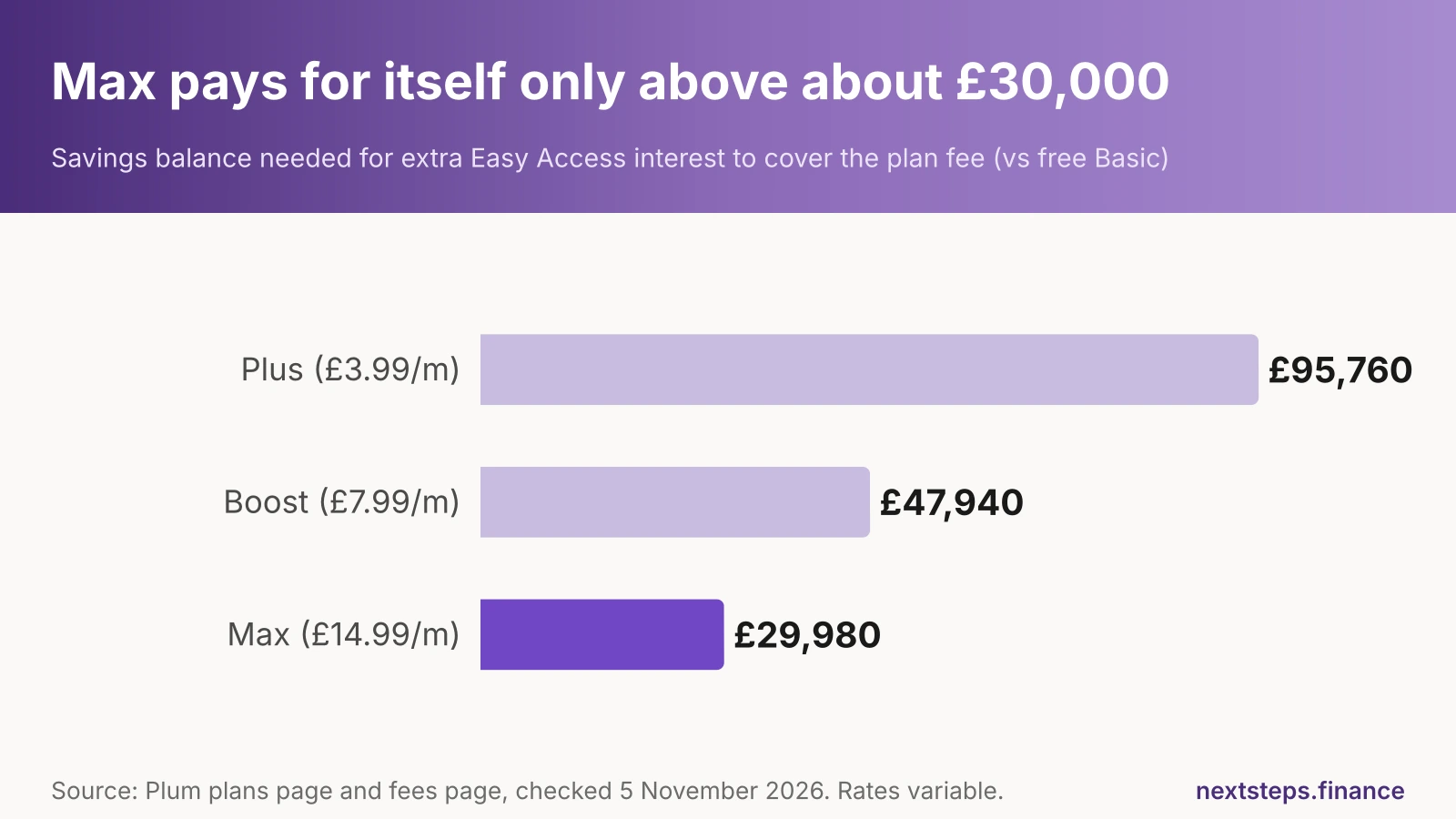
The maths: Max pays 0.60 percentage points more than Basic (3.65% vs 3.05%). Its £179.88 yearly cost divided by 0.60% is £29,980. Below that balance, you're paying more for Max than it earns you in extra interest. Plus only adds 0.05 points, so you'd need £95,760 saved before it breaks even.
A paid plan can still make sense if you'll use the other features: more pockets and automations, lower investing fees on a big portfolio, or the Max perks such as travel insurance. Value those honestly, rather than assuming you'll use them all. The first month is free, which is a fair way to find out.
Take Action: Start on Basic. Only upgrade if you hit the 6-automation or 1-pocket limit, or your investments are large enough for the lower fee to matter.
What interest rate does Plum pay on savings?
Plum's Easy Access account paid 3.05% to 3.65% AER variable on 5 November 2026, and its Cash ISA paid 4.66% AER variable on every plan. Plum says the Easy Access account is provided by Lloyds Bank PLC.
That puts Plum below the top of the market. Moneyfacts' easy access table on 3 November showed Oxbury Bank at 4.57% AER and Zopa at 4.56% (including a 1.05% bonus for 12 months). LemFi topped the table at 5.00%, but that includes a six-month bonus of 1.89%, after which it drops to 3.04% according to Moneyfacts' weekly round-up.
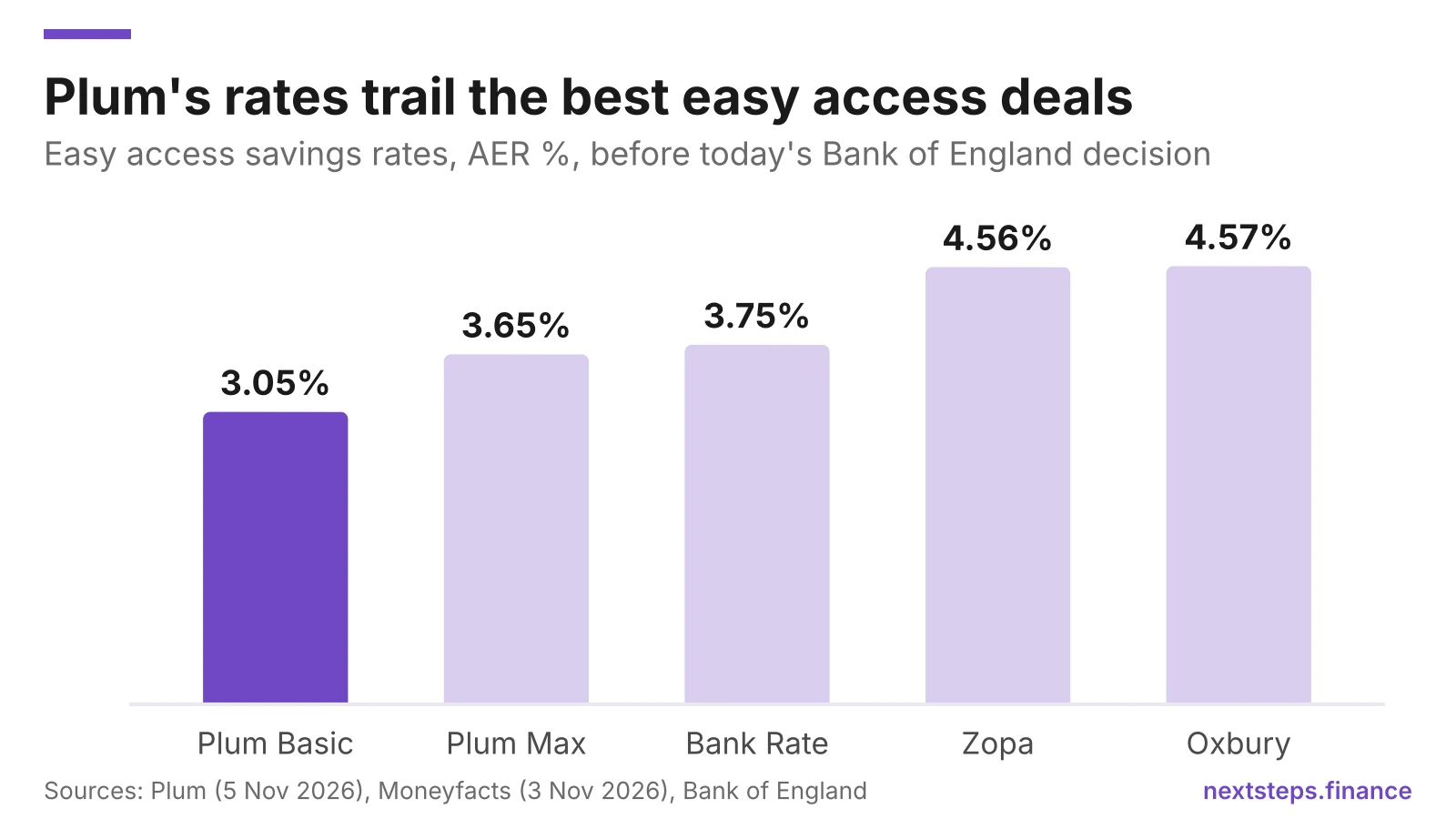
Timing matters this week. The Bank of England announces its next decision on Thursday 5 November 2026, with Bank Rate at 3.75% going in. Plum's rates are variable, so they could move after the decision. Our Bank of England rate rise explainer covers what a change would mean for savers.
Try it with your own numbers: how much more would £10,000 earn in a top easy access account than in Plum Max?
- Amount saved£10,000
- Rate A (AER)4.57%
- Rate B (AER)3.65%
- Months12 months
The Cash ISA is the stronger product. At 4.66% AER on every plan, including free Basic, it sits above the best ordinary easy access rates in the Moneyfacts table, and interest inside an ISA is tax-free. That matters more from April 2027, when tax on savings interest rises. ISA rules apply, including the £20,000 yearly allowance.
Take Action: If you mainly want a home for cash, compare Plum's Cash ISA with our best savings accounts guide before opening the Easy Access account.
Is Plum safe? FSCS protection explained
Plum is regulated by the FCA, and savings in the Easy Access account and Cash ISA are covered by the FSCS up to £120,000 per person, per bank. Money sitting in your main Plum pockets is different: it's e-money, which isn't FSCS-protected.
Plum's own wording is clear: "Whilst Electronic Money products are not covered by the Financial Services Compensation Scheme (FSCS) your funds will be held in one or more segregated accounts and safeguarded in line with the Electronic Money Regulations 2011." Safeguarding means your money is kept separate from Plum's own, but it isn't the same as a government-backed guarantee.
Three points worth knowing:
- The FSCS limit is per bank, not per app. Plum's Easy Access account is provided by Lloyds Bank. If you already hold savings with Lloyds, or a bank in the same group, the £120,000 limit covers your combined balance there.
- Plum Interest is a money market fund, not a savings account. It pays a variable return (2.86% to 3.79% depending on plan) from the BlackRock ICS Sterling Liquidity Fund. Total yearly fees range from 1.03% on Basic to 0.10% on Max. It's an investment, so capital is at risk.
- Investments aren't covered for falls in value. The FSCS protects against a firm failing, not against markets falling.
On reputation, Plum had a TrustScore of 4 out of 5 ("Great") from around 9,765 reviews on Trustpilot on 5 November 2026, though 15% of those reviews were one-star.
Plum investing and Stocks & Shares ISA: what you need to know
Plum's Stocks & Shares ISA and General Investment Account give you ready-made funds, with a management fee of 0.60% a year on Basic falling to 0.15% on Max, plus the fund manager's own charge. Capital at risk - the value of investments can go down as well as up.
The fees page shows how the paid plans cut the cost. Plus, Boost and Max charge 0.45%, 0.30% and 0.15%, with rebates paid back to your Primary Pocket. There are no dealing, deposit, withdrawal or ISA transfer fees. Note that Plum's Stocks & Shares ISA holds funds only: you can't hold individual shares inside it. US shares are a separate product with an FX fee on every trade.
For a DIY investor, a 0.60% fee is high. On £10,000, that's £60 a year before fund charges. InvestEngine charges no platform fee on DIY ETF portfolios and 0.25% a year for its managed portfolios, according to its costs page, with ETF charges from 0.03% a year. It also has no account fee on its SIPP. Capital at risk - the value of investments can go down as well as up. See our InvestEngine review for the catches, including no interest on uninvested cash.
Take Action: Use Plum for automatic saving if that helps you, but compare the total yearly cost of investing before you put a large ISA there. Our best stocks and shares ISA guide compares the main platforms.
Plum vs the alternatives
Plum is best at automatic saving. Other apps beat it on budgeting tools, savings rates or investing costs, so the right choice depends on what you need most.
| App | Best for | Key catch | Link |
|---|---|---|---|
| Plum | Automatic saving, 4.66% Cash ISA | Paid plans rarely pay for themselves on interest | Sign up to Plum |
| InvestEngine | Low-cost DIY ETF investing | No interest on uninvested cash; capital at risk | InvestEngine |
| A top easy access account (e.g. Oxbury, Zopa) | The highest rate on cash | No automations; you move money yourself | Compare via Moneyfacts |
| A budgeting app (e.g. Emma) | Seeing where your money goes | Saving features are secondary | Emma review |
Plenty of people combine them: a budgeting tool to set a target, an app like Plum to move money automatically, and a top-rate account or ISA for the bulk of their savings. Our best budgeting apps guide compares Plum with Emma and Snoop, and the free UK Budget Planner helps you work out how much you can save each month.
Plum pros and cons
Plum's main strength is that it saves for you. Its weaknesses are cost and rates.
Pros
- Automations make saving effortless, even on the free plan
- Cash ISA at 4.66% AER on every plan, with no fees
- Easy Access account provided by Lloyds Bank, FSCS-protected up to £120,000
- Free first month on paid plans, and you can switch or cancel plans any time
- Everything (saving, ISAs, investing, pension) in one app
Cons
- Easy Access rates of 3.05% to 3.65% trail the best accounts at around 4.5%
- Paid plans need large balances to pay for themselves through interest
- Investing fees of 0.60% on Basic are high compared with low-cost platforms
- Money in standard pockets is e-money, not FSCS-protected
- The Stocks & Shares ISA holds funds only, not individual shares
Our verdict: is Plum worth it in 2026?
Plum is worth it on the free Basic plan if you struggle to save consistently, and its Cash ISA is competitive on any plan. The paid plans are harder to justify unless you'll use the extra features, because the higher interest rarely covers the subscription.
This may suit you if you want saving to happen in the background and you value the habit more than squeezing out the top rate. It may not suit you if you're already disciplined, because you'll earn more by moving cash to a top easy access account or ISA yourself.
If you'd like a second opinion on where your savings and investments should sit, our personal finance review looks at your whole picture.
Take Action: Sign up to Plum on Basic, set up two or three automations, and review after a month whether it's changed how much you save.
FAQ
Is Plum safe to use in the UK?
Plum is authorised by the Financial Conduct Authority through Saveable Limited (FRN 739214). Its Easy Access account and Cash ISA are covered by the FSCS up to £120,000 per person, per bank. Money in standard pockets is e-money, which is safeguarded in separate accounts but not FSCS-protected. Investments can fall in value.
Is Plum worth paying for?
For most savers, Plum's paid plans don't pay for themselves through interest alone. On 5 November 2026, Max cost £179.88 a year and paid 0.60 points more than free Basic on Easy Access, so you'd need about £29,980 saved to break even. A paid plan may suit you if you'll use the extra features.
How much does Plum charge?
Plum Basic is free. Plus costs £3.99 a month, Boost £7.99 and Max £14.99, with the first month of a paid plan free. Investing adds a management fee of 0.60% a year on Basic down to 0.15% on Max, plus fund charges. The SIPP costs 0.45% a year on every plan.
What interest rate does Plum pay?
On 5 November 2026, Plum's Easy Access savings paid 3.05% AER on Basic, 3.10% on Plus, 3.25% on Boost and 3.65% on Max. The Cash ISA paid 4.66% AER and the Cash Lifetime ISA 4.30% on every plan. All the rates are variable and can change, including after Bank of England decisions.
Can I withdraw money from Plum at any time?
Yes, Plum's easy access savings let you withdraw at any time without a fee. Plum says withdrawals requested by 3pm on a working day usually arrive the same day. Money in a Cash ISA can also be withdrawn, but ISA rules apply, and Lifetime ISA withdrawals for other purposes carry a government penalty.
How does Plum make money?
Plum earns money mainly from its paid subscription plans and from fees on investments, such as the yearly management fee on its Stocks & Shares ISA, General Investment Account, Plum Interest fund and SIPP. It also earns FX fees and trade fees on US share dealing for users on its lower plans.