
Emma is one of the UK's most popular budgeting apps, rated 4.7 out of 5 from around 27,000 ratings on the UK App Store. The free version tracks your accounts in one place. The paid plans add more bank logins, custom categories, cashback, rent reporting, cheaper investing and higher savings rates.
This Emma app review checks every price and rate against Emma's own help centre today, 31 October 2026, and works out when a paid plan actually pays for itself. If you're still choosing between apps, our Emma vs Snoop vs Plum comparison covers the wider field.
Key takeaways
- Emma's paid plans cost £4.99, £9.99 or £14.99 a month (Plus, Pro, Ultimate), or £41.99, £83.99 or £124.99 a year, about 30% less than paying monthly (Emma help centre, updated 15 September 2026).
- Emma Easy Access Pots pay 1.67% AER on the free Basic plan, rising to 2.08% on Plus, 2.93% on Pro and 3.20% on Ultimate (Emma). All rates are variable.
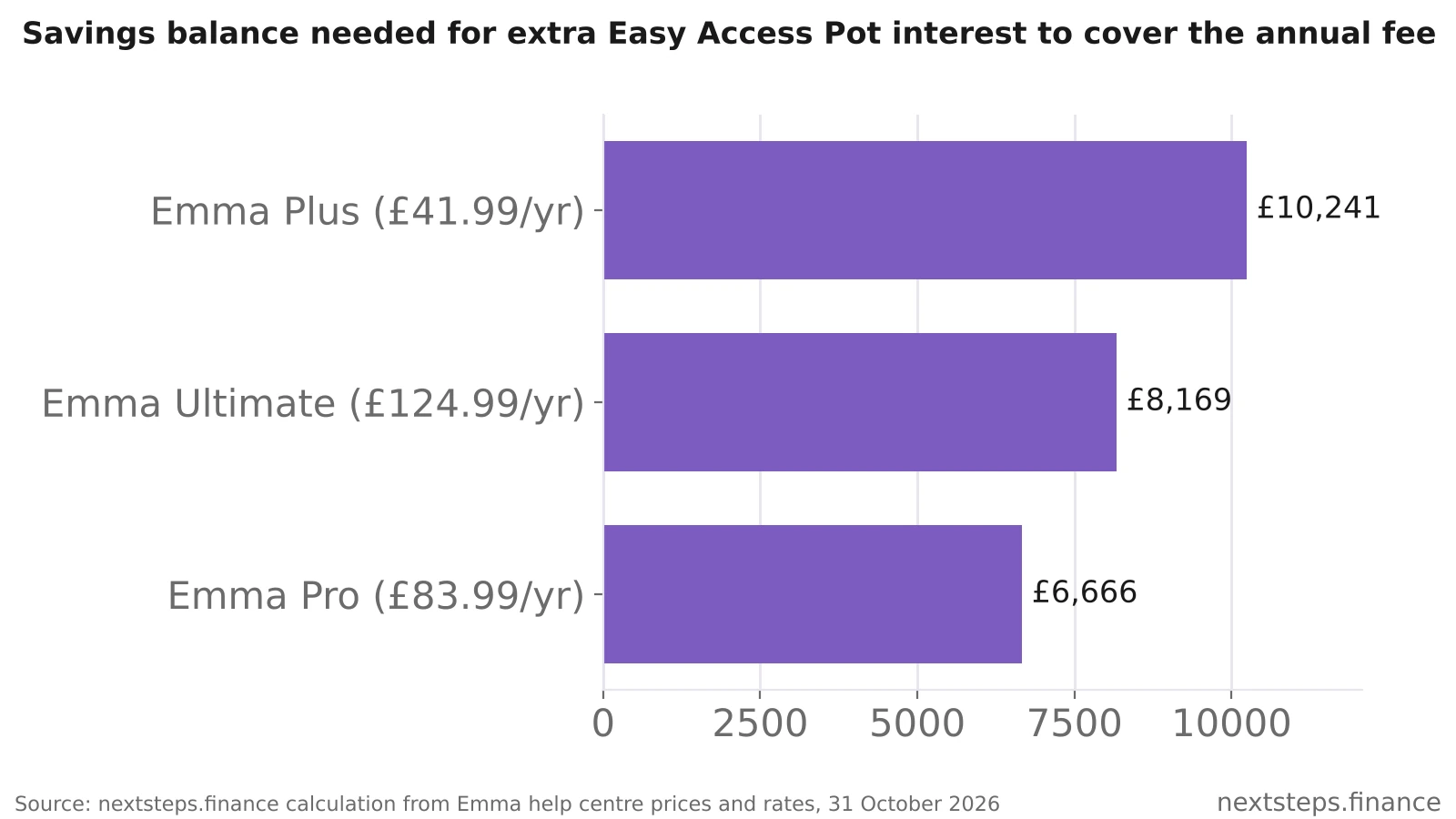
- On savings alone, Emma Pro pays for itself from about £6,700 in an Easy Access Pot; Plus needs about £10,200 and Ultimate about £8,200 (our calculation).
- Free accounts elsewhere pay more than Emma Basic: Plum's free Easy Access pays 3.05% AER and Revolut's free Standard plan pays 2.90%.
- Emma Easy Access Pots and the Cash ISA have FSCS protection up to £360,000 combined, because Bondsmith spreads money across partner banks; 45 Day Notice Pots are covered up to £120,000 (Emma).
What is the Emma app and how does it work?
Emma is a money management app that connects to your bank accounts, credit cards and other accounts through Open Banking and shows them in one dashboard. It sorts transactions into categories, tracks subscriptions and sets budgets, and it can also hold savings and investments.
Emma Technologies Ltd is registered with the Financial Conduct Authority under the Payment Services Regulations 2017 (FRN 794952), and is authorised and regulated by the FCA for investment services and consumer credit activities (FRN 1042167), according to its App Store listing and website. Open Banking gives the app read-only access to your transactions, so linking accounts doesn't let it move money out of your bank.
Over 2026 Emma has added more than budgeting. Its blog announced a new investing experience in January, a Stocks & Shares ISA in February and NordVPN inside Emma Ultimate in March.
You can sign up to Emma and stay on the free plan for as long as you like. Emma says you aren't automatically subscribed to a paid plan when you download the app.
How much does Emma cost in 2026?
Emma is free to download and use on its Basic plan. The three paid plans cost the following, according to Emma's pricing page, updated 15 September 2026:
| Emma plan | Monthly | Annual | Bank logins | Best for |
|---|---|---|---|---|
| Basic | Free | Free | Not stated | Seeing your spending in one place |
| Plus | £4.99 | £41.99 | 4 | Cashback and rent reporting to Experian |
| Pro | £9.99 | £83.99 | Unlimited | Custom categories, net worth, data export |
| Ultimate | £14.99 | £124.99 | Unlimited | Business accounts, Spaces, NordVPN, top rates |
Paying annually saves about 30% compared with monthly. Pro paid monthly costs £119.88 a year, so the annual price of £83.99 saves you £35.89.
Watch the free trial. When you start a trial Emma may take a temporary £1 pre-authorisation, which it says isn't a real charge. If you don't cancel before the trial ends it rolls into a paid subscription.
What do Emma Plus, Pro and Ultimate include?
The paid plans differ mainly in bank logins, extra tools and the rates and fees on Emma's savings and investing. This is Emma's own plan comparison for UK users:
| Feature | Plus | Pro | Ultimate |
|---|---|---|---|
| Bank logins | 4 | Unlimited | Unlimited |
| Bank transfers in app | Up to £1,500 a month | Up to £3,000 a month | Unlimited |
| Custom categories | No | Yes | Yes |
| Net worth, CSV import, data export | No | Yes | Yes |
| Rent reporting | Experian | Experian, Equifax, TransUnion | Experian, Equifax, TransUnion |
| Cashback | Yes | Yes | Yes |
| Investing annual fee (AUM) | 0.60% | 0.20% | 0.10% |
| Business accounts, Spaces, NordVPN | No | No | Yes |
Is Emma cashback worth it?
Emma Cashback is a paid-plan feature: you shop through a retailer link inside the app and the reward lands in your Emma Wallet. Emma's cashback help page says cashback takes about two months on average to arrive, and you can withdraw to PayPal once you have £5. That's slower and narrower than a dedicated cashback site, so treat it as a bonus rather than a reason to pay.
Does Emma rent reporting help your credit score?
Rent reporting sends your rent payments to credit reference agencies, which may help if you have a thin credit file. Plus reports to Experian only, while Pro and Ultimate report to all three main agencies. If building credit is your goal, see our guide to improving your credit score.
Take Action: Write down the one or two paid features you'd actually use. If none appear in the table above, stay on Basic.
Emma Pots savings rates: how do they compare?
Emma Pots are savings accounts inside the app, available to UK customers only, and the rate you get depends on your plan. These are Emma's current Pot rates (all AER variable; Emma says to check the app for the latest):
| Pot | Basic (free) | Plus | Pro | Ultimate |
|---|---|---|---|---|
| Easy Access Pot | 1.67% | 2.08% | 2.93% | 3.20% |
| 45 Day Notice Pot | 2.53% | 3.67% | 3.67% | 3.67% |
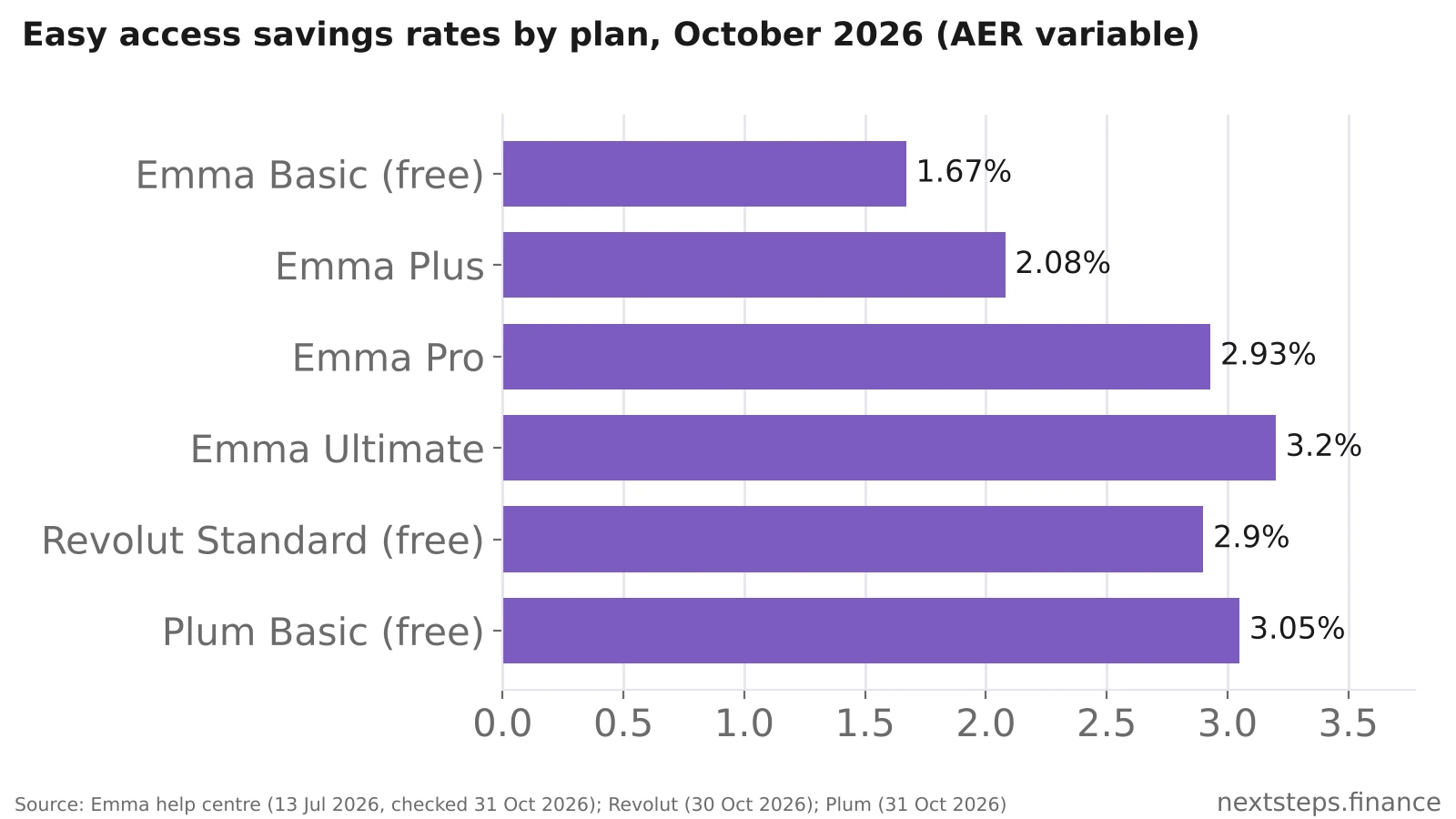
The free Basic rate of 1.67% is low. Bank Rate is 3.75% (Bank of England), and free accounts elsewhere pay far more: Plum's Easy Access pays 3.05% AER on its free Basic plan, and Revolut's free Standard plan pays 2.90% (see our Revolut savings review). Emma Ultimate's 3.20% is competitive, but only once you've paid £124.99 for the plan.
Who provides Emma Pots and are they FSCS protected?
Your money isn't held by Emma itself. Easy Access Pots and the Cash ISA Pot are provided by Bondsmith, a savings platform that places your money with partner banks, and 45 Day Notice Pots are provided by Santander International through Bondsmith (Emma).
Emma says eligible deposits in Easy Access Pots and the Cash ISA are protected by the FSCS up to £360,000 combined, because your money can be spread across more than one bank. 45 Day Notice Pots are protected up to £120,000. The usual rule still applies: the £120,000 limit is per person, per bank, so money you already hold directly at the same partner bank counts towards it (Emma). Money in the Emma Wallet is safeguarded, not FSCS protected.
Easy Access withdrawals requested before 10am on a weekday are processed the same day and usually arrive after 6:30pm (Emma).
Is Emma Pro worth it? The break-even maths
Emma Pro is worth paying for if you'd use custom categories and net worth tracking, or if you keep a large enough balance in an Emma Pot that the higher rate covers the fee. On savings alone, the numbers look like this.
On an Easy Access Pot, Pro pays 1.26 percentage points more than Basic (2.93% vs 1.67%). The extra interest covers Pro's £83.99 annual fee once you hold about £6,666. Ultimate (1.53 points more, £124.99) breaks even at about £8,169, and Plus (0.41 points more, £41.99) at about £10,241.
Worked example with £10,000 in an Easy Access Pot for a year (rates unchanged, before tax):
| Plan | Interest | Annual fee | Net |
|---|---|---|---|
| Basic | £167 | £0 | £167 |
| Plus | £208 | £41.99 | £166 |
| Pro | £293 | £83.99 | £209 |
| Ultimate | £320 | £124.99 | £195 |
So with £10,000, Pro comes out about £42 a year ahead of Basic. But the same £10,000 in a free account paying 3.05% would earn about £305 with no fee, beating every Emma plan. The paid plans only win on savings if you'd keep the money in Emma anyway for its budgeting tools.
The 45 Day Notice Pot changes the maths: every paid plan pays 3.67% against 2.53% on Basic, so Plus covers its fee from about £3,700 there. You'd need to be comfortable waiting 45 days for withdrawals.
Two more points. Savings rates are variable and could rise if the Bank of England raises rates on 5 November (see our rate rise explainer). And interest above your Personal Savings Allowance is taxable, with savings tax rates rising from April 2027, whereas your subscription is paid from taxed income.
Take Action: Multiply the balance you'd realistically keep in Emma by the rate difference, then compare it with the annual fee. If it doesn't clear the fee, the paid plan has to earn its keep through features.
Emma investing and Stocks & Shares ISA: what to know
Emma Invest lets you buy shares and funds in the app, including commission-free trading in over 1,800 US stocks, according to its App Store listing, and a Stocks & Shares ISA launched in February 2026. With investing, capital at risk: the value of your investments can fall as well as rise.
The main cost is an annual platform (AUM) fee that depends on your plan: 0.60% on Plus, 0.20% on Pro and 0.10% on Ultimate. Emma doesn't publish the Basic plan fee in its comparison table, so check it in the app. On a £10,000 portfolio, 0.60% is £60 a year and 0.20% is £20. US shares also carry a currency conversion fee, so check Emma's current FX charge before you trade.
If you mainly want a low-cost ISA, compare Emma against the platforms in our best stocks and shares ISA guide before choosing.
Emma downsides and alternatives
Emma's biggest weakness is that many of the features serious budgeters want sit behind a paywall. Custom categories, net worth and data export need Pro at £9.99 a month, and cashback needs at least Plus.
Other things to weigh:
- Low Basic savings rate. 1.67% on the free plan is well below free accounts from Plum or Revolut.
- Plan-dependent pricing everywhere. Savings rates, investing fees and transfer limits all change with your plan, so a downgrade cuts your rate. Emma says Pots and Emma Invest switch to Basic rates and fees if you cancel.
| App | Free plan | Paid from | Stands out for | Link |
|---|---|---|---|---|
| Emma | Yes | £4.99 a month | All-round tracking, savings and investing in one app | Emma budgeting app |
| Snoop | Yes | Paid plan available | Spotting bill rises and cheaper deals | Snoop app |
| Your bank's app | Yes | Free | Basic spending insights with no extra app | - |
| A spreadsheet | Yes | Free | Full control, no data sharing | UK Budget Planner |
Take Action: Try the free versions of Emma and Snoop side by side for a month, then keep the one you actually open.
How to cancel an Emma subscription
You can cancel a paid Emma plan in the app at any time, and you keep paid features until the end of the billing period or trial. Emma's cancellation guide (updated 19 October 2026) gives these steps:
- Open the Feed and tap your profile.
- Tap your plan tile, then Manage.
- Tap Change Plan and select Basic.
If you subscribed directly through Emma, the subscription won't appear in your Apple App Store or Google Play subscriptions, so cancel it in the app. If you paid through Apple, it renews unless you cancel at least 24 hours before the billing period ends. When you downgrade from Pro or Ultimate, transactions in custom categories go back to default categories, though Emma restores them if you resubscribe.
FAQ
Is the Emma app worth it?
The free Emma app is worth it if you want all your accounts and spending in one place. A paid plan is worth it only if you'll use its features: Pro at £83.99 a year suits people who want custom categories and net worth, or who keep over about £6,700 in an Emma Easy Access Pot, where the higher rate covers the fee.
Is the Emma app safe?
Emma Technologies Ltd is registered with the FCA as a payment services firm (FRN 794952) and authorised for investment and consumer credit activities (FRN 1042167). It connects to banks through Open Banking with read-only access. Emma Pot savings are held with partner banks through Bondsmith and are FSCS protected; money in the Emma Wallet is safeguarded, not FSCS protected.
Are Emma savings pots FSCS protected?
Yes, eligible deposits are. Emma says Easy Access Pots and the Cash ISA Pot are protected up to £360,000 combined because Bondsmith spreads money across partner banks, while 45 Day Notice Pots, held with Santander International, are protected up to £120,000. The limit is per person, per bank, including money you hold there directly.
What interest rate does Emma pay?
Emma's Easy Access Pot pays 1.67% AER variable on the free plan, 2.08% on Plus, 2.93% on Pro and 3.20% on Ultimate, according to Emma's help centre. Its 45 Day Notice Pot pays 2.53% on Basic and 3.67% on every paid plan. Rates are variable and can change, so check the app before you deposit.
How do I cancel Emma Pro?
Open the Emma app, tap your profile in the Feed, tap your plan tile, choose Manage, then Change Plan and select Basic. You keep Pro features until the end of the period you've paid for. If you subscribed through the App Store or Google Play, you can also cancel there, at least 24 hours before renewal.
Our verdict on Emma in 2026
Emma is an excellent free budgeting app and a solid paid one, but most people don't need to pay. Start on Basic, link your accounts, and upgrade only if you need custom categories, net worth or unlimited bank logins, in which case Pro at £83.99 a year is the best-value plan.
Don't upgrade just for the savings rate unless you'd keep well over £6,700 in Emma anyway; free accounts from Plum or Revolut pay more than Emma's Basic and Plus rates without a fee. You can sign up to Emma free, and pair it with the UK Budget Planner to set your monthly plan. If you'd like a qualified second opinion on your budget, savings and debts, book a personal finance review.