
Key takeaways
- Nationwide's new mortgage is a 99% loan-to-value (LTV) deal: a 1% deposit covers only a small part of the purchase price.
- The launch offer is a five-year fixed rate of 5.99%, with no product fee, subject to the lender's criteria.
- The offer has restrictions: minimum income of £30,000 (sole) or £50,000 (joint), existing houses only (no flats or new builds), and no self-employed applicants, according to launch coverage.
- A small deposit reduces the cash needed upfront, but leaves less equity to absorb a house-price fall and means borrowing more.
- The deposit is not the whole buying budget: legal fees, survey, moving, mortgage costs and property tax may still need to be funded.
A low deposit can shorten the time it takes to buy, but it does not make the mortgage itself cheaper or remove the need for affordability checks. Nationwide's new 1% offer is a specific lender product, not a general promise that every first-time buyer can borrow with 1% down.
What is a 1% deposit mortgage?
A 1% deposit mortgage is a loan where the buyer contributes 1% of the purchase price and borrows the remaining 99%. That is a 99% LTV mortgage: the mortgage is worth 99% of the property's value or purchase price used by the lender.
Nationwide announced its Helping Hand 1% Deposit Mortgage on 25 November 2026, as reported by Mortgage Solutions and The Negotiator. It is a five-year fixed rate at 5.99% with no product fee, and it extends Nationwide's Helping Hand range, which can lend up to six times income. It is available on an advised basis through brokers and Nationwide's own mortgage advisers, and every application still goes through affordability, credit scoring and underwriting. Nationwide says it will lend up to £1bn a year through the product, aiming to help more than 5,000 additional first-time buyers a year.
The rate is not 1%. The 1% refers to the deposit, not the interest charged on the mortgage. The 5.99% rate is the launch rate for this offer, not a forecast of rates after the five-year fixed period ends.
How much deposit do 1%, 5% and 10% mean?
The cash difference between a 1% and 5% deposit can be substantial. Nationwide's launch announcement used the example of an average £235,200 first home. On that example, the deposits and mortgage amounts are:
| Deposit | Cash deposit | Mortgage amount |
|---|---|---|
| 1% | £2,352 | £232,848 |
| 5% | £11,760 | £223,440 |
| 10% | £23,520 | £211,680 |
These are arithmetic illustrations using the same property price, not comparable mortgage offers. A 5% or 10% deposit may unlock a different rate or lender choice; the table does not assume that the interest rate would be the same at each LTV.
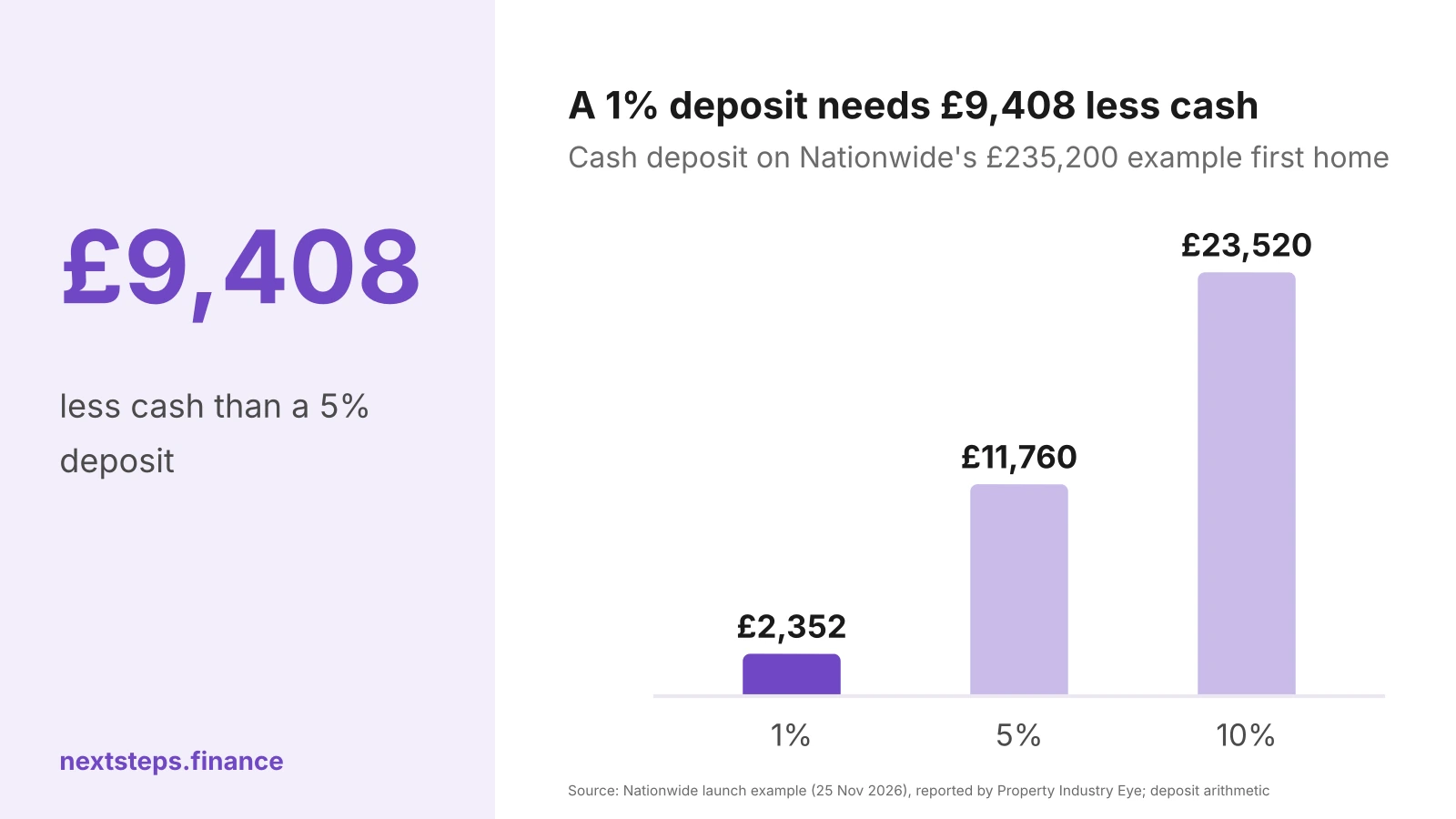
The 1% option means £9,408 less cash for the deposit than a 5% deposit on this example. But the smaller deposit also means a larger mortgage, so compare the monthly repayment, total borrowing, term and the risk of negative equity rather than judging only by the cash needed to get started.
Who can apply for Nationwide's 1% deposit mortgage?
It is for first-time buyers who meet Nationwide's Helping Hand lending criteria. Launch coverage from Property Industry Eye, The Negotiator and Mortgage Solutions reports these headline conditions:
| Condition | What's been reported |
|---|---|
| Deposit | At least 1% (99% loan-to-value) |
| Product | Five-year fixed rate at 5.99%, no product fee |
| Minimum income | £30,000 sole applicant, £50,000 joint applicants |
| Property | Existing houses only, not flats or new builds |
| Employment | Not open to self-employed applicants |
| How to apply | Advised: through a broker or a Nationwide mortgage adviser |
| Borrowing | Up to six times income, subject to affordability and underwriting |
Nationwide's own first-time buyer definition, age, term, maximum loan and leasehold rules are set out in its full criteria, so check the lender's live eligibility and terms or ask a broker before making plans. Criteria and rates can change.
Also keep the lender's eligibility separate from tax rules. Being accepted as a first-time buyer by Nationwide doesn't mean you qualify for Stamp Duty first-time buyer relief or can use a Lifetime ISA: each has its own statutory rules. Stamp Duty Land Tax applies in England and Northern Ireland, while Scotland and Wales have their own property taxes. GOV.UK's Stamp Duty reliefs page covers first-time buyer relief. Our 4.5x mortgage rule guide explains borrowing multiples, but it does not predict a lender's offer.
What would a 99% LTV mortgage cost?
The mortgage amount, rate and term drive the monthly repayment. A longer term can reduce the monthly payment, but it means paying interest for longer and may leave you with a mortgage later in life. A lender's affordability assessment may also limit the amount it will lend, regardless of the deposit.
Use the calculator to test a loan amount and term. It uses 5.99% as an illustration of Nationwide's launch rate; the offer is fixed for five years, so this calculator does not predict the rate or payment after that period.
- Mortgage amount£232,848
- Interest rate5.99%
- Term25 yrs
- Monthly overpayment£0
A mortgage calculator is not an affordability assessment or a mortgage offer. Lenders consider income, spending, credit history, dependants, other borrowing, the property and their own underwriting criteria.
What risks come with a 1% deposit?
Negative equity. With only 1% of the purchase price as initial equity, a house-price fall can leave the mortgage larger than the property's market value. That can make selling or remortgaging difficult, especially if you need to move before you've repaid much of the loan.
Higher borrowing and interest costs. You are borrowing more than with a larger deposit. A longer term can lower the payment but increase the interest paid if the rate and term are held constant. A five-year fixed rate provides payment certainty during that period, not beyond it.
Limited choice. This is one lender's product with strict criteria. It is not available for every property or applicant. A 5% or 10% deposit may give you a broader choice of mortgages, so compare the whole market rather than treating a 1% option as the default.
Life changes. A long mortgage term and a five-year fixed deal may be difficult to adapt to if your circumstances change. Check early repayment charges, portability, overpayment rules and what happens if you move, separate, change jobs or need to sell.
What costs do you still need to save for?
Even if the deposit is 1%, the purchase budget needs more than that. Depending on the transaction, you may need cash for:
- Conveyancing, searches and Land Registry fees.
- A survey, which is separate from a lender's valuation.
- Mortgage or broker fees, if applicable.
- SDLT in England and Northern Ireland, LBTT in Scotland or LTT in Wales, depending on the property and your circumstances.
- Moving, furniture, initial repairs and insurance.
MoneyHelper's buying and moving costs guide lists costs to consider. Our house survey types guide explains the survey options and why the lender's valuation is not a buyer's survey.
If your deposit includes a family gift, our gifted deposit mortgage guide explains the paperwork lenders may ask for.
If you're using a Lifetime ISA, its own rules still apply independently of the mortgage, including a property price limit, a minimum time the account must have been open and the home being your main residence. Read the GOV.UK withdrawal conditions and our Lifetime ISA first-home withdrawal guide before relying on the bonus.
How should you plan before applying?
- Set a property-price ceiling. Use the amount you could comfortably pay, not the lender's maximum, as the starting point.
- Budget for the full cash requirement. Keep the deposit separate from survey, legal, tax, moving and initial household costs.
- Test the monthly payment. Check the payment at the offer rate, then stress-test a higher rate for the period after the five-year fix. Consider whether the mortgage still fits if income falls or costs rise.
- Compare deposit sizes. Check the 1%, 5% and 10% options, the rates available at each LTV, the total borrowing and the trade-off between buying sooner and keeping a larger equity buffer.
- Check the eligibility rules. The Nationwide offer is not suitable for every buyer or property. Compare other lenders and consider regulated mortgage advice; a personal finance review can help you get the rest of your finances in order first.
The UK First-Time Buyer Planner can help organise savings pots, a deposit target, LISA contributions, purchase costs and mortgage estimates in one workbook. It is a planning spreadsheet, not a mortgage adviser or lender-specific eligibility checker, and it does not model Nationwide's underwriting. The planner is also not designed for Shared Ownership, Right to Buy, guarantor mortgages, buy-to-let or non-resident purchases.
See the UK First-Time Buyer Planner if you want a structured way to keep the deposit, costs and mortgage assumptions together.