House survey types UK buyers see advertised can have confusing old and new names. The right report depends on the building you are buying, how much detail you need and whether you are planning repairs-not simply the price. Here is what each level covers, what it costs and what to do with the findings.
Key takeaways
There are 3 RICS survey levels: Level 1 is the basic condition report, Level 2 adds more detail and repair guidance, and Level 3 is the most comprehensive.
Indicative 2026 prices range from £300 to £1,500+: the cost rises with the level, property value, size, location and complexity.
A mortgage valuation is not a buyer's survey: it is for the lender's decision and may not identify repairs.
Choose the report for the property: older, unusual, altered or visibly troubled buildings may justify Level 3; Scotland normally supplies a seller's Home Report.
What are the three house survey types UK buyers can choose?
The RICS Home Survey Standard, introduced on 1 March 2021, has 3 report levels. RICS says Level 1 was previously called a Condition Report, Level 2 a HomeBuyer Report and Level 3 a Building Survey. They are visual, non-invasive inspections, but the amount of detail and advice varies.
Survey
What it provides
Usually suited to
Indicative 2026 price
Level 1 - Condition Report
Basic condition summary and ratings for visible defects; no repair advice or valuation
Newer, conventional homes in good condition
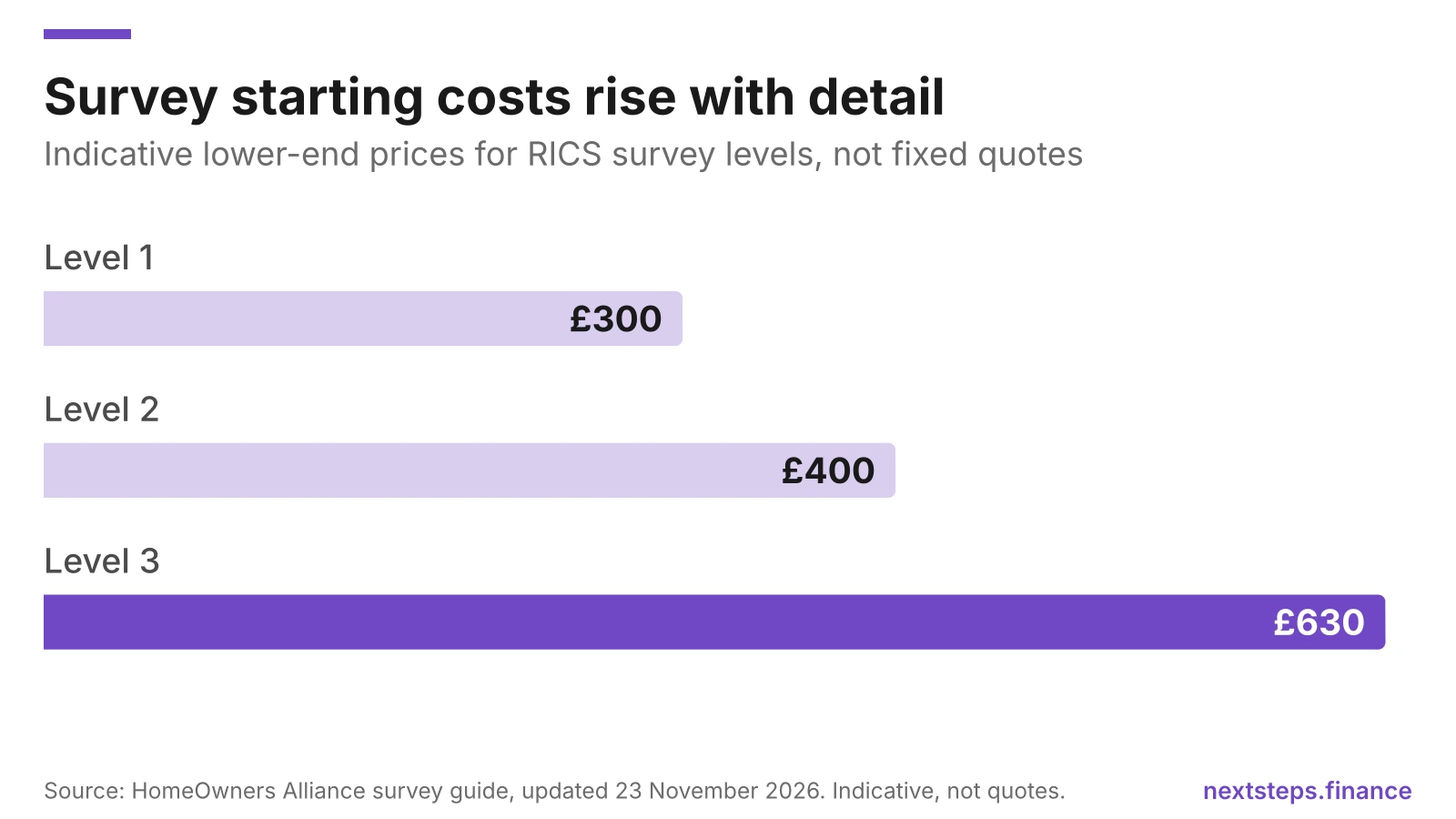
£300-£900
Level 2 - Home Survey
Wider inspection (including roof space and drainage chambers), advice on defects, repairs and maintenance; available with or without a valuation
Conventional homes in reasonable condition
£400-£1,000
Level 3 - Building Survey
The most comprehensive report: in-depth analysis of condition with advice on defects, repairs and maintenance options
Older, large, altered, unusual or run-down homes; planned major works
£630-£1,500
These are indicative ranges from the HomeOwners Alliance's survey guide, updated 23 November 2026, not a price list from RICS or a quote for a specific address. Some reports may include a valuation or additional services, so compare like-for-like quotes.
The report levels are not guarantees that every hidden problem will be found. RICS says the standard visual inspection for Levels 1 and 2 doesn't remove secured panels, electrical fittings or inspection chamber covers. Where parts are hidden or inaccessible, the report should say what needs further investigation, when and by whom.
Which house survey should I choose for my property?
For a conventional home in reasonable condition, a Level 2 is often the practical middle ground. Level 1 is more limited; Level 3 is worth discussing where the building's age, construction, alterations or visible condition create more risk.
Use the property-not your budget alone-to decide:
Level 1: consider it for a newer, standard home that appears to be in good condition. It gives a basic picture and flags significant visible defects, but does not explain repair options in depth.
Level 2: consider it for a conventional house or flat in reasonable condition. It offers more extensive inspection and advice on maintenance, repairs and defects, with valuation available as an extra option.
Level 3: discuss it with a surveyor for an older property, unusual construction, a substantial extension, significant alterations, visible defects or planned renovation. RICS describes it as the most comprehensive of the 3 reports, with advice on defects, repairs and maintenance options.
If you are unsure, describe the property to a surveyor before booking: age, construction, size, extensions, condition, any visible cracks or damp and the work you intend to do. Ask them to recommend the level and explain the scope in writing. You can also ask about specialist checks if there is a known concern.
How much does a house survey cost in the UK?
Published 2026 guidance puts typical RICS survey prices at £300-£900 for Level 1, £400-£1,000 for Level 2 and £630-£1,500 for Level 3. The property's value, location, size, age, condition and complexity can move a quote outside these ranges.
Source: HomeOwners Alliance, updated 23 November 2026
The HomeOwners Alliance gives these indicative ranges by survey level and says surveys typically cost £300 to £1,500 or more. RICS itself doesn't publish a price list: it says Level 1 starts at a few hundred pounds and some bespoke services cost over £1,000. Which? gives the same broad picture.
Before accepting a quote, check:
What is included? Does the Level 2 include a valuation, or is it survey-only? Are extra services separately priced?
Is VAT included? Make sure you compare the final amount, not a headline fee.
What are the inspection limits? Ask what the surveyor cannot access or test.
What happens if further checks are recommended? A damp, timber, roof, drainage or structural report may cost extra.
When will the report arrive? Ask about the inspection date, report turnaround and any time-sensitive follow-up.
A survey is one of several purchase costs alongside legal fees, searches, mortgage fees, moving costs and any purchase tax. Keep it in a separate savings line so you do not spend the money reserved for your deposit. If you want to map those costs against your deposit and target date, the UK First-Time Buyer Planner can bring the figures together. If part of your deposit is in a Lifetime ISA, our guide to Lifetime ISA withdrawals for a first home explains the timing your conveyancer will need.
Is a mortgage valuation the same as a home survey?
No. RICS says a lender's valuation is "a limited check on the property" carried out for the lender, not the buyer. Which? notes it sometimes doesn't involve anyone visiting the property in person, and it is not designed to give you a detailed list of defects or repair advice.
A home survey is commissioned for the buyer's information. It can identify visible issues, explain their significance and recommend further investigation. Do not assume that the valuation your lender arranges protects you from repair costs.
An Energy Performance Certificate (EPC) is different again. It assesses energy efficiency, not whether the building is structurally sound or whether its services and roof are in good condition.
GOV.UK's buying a home guide treats them as separate steps: your mortgage provider carries out a valuation before approving the mortgage, and you can get a homebuyer survey to check the condition of the property. The survey is your opportunity to understand the property's condition before you exchange contracts.
What should I do after a house survey?
Read the report, ask the surveyor to explain anything unclear and obtain specialist quotes for defects that need further investigation. A report is a decision tool: it does not automatically mean you should withdraw, nor does it guarantee that a seller will agree to a price reduction.
A sensible follow-up process is:
Separate urgent from routine issues. Ask the surveyor what needs immediate attention and what can be monitored or maintained.
Get specialist reports or quotes. If the survey recommends checking electrics, drainage, damp, roof structure or another specific issue, use a qualified specialist.
Estimate the real cost. Ask for written quotes where possible and allow for uncertainty, access and timing.
Discuss your options with your conveyancer. You may renegotiate, ask the seller to remedy an issue, proceed with a plan or withdraw before exchange.
Keep a cash buffer. Do not use all your savings for the deposit and completion costs if repairs may be needed soon.
GOV.UK says an offer is not legally binding in England and Wales until you exchange contracts, and that an offer made "subject to contract" means the price can still be negotiated, for example if a survey finds a problem. The seller doesn't have to agree to a lower price or to fix anything, so get quotes before you go back to them.
If you are comparing the borrowing side as well as the property's condition, see our 4.5x mortgage rule guide. For a family contribution to your deposit, our gifted deposit mortgage guide explains what lenders and conveyancers may ask for.
Do new-builds and flats need a different survey?
A new-build usually calls for an independent snagging inspection rather than a standard RICS Level 1, 2 or 3 report. A snagging survey lists defects or unfinished work, such as uneven plaster or sticking windows, for the developer to address. Which? puts the cost at around £300 to £600 depending on size, and the HomeOwners Alliance at £350 to £600; ask the inspector when to book it and how the report fits the builder's warranty and defect process.
For a flat, ask the surveyor what they can inspect inside the unit and what is outside the scope of the report. A survey of your flat may not provide a full assessment of communal areas, the roof, the building's structure or the management arrangements. Your conveyancer should review the lease, service charge information, major works and other legal documents separately.
If the flat is leasehold, the Leasehold Reform Bill guide explains the current reform proposals. A survey does not replace legal due diligence.
What happens if I buy a home in Scotland?
Scotland normally uses a seller-provided Home Report rather than the buyer commissioning a survey after an offer. mygov.scot says it has three parts: a single survey and valuation, a property questionnaire and an energy report (an Energy Performance Certificate).
Ask the seller or agent for the report: mygov.scot says they must give it to you within nine days of you asking. Read the condition ratings and ask for estimates for repairs marked as urgent or needing future attention. You may still want further specialist advice or your own inspection if the report or viewing raises concerns.
RICS describes the Home Report's survey as a Level 2 survey and valuation, but it is commissioned by the seller, so you may want a Level 3 or specialist report for an older or altered home. New houses sold off-plan or to the first occupier don't need a Home Report, though the seller must still provide an EPC.
Frequently asked questions about house survey types
Do I need a house survey when buying a home?
A survey is strongly recommended because a mortgage valuation does not give you the same condition information. The survey level depends on the property and your concerns. It is worth discussing the building's age, construction, alterations and visible problems with a surveyor before you book.
Is a Level 2 survey enough for a first-time buyer?
A Level 2 often suits a conventional property in reasonable condition, but being a first-time buyer does not automatically make it the right choice. An older, altered, unusual or visibly defective home may warrant Level 3. Ask a surveyor to assess the property-specific risk before deciding.
Can I negotiate the house price after a survey?
You can ask the seller to reduce the price, fix a defect or agree another solution, but they do not have to accept. Obtain quotes for significant work and discuss the findings with your conveyancer before changing your offer or deciding whether to proceed.
How long does a house survey take?
Which? says a basic survey might take an hour or two, a mid-range survey up to three hours and a full building survey as long as a full day. It expects the report within about five days for Level 1 or 2 and 10 days for Level 3. Confirm both with your surveyor before booking.
Can I use my lender's valuation instead of a survey?
You can choose not to commission a survey, but the lender's valuation is not designed to identify defects or give you repair advice. If you rely only on it, you may be taking on repair risks without a buyer-focused condition report.