Working from home expenses for sole traders are not the same as employee homeworking costs. In 2026/27, you can use HMRC's simplified flat rate or claim a reasonable business share of actual household costs. The flat rate reduces taxable profit; it is not a cash refund.
This guide is for sole traders using part of their home for business. Limited companies, employees and partnerships with a company partner have different rules. See our UK self-employment guide for the wider tax and record-keeping picture.
Key takeaways
- The 2026/27 flat rates are £10, £18 or £26 for each month you meet the relevant hours band.
- You need at least 25 qualifying business hours at home in a month to use the flat rate for that month.
- Phone and broadband can be claimed separately; the flat rate covers household running costs.
- Actual costs need a reasonable apportionment based on area, time and, where relevant, usage.
- A room used partly as a home and partly for work is different from a room used exclusively as a business office for Capital Gains Tax.
- Keep a monthly hours log. A planning spreadsheet does not replace MTD-compatible software if you must use it.
What counts as working from home for a sole trader?
HMRC counts hours spent wholly and exclusively on core business activities at home, not every hour you are in the house. It lists three: providing goods or services, maintaining business records, and marketing or finding new business. Breaks and personal tasks do not count.
For 2026/27 (6 April 2026 to 5 April 2027), the monthly flat rates are:
| Qualifying business hours at home | Flat-rate deduction |
|---|---|
| Under 25 | No flat-rate claim |
| 25 to 50 | £10 |
| 51 to 100 | £18 |
| 101 or more | £26 |
The bands are assessed month by month. HMRC's example is 40 hours at home in 10 months and 60 hours in two months: 10 × £10 plus 2 × £18 gives a £136 deduction. You cannot average the hours across the year to reach a higher band. Try it with a month's hours:
- Qualifying business hours at home this month£40
The flat rate is optional and works with either cash basis or traditional accounting. It is a simplified expense for unincorporated businesses: sole traders, and partnerships whose partners are all individuals. Limited companies don't use it. See HMRC's simplified expenses guidance and its BIM75010 manual.
How much can you claim using HMRC's flat rate?
If you meet the same band in every month, the annual deductions are £120, £216 or £312. Your claim should reflect the hours actually worked at home in each month, not an automatic annual allowance.
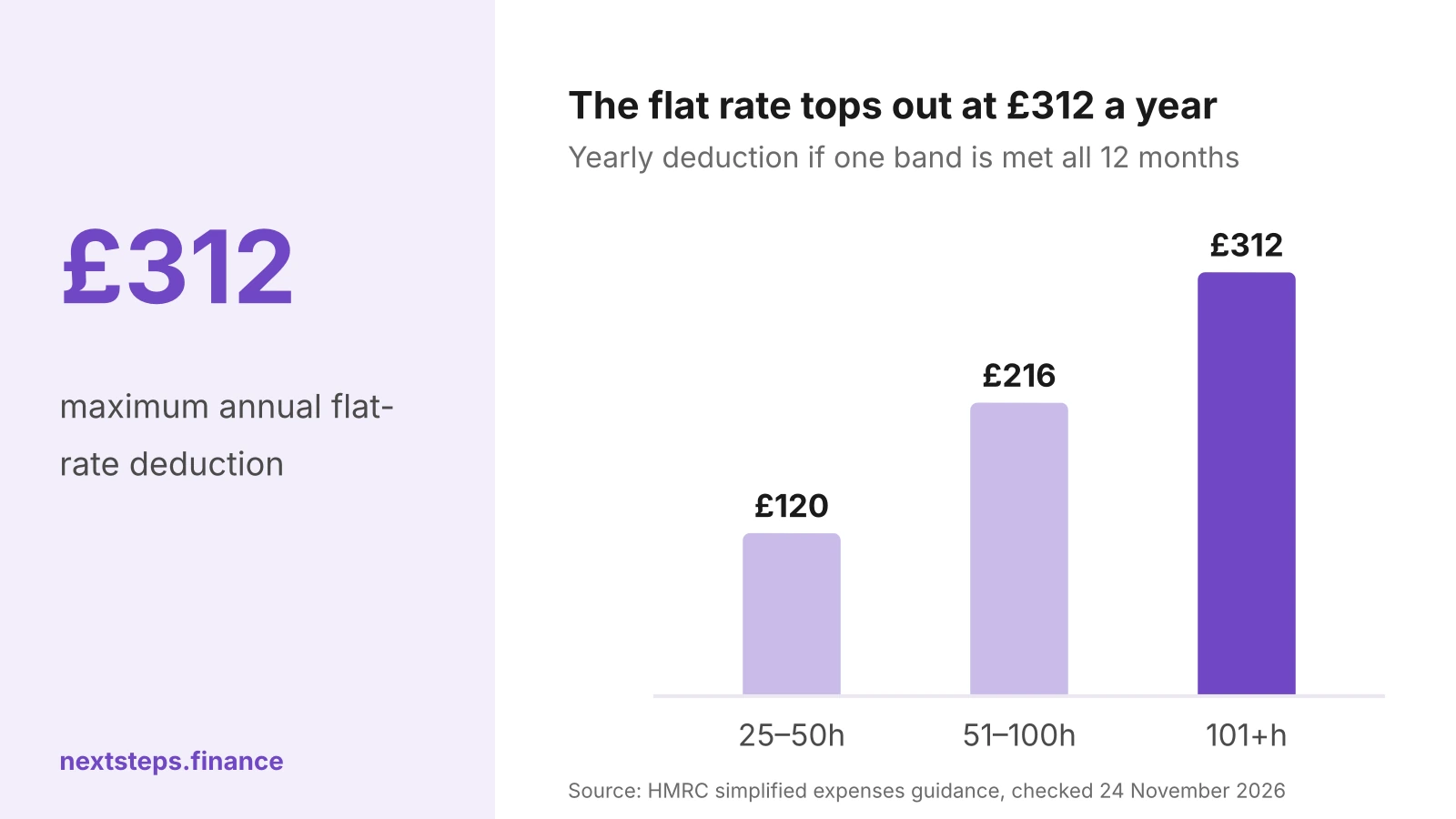
The £312 maximum is a deduction from profit, not £312 paid back by HMRC. Your tax saving depends on your marginal Income Tax and National Insurance position. Scottish taxpayers have different non-savings Income Tax bands, so the tax effect can differ even though the homeworking flat rates are the same across the UK. See the Scottish Government's 2026/27 rates and bands.
The flat rate covers household running costs. It does not include telephone or internet, so you can claim the business proportion separately. HMRC also allows a separate deduction for identifiable business proportions of certain fixed costs, such as Council Tax (domestic rates in Northern Ireland), insurance and mortgage interest. You need a defensible business-use calculation, not an arbitrary percentage.
Is the flat rate better than actual home costs?
The flat rate is simpler, but actual costs may give a larger deduction where business use is substantial. Compare both methods using a typical year and never claim the same household running costs twice.
| Method | How it works | Advantage | Watch-out |
|---|---|---|---|
| Flat rate | £10, £18 or £26 for each qualifying month | Simple hours record | May be lower than actual costs |
| Actual costs | Apportion the allowable share of household bills | Reflects real business use | Needs a reasonable calculation and evidence |
For actual costs, HMRC says there is no universal percentage. Consider:
- Area: what part of the home is used for business?
- Time: how long is that space used for business rather than private purposes?
- Usage: how much heat, electricity or metered water does the business use?
HMRC's BIM47815 guidance says the method must reflect the facts. In one example, a room occupying 5% of a home was used exclusively as an office. The business share of £4,500 in Council Tax, insurance and mortgage interest was £225; 5% of a £300 electricity bill was £15. That 5% was specific to the example, not a standard allowance. See HMRC's BIM47825 worked examples.
Use the free HMRC simplified expenses checker to compare the methods. Keep the working behind an actual-cost claim.
Which home expenses can you claim separately?
Only the identifiable business share is potentially allowable; personal living costs remain private. HMRC groups home costs into fixed costs, running costs and communications.
| Cost | What may be allowable |
|---|---|
| Heating, lighting and power | A reasonable share based on area, time and usage |
| Rent or mortgage interest | An appropriate share where part of the home is set aside solely for trade use for a period |
| Mortgage repayments | Interest may qualify; capital repayments do not |
| Council Tax or NI domestic rates | An identifiable business proportion where conditions are met |
| Insurance, water rates and general repairs | An appropriate business share, depending on the facts |
| Phone and broadband | The business proportion of calls, line rental or connection costs |
| Desk, laptop and stationery | Separate expense or capital-allowance rules, not the homeworking flat rate |
HMRC's BIM47820 guidance explains fixed and running costs. A sole trader cannot charge rent to themselves. General household repairs may be apportioned, but decorating a room never used for business is not an allowable business expense. HMRC's broader self-employed expenses guide explains the business-use rule for mixed costs.
One cash-basis point if you include mortgage interest: some HMRC manual pages still mention a £500 cap on interest for cash-basis businesses, but HMRC's Expanding the cash basis policy paper removed that restriction from the 2024/25 tax year. Interest still needs a genuine business share, and capital repayments are never allowable.
Can a dedicated home office affect Capital Gains Tax?
It can, but using a room as a study does not automatically create a Capital Gains Tax bill when you sell your home. HMRC says a room used partly for business and partly for residential purposes normally qualifies in full for Private Residence Relief.
The position changes if part of the home is used exclusively for a trade or business. HMRC's CG64663 guidance, updated on 9 November 2026, explains that the exclusive-use test is stringent: regular private use generally means the room remains part of the residence, although occasional and very minor private use may be disregarded.
If you are considering setting aside a room exclusively for business, get tax advice before doing so. A homeworking deduction alone does not remove relief on part of your home.
Does the £6 a week homeworking allowance still apply in 2026/27?
No, not as a deduction employees can claim from HMRC for unreimbursed household expenses. From 6 April 2026, employees can no longer deduct those costs from taxable pay, as set out in HMRC's policy paper on removing the relief. HMRC also confirms this in its P87 guidance and EIM32759 manual.
The £6 figure has a separate use. Where regular homeworking arrangements exist, employers can still reimburse eligible additional costs tax-free. HMRC says an employer can pay £6 a week (£26 a month for monthly paid employees) without the employee keeping records, or pay more where there is evidence to justify it. That is an employer payment, not an employee deduction or a sole-trader expense rate. See EIM01472 and EIM01476.
Having a PAYE job does not stop you claiming allowable costs for a separate sole-trader business; our guide to side hustle tax when you're employed covers how the two incomes are taxed together. Keep the business hours and costs distinct from your employee duties. Sole traders continue to use the £10, £18 and £26 monthly rates in 2026/27. The flat-rate amounts are UK-wide; Northern Ireland has domestic rates rather than Council Tax, while Scottish taxpayers use separate non-savings Income Tax bands.
How should you record homeworking expenses for Self Assessment?
Record hours and costs as you go. A monthly log should show qualifying hours at home, the method used, the amount claimed and where the evidence is stored. If you use actual costs, keep the bills and a short note explaining your area, time and usage calculation.
A free spreadsheet and HMRC's checker may be enough if you have few transactions. Our trading allowance guide explains why that allowance is separate from claiming actual expenses; the payments on account guide explains how business costs feed into tax planning.
If you want homeworking hours, income, expenses and a tax estimate together, the UK Self-Employed Tax Tracker is a Google Sheets option. It has seven connected tabs, 15 HMRC-matched expense categories and a Mileage & Home tab for monthly homeworking hours.